
If you’re asking “why my vat refund was rejected,” start by comparing the FTA’s notice with your refund application, VAT return and supporting records. The stated reason, affected amount and tax period can help you identify whether the issue is a calculation, evidence or eligibility question.
A rejection can be difficult to interpret, especially when the notice uses technical language or the figures in your records seem to differ. The right next step depends on the issue identified. Missing documents, non-qualifying expenses, return discrepancies, registration concerns and questions about a supplier call for different checks.
This article explains how to trace the concern through your records, prepare a focused response and consider the FTA reconsideration route. Use the instructions in your notice and current FTA guidance to confirm the procedure and any applicable deadline.
A rejection notice gives you a starting point, but you may need to trace the concern through your records to understand its cause. If you’re asking “why my vat refund was rejected,” first confirm whether the request is rejected or still pending. Check the status and latest messages in your FTA account, including EmaraTax. A pending request may call for clarification or additional evidence; a formal rejection requires you to review the decision and the next steps it sets out.
Common issues include whether an expense qualifies for input VAT recovery, whether the refund request matches the VAT return, whether transaction evidence supports the claim, and whether the application is complete. For example, a difference between the refund request and the corresponding return figure may point to a reconciliation issue. An invoice that does not support the transaction may raise an evidence concern. Understanding the general concept of Value Added Tax (VAT) can provide context, but the FTA notice and UAE requirements govern your claim. Reviewing the relevant UAE tax services records can help clarify how the figures connect.
Note the reason given, the amount affected, the tax period and any action requested by the FTA. Identify whether the notice asks for clarification, a correction or additional supporting evidence. Then compare that instruction with the application and the records submitted. A technical phrase may point to the issue without explaining its full cause, so check the underlying transactions before deciding what it means for the rest of your claim.
Do not assume a deadline, remedy or outcome from general guidance. Follow the instructions attached to your specific notice and verify the applicable response route and timing against current FTA directions. Review the notice alongside the submitted records before choosing a remedy.
Once you have identified the concern in the FTA notice, trace it through the refund request, the relevant VAT return and the underlying transactions. This helps distinguish an eligibility question from a missing document or a calculation mismatch. If you’re still asking “why my vat refund was rejected,” test each possible cause against the records instead of assuming one correction will resolve the claim.
Match each claimed amount to its invoice and transaction. Check that supplier details, tax amount, date and description are consistent with the accounting entry. Locate related payment or import records where relevant. Then consider two separate questions: does the evidence support the transaction, and does the expense qualify for input VAT recovery? A complete invoice helps document a claim, but it does not by itself establish that the expense qualifies.
Recalculate the claim from transaction-level records and compare the result with the refund request and corresponding VAT return. Check for duplicate entries, omitted adjustments, amounts assigned to a different tax period, or differences between invoice and ledger values. For each variance, trace the amount back to its source before deciding whether the claim figure or supporting record needs correction.
Use the following diagnostic guide to focus your review. For eligibility and supporting requirements, refer to the UAE Federal Tax Authority VAT Refunds guidance.
A structured review of VAT records can connect the return figures, transaction evidence and refund request, making it easier to identify what needs attention before you decide how to respond.
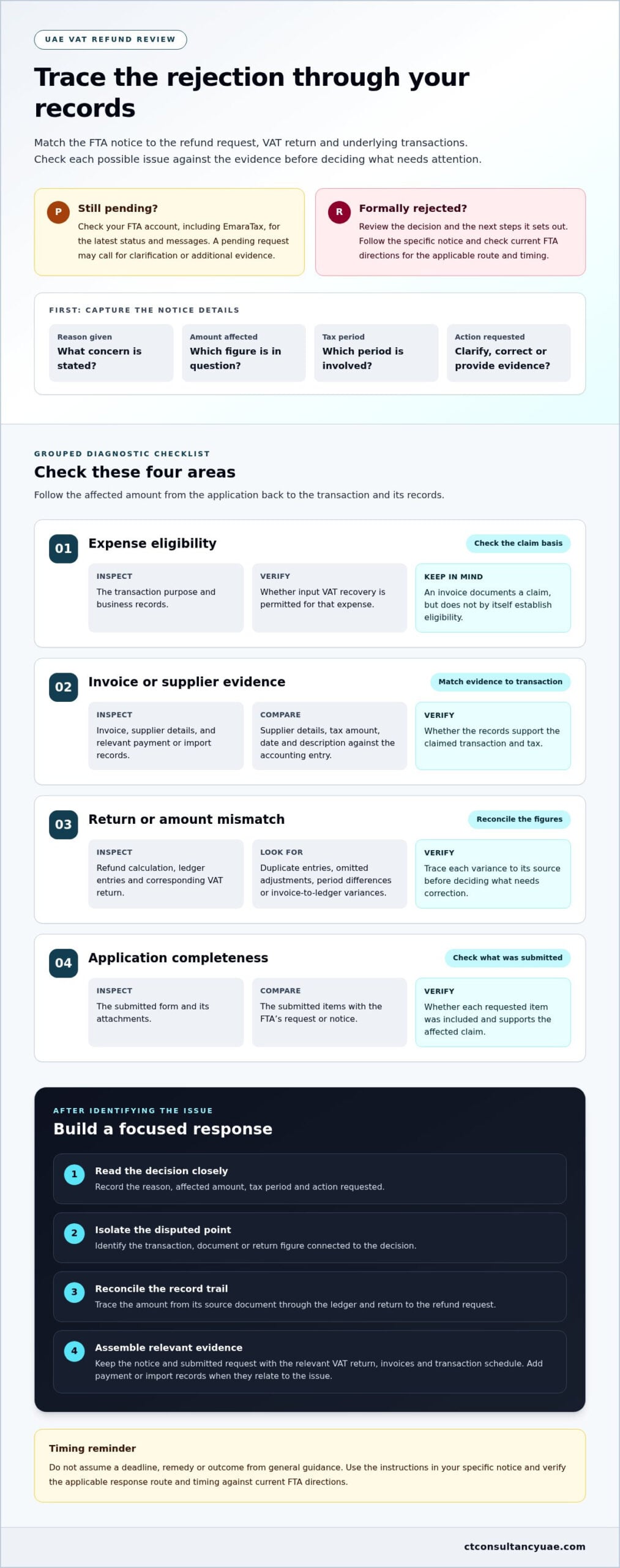
Start with the specific reason in the FTA decision, rather than a broad assumption about why my vat refund was rejected. Work through the notice and records in sequence, keeping any applicable review deadline in view. If bookkeeping entries or return figures need correction, establish what is wrong and how it affects the claim before preparing another submission.
Keep the FTA notice and submitted refund request with the relevant VAT return, invoices and transaction-level schedule. Add payment records, import documents or other evidence only when they relate to the issue raised. A concise reconciliation should link each disputed figure to its source document, accounting entry and reported amount. This makes gaps and inconsistencies easier to spot.
The appropriate route depends on the decision and your circumstances. Under current UAE guidance, an FTA reconsideration request must be submitted within 40 business days of notification, through EmaraTax and in Arabic. Promptly verify the instructions and deadline for your specific decision. Do not let the work of correcting records cause you to overlook a review deadline. Tailored VAT refund support can help you assess the evidence and prepare a response.
For a structured review of the notice, relevant returns and supporting records, CTC Tax & Accounting provides tailored VAT refund support.
A rejection can involve more than one issue. A focused review connects the FTA’s stated concern to the records behind the claim. CTC Tax & Accounting can carry out a VAT health check covering relevant returns, refund calculations and supporting records. This helps clarify whether the figures reconcile and where documentation or bookkeeping may need attention. The review is tailored to the notice and available evidence; it does not guarantee that the FTA will approve a refund.
The review can map the notice’s stated issue to the relevant invoice, transaction, return entry or calculation. It can also help distinguish a correctable documentation gap from a question about whether input VAT recovery is permitted. That distinction helps keep your response focused on the underlying concern rather than only its symptoms.
If the records show a discrepancy, the next step may be to correct bookkeeping or reconcile return figures before preparing a further submission. If the issue calls for interpretation of UAE VAT rules, the relevant facts and documents can be considered together. Verify procedural requirements, submission routes and timing against current FTA guidance for the specific decision.
CTC’s certified tax experts and agents support UAE VAT compliance through an a-la-carte service model, so support can be tailored to the review required. The firm has operated since 2015 and reports 75 years of combined international finance and accountancy experience. This structured approach can help clarify “why my vat refund was rejected” while keeping the assessment focused on your circumstances and available evidence.
To discuss the notice and records relevant to your case, book a 20-minute free* consultation. You can outline the issue and consider a practical next step without treating a refund outcome as certain.
A rejected refund need not leave your business unsure whether to correct records or challenge an FTA decision. Once you understand why my vat refund was rejected, focus on what the notice and records support, then choose a response that fits the issue and applicable procedure. Avoid resubmitting figures or evidence until you have examined discrepancies and verified the relevant FTA instructions.
If the cause remains unclear, a focused review can help distinguish a recordkeeping correction from a matter that needs closer VAT analysis. CTC Tax & Accounting provides VAT refund request and VAT health check support through a tailored, a-la-carte approach. Its certified tax experts and agents can review the circumstances, but no review can guarantee that a refund will be approved.
Bring the notice and relevant claim records to a 20-minute free* consultation to discuss your rejected VAT refund. CTC Tax & Accounting can help you identify a clear, evidence-led next step.
The time can vary by case, particularly if the FTA requests more information or clarification. Check the application status and messages in your EmaraTax account, and follow the instructions shown there. A request marked pending or under review is not the same as a formal rejection. Treat it as unresolved unless the FTA has issued a decision notice.
If you’re asking why my vat refund was rejected, the appropriate next step depends on the reason and the decision notice. Do not submit the same figures and documents again without addressing the issue identified. Review the current FTA procedure, required submission method and applicable time limits for your circumstances before deciding whether to correct records, make another request or seek a review.
No. A rejection does not by itself establish that every amount claimed is permanently unrecoverable. The FTA may have identified an evidence gap, calculation discrepancy or procedural issue, while a substantive restriction may concern the expense itself. A missing supporting record, for example, is different from a restriction on recovery. Check the transaction facts against current UAE VAT rules before concluding that input VAT cannot be recovered.
Keep the rejection notice, refund submission, relevant VAT returns, invoices and transaction schedules together in a review file. Label documents by tax period and link each disputed amount to its source record, so the calculation can be followed without searching across unrelated files. Payment or import documents may also be relevant, depending on the transaction and the reason stated by the FTA.
Check the application status and messages for any request for further information before treating a delay as a refusal. Keep the FTA correspondence and note what you submitted and when, so you can track outstanding items accurately. Respond through the channel specified in the current instructions and follow the status shown for your application. A delay alone does not confirm that the refund has been rejected.