
The era of standalone Economic Substance Regulations (ESR) filing has officially concluded, yet the requirement to demonstrate genuine economic presence in the UAE is more rigorous than ever before. You’ve likely felt the weight of shifting regulatory deadlines and the frustration of managing overlapping compliance frameworks as the landscape evolves. This guide provides the strategic clarity you need to determine exactly who needs to file esr in uae for historical periods while detailing how these requirements have been seamlessly integrated into the Federal Corporate Tax regime.
We understand that navigating the transition from Cabinet Decision No. 98 of 2024 to the substance mandates of Federal Decree-Law No. 47 of 2022 requires precision and an expert perspective. You’ll gain a definitive understanding of your liability for the 2019 to 2022 financial years and learn why maintaining “adequate substance” is now the primary prerequisite for securing a 0% tax rate as a Qualifying Free Zone Person. By the end of this briefing, you’ll have a clear roadmap to ensure your corporate structure remains compliant, secure, and optimized for long-term stability in the current fiscal environment.
The implementation of Economic Substance Regulations (ESR) marked a pivotal shift in the landscape of Taxation in the United Arab Emirates, aligning the nation with global efforts to combat harmful tax practices. At its core, ESR was designed to ensure that UAE entities conducting specific “Relevant Activities” did not merely exist as shell companies to shift profits. Instead, these businesses were required to demonstrate a genuine economic presence through adequate staff, physical assets, and local expenditure. While the regulatory environment has matured, the question of who needs to file esr in uae remains a point of significant inquiry for executives managing multi-year compliance calendars.
With the introduction of Federal Decree-Law No. 47 of 2022 on Corporate Tax, the reporting mechanism for economic substance underwent a profound transformation. Cabinet Decision No. 98 of 2024 clarified that for any financial year commencing on or after January 1, 2023, the requirement to submit separate ESR notifications and reports has been repealed. This legislative evolution doesn’t signal a relaxation of standards; rather, it represents a strategic integration. Substance requirements are now a foundational pillar of the tax services and compliance framework, specifically serving as a mandatory condition for Free Zone entities seeking to benefit from the 0% preferential tax rate.
The jurisdiction of ESR extends to all UAE licensees, encompassing both mainland companies and those situated within Free Zones. While the filing obligations for new financial years have shifted to the Corporate Tax return, the definition of a “Relevant Activity” remains consistent. Free Zone entities face a higher level of scrutiny because their “Qualifying Free Zone Person” status depends entirely on maintaining adequate substance. Regulatory authorities continue to monitor these entities closely to ensure that core income-generating activities are performed within the designated zones, preventing the erosion of the UAE’s tax base through artificial structures.
A critical gap in current market understanding involves the treatment of historical filings. It’s vital to recognize that the repeal of annual ESR filings only applies prospectively. The Ministry of Finance maintains the authority to audit and penalize non-compliance for the financial years between 2019 and 2022. If your organization discovers a missed filing or an inaccuracy from this period, the obligation to rectify the record remains active. Administrative penalties issued for these specific years are not subject to the recent cancellations applied to post-2022 periods. Addressing these legacy liabilities is essential for maintaining a clean compliance record and ensuring a frictionless transition into the full Corporate Tax regime.
The regulatory framework established by the UAE’s Economic Substance Regulations identifies nine specific sectors that carry a higher risk of profit shifting. To accurately assess who needs to file esr in uae, a business must evaluate its operational reality against these categories rather than relying solely on the activities listed on its trade license. The central pillar of this evaluation is the concept of Core Income Generating Activities (CIGA). These are the essential, revenue-driving functions that must be performed within the UAE to satisfy substance requirements. If a firm claims to manage an investment fund but conducts all decision-making abroad, it fails the CIGA test. This requirement ensures that the economic value created by the business is directly linked to its physical presence in the country.
Banking, Insurance, and Investment Fund Management represent the highest tier of regulatory oversight. These sectors require substantial physical presence, specialized personnel, and localized management due to their systemic importance. Lease-Finance and Headquarters Business categories often catch diversified groups off guard through the “intragroup service trap.” If your entity provides centralized administrative services, senior management oversight, or financing to related group companies, it likely triggers these reporting requirements regardless of its primary trade license. Intellectual Property (IP) Business remains the most scrutinized area. The UAE authorities apply a rigorous “high-risk IP” classification to entities that do not perform the underlying research and development locally, often requiring proof of local innovation to maintain compliance.
Shipping Business covers entities operating ships in international traffic, though it excludes local fishing or coastal activities. It focuses on the management of crews, hauling of goods, and technical maintenance conducted from UAE shores. Even passive entities fall under the Holding Company Business category. While these firms have reduced substance requirements, they must still demonstrate adequate governance through local board meetings and physical premises. Distribution and Service Centres is perhaps the most common category for UAE SMEs. This applies to businesses that purchase goods from a foreign related party for resale or provide services to a foreign related party. When determining who needs to file esr in uae for historical periods, this category requires the most careful documentation of transactional relationships. If you are unsure how your multi-faceted operations align with these definitions, seeking specialized business advisory can prevent costly misclassifications.
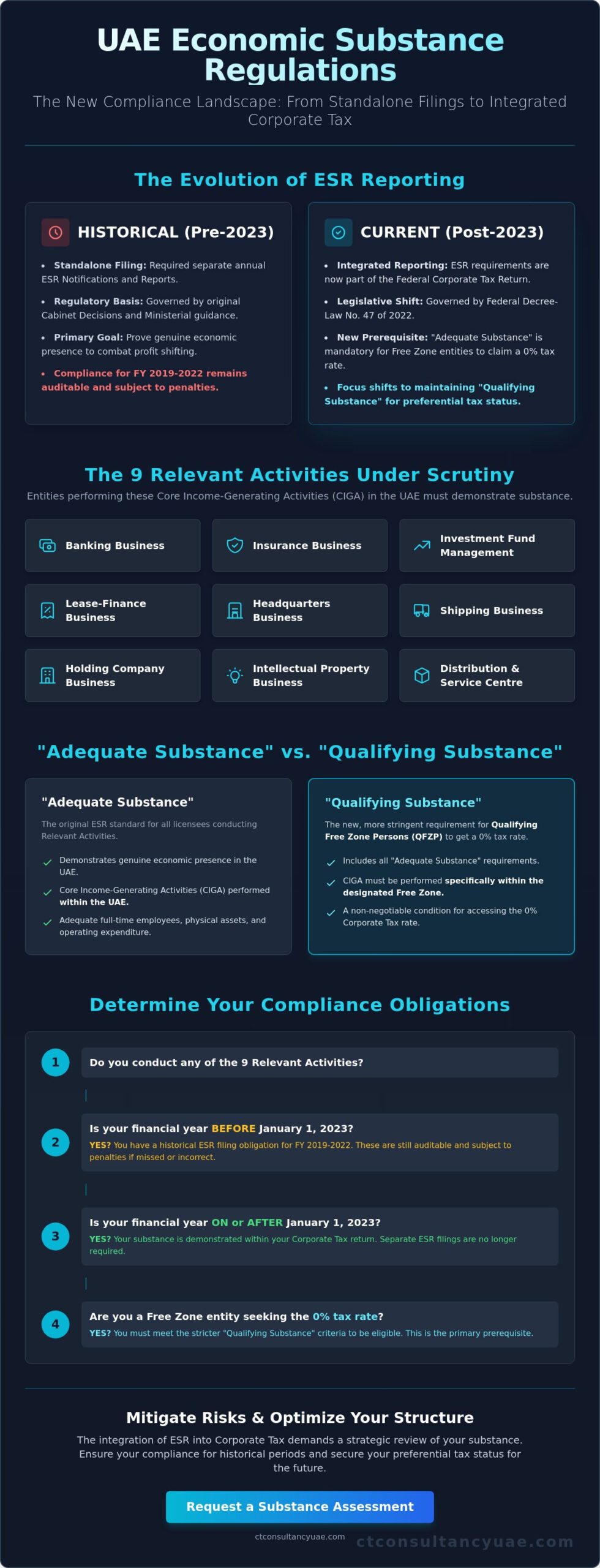
The regulatory environment in 2026 is defined by consolidation rather than elimination. While the Ministry of Finance has repealed the requirement for standalone annual filings for financial years starting on or after January 1, 2023, the core principles of economic substance have been woven into the fabric of the UAE Corporate Tax system. Determining who needs to file esr in uae now requires a shift in perspective; the focus has moved from submitting a separate notification to disclosing substance metrics within the annual Corporate Tax return. This integration streamlines the administrative burden but significantly raises the stakes for non-compliance. Under the previous regime, failure to meet substance requirements resulted in administrative penalties; today, it can lead to the total loss of preferential tax status.
The transition from “Adequate Substance” under ESR to “Qualifying Substance” under Corporate Tax is more than a change in terminology. While the ESR framework established the baseline for local presence, the Corporate Tax law utilizes these same metrics to validate a company’s right to benefit from the UAE’s competitive tax rates. For entities operating in 2026, the traditional “Notification & Report” cycle has been replaced by a regime of “Disclosure & Audit Readiness.” Businesses must now be prepared to substantiate their claims of local economic activity during routine tax audits conducted by the Federal Tax Authority (FTA).
The link between economic substance and tax liability is most visible for companies situated within the UAE’s numerous Free Zones. To maintain the status of a Qualifying Free Zone Person (QFZP) and access the 0% tax rate on qualifying income, an entity must satisfy rigorous substance requirements that mirror the original ESR Core Income Generating Activities (CIGA). Failure to demonstrate an adequate number of qualified employees, sufficient operating expenditure, and appropriate physical assets within the Free Zone will result in the entity being taxed at the standard statutory rate of 9% for income exceeding AED 375,000. Maintaining “adequate substance” is the indispensable bridge between a Free Zone entity’s operations and its entitlement to the 0% Corporate Tax rate in 2026.
The Federal Tax Authority (FTA) has assumed a primary role in monitoring substance through the centralized Corporate Tax portal. Your Tax Registration Number (TRN) now serves as the primary identifier for all substance-related disclosures, creating a unified profile of your firm’s fiscal and operational footprint. This consolidated reporting approach requires a high degree of precision in bookkeeping and internal documentation. Organizations that previously managed ESR as a once-a-year administrative task must now adopt a continuous compliance mindset. Engaging professional Tax Services ensures that your substance disclosures are not only accurate but also strategically aligned with the latest FTA guidelines, protecting your bottom line from unexpected tax liabilities.
The transition to a consolidated tax environment requires a methodical approach to verify that your entity meets its regulatory burdens. While the mechanism of reporting has evolved, the underlying criteria for economic presence remain firm. Identifying who needs to file esr in uae for historical purposes involves a retrospective look at your financial start dates. Use the following structured checklist to evaluate your organization’s current standing and future requirements.
The Federal Tax Authority (FTA) seeks concrete proof that an entity’s “Core Income Generating Activities” are genuinely local. For high-risk sectors such as Intellectual Property or Banking, the reliance on “flexi-desks” or virtual offices is generally insufficient to meet the “adequate substance” threshold. You must demonstrate that your staff possess the necessary qualifications to execute their roles and that your local operating costs are proportionate to your revenue. Documenting that management and control are exercised within the UAE is non-negotiable; this involves holding a sufficient number of board meetings where a quorum of directors is physically present in the country.
Regulatory scrutiny is intensifying as the FTA integrates substance checks into routine tax audits. Conducting a proactive gap analysis is the most effective way to identify vulnerabilities before they result in a loss of tax benefits. Engaging professional Internal Audit Services provides an objective assessment of your compliance posture, ensuring that your records are robust enough to withstand an official inquiry. This preparation is equally vital for managing information requests from the Ministry of Finance regarding the 2019 to 2022 window. If your business determines who needs to file esr in uae criteria applies to its current structure, maintaining a “digital audit trail” of all substance related evidence is your primary defense against administrative penalties. To ensure your entity is fully prepared for the next audit cycle, contact our advisory team for a comprehensive substance review.
Navigating the intersection of historical ESR mandates and modern Corporate Tax substance requirements demands more than just administrative diligence; it requires a partner capable of providing high-level corporate guidance. At CTC Tax & Accounting, we simplify the complex transition from standalone Economic Substance Regulations to the integrated disclosure regime. Determining who needs to file esr in uae requires a nuanced understanding of both historical Cabinet Decisions and current Federal Decree-Laws. Our team provides the granular analysis necessary to distinguish between legacy obligations for the 2019 to 2022 window and the ongoing substance requirements essential for Corporate Tax optimization.
Our bespoke approach to substance assessment ensures that SMEs and Free Zone entities aren’t forced into one-size-fits-all solutions that don’t reflect their operational reality. By utilizing our integrated Accounting Services, your business gains access to real-time compliance monitoring. This proactive stance allows for the continuous tracking of local expenditure, employee qualifications, and asset allocation, ensuring that your substance metrics are always audit-ready. Professional advisory is the most reliable method to ensure friction-free regulatory transitions, positioning your organization for long-term stability in a rapidly evolving fiscal landscape.
We provide a unified service package that encompasses ESR, Ultimate Beneficial Ownership (UBO), and Anti-Money Laundering (AML) compliance. This holistic view ensures that your corporate governance framework is robust enough to defend your substance status during any potential Federal Tax Authority audit. Our experts act as a primary friction-remover, managing the complexities of multi-jurisdictional reporting so you can focus on core business growth. Furthermore, the integration of CFO Advisory Services allows for strategic substance planning that aligns your physical operational footprint with your broader international tax objectives.
Compliance shouldn’t be viewed as a yearly hurdle but as a foundational element of your business strategy. By moving beyond a simple “filing” mindset to a culture of strategic financial compliance, you protect your entity’s eligibility for the 0% tax rate. Our meticulous planning ensures that your Free Zone entity remains a Qualifying Free Zone Person by meeting all necessary substance metrics in real-time, preventing the unexpected application of the 9% statutory tax rate. We’re committed to providing the precision and reliability you need to thrive in the UAE market. To secure your corporate standing and ensure full alignment with the 2026 compliance standards, consult with our experts today.
The evolution from standalone Economic Substance Regulations to the comprehensive Federal Corporate Tax regime represents a significant maturation of the UAE’s fiscal landscape. While the administrative mechanism has changed, the underlying requirement for genuine economic presence remains a non-negotiable pillar of compliance. Precision matters. Businesses must remain vigilant regarding their historical obligations for the 2019 to 2022 period while simultaneously aligning their current operations with the substance mandates required to secure preferential tax rates. Identifying precisely who needs to file esr in uae is no longer just a matter of avoiding penalties; it’s a strategic necessity for maintaining the status of a Qualifying Free Zone Person.
With decades of international regulatory expertise and a specialized focus on SME compliance within the Emirates, CTC Tax & Accounting provides the end-to-end support necessary for a seamless transition. Our consultants ensure your substance disclosures are robust and audit-ready. Ensure your business meets the 2026 substance requirements; book a consultation with CTC Tax & Accounting. Proactive planning is the surest way to secure your organization’s future and enjoy the long-term stability of the UAE’s thriving business environment.
No, standalone Economic Substance Regulations (ESR) notifications are no longer required for any financial year commencing on or after January 1, 2023. For the 2025 financial year, your substance disclosures are integrated directly into your annual Corporate Tax return. This change streamlines the reporting process but requires meticulous record-keeping to ensure all substance metrics are accurately reflected within the Federal Tax Authority’s centralized portal.
In 2026, the primary consequence for failing to maintain adequate substance is the disqualification from the 0% Corporate Tax rate. While previous administrative penalties for financial years ending after December 31, 2022, were cancelled by Cabinet Decision No. 98 of 2024, non-compliance now triggers a standard 9% tax rate on all taxable income exceeding AED 375,000. This shift makes substance a critical factor in fiscal optimization rather than just a regulatory filing.
No, a Free Zone entity cannot benefit from the 0% Corporate Tax rate on its qualifying income if it fails to satisfy the “adequate substance” requirements. Maintaining a physical presence, qualified employees, and sufficient local expenditure are mandatory conditions for “Qualifying Free Zone Person” status. Failure to meet these criteria results in the entity being taxed at the statutory 9% rate, effectively removing the primary fiscal advantage of operating within a UAE Free Zone.
The Ministry of Finance and the Federal Tax Authority verify employee adequacy through a review of your payroll records, residency visas, and professional qualifications. They assess whether the staff conducting your Core Income-Generating Activities are physically present in the UAE and possess the technical expertise required for your specific Relevant Activity. For those determining who needs to file esr in uae for historical audits, providing detailed timesheets and organizational charts is essential to prove operational substance.
Yes, Economic Substance Regulations apply to all UAE-registered entities, including offshore companies, provided they conduct a Relevant Activity and earn income from it. While offshore entities often have limited physical footprints, they must still demonstrate that their core management and control functions are exercised within the UAE. This usually involves holding board meetings locally and ensuring that strategic decisions are not merely rubber-stamped from a foreign jurisdiction.
Missing an ESR filing for the 2021 financial year constitutes a legacy compliance failure that must be rectified immediately. The recent cancellation of penalties only applies to financial years starting after December 31, 2022; historical non-compliance remains subject to administrative fines. You should complete the outstanding filing through the Ministry of Finance portal as soon as possible to mitigate further regulatory scrutiny and ensure your historical record is clean for future tax audits.
A physical office is a fundamental requirement for demonstrating adequate substance, although the specific nature of the premises may vary based on the activity’s scale. For high-risk sectors such as Intellectual Property or Banking, a dedicated office space is typically mandatory; the use of “flexi-desks” or virtual offices is often viewed as insufficient by the Federal Tax Authority. The premises must be proportionate to the business’s operations and provide a suitable environment for employees to perform their core functions.
Your business is classified as a “Distribution and Service Centre” if it purchases goods from a foreign related party for resale or provides services to a foreign related party. This category is frequently triggered by SMEs engaged in intragroup logistics or centralized support functions. When assessing who needs to file esr in uae for historical periods, it’s vital to analyze your transactional relationships with affiliates to ensure you haven’t overlooked this common, high-scrutiny category.