
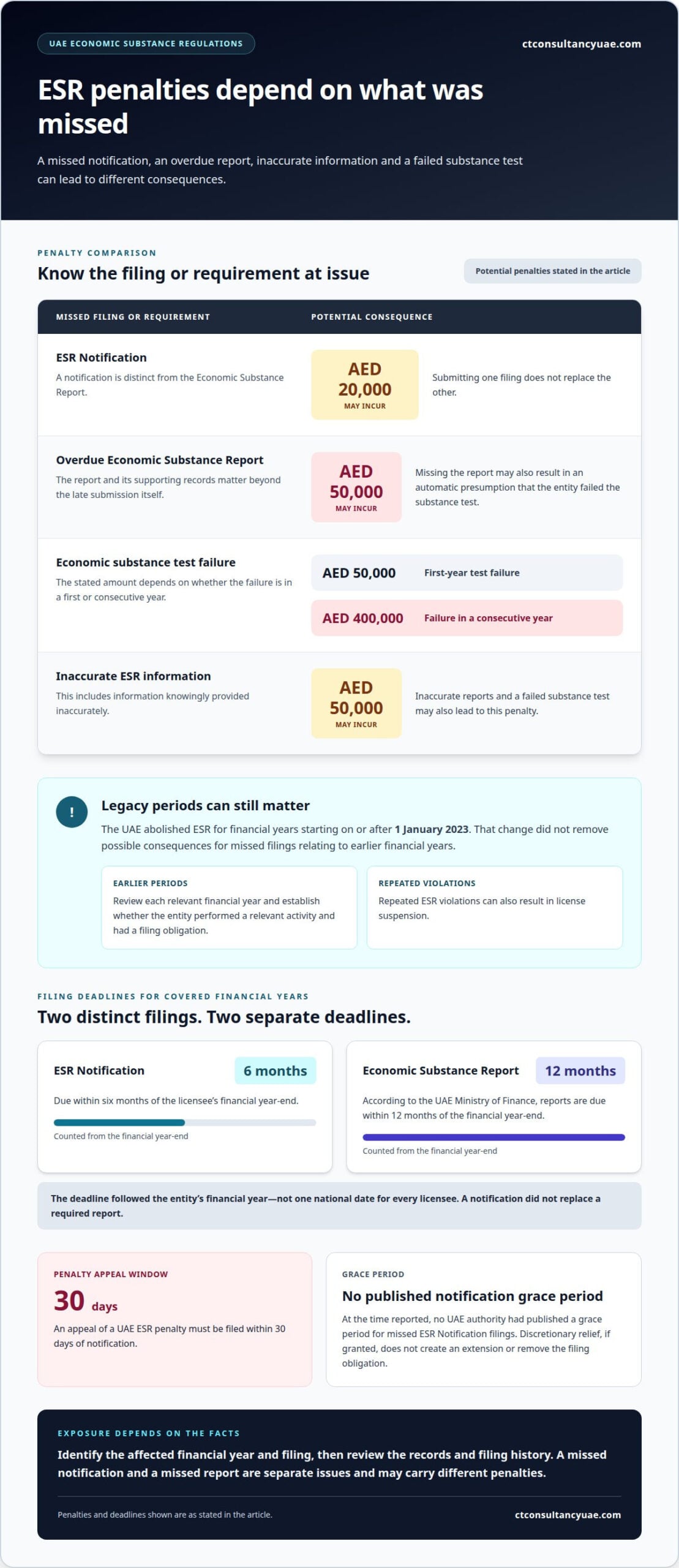
A missed UAE ESR deadline can expose a business to a penalty, and the consequences depend on which filing or requirement was missed. If you’re asking what happens if I miss the ESR deadline, a missed notification may incur a penalty of AED 20,000; failure to submit an Economic Substance Report or failure of the economic substance test may incur AED 50,000 for the first year and AED 400,000 in a consecutive year.
It’s understandable to assume the issue ended when the UAE abolished ESR for financial years starting on or after 1 January 2023, but unresolved filings for earlier periods may still have consequences. This article explains which penalties may apply, how an unresolved legacy filing can affect a business, and what follows an economic substance test failure. It also clarifies the distinction between a missed notification and a missed report, so you can understand the nature of the exposure and why addressing outstanding ESR matters.
In the UAE, the consequences of missing an ESR deadline depend on which filing or requirement was missed. A late notification, overdue report, inaccurate information or failed substance test can each lead to different consequences.
An overdue Economic Substance Report may incur a AED 50,000 penalty. This matters because missing the report can also result in an automatic presumption that the entity failed the economic substance test. For a first-year test failure, the penalty is AED 50,000; failure in a consecutive year may incur AED 400,000. The filing and its supporting records therefore affect more than the late submission alone.
A missed ESR Notification may incur a AED 20,000 penalty. The notification is distinct from the report, so submitting one does not replace the other. Check which filing was missed for the relevant financial year, then address that omission through the ESR portal as soon as possible. Prompt remediation is advised to reduce the risk associated with late submission.
Inaccurate ESR information may incur a AED 50,000 penalty, including when information is knowingly provided inaccurately. Inaccurate reports and a failed substance test may also lead to that penalty. A consecutive-year test failure carries a higher stated penalty of AED 400,000, making the entity’s compliance history relevant to the exposure.
At the time reported, no UAE authority had published a grace period for missed ESR Notification filings. Discretionary relief, if granted, does not create an extension or remove the filing obligation.
If you discover a missed deadline, first identify the affected financial year and filing, then gather the relevant records. Submit the overdue notification or report promptly. A missed notification and a missed report are separate issues and may carry different penalties.
Submit an overdue filing or correct an omission through the ESR portal, selecting the relevant notification or report and entering accurate information. Keep the submission record and supporting documents. They can help show what corrective action you took and the basis for the information submitted.
The UAE abolished Economic Substance Regulations for financial years starting on or after 1 January 2023. However, this change did not remove possible consequences for missed ESR Notifications or reports relating to earlier financial years. A filing gap from a legacy period can therefore remain relevant even when the business has no ESR filing obligation for a later year.
Start by identifying each financial year before 1 January 2023 and establishing whether the entity performed a relevant activity. The activity, the entity’s status, and the period under review help determine whether an ESR Notification or Economic Substance Report was required. For example, a business that stopped a relevant activity before year-end may still have had a notification obligation for that financial year.
Leaving a required filing unresolved can lead to administrative consequences for the earlier non-compliance. Repeated ESR violations can also result in license suspension. Review the business’s full filing history rather than treating one missed notification as an isolated administrative error.
During remediation, establish whether an ESR obligation existed within the first 48 hours, then assess the evidence for the relevant period. Useful records include board minutes, employee and expenditure records, and documentation of physical presence. These materials help support an accurate account of how activities were conducted and whether the economic substance requirements applied.
Keep the review focused on the specific financial years and activities involved. A corporate entity’s later compliance position does not, by itself, resolve an earlier filing omission. ESR compliance support can help organize the historical assessment and outstanding filings; consider ESR compliance assistance when legacy periods remain unresolved.
For financial years covered by the UAE Economic Substance Regulations, deadlines depended on the licensee’s year-end and the type of filing required. Relevant activities included banking, insurance, fund management, leasing, headquarters, shipping, holding, intellectual property, and distribution and service centre business. UAE entities holding a trade license and carrying out relevant activities had to notify their Regulatory Authority, even if the activities took place outside the UAE.
The ESR Notification deadline was within six months of the licensee’s financial year-end. Separately, according to the UAE Ministry of Finance, ESR reports are due within 12 months of the financial year-end. These were distinct annual filings for licensees within the ESR scope, so submitting a notification did not replace a required report. The applicable deadline followed the entity’s financial year, rather than one national date applying to every licensee.
A licensee had to notify its Regulatory Authority of every relevant activity performed during the financial year, even if it took place for only part of that year. A UAE parent company or head office also had to report its own relevant activities and those of its UAE branches, even if it performed no relevant activity itself. An entity in liquidation had to file for the liquidation year if it performed relevant activities during that period.
For an ESR Return, the entity had to address whether it was managed and directed in the UAE, maintained adequate employees, expenditure and physical assets there, and conducted its core income-generating activity there. The managed-and-directed test included UAE board meetings, with the required quorum of directors physically present. Entities with no relevant activities should still check whether a filing step applies, rather than assume none is required.
To identify the applicable deadline, establish the financial year-end, determine which activities the licensee performed, and distinguish the notification from the report. These details determine which filing applied and when it was due.
A missed UAE ESR deadline and a penalty notice are separate matters. The available facts identify an appeal period but do not establish a general right to extend a filing deadline. At the time reported, no UAE authority had published a grace period for a missed ESR Notification. Do not treat any discretionary grace period as an automatic extension.
If an authority issues an ESR penalty, an appeal must be filed within 30 days of penalty notification. The notification date is therefore central to calculating the appeal window. Record the date the notice was received and identify the affected financial year, filing, and stated violation. Missing the appeal period can limit the available response to that penalty.
Before submitting an appeal, prepare a clear account of the matter. Gather the penalty notice, the relevant ESR Notification or Economic Substance Report, the submission record and supporting documents for the period. Board minutes, employee records, expenditure records and evidence of physical presence can help explain the entity’s position against the economic substance requirements.
Separate factual corrections from arguments about the penalty. For example, if a report was submitted but the notice treats it as missing, include the portal submission record and relevant filing details. If information was inaccurate, identify the affected entry and provide accurate supporting records. The distinction matters because a missed filing, inaccurate information and a failed test are separate compliance concerns.
Do not assume that requesting an appeal extends the original ESR deadline or pauses any other obligation. Address the overdue filing separately, retain copies of the submission and appeal materials, and track the 30-day period from penalty notification. Get assistance assessing an ESR penalty or appeal with the relevant notice and filing records available.
CTC Tax & Accounting helps businesses strengthen the financial processes that support regulatory compliance. If a missed ESR filing raises questions about record accuracy, an internal review can identify gaps in accounting records and documentation. Bookkeeping and Accounting Services support reliable financial records, while Internal Audit Services can assess internal controls and highlight process weaknesses.
If ESR remediation is connected to wider tax obligations, Corporate Tax Advisory can help clarify related corporate tax considerations. VAT Registration and Compliance can address separate VAT duties. These services support related financial and compliance needs, but do not replace a filing-specific review of the ESR issue.
Contact CTC Tax & Accounting to discuss your business’s accounting, audit, or tax advisory needs.
Understanding what happens if you miss the ESR deadline is only the first step. Make compliance a defined part of your company’s financial governance, with clear responsibility for records, supporting documents and internal review. This can help prevent a legacy filing issue from becoming disconnected from how the business manages its wider obligations.
CTC Tax & Accounting supports related financial needs through Bookkeeping and Accounting Services, Internal Audit Services and VAT Registration and Compliance. These services can help businesses strengthen recordkeeping and review processes alongside broader compliance responsibilities. The right focus depends on the specific accounting, audit or VAT matter requiring attention.
Bring your outstanding questions and relevant business context into a focused discussion, then decide on a practical next step for your organisation. Contact CTC Tax & Accounting to discuss how its services may support your business. A considered approach can help you move forward with greater clarity and confidence.
CTC Tax & Accounting provides Economic Substance Regulations (ESR) Compliance services. If an ESR deadline has passed, contact the team to discuss your compliance needs.
The team also supports related accounting and compliance work, including Bookkeeping and Accounting Services, VAT Registration and Compliance, Ultimate Beneficial Ownership (UBO) Filing and Anti-Money Laundering (AML) Compliance.
According to the UAE Ministry of Finance, an ESR Report is due within 12 months of the financial year-end. For example, a qualifying business with a financial year ending 31 March 2021 had a report deadline of 31 March 2022, subject to the applicable income and exemption conditions. The relevant year-end, rather than the calendar year alone, determines the reporting timetable.
The deadline depends on the filing: a UAE ESR Notification was due within six months of the licensee’s financial year-end, while an ESR Report was due within 12 months. These requirements applied to licensees within the regulations’ scope for relevant financial years. Since ESR was abolished for financial years starting on or after 1 January 2023, determine whether the period in question predates that change.
A missed filing can expose a UAE entity to administrative penalties and further compliance risks. The type of omission matters: a Notification and an Economic Substance Report are separate filings, while inaccurate reporting and a failed substance test raise different issues. For an older financial year, establish which obligation applied and whether the entity’s activities fell within ESR scope before deciding how to address the omission.
Yes. A missed ESR Notification may incur a penalty of AED 20,000; failure to submit an Economic Substance Report may incur AED 50,000. Inaccurate information or a first-year substance test failure may also incur AED 50,000, while failure in a consecutive year may incur AED 400,000. These are administrative penalties, not a separate daily late-fee calculation.
The stated regulatory risk concerns the entity’s ESR compliance and license status. Repeated UAE ESR violations can lead to license suspension, which may affect the entity’s ability to operate under that license. A missed ESR filing does not determine the outcome for a separate benefit or eligibility program; each program has its own criteria and rules.
For applicable legacy periods, UAE licensees had separate annual notification and reporting duties: the Notification deadline was within six months of year-end, and the Report deadline was within 12 months. Potential penalties vary by violation, including missed notifications, missing reports, inaccurate information, or failed substance tests. ESR no longer applies to financial years starting on or after 1 January 2023, but earlier obligations may remain relevant.