
Profit doesn’t guarantee cash in the bank. Getting control of your company’s cash flow starts with tracking when money is expected to arrive and when payments are due, then using that information to plan ahead. A business can be profitable on paper and still face a shortfall when customers haven’t paid. The timing of receipts matters as much as the sale itself.
Sales and profitability matter, but the timing of receipts and payments shapes day-to-day operations too. A cash flow budget puts those movements into view, helping you anticipate commitments before a squeeze develops. It’s a practical step toward managing cash flow without relying on profit figures alone.
This guide explains how to manage cash flow, build a practical forecast, use accounting tools and dashboards, and apply internal controls to collections, spending, and cash reporting. Together, these practices give you a clearer basis for liquidity and working-capital decisions, whether you’re managing routine payments or planning for growth.
Cash flow management means monitoring money coming into and leaving the business so you can meet expenses when they fall due. Accounting profit and recorded income do not necessarily mean cash is available, because businesses may not receive payment for sales immediately. Working capital covers the period between starting work and receiving payment, making timing central to financial health.
For example, a business that pays suppliers within 30 days but collects from customers within 90 days faces a timing gap. It can negotiate customer terms closer to 30 days, request supplier terms of 45 or 60 days, or agree staged billing. Pay creditors on the invoice due date where possible, rather than paying early and reducing available cash or paying late and risking strained supplier relationships.
Early-payment discounts can accelerate collections, but compare the cash benefit with the margin given up. A business might offer a 1% or 2% discount for prompt payment. One example is 2% off an invoice when a customer pays within 10 days. State the discount and deadline clearly, then monitor whether earlier cash receipts justify the reduction in income. If agreed terms require payment within 30 days, interest may be considered when a customer pays after 90 days, based on the agreement.
To reduce costs without disrupting operations, review recurring expenses and identify purchases that don’t support essential work. Adjust inventory levels, cancel unused subscriptions, and negotiate supplier terms before cutting staffing or service capacity.
A business can target cash reserves equal to 3-6 months of operating expenses. Calculate the reserve using essential costs and expected payment timing, then build it gradually from retained profits or planned financing.
A business line of credit can bridge a temporary cash gap, but borrowing brings repayment obligations and interest costs. If collections remain delayed, repeated borrowing may deepen the shortfall instead of addressing its cause.
In the UAE, grants and loans depend on the programme, lender, and business eligibility, so they aren’t automatic sources of cash flow support. Include VAT and Corporate Tax commitments in your cash plan, and distinguish tax-payment planning from borrowing or grant funding.
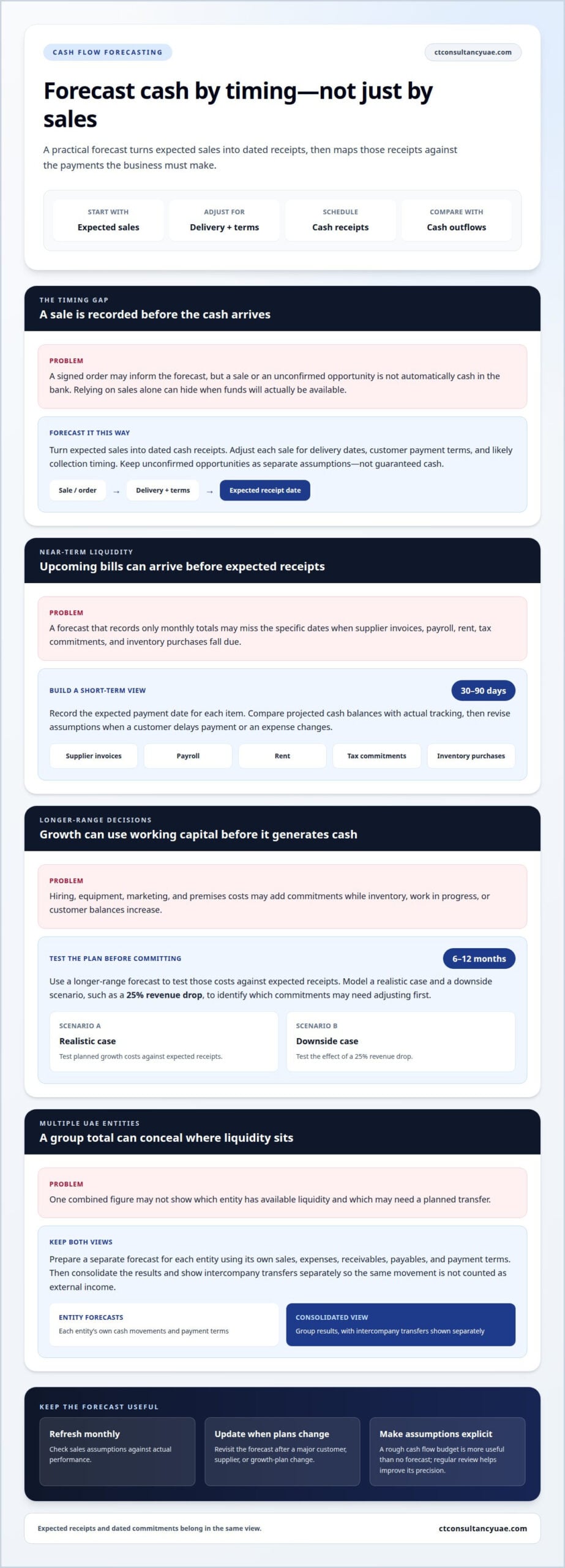
A useful forecast turns expected sales into dated cash receipts, then maps those receipts against outflows. Start with monthly sales projections, adjusting each sale for delivery dates, customer payment terms, and likely collection timing. A signed order may inform the forecast, while an unconfirmed sales opportunity should remain a separate assumption, not guaranteed cash.
Build a 30-90 day forecast for near-term liquidity decisions, including supplier invoices, payroll, rent, tax commitments, and inventory purchases. Record the expected payment date for each item, not merely its accounting month. Then compare projected cash balances with actual tracking and revise assumptions when a customer delays payment or an expense changes.
For longer-range decisions, use a 6-12 month forecast to test hiring, equipment purchases, marketing, and premises costs against expected receipts. Growth can consume working capital before it generates cash, particularly when inventory, work in progress, or customer balances increase. Model a realistic case and a downside scenario, such as a 25% revenue drop, to identify which commitments need adjusting first.
Businesses with multiple UAE entities need both separate forecasts and a consolidated view. Prepare each entity’s forecast using its own sales, expenses, receivables, payables, and payment terms. Then consolidate the results, showing intercompany transfers separately so the group view doesn’t count the same movement as external income. This helps decision-makers see which entity has available liquidity and which may need a planned transfer.
Refresh monthly sales assumptions against actual performance, and update the forecast whenever a major customer, supplier, or growth plan changes. A rough cash flow budget is more useful than no forecast; precision improves when assumptions are explicit and regularly reviewed. For tailored support connecting forecasts with strategic decisions, CFO advisory services can help structure the analysis.
Accounting software can bring bank transactions, customer invoices, and supplier bills into one working view. Use a cash flow planner to sort each item by expected payment date, then compare scheduled receipts with outflows. This makes it easier to distinguish recorded income from cash available for operations, capital needs, and investment.
For accounts receivable, maintain an invoice register showing the customer, amount, due date, and collection status. Review overdue accounts by age, including invoices 30, 60, or 90 days past due, and assign a follow-up action to each. Prompt invoicing and regular collection reviews help teams identify slow-paying customers before delayed receipts disrupt planned payments.
Give accounts payable its own schedule. Record supplier names, invoice amounts, due dates, and payment terms, then plan payments against expected cash balances. This helps prevent paying bills too early when funds are needed elsewhere, while keeping upcoming obligations visible. Direct payroll deposits and automated bill payments can support consistent cash handling.
A dashboard should highlight exceptions, not just display a bank balance. Track cash on hand, overdue receivables, bills due, and projected liquidity together. A profitable sale, for example, can still leave the bank account under pressure before the customer pays. Linking the sale to its expected receipt date makes the timing gap clear.
Use the same accounting records to reconcile bank transactions and compare actual receipts and payments with the cash plan. Investigate unexplained differences, late collections, or spending that exceeds expectations, then update the underlying records. Accurate bookkeeping and accounting gives a cash planner more reliable information, while consistent invoice and payment tracking helps managers act on emerging pressure rather than outdated figures.
Reliable cash controls turn a forecast into everyday discipline. Assign responsibility for approving payments, recording receipts, and reconciling bank activity. Where staffing allows, separate preparation from approval so one person doesn’t initiate and authorize the same transaction. Clear responsibilities help managers spot errors, duplicate payments, or unusual withdrawals before they affect working capital.
Protect inflows from the point of sale through collection. Set customer credit limits, assess new customers before extending credit, and issue invoices promptly. Review aged receivables regularly, recording follow-up actions and expected payment dates. Deposit customer payments daily so receipts are reflected accurately and matched against invoices.
Control outflows with documented approval limits and an up-to-date payment schedule. Match supplier invoices to approved purchases before paying them, and pay creditors on their due dates. Review stock regularly, set minimum and maximum levels, and avoid excess inventory that ties up cash. These checks preserve funds for essential expenses without disrupting delivery or revenue.
Measure results, not just intentions. Compare actual cash flow with the budget monthly, investigate significant spending differences, and update the rolling budget as business conditions change. If collections fall behind forecast or expenses rise, assign a corrective action and assess its effect on projected inflows and outflows. Recording the decision and assigning an owner makes follow-through easier to monitor.
For stronger oversight, an internal audit can assess whether payment approvals, invoice handling, bank reconciliations, and stock controls operate as designed. This is especially useful when growth, staff changes, or recurring cash discrepancies make existing processes harder to manage. Strengthen cash controls with Internal Audit Services and identify where control procedures need refinement.
CTC Tax & Accounting provides Company Liquidation Services for businesses that have decided to close rather than continue trading. Cash flow pressure alone doesn’t mean liquidation is the right decision: forecasts, obligations, and the company’s wider position all matter. For a continuing business, Accounting Services can support clearer financial records, while Internal Audit Services can assess cash-related controls.
For UAE businesses, VAT Registration and Compliance can also support the management of VAT-related records and obligations. If closure is under consideration, CTC Tax & Accounting can provide Company Liquidation Services as the relevant next step, rather than treating short-term cash controls as a substitute for a considered closure decision. Contact CTC Tax & Accounting to discuss the accounting or liquidation support relevant to your situation.
If getting control of my company’s cash flow is your priority, review how financial decisions are supported across your business. Clear records and effective oversight help decision-makers assess the information behind those decisions, identify process gaps, and respond with discipline. Managing cash flow also means ensuring that the people responsible can act on accurate, relevant financial information.
CTC Tax & Accounting offers Bookkeeping and Accounting Services, Internal Audit Services, and VAT Registration and Compliance. These services can support businesses seeking more reliable accounting records, a review of internal controls, or assistance with VAT compliance. The appropriate starting point depends on the specific issue your business needs to address.
Bring your current priorities into the conversation, whether they concern the quality of financial records, control procedures, or VAT-related accounting. Contact CTC Tax & Accounting to discuss your business’s accounting and compliance needs. A considered next step can help build a stronger foundation for decisions and support more confident cash management.
CTC Tax & Accounting offers Accounting Services and CFO Services to help you understand your company’s financial position and plan for cash needs. These services are a practical next step when you need clearer visibility into money moving in and out of the business.
If cash flow concerns are linked to tax obligations or compliance, CTC Tax & Accounting also provides VAT Registration and Compliance, Corporate Tax Advisory, and Economic Substance Regulations (ESR) Compliance. Turn to the firm when you need support reviewing these areas alongside your cash flow planning.
Cash flow management is the ongoing process of planning and overseeing when money enters and leaves a business. It helps decision-makers distinguish cash available for use from revenue recorded but not yet collected. For example, a project may show a profit in the accounts while the business still needs to fund wages or materials before the customer pays.
Improve accounts receivable (AR) and accounts payable (AP) by coordinating collection and payment routines. For AR, issue accurate invoices promptly, set clear due dates, and assign responsibility for follow-up. For AP, verify invoices against approved purchases and schedule payment according to agreed terms. Reviewing both schedules together reveals timing mismatches and supports informed decisions about working capital.
Start with actions that can change the timing of receipts or spending without interrupting essential operations. Follow up with customers who have overdue balances, invoice completed work, and pause discretionary purchases until near-term obligations are mapped. Review stock for slow-moving items that may be tying up funds. These steps clarify immediate options, though their effect depends on customer responses and upcoming commitments.
Build a forecast by recording opening cash, expected receipts, and planned payments across a chosen period. Use expected collection dates rather than invoice dates, and include recurring expenses, one-off purchases, and tax commitments. Separate confirmed transactions from estimates, then calculate the expected closing balance for each period. Compare actual results with the forecast and revise assumptions when timing or business conditions change.
Profit measures income and expenses under accounting rules, while cash flow tracks money actually received and paid. A business can record a profitable sale before collecting the invoice, or incur an expense before paying its supplier. For example, completed work may increase reported income today, while the related cash arrives later. That timing difference explains why profit alone doesn’t show immediate liquidity.
Set clear payment terms before work begins, send invoices as soon as an agreed milestone is reached, and make payment instructions easy to follow. Review overdue invoices regularly and send specific reminders identifying the invoice and due date. For suitable customers, an early-payment discount may encourage faster settlement; assess its effect on margins before offering one.