
Confident business decisions come from dependable numbers, not instinct alone. To understand how to feel confident about my business finances, build decisions on accurate, current records, review cash flow and financial reports regularly, and compare spending with a realistic budget. An accounting professional can help turn those records into a clearer view of what your business can sustain and where it may have room to grow.
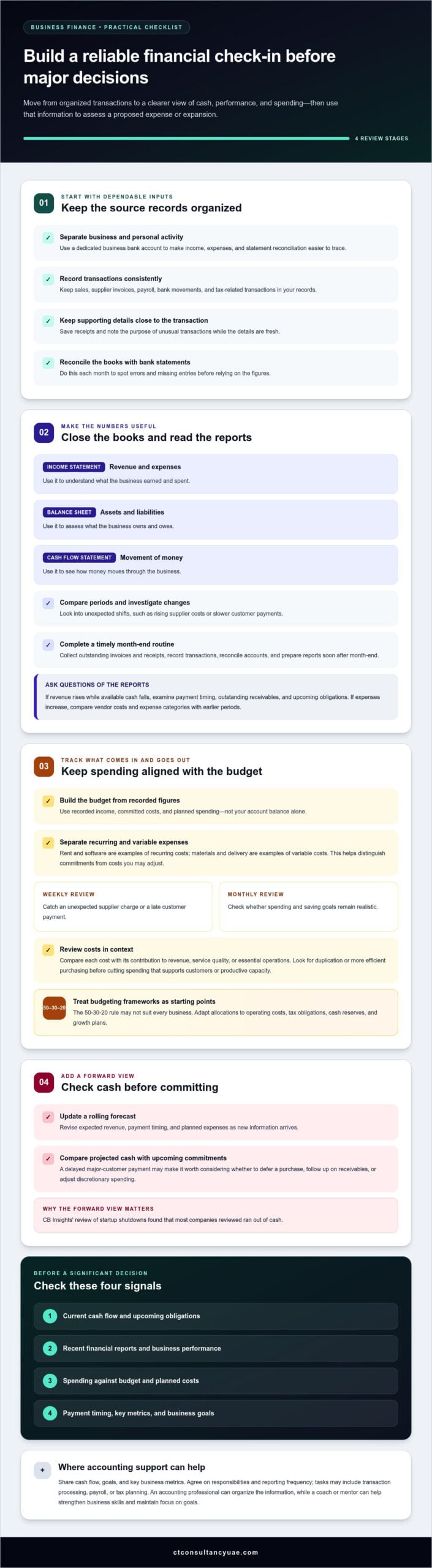
It’s understandable to hesitate when your figures feel incomplete or difficult to interpret. To feel confident about your business finances, use reliable bookkeeping, clear financial reports, budgeting, and expense tracking to make decisions based on current information. Professional accounting support can help you understand what the figures mean. Here are practical ways to review your business’s financial health and decide what to consider before committing to a new expense, expansion, or other significant decision.
Use a dedicated business bank account to separate company transactions from personal spending and simplify bookkeeping. You’ll be able to trace income, document expenses, and reconcile statements against your records more easily. Keep receipts and note the purpose of unusual transactions while the details are fresh.
What accounting software is best for small businesses in the UAE? There isn’t one best option for every business. Look for software that supports AED records, UAE VAT tracking, invoicing, bank reconciliation, clear financial reports, and access for your accountant. A spreadsheet can help you track assumptions, but it shouldn’t replace organized transaction records.
What are the UAE tax and VAT rules for small businesses? Businesses need to account for VAT and Corporate Tax in their financial processes. An accountant can assess which obligations apply to your circumstances and help organize the related records, filings, and deadlines.
Accounting support can be tailored to your workload. Rather than managing every financial task alone, you can delegate tasks such as transaction processing, payroll, and tax planning where appropriate. Share your cash flow, goals, and key business metrics so an accounting professional can organize the data around your decisions, identify potential efficiencies, and highlight opportunities to manage costs.
A deliberate system for allocating income can help make business finances easier to manage. Separate accounts can help distinguish operating funds, profit, taxes, and owner compensation. Review allocations regularly and adapt them to your actual obligations and business model.
Outsourced accounting can suit owners who need consistent records but don’t require a full-time finance employee. Agree on responsibilities, reporting frequency, and the decisions the reports should support. An accountant organizes financial information, while a coach or mentor can help strengthen business skills and maintain focus on goals. Together, these roles can turn figures into practical actions, such as reviewing a cost pattern or planning a purchase against expected cash flow.
Accurate bookkeeping turns individual transactions into a usable record of business performance. Consistently record sales, supplier invoices, payroll, bank movements, and tax-related transactions. Reconcile the books with bank statements each month so you can spot errors and missing entries before relying on the figures to make decisions.
Current records also make financial reports more meaningful. Review the income statement to understand revenue and expenses, the balance sheet to assess assets and liabilities, and the cash flow statement to see how money moves through the business. Compare reports with earlier periods and investigate unexpected changes, such as rising supplier costs or slower customer payments.
Set a clear month-end routine: collect outstanding invoices and receipts, record transactions, reconcile accounts, and prepare reports promptly. Complete the monthly financial close soon after month-end rather than letting it slip for weeks. Timely reports give you a more useful view of recent performance when considering hiring, equipment purchases, or spending changes.
Use reports to answer specific questions, not just to archive figures. If revenue rises while available cash falls, examine payment timing, outstanding receivables, and upcoming obligations. If expenses increase, compare vendor costs and expense categories with earlier periods. These checks can reveal patterns that a single account balance might conceal.
Transparent, accurate records also support financing discussions because lenders and investors need a clear picture of business performance. Keep supporting documents organized so reported figures can be traced to invoices, receipts, and bank activity. For businesses that need consistent recordkeeping and clearer reporting, professional bookkeeping and accounting support can help establish a dependable monthly process.
Build a budget from recorded income, committed costs, and planned spending, rather than relying on your account balance alone. Separate recurring expenses, such as rent and software, from variable costs, such as materials or delivery. This shows which commitments remain payable when sales fluctuate and which costs you can adjust.
Review your budget weekly and monthly. Weekly checks can catch an unexpected supplier charge or late customer payment; monthly reviews show whether spending and saving goals remain realistic. Track customer behavior, cash flow patterns, vendors, and expense categories together. A change in one area may explain pressure elsewhere, such as lower collections alongside unchanged purchasing.
A rolling forecast adds a forward view to your budget. Update expected revenue, payment timing, and planned expenses as new information arrives, then compare projected cash with upcoming commitments. If a major customer delays payment, the forecast can help you decide whether to defer a purchase, follow up on receivables, or adjust discretionary spending before cash becomes constrained. CB Insights’ review of startup shutdowns found that most companies reviewed ran out of cash.
How can I reduce business expenses without harming growth? Compare each cost with its contribution to revenue, service quality, or essential operations. Before cutting spending that supports customer retention, delivery, or productive capacity, look for duplication or more efficient purchasing options.
The 50-30-20 rule is one budgeting framework, but its categories may not suit every business. Treat it as a starting point, then adapt allocations to operating costs, tax obligations, cash reserves, and growth plans. For example, someone reviewing a spreadsheet can label each expense by purpose and flag costs that no longer support a current objective.
Turn your findings into a clear next action: revise a forecast assumption, review a vendor contract, or pause a nonessential purchase. Record the decision and revisit it during your next weekly or monthly review. This feedback loop helps you adjust the budget based on actual performance rather than guesswork.
Assess financial health through liquidity, profitability, debt, and the timing of cash movements. Start with available cash and near-term obligations, then compare revenue with operating costs. A profitable income statement doesn’t necessarily mean cash is available today, especially when customers pay late or significant bills fall due. Include expected UAE tax obligations in cash planning.
Review the balance sheet for assets, liabilities, and the capital supporting operations. Check whether receivables are growing faster than collections, inventory is tying up cash, or liabilities are increasing. Then examine the income statement for changes in revenue, margins, and expenses. Comparing reports across periods helps distinguish temporary fluctuations from developing patterns.
Pay particular attention to cash flow. Map expected customer receipts against payroll, rent, supplier invoices, and tax obligations. A timing shortfall may call for a different response than a sustained decline in sales. For example, delayed customer payments may require closer collection follow-up, while falling sales could mean revisiting planned commitments.
Translate your findings into decisions. If receivables are delayed, strengthen collection follow-up and account for payment timing in purchasing plans. If a cost category rises, identify the driver before reducing spending that supports delivery or customer retention. If debt obligations limit flexibility, model their effect on future cash commitments before taking on additional costs.
Use a concise review for each reporting period: cash available, amounts owed to the business, upcoming obligations, profitability, and material changes from prior reports. Record the issue, its likely cause, and the action you’ll take; revisit that action during the next review. This makes financial health a decision tool rather than a static snapshot. For a structured view of enterprise worth, explore business valuation support when assessing a major strategic decision.
CTC Tax & Accounting provides Bookkeeping and Accounting Services for businesses that need organized financial records and reports to support decisions. This can help when transactions are difficult to keep current, reports are unclear, or financial information lacks a consistent process. Reliable bookkeeping helps you review business performance and understand the figures behind spending and growth decisions.
For needs beyond routine recordkeeping, CTC Tax & Accounting also offers Internal Audit Services, VAT Registration and Compliance, and Corporate Tax Advisory. These services can support stronger oversight and financial processes aligned with your business’s UAE tax responsibilities.
Ready to bring more clarity to your business finances? Contact CTC Tax & Accounting to discuss your accounting needs.
Financial confidence grows when you turn uncertainty into a decision process: define the choice, identify the information it depends on, and decide when to review the outcome. This keeps future plans connected to your business’s actual position rather than assumptions made under pressure. The question of how to feel confident about my business finances becomes more manageable when each decision has a clear financial basis.
When you need support strengthening that foundation, CTC Tax & Accounting offers Bookkeeping and Accounting Services, Internal Audit Services, and VAT Registration and Compliance. These services can help address recordkeeping, oversight, and compliance needs that affect financial decisions.
Consider the area where clearer financial information would help your next decision. Explore how CTC Tax & Accounting can support your business, and take the next step with a more structured view of your finances.
A fractional CFO helps translate financial data into choices, trade-offs, and forward-looking scenarios. Before you add a staff member, for example, a CFO can assess the projected effect on payroll, cash availability, and operating results under different revenue assumptions. This gives you a structured basis for deciding whether to proceed, postpone, or revise the plan, without requiring a full-time finance executive.
Confidence comes from knowing what information supports a decision and having a repeatable way to review the outcome. If you’re wondering how to feel confident about my business finances, write down the decision, the assumptions behind it, and the result you expect. Later, compare the actual outcome with that expectation. This turns experience, including setbacks, into better-informed future choices.
Review the profit and loss statement, balance sheet, and cash flow statement together. The profit and loss statement shows performance across a period; the balance sheet records assets and liabilities at a point in time; and the cash flow statement explains cash movements. Compare reported profit with cash generated, for example, to identify timing differences that may affect upcoming commitments.
Track cash on hand, operating cash flow, overdue receivables, upcoming payables, and the difference between forecast and actual cash movements. These measures show whether customer collections are keeping pace with obligations. If receivables age while supplier payments remain due, review collection priorities and expected payment dates. Considering both timing and direction makes your cash position more informative than a balance alone.
Set a reserve based on your fixed commitments, revenue variability, customer payment patterns, and access to incoming cash. A business with seasonal sales or delayed collections may need a different buffer from one with predictable receipts. Define the situations that justify using the reserve, then prioritize replenishing it after withdrawals. Review the policy as costs, sales patterns, and obligations change.
Build your budget from actual transaction history, signed customer commitments, supplier terms, and known operating obligations. Separate confirmed revenue from estimates, and document the assumptions behind each projection. Test a lower-sales or delayed-payment scenario to see which costs or decisions may be difficult to sustain. Update the forecast when customer demand, costs, or payment timing changes, and record why each significant assumption shifted.