Could a minor administrative delay in your VAT de-registration process in the UAE result in a staggering AED 10,000 penalty and disrupt your broader corporate restructuring goals? It’s a valid concern for executive decision-makers who recognize that the Federal Tax Authority’s 2026 standards require more than just a simple cessation of trade. You likely understand that exiting the tax system is as high-stakes as entering it, especially when the distinction between formal business liquidation and a mere drop in taxable turnover remains a common point of confusion for many entrepreneurs.
This guide empowers you to navigate these regulatory complexities with precision, ensuring a seamless transition that protects your bottom line and secures a clean tax clearance. We’ll provide a comprehensive briefing on the mandatory 20-day filing window, the technical nuances of the EmaraTax portal, and the critical intersection of VAT de-activation with your ongoing Corporate Tax obligations. By following this structured roadmap, you’ll gain the strategic reassurance needed to manage your exit without incurring unnecessary administrative friction or financial liabilities.
Key Takeaways
- Identify the specific financial thresholds and mandatory triggers that necessitate a formal cancellation of your Tax Registration Number to maintain regulatory alignment.
- Execute the VAT de-registration process in the UAE via the EmaraTax portal using the correct documentation checklist to prevent technical rejections or processing delays.
- Secure essential administrative clearances, including the Turnover Template and liquidation documentation, to facilitate a smooth and successful FTA review.
- Adhere to the strict 20-business-day filing deadline to mitigate the risk of significant administrative penalties and recurring monthly fines.
- Synchronize your tax de-activation with broader Corporate Tax requirements and licensing cycles to ensure a comprehensive exit from the UAE tax landscape.
Understanding VAT De-Registration in the UAE: Mandatory vs. Voluntary Criteria
The VAT de-registration process in the UAE begins with a precise assessment of whether the cancellation of a Tax Registration Number (TRN) is a statutory obligation or a strategic business choice. De-registration is the formal procedure through which a taxable person or entity annuls their tax status with the Federal Tax Authority (FTA). Since the implementation of Taxation in the United Arab Emirates, this process has served as a critical compliance milestone for businesses undergoing structural changes or experiencing shifts in revenue. It’s not simply a matter of stopping filings; it’s a documented exit that requires synchronization with VAT compliance standards to avoid lingering liabilities.
A fundamental distinction exists between company liquidation and a mere change in legal form. When an entity undergoes liquidation, it ceases to exist as a legal person, making de-registration an absolute prerequisite for obtaining final tax clearance. However, if a business transitions from a sole establishment to a limited liability company, the original TRN must often be cancelled to make way for a new registration under the revised legal structure. Understanding these nuances prevents the procedural errors that often lead to administrative friction during the transition period.
When is De-Registration Mandatory?
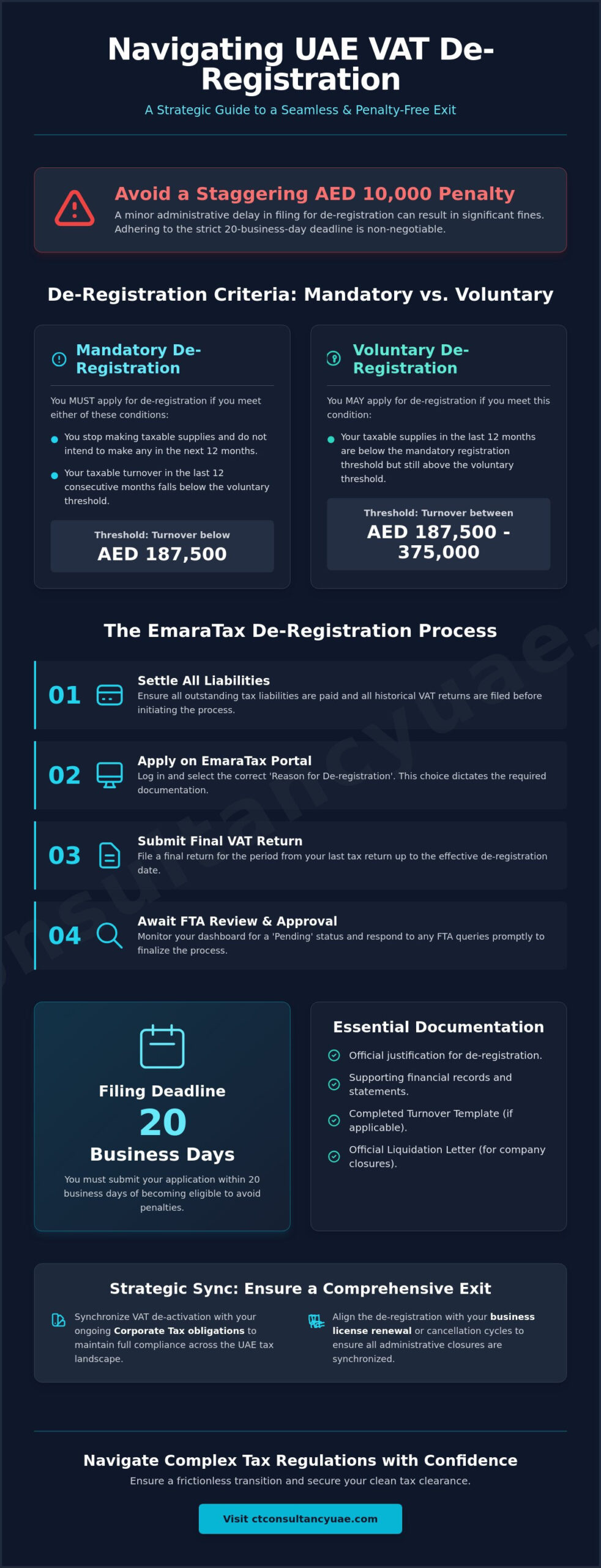
Mandatory de-registration is triggered by two specific conditions. First, it’s required if a business stops making taxable supplies and does not intend to make any in the next 12 months. Second, it becomes compulsory if the taxable turnover in the preceding 12 consecutive months falls below the voluntary registration threshold of AED 187,500. The FTA is strict about the timeline for these applications. You must submit your request within 20 business days of becoming eligible. Failure to meet this window often results in significant financial penalties that can disrupt your exit strategy.
Eligibility for Voluntary De-Registration
Entities that continue to operate but see their revenue decline may opt for voluntary de-registration. This is possible if the total value of taxable supplies in the previous 12 months is less than the mandatory threshold of AED 375,000 but remains above the voluntary limit of AED 187,500. This decision often involves a strategic cost-benefit analysis. While remaining registered allows for the recovery of input tax on business expenses, the overhead of maintaining precise records and filing regular returns can be excessive for smaller operations. Businesses facing a sustained downward revenue trend or those entering a seasonal lull often find that de-registering provides a more streamlined financial profile.
The Step-by-Step VAT De-Registration Process on EmaraTax
Executing the VAT de-registration process in the UAE requires a meticulous approach through the EmaraTax portal, which serves as the unified digital environment for all Federal Tax Authority VAT De-registration services. It’s not enough to simply cease operations; you must formally initiate the request via your dashboard. Choosing the correct ‘Reason for De-registration’ is a pivotal step, as this selection dictates the specific documentation requirements the system will generate. Whether you’re citing a business liquidation or a drop in taxable turnover, any mismatch between your stated reason and your supporting evidence can lead to immediate administrative friction.
Before the FTA considers your application, all outstanding tax liabilities must be settled in full. This includes the submission of a Final VAT Return, which covers the period from the end of your last tax return until the effective date of de-registration. Many businesses fall into the trap of assuming their obligations end the moment they click submit. In reality, you’re required to monitor your dashboard for a ‘Pending’ status, which indicates the authority is actively reviewing your financial history for discrepancies. Settling these balances promptly is the only way to ensure the portal allows the application to move toward final approval.
Navigating the EmaraTax Portal
To begin, ensure that all historical returns are filed and any balances are cleared. The portal won’t permit the de-registration form to be submitted if there are pending payments or unfiled periods. You’ll need to enter the exact effective date when you met the de-registration criteria. This date is critical because it determines the cutoff for your final tax period. If you’re unsure about the precise timing of your eligibility, consulting with a specialized tax advisor can help you avoid costly miscalculations during the VAT de-registration process in the UAE.
Timelines and FTA Approval Stages
The FTA typically adheres to a 20-business-day timeline for the initial review of de-registration applications. During this phase, the status will remain as ‘Submitted’. If the authority requires further evidence, such as a detailed turnover template or a liquidation letter, they’ll issue a ‘Request for Clarification’. Your response time here is vital. Once the review is complete, the status shifts to ‘Approved’, at which point the TRN is suspended. You’ll then receive a final notification confirming your exit from the VAT system, though you must retain all records for the statutory five-year period.
Essential Documentation and Financial Records for UAE De-Registration
Success in the VAT de-registration process in the UAE hinges on your ability to substantiate the claim that your business no longer meets the criteria for tax registration. This isn’t merely an exercise in uploading files; it’s a rigorous reconciliation of your corporate history against current regulatory standards. The Federal Tax Authority (FTA) requires a specific dossier that demonstrates either the total cessation of your taxable supplies or a decline in turnover that justifies an exit. Central to this dossier is the Federal Tax Authority VAT De-Registration Guide, which outlines the mandatory evidentiary standards every applicant must meet to ensure procedural integrity. By preparing these records in advance, you position your firm as a compliant entity, ready for a frictionless transition out of the VAT system.
Evidence of Business Cessation or Liquidation
For businesses undergoing formal closure, the primary document is the Revoked Trade License or a Liquidation Letter from the relevant licensing authority. Mainland companies and Free Zone entities face slightly different requirements; for instance, a Free Zone entity may need to provide a specific de-registration certificate from its respective authority. If the de-registration is triggered by the sale of the business, you’ll need to submit the original and amended sales contracts, alongside board resolutions that formalize the transfer of assets. Additionally, letters from the Ministry of Labour confirming the cancellation of employee visas or status changes serve as vital secondary evidence that operations have truly ceased. These documents provide the legal context the FTA needs to verify that your business is no longer a taxable person.
Financial Turnover Templates and Audit Requirements
A frequent point of friction for many SMEs is the ‘Turnover Template’. This document requires a granular, month-by-month breakdown of your taxable income and expenses from the initial date of your TRN registration until the proposed de-registration date. It’s not enough to provide high-level figures. The FTA scrutinizes these templates to ensure they align perfectly with your historical VAT returns. Any discrepancy between your filed returns and the data in this template can trigger a request for a comprehensive internal audit. Providing audited or well-prepared internal financial statements, including Balance Sheets and P&L statements, adds a layer of professional authority to your application. This signals to the FTA that your financial records are beyond reproach. Precision here doesn’t just prevent delays; it’s your primary defense against the scrutiny that often accompanies a TRN cancellation in the VAT de-registration process in the UAE.
Avoiding Late Filing Penalties and Common Compliance Pitfalls
The VAT de-registration process in the UAE carries significant financial weight, as the Federal Tax Authority (FTA) maintains a zero-tolerance policy for administrative delays. While the preceding sections detailed the technical steps and documentation required, the most common point of failure for executive teams is the timing of the application. An oversight in calculating the statutory window can lead to an immediate penalty of AED 1,000 for the first month of delay, which continues to accrue for each subsequent month. This compounding fine can reach a maximum cap of AED 10,000, creating an unnecessary financial burden for businesses already navigating the complexities of liquidation or restructuring. If you’ve already incurred these costs, it’s possible to apply for penalty waivers, though success depends on proving exceptional circumstances that prevented timely filing.
Another frequent compliance trap is the ‘Final Return’ requirement. Many business owners believe their obligations end once the TRN is suspended on the portal. However, you’re still required to file one last return that covers the period up to the effective de-registration date. Failing to submit this final document can lead to additional fines, even if the business has ceased all operations. Maintaining a clean tax record is essential, especially if you intend to utilize VAT registration services in the UAE for a future venture. The FTA keeps detailed compliance histories, and past infractions can lead to increased scrutiny or delays when you attempt to re-enter the market.
The 20-Business-Day Rule and Financial Implications
The "Date of Eligibility" is the catalyst for the 20-business-day rule. For mandatory de-registration, this date is usually when you stop making taxable supplies or when your turnover falls below the voluntary threshold. A common error is counting calendar days instead of business days. In the UAE, business days exclude weekends and public holidays. You shouldn’t wait for your trade license cancellation to be 100% complete before initiating the VAT de-registration process in the UAE. Proactive filing based on the cessation of supplies is often the safest path to avoid the month-one penalty.
Managing Outstanding Tax Liabilities and Penalties
You must clear your "Tax Ledger" on EmaraTax before the de-registration can be finalized. If you attempt to de-register with outstanding liabilities, you risk being flagged for "De-registration with Liability." This status can have personal repercussions for business owners and managers, as the debt remains tied to the legal person even after the TRN is cancelled. It’s strategically sound to address any legacy errors or audit discrepancies before the FTA begins its final review. If you’re concerned about hidden liabilities, our experts can provide a comprehensive VAT compliance review to ensure your ledger is perfectly balanced before submission.
Strategic Tax Advisory: Ensuring a Frictionless Transition with CTC
Successfully completing the VAT de-registration process in the UAE is rarely a standalone achievement. In the current regulatory environment, an exit from the VAT system must be viewed through a holistic lens that encompasses your entire corporate footprint. CTC Tax & Accounting serves as a primary friction-remover for SMEs, freelancers, and multinational entities, ensuring that a TRN cancellation doesn’t inadvertently trigger complications in other areas of your business. We provide the strategic reassurance required to manage complex restructures, mergers, or simple cessations of trade with absolute procedural integrity. Our approach prioritizes long-term stability, moving beyond mere form-filling to offer a comprehensive compliance roadmap.
When you partner with our team, you gain access to customized solutions designed to navigate the high-stakes nature of tax law. We recognize that every business transition is unique. Whether you’re a freelancer scaling down or a corporation undergoing a significant merger, the documentation and reconciliation required by the Federal Tax Authority (FTA) demand a high level of precision. By entrusting your de-activation to seasoned consultants, you mitigate the risk of administrative errors and secure a clean tax clearance that protects your professional reputation and your bottom line.
Integrating VAT and Corporate Tax Compliance
Since the introduction of new fiscal regimes, synchronizing your VAT exit with Corporate Tax consultants in Dubai has become a vital compliance safeguard. It’s a common misconception that VAT de-registration automatically settles your Corporate Tax (CT) obligations. In reality, these two systems have separate de-registration requirements and different statutory triggers. We ensure your financial statements satisfy both VAT and CT audit standards simultaneously. This methodical planning prevents a scenario where a successful VAT de-registration accidentally highlights discrepancies in your Corporate Tax filings, ensuring a seamless and secure exit from the tax landscape.
Professional Support for Company Liquidation
For entities entering formal closure, our business advisory services are instrumental in streamlining the liquidation process. The VAT de-registration process in the UAE is often the final hurdle before a company can be legally dissolved. We coordinate directly with external auditors to provide final certification of your financial statements, ensuring that every asset disposal and liability settlement is correctly reflected in your records. This coordination is essential for obtaining the final tax clearance certificate from the FTA. By managing these technical nuances on your behalf, we allow you to focus on your next venture while we secure the official confirmation of your de-registration, marking a clean and compliant end to your business operations.
Securing Your Corporate Legacy through Precise Compliance
Mastering the VAT de-registration process in the UAE requires a sophisticated understanding of both statutory timelines and the technical intricacies of the EmaraTax portal. By prioritizing the 20-business-day filing window and reconciling your historical turnover with absolute precision, you protect your organization from the compounding penalties that often accompany administrative oversight. As the UAE tax landscape continues to mature, the synchronization of your VAT exit with broader Corporate Tax obligations remains the most effective strategy for ensuring a clean regulatory clearance and maintaining long-term financial stability.
At CTC Tax & Accounting, we leverage decades of international tax experience and specialized expertise in SME compliance and company liquidation to act as your primary friction-remover. Our team provides dedicated support for EmaraTax portal management, ensuring every submission is meticulously prepared and strategically timed to meet the Federal Tax Authority’s rigorous standards. Ensure a frictionless VAT de-registration with CTC Tax & Accounting to secure your business’s standing and facilitate a smooth transition into your next phase of growth. We look forward to helping you navigate these high-stakes requirements with confidence and professional calm.
Frequently Asked Questions
What is the penalty for late VAT de-registration in the UAE?
The penalty for failing to submit a de-registration application within the 20-business-day window is AED 1,000 for each month of delay, which is capped at a maximum of AED 10,000. These administrative fines are strictly enforced by the Federal Tax Authority to ensure timely compliance. Business owners shouldn’t wait until the final stages of liquidation to identify their "Date of Eligibility," as these costs can compound quickly during a corporate restructuring.
Can I de-register for VAT if I still have outstanding tax payments?
You cannot complete the VAT de-registration process in the UAE if there are outstanding tax liabilities or unfiled returns on your EmaraTax account. The portal typically prevents the final submission of the de-activation form until the "Tax Ledger" shows a zero balance. Settling all historical dues and penalties is a prerequisite for the FTA to begin its formal review, as the authority won’t release an entity from the tax system while debts remain.
How long does the FTA take to approve a VAT de-registration application?
The Federal Tax Authority generally takes 20 business days to process a VAT de-registration application from the date of submission. This timeline assumes that all required documentation, such as the turnover template and liquidation letters, is complete and accurate. If the authority issues a "Request for Clarification," the processing period may extend as they verify the provided financial records against your historical tax filings to ensure total compliance.
Is VAT de-registration automatic once a trade license is cancelled?
VAT de-registration isn’t an automatic consequence of cancelling your trade license; it’s a distinct statutory requirement that must be initiated through the EmaraTax portal. While a revoked license is a primary trigger for mandatory de-registration, the business remains a "taxable person" in the eyes of the FTA until the TRN is formally suspended. Relying on license cancellation alone often leads to late filing penalties and unnecessary administrative complications for the owners.
What is the turnover threshold for voluntary VAT de-registration?
A business is eligible for voluntary VAT de-registration if its taxable supplies in the preceding 12 months were less than the mandatory threshold of AED 375,000. However, the entity must have been registered for at least 12 months if the original registration was voluntary. This option allows smaller firms to reduce administrative overhead while maintaining the flexibility to re-enter the tax system if their revenue trends upward in future fiscal cycles.
Do I need to file a VAT return after applying for de-registration?
You’re required to continue filing regular VAT returns until you receive official confirmation of de-registration and are prompted to submit your "Final Tax Return." The VAT de-registration process in the UAE requires a clear cutoff, and any transactions occurring between the application date and the effective de-registration date must be documented. Failing to maintain filing cycles during the review period can result in unnecessary fines for non-compliance and disrupt your final tax clearance certificates.
Can I re-register for VAT after I have de-registered?
Re-registering for VAT is entirely possible if your business activities resume or if your taxable turnover once again exceeds the mandatory or voluntary thresholds. The FTA will issue a new Tax Registration Number (TRN) upon a successful application. However, your previous compliance history, including any past de-registration penalties or audit discrepancies, remains on record and may influence the scrutiny level of your new registration request when you re-enter the market.
Does VAT de-registration affect my Corporate Tax status?
VAT de-registration doesn’t automatically terminate your Corporate Tax obligations, as the two regimes operate under separate legislative frameworks in the UAE. While a business may no longer be a "taxable person" for VAT, it might still have Corporate Tax filing requirements until it completes a formal tax de-registration for CT purposes. Aligning these two exit strategies is crucial for ensuring a comprehensive and frictionless transition out of the regional regulatory landscape.

