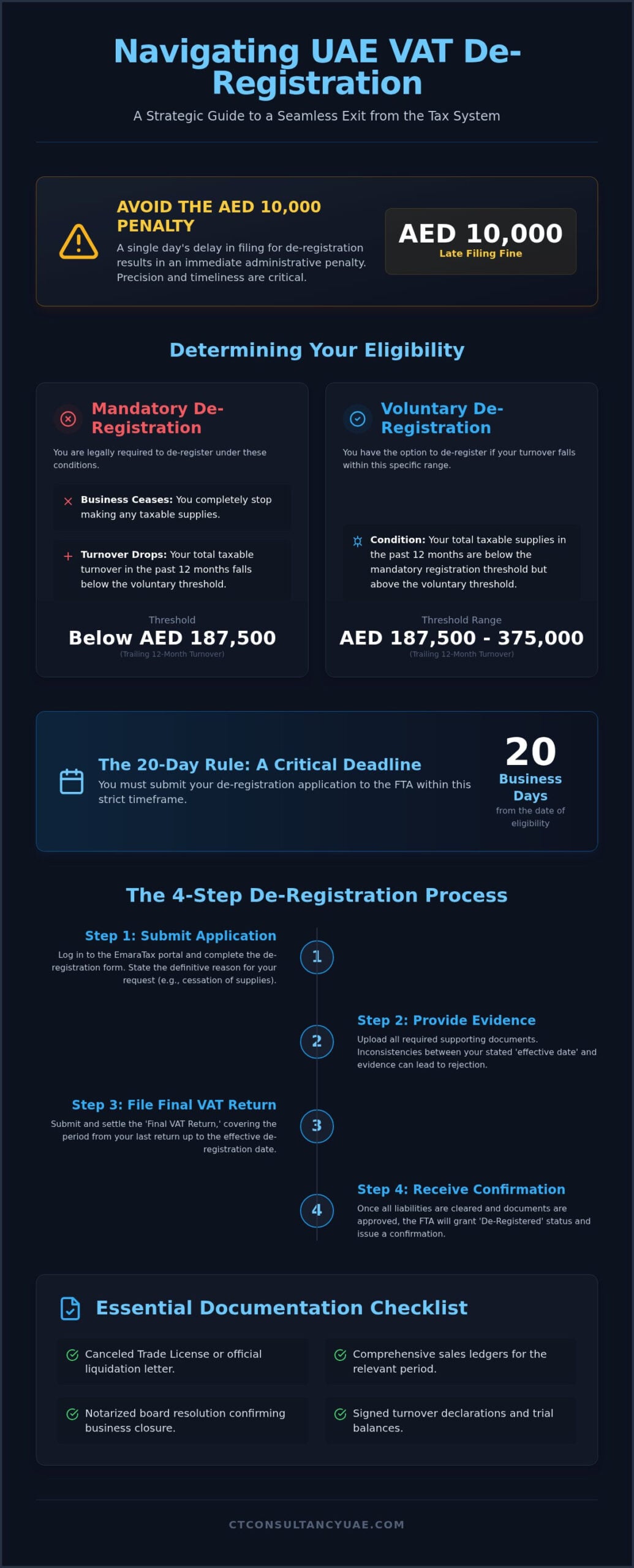
A single day of administrative oversight in the United Arab Emirates can transform a routine business restructuring into a costly regulatory setback, specifically an immediate AED 10,000 penalty for non-compliance. You’ve likely found that while entering the tax system was a milestone for your company’s growth, exiting it requires a more sophisticated level of precision to ensure no lingering liabilities remain. Navigating the VAT de-registration in the UAE landscape doesn’t have to be a source of anxiety if you approach it with a structured and logical framework.
This definitive 2026 guide provides the strategic reassurance needed to master the Federal Tax Authority’s requirements and avoid common filing pitfalls. We’ll examine the critical distinctions between mandatory and voluntary de-registration, the complexities of the Final VAT Return, and the exact steps required for a frictionless exit. You’ll gain the clarity to secure a successful de-registration confirmation while ensuring zero penalties are incurred during your corporate transition.
Key Takeaways
- Distinguish between mandatory and voluntary thresholds to ensure the business maintains its registration only when legally necessitated or strategically advantageous.
- Master the strict 20-day notification timeline to mitigate the risk of the AED 10,000 administrative penalty associated with late VAT de-registration in the UAE applications.
- Identify the essential documentary evidence, ranging from trade license cancellations to certified financial statements, required to facilitate a seamless Federal Tax Authority approval process.
- Synchronize tax de-registration with company liquidation and Corporate Tax clearances to ensure a comprehensive and frictionless transition out of the UAE tax system.
Determining Eligibility: Mandatory vs. Voluntary VAT De-Registration
Determining if your entity is legally required to exit the tax system or merely eligible to do so is the first step in maintaining regulatory integrity. In the United Arab Emirates, VAT de-registration in the UAE is categorized into two distinct pathways based on your 12-month trailing financial performance. Mandatory de-registration occurs if your business stops making taxable supplies entirely or if your taxable turnover falls below the voluntary threshold of AED 187,500 over the previous year. Conversely, voluntary de-registration is an option when supplies stay below the mandatory threshold of AED 375,000 but remain above the AED 187,500 floor.
The Cessation of Taxable Supplies
Identifying the precise date your business ceased trading is vital for FTA reporting. A "cessation of business" implies a total stop in commercial activity, whereas a "reduction in taxable turnover" suggests the business remains active but at a lower fiscal volume. If your entity remains active but produces zero taxable invoices, you aren’t automatically exempt from filing. The FTA expects a formal de-registration application once the intent to stop making taxable supplies is finalized.
Threshold Analysis for 2026 Compliance
To remain compliant in 2026, you must conduct a rigorous calculation of your trailing 12-month turnover to determine your status for VAT de-registration in the UAE. This isn’t based on the calendar year but a rolling window. If your turnover hasn’t exceeded AED 187,500 in the last 12 months, the FTA mandates your exit. Understanding these limits is just as critical as understanding the initial VAT registration services UAE requirements. While falling turnover triggers eligibility, some firms choose to remain registered voluntarily to continue recovering input tax on business expenses, provided they stay above the AED 187,500 mark. This strategic choice requires balancing administrative costs against potential tax savings.
The 20-Day Rule: Navigating the De-Registration Timeline
Precision is paramount when managing the 20-day statutory window. The Federal Tax Authority (FTA) is uncompromising: the countdown commences the moment your entity meets the eligibility criteria discussed previously, not upon your internal decision to terminate the registration. Failure to submit the VAT de-registration in the UAE application within this 20-day timeframe triggers an automatic AED 10,000 administrative penalty. It’s one of the most substantial penalties for a single filing error, and its automated nature makes successful appeals exceptionally rare for businesses without documented force majeure.
Step-by-Step FTA Portal Submission
Executing the application for VAT de-registration in the UAE requires a meticulous approach within the EmaraTax portal. After selecting the de-registration service, you must provide a definitive reason for the request, such as the cessation of taxable supplies or falling below the voluntary threshold. Supporting evidence, including board resolutions or trade license cancellations, must be uploaded with precision. Inconsistencies between your stated "effective date" and the date of your final invoice often lead to rejection, resetting the clock and potentially exposing the firm to late-filing fees.
Managing the Final VAT Return
Approval is contingent upon the submission and settlement of the ‘Final VAT Return.’ This specific filing covers the period from your last regular return up to the effective date of de-registration. All outstanding tax liabilities must be cleared; the FTA won’t grant ‘De-Registered’ status to entities with an open balance. For those managing complex wind-downs, engaging expert VAT compliance support ensures that final liabilities are calculated accurately, preventing the administrative friction of an audit during your exit phase.
Essential Documentation and Evidence for a Successful Exit
Securing formal approval for VAT de-registration in the UAE necessitates a robust evidentiary trail that substantiates your eligibility claim. The Federal Tax Authority (FTA) conducts a rigorous review of submitted documents to ensure no tax leakage occurs during the entity’s transition. Primary requirements include:
- Proof of Business Closure: A copy of the canceled trade license or a notarized board resolution confirming the commencement of liquidation.
- Financial Substantiation: Comprehensive sales ledgers, trial balances, and turnover declarations signed by authorized signatories.
- Voluntary Exit Proof: Evidence demonstrating that taxable supplies won’t exceed the AED 187,500 threshold within the subsequent 30-day period.
Reconciling Books for the Final Submission
Achieving fiscal finality requires a meticulous reconciliation of your accounts before the final portal submission. You must verify that all input tax has been accurately recovered and that output tax is correctly accounted for on any remaining assets. Discrepancies between your internal records and previous filings are primary triggers for a post-registration audit. Utilizing professional accounting services ensures that your financial data is perfectly aligned with the information presented in the EmaraTax portal, providing a layer of strategic security against future scrutiny.
Handling Stock and Assets at De-Registration
One of the most complex aspects of the exit process is the "Deemed Supply" rule. Under this regulation, any assets or inventory remaining in the business’s possession at the time of VAT de-registration in the UAE are considered a taxable supply. You’re required to account for VAT on the fair market value of these items, including office equipment, vehicles, and unsold stock. Accurate valuation is non-negotiable to prevent under-reporting. If your transition involves complex asset disposals, our specialized tax services provide the technical proficiency required to manage these valuations and ensure your final return is beyond reproach.
VAT De-Registration During Company Liquidation and Restructuring
Liquidation is a high-stakes tax event where the liquidator assumes formal responsibility for all outstanding obligations. Precision is your best defense. Achieving a successful VAT de-registration in the UAE during this phase requires technical coordination between the winding-up process and tax authorities. It’s vital to align with Corporate Tax consultants UAE to ensure that your final VAT clearances are synchronized with Corporate Tax requirements. Even after receiving your de-registration certificate, you’re legally mandated to preserve all tax records for 5 years, or 15 years for real estate transactions.
Compliance Beyond VAT: UBO and AML
Exiting the market involves multiple regulatory layers that extend beyond the tax portal. Maintaining AML compliance UAE standards is mandatory until the final license cancellation is complete. Similarly, you must provide accurate Ultimate Beneficial Ownership (UBO) updates during the liquidation process. Overlooking these requirements can lead to administrative delays that frustrate the closure timeline and invite additional scrutiny from licensing bodies.
Why Professional Advisory is Essential
The probability of a Federal Tax Authority audit is highest during the de-registration phase. Strategic oversight is necessary to navigate these final hurdles without incurring the AED 10,000 late-filing penalty. Our CFO advisory services help manage cash flow during these final settlements, ensuring all liabilities are extinguished before the entity is dissolved. CTC Tax & Accounting serves as your elite partner, providing the professional calm and specialized expertise needed for a frictionless business exit.
Securing Your Corporate Legacy Through Precise Regulatory Exit
Successful closure of your tax profile is as significant as its inception. It requires a meticulous alignment of financial records, strict adherence to the 20-day filing window, and a comprehensive understanding of deemed supply rules. Accuracy is non-negotiable. Managing VAT de-registration in the UAE demands a strategic approach to ensure that your final tax clearance is absolute and definitive.
By prioritizing documentation integrity, you protect your entity from the automatic AED 10,000 late-filing penalty. Our FTA-aligned compliance experts provide the specialized oversight necessary to manage this high-stakes transition. Secure your frictionless VAT de-registration with CTC Tax & Accounting to benefit from our comprehensive liquidation support and strategic risk mitigation. We’re here to ensure your next business venture begins with a perfectly clean financial slate.
Frequently Asked Questions
What is the penalty for late VAT de-registration in the UAE?
The administrative penalty for failing to submit a vat de-registration uae application within the 20-day statutory window is exactly AED 10,000. This fine is applied automatically by the Federal Tax Authority’s system once the deadline expires. It serves as a significant deterrent against administrative negligence. Consequently, businesses must monitor their turnover thresholds or cessation dates with extreme precision to avoid this substantial fiscal liability during their exit phase.
How long does the FTA take to approve a VAT de-registration application?
The Federal Tax Authority typically processes de-registration applications within 20 business days from the date of submission. However, this timeline depends heavily on the accuracy and completeness of the provided documentation. If the FTA requests additional clarifications or evidence, the approval period will naturally extend. Maintaining a clean tax record and ensuring all previous returns are settled can facilitate a more efficient and predictable approval process for your entity.
Can I de-register for VAT if I still have outstanding tax to pay?
You cannot finalize the de-registration process while there are outstanding tax liabilities or penalties on your account. The FTA requires that all due taxes and administrative fines be fully settled before they grant a "De-Registered" status. Any open balance will lead to the rejection of your application, potentially exposing the business to additional late-filing risks. It’s essential to reconcile your statements and clear all payments prior to submitting your formal request.
What is the ‘Final VAT Return’ and when must it be filed?
The Final VAT Return is a specific tax filing that covers the period from the end of your last regular tax period up to the effective date of your vat de-registration uae. This return must be submitted and the associated tax paid within 28 days from the end of the tax period, or as otherwise directed by the FTA. It’s the concluding step in your tax compliance journey and requires absolute financial accuracy.
Do I need to de-register for VAT if I am changing my company legal form?
Changing your company’s legal form generally necessitates a de-registration of the existing Tax Registration Number and a subsequent new registration for the new legal entity. The FTA views a change in legal structure as the cessation of one taxable person and the birth of another. Failing to manage this transition correctly can result in significant compliance gaps. Professional advisory ensures your new entity is correctly registered while the old one is legally dissolved.