What if a profitable month still leaves your UAE business short of cash? Understanding your financial statements means looking beyond the profit figure to see how performance, assets, liabilities and cash movement connect. Accounting terminology can make monthly reports difficult to interpret, especially when it is unclear which figures should guide everyday decisions.
Each statement answers a different question. Together, they help you assess performance, financial position and cash movement. This guide explains what the balance sheet, income statement and cash flow statement reveal, how to read them alongside one another, and which changes may deserve attention. You’ll also find practical checks for reviewing monthly reports and spotting gaps between reported profit and cash available. With accurate bookkeeping and a structured review, financial statements can support informed decisions about costs, cash flow and growth.
Key Takeaways
- Understand the role of each report when assessing business performance and financial position.
- Read the balance sheet, income statement and cash flow statement together rather than relying on a single figure.
- Compare like-for-like periods, investigate unusual changes and examine differences between reported profit and available cash.
- Turn trends into practical questions about liquidity, costs and growth, then use forecasting or KPI analysis to assess your options.
What financial statements tell you about your business
Financial statements are structured reports that describe a business’s financial position and performance. They turn recorded transactions into information owners and managers can use to understand what the business owns and owes, how it has performed, and how money has moved. Each report answers a different question, so understanding your financial statements means considering them together rather than relying on one figure or report.
Financial position is what a business owns and owes at a point in time; financial performance is how it earns income and incurs costs over a period. This distinction explains why a positive result for a reporting period does not, on its own, show the business’s full financial condition. The financial statements overview also describes the purpose and main types of these reports.
Consider a UAE SME that supplies products to business customers. Sales may appear in its accounts before customers pay their invoices. The owner still needs to know which receivables are overdue, what supplier payments are coming up, and whether cash is available for the next stock purchase. Reading the reports together helps answer those questions without treating revenue or profit as a measure of cash in the bank.
Who uses financial statements, and why?
Owners and managers use financial information to review results, plan cash requirements and weigh growth decisions. Lenders may assess repayment capacity, while investors may consider performance and financial risk. Advisers can use reports to support planning, forecasting or business analysis. Accurate monthly bookkeeping helps make those reports useful. CTC Tax & Accounting’s accounting and bookkeeping services include monthly bookkeeping and financial reporting.
Management reports support internal decisions, but they are not a substitute for formal compliance guidance or an audit opinion. The appropriate use depends on the purpose of the reports and the requirements that apply to the business. Keep operational reporting distinct from regulatory and assurance needs, which may call for separate assessment.
The three core financial statements, and what each one reveals
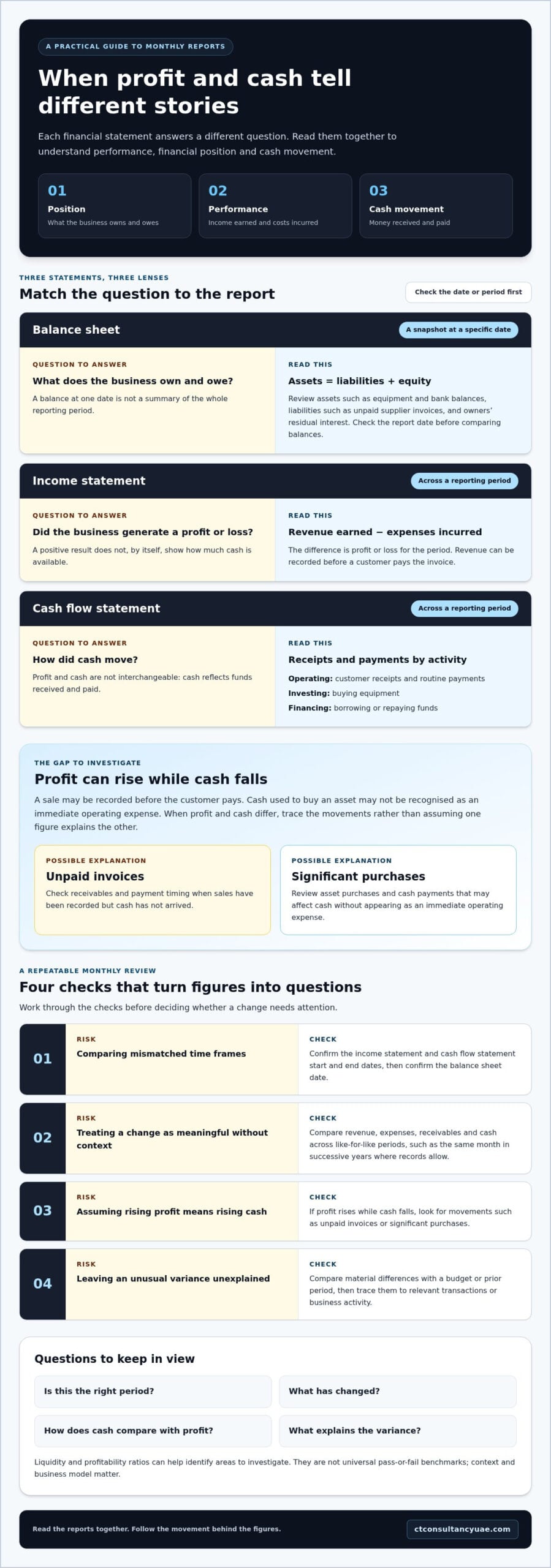
Each statement presents a different view of a business. Understanding your financial statements starts with knowing what each report covers and the time frame it represents.
| Statement |
Purpose |
Time frame |
Key question |
| Balance sheet |
Shows assets, liabilities and equity |
At a specific date |
What does the business own and owe? |
| Income statement |
Summarises revenue, expenses and profit or loss |
Across a reporting period |
Did the business generate a profit? |
| Cash flow statement |
Tracks cash received and paid |
Across a reporting period |
How did cash move? |
Balance sheet: what the business owns and owes
The balance sheet is a snapshot on its stated date, not a summary of the entire reporting period. Its core relationship is assets = liabilities + equity. For example, an illustrative UAE SME might list office equipment and its bank balance as assets, unpaid supplier invoices as liabilities, and the owners’ residual interest as equity. Check the date before comparing balances, since the report describes the position at that point in time.
Income statement and cash flow statement: performance versus movement of cash
The income statement records revenue earned and expenses incurred during a period; the difference is profit or loss. Revenue represents income from business activity, while expenses are costs recorded for that period. The cash flow statement tracks cash movements in operating activities, such as customer receipts and routine payments; investing activities, such as buying equipment; and financing activities, such as borrowing or repaying funds.
Profit measures performance over a period; cash reflects funds received and paid, so the two are not interchangeable. A sale may be recorded before the customer pays, while cash used to buy an asset may not be recognised as an immediate operating expense. When the figures differ, check receivables, payment timing and significant asset purchases. Accurate monthly bookkeeping supports consistent reports, and accounting and bookkeeping support helps maintain that foundation.
How to read financial statements and identify what needs attention
A repeatable review turns monthly reports into useful questions instead of a collection of figures. For understanding your financial statements, work through these checks before deciding whether a change needs action.
- Confirm the reporting period. Check the income statement and cash flow statement start and end dates, then confirm the balance sheet’s reporting date.
- Scan comparable trends. Compare revenue, expenses, receivables and cash across like-for-like periods, such as the same month in successive years where records allow.
- Compare cash with profit. If profit rises while cash falls, identify the movements that may explain the difference, such as unpaid invoices or significant purchases.
- Investigate variances. Compare material differences with a budget or prior period, then trace them to relevant transactions or business activity.
Ask: Is this the right period? What has changed? How does cash compare with profit? What explains the variance? Ratios, such as measures of liquidity or profitability, can help identify areas to investigate. They are not universal pass-or-fail benchmarks because context and business model matter.
Compare periods and follow the movement behind the figures
Figures can move at different rates. Revenue may increase before customers pay, while expenses and cash payments may fall in different periods. One month can therefore give an incomplete picture, especially when activity varies over the year. Compare like-for-like periods, then check notable movements against the budget or prior results. For example, if sales have increased but receivables have risen as well, review which invoices remain unpaid and when payment is expected.
Check report quality before acting on a trend
Before acting, verify that the dates are correct, expected transactions are included, and similar items are categorised consistently between periods. A change in the report may reflect a missing entry or a classification difference rather than a shift in business performance. Check account details and supporting records when a figure looks unusual. Current, accurate bookkeeping supports dependable monthly reporting and meaningful comparisons.
For help interpreting monthly reports, cash flow forecasts and KPIs, explore CFO advisory services.
Turn financial statement insights into stronger business decisions
Make a trend useful by connecting it to a specific business question. If cash is tightening, review the timing of customer receipts against upcoming commitments. If costs are rising faster than revenue, identify which expense categories account for the change. Before committing to investment or growth, assess whether available resources and expected cash flows can support the plan.
Understanding your financial statements can help frame these decisions, but the figures need to be dependable and relevant to the choice at hand. Consistent monthly records make it easier to distinguish a sustained pattern from a one-off movement. CTC Tax & Accounting’s accounting services include monthly bookkeeping and financial reporting, giving you a consistent basis for review.
When accounting support can clarify the picture
Monthly bookkeeping keeps transactions organised and supports reports that can be compared over time. Regular reporting lets owners review income, costs, balances and cash movements using records prepared on a consistent basis. That clarity helps you check whether a change is sustained before adjusting spending, operations or plans. For startups and SMEs in New Zealand, specialized providers like Proledger assist with ongoing bookkeeping and advisory support to ensure reports stay reliable.
When a CFO perspective can connect reports to planning
Deeper analysis can help when a decision involves several moving parts, such as hiring, new investment or planned expansion. Cash-flow forecasting helps assess the timing of expected receipts and payments, while KPI analysis connects financial results to measures of business performance. CTC Tax & Accounting’s CFO support includes monthly profit and loss and balance sheet reporting, cash-flow forecasting and KPI analysis. Explore CFO advisory services to connect reports with financial planning.
A practical next step is to identify one decision your latest reports need to inform, then note the figures and assumptions behind it. If you’d like support interpreting your reports or planning ahead, book CTC Tax & Accounting’s free 20-minute consultation.
Make your next financial decision with greater clarity
Choose one upcoming decision, such as adjusting spending, investing in capacity or planning growth, and identify the financial information that would help you make it. Understanding your financial statements is most valuable when reliable reporting is tied to a clear business question, rather than reviewed as an exercise in itself. For entrepreneurs who also need to align business success with personal exit or retirement goals, specialists like Evergreen Wealth Management provide comprehensive pre- and post-retirement planning.
CTC Tax & Accounting has supported businesses since 2015, drawing on 75 years of combined international finance and accountancy experience. Its accounting and CFO support includes monthly financial reporting and cash-flow forecasting, helping business owners build a structured basis for planning and review.
To discuss how clearer financial insight could support your next decision, book your free 20-minute consultation. Use the conversation to identify which information matters most and where to focus your attention next.
Frequently Asked Questions
Can a business be profitable but still run short of cash?
Yes. A business can report a profit while having limited cash available. A customer invoice may count as revenue before payment arrives, while supplier bills or payroll are due sooner. Inventory purchases can also use cash before products are sold. Review expected collection dates, payment obligations and upcoming cash commitments together to see whether the timing of inflows and outflows creates pressure.
How often should a small business review its financial statements?
Monthly review is a useful rhythm for many small businesses, though the right frequency depends on transaction volume and management needs. Set a regular review date after the period’s transactions have been recorded, then assign follow-up for unanswered questions. If activity is seasonal, compare with a similar period as well as the preceding month so that context informs decisions.
What does a negative figure on a financial statement mean?
A negative figure needs context; it does not have one fixed meaning across every report or account. It might represent a loss, a cash outflow or a balance presented as a reduction. For example, a negative result in an expense adjustment may have a different explanation from negative equity. Check the account label, reporting basis and related entries, then investigate any amount that remains unexplained.
Do I need an accounting background to understand financial statements?
No. A basic understanding of each report’s purpose can help you ask practical questions without mastering accounting terminology. Start by noting an unfamiliar line item, the period it covers and how it relates to a business decision. You can build confidence through regular review. If a classification or technical treatment remains unclear, CTC Tax & Accounting’s accounting services can help explain the underlying records and reporting.