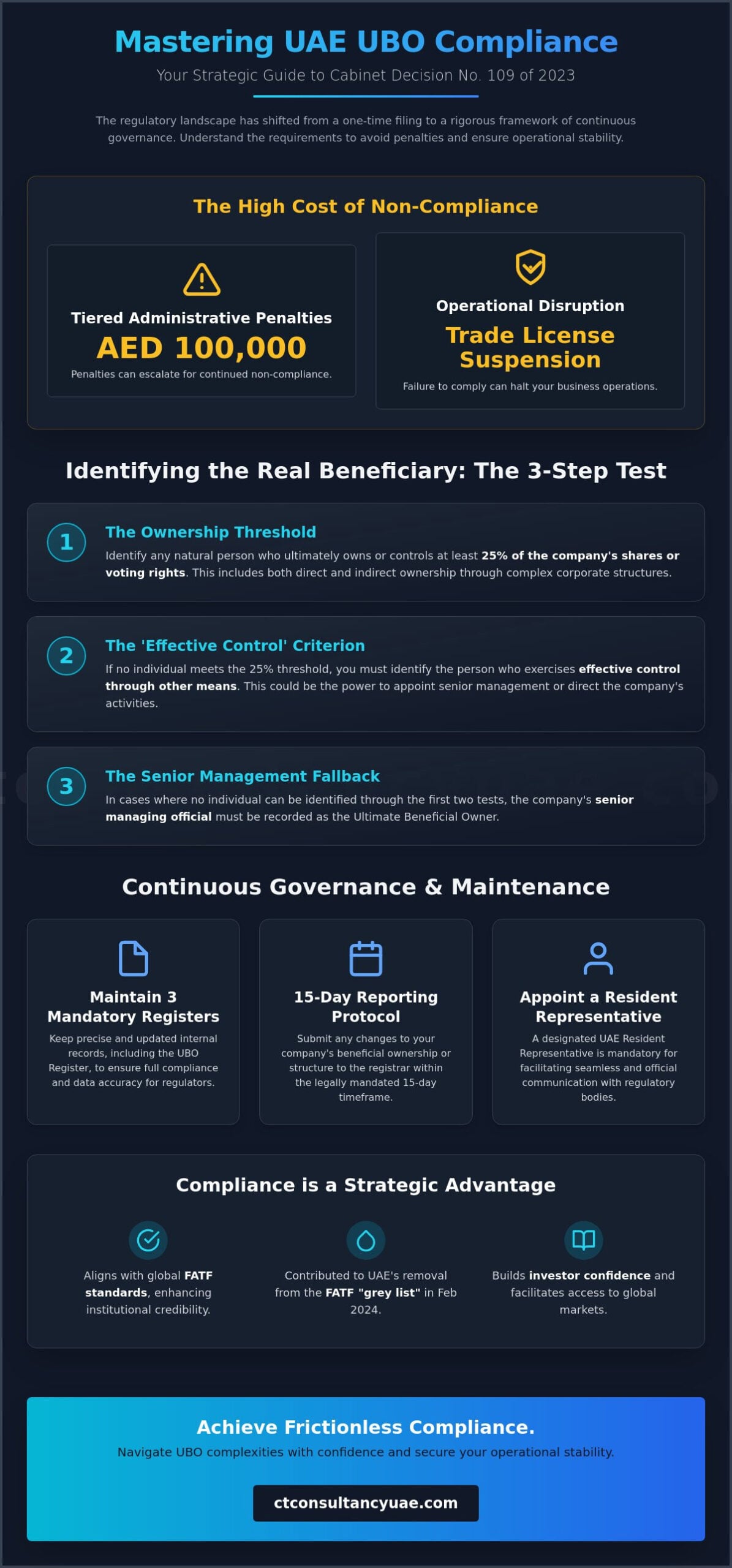
The assumption that a one-time filing satisfies your regulatory obligations is perhaps the most expensive misconception a UAE business leader can hold in 2026. With the recent enforcement of Cabinet Decision No. 109 of 2023, the landscape for UBO register requirements has shifted from simple disclosure to a rigorous framework of continuous governance. You likely recognize the mounting pressure to maintain absolute transparency, yet the complexity of identifying a "Real Beneficiary" within multi-layered corporate structures remains a significant source of operational friction for even the most diligent executives.
We understand that the fear of tiered administrative penalties, which can escalate to AED 100,000 or lead to trade license suspension, creates a high-stakes environment for your compliance team. This guide provides the strategic reassurance you need to master these mandates with precision. We’ll break down the definitive 3-step identification process, detail the maintenance protocols for your three mandatory internal registers, and ensure your entity achieves frictionless compliance in an increasingly scrutinized international market. By the end of this briefing, you’ll possess a clear roadmap to navigate these sophisticated reporting protocols with total confidence.
Key Takeaways
- Navigate the 25% ownership threshold and the alternative “effective control” criteria to identify your real beneficiaries with absolute precision.
- Gain a comprehensive understanding of the UBO register requirements and the specific data points needed to maintain your three mandatory internal corporate registers.
- Establish a robust 15-day reporting protocol to ensure all structural changes are submitted to the registrar within the legally mandated timeframe.
- Recognize the strategic necessity of appointing a designated UAE Resident Representative to facilitate seamless communication with regulatory bodies.
- Discover how customized maintenance solutions can mitigate the risk of trade license suspension and ensure long-term operational stability.
The Legal Framework of UBO Register Requirements in the UAE
The legal architecture governing corporate transparency in the Emirates has undergone significant refinement to meet international standards. Central to this evolution is Cabinet Decision No. (109) of 2023, which superseded the earlier Cabinet Resolution No. (58) of 2020. This legislative shift reinforces The Legal Framework of UBO by mandating that all legal entities identify the natural persons who ultimately reap the benefits of their operations. Understanding these UBO register requirements is essential for maintaining operational continuity and institutional integrity. It’s a fundamental shift from simple disclosure to a rigorous framework of continuous governance.
Within the UAE regulatory context, an Ultimate Beneficial Owner is defined as any natural person who ultimately owns or controls at least 25% of a company’s shares or voting rights. This control may be exercised directly or indirectly through a chain of ownership. If no such individual can be identified via the ownership test, the regulations require the identification of the person exercising effective control through other means. In cases where even this remains ambiguous, the senior managing official of the company must be recorded as the UBO. This tiered approach ensures that no layer of corporate complexity can obscure the individuals who hold ultimate authority.
The Strategic Importance of Transparency
The UAE’s commitment to transparency is a cornerstone of its ambition to remain a premier global trade hub. By aligning national regulations with the Financial Action Task Force (FATF) standards, the Emirates successfully secured its removal from the FATF "grey list" in February 2024. This achievement offers strategic reassurance to international investors and financial institutions. It signals that the jurisdiction possesses robust mechanisms to combat money laundering and terrorism financing. Compliance isn’t just a legal hurdle. It’s a badge of institutional reliability that facilitates smoother transitions into global markets.
Regulatory Oversight and Licensing Authorities
The Ministry of Economy maintains jurisdictional reach over all mainland entities and most non-financial free zone companies. However, certain entities are exempt from these specific national mandates. These include companies wholly owned by federal or local governments and those registered within financial free zones like the DIFC or ADGM, which operate under their own independent regulatory frameworks. The UBO Register is a centralized database for identifying natural persons with significant control. Licensing authorities act as the primary Registrar, coordinating with the Federal Tax Authority to ensure data accuracy across all corporate filings. This coordination ensures that the UBO register requirements are met with precision, reducing the risk of administrative friction during annual renewals.
Identifying the Real Beneficiary: The Three-Step Test
Identifying the ultimate beneficial owner requires more than a cursory glance at a share certificate. It demands a systematic, three-step inquiry designed to pierce through layers of corporate shielding. This methodology ensures that the UBO register requirements are met with the granular detail required by UAE authorities. The process is designed to be exhaustive, leaving no room for ambiguity in the identification of natural persons who hold ultimate authority over a legal entity.
The 25% Ownership Threshold
The primary diagnostic tool in this process is the 25% ownership threshold. This calculation must account for both direct and indirect ownership stakes. When a natural person holds this percentage through a parent company or a sophisticated chain of intermediaries, they must be identified as a Real Beneficiary. Joint ownership and voting agreements often complicate this assessment. If multiple parties act in concert to control a combined stake of 25% or more, each individual may be subject to disclosure. This level of scrutiny aligns with the observations found in the FATF Mutual Evaluation Report on the UAE, which emphasizes the necessity for transparent and verifiable ownership chains to mitigate financial risks.
For those managing sophisticated ownership chains through cross-border trusts, Sheikh Najam TEP offers specialized support in aligning these structures with global tax and estate administration requirements.
Control Beyond Equity
When ownership is fragmented or held by entities without clear individual majority holders, the focus shifts to "significant control." This second step involves evaluating who possesses the legal or de facto power to appoint or dismiss the majority of the board of directors. Veto rights on strategic decisions, specific power of attorney grants, or the ability to exert dominant influence over executive decision-making can all trigger UBO status. Nominee arrangements must be scrutinized with particular care. The law requires the disclosure of the person behind the nominee, as they are the true source of control. For entities managing complex multi-national structures, seeking specialized business advisory can help streamline these identification protocols and prevent administrative delays.
If the first two steps of the test fail to yield a natural person with clear ownership or control, the law provides a definitive fallback position. In these specific instances, the Senior Managing Official (SMO) of the company is designated as the UBO. This ensures that every legal entity registered in the UAE has a natural person recorded in the register who is ultimately accountable for the company’s governance. This three-step approach provides a clear, logical progression that eliminates gaps in the reporting framework, ensuring that your UBO register requirements are fulfilled with absolute precision and legal certainty.
The Three Mandatory Internal Registers for National Compliance
Fulfilling the UBO register requirements involves more than a digital submission to the licensing authority. It necessitates the continuous maintenance of three distinct internal registers at the company’s registered office. These documents serve as the primary source of truth for regulatory audits and must be kept in a state of constant readiness for inspection by the Registrar. By establishing a rigorous internal record-keeping protocol, entities can mitigate the risk of administrative friction and demonstrate a commitment to the UAE’s high-level corporate governance standards.
The first and most critical document is the Register of Ultimate Beneficial Owners, which focuses exclusively on the natural persons identified through the three-step test. Parallel to this, the Register of Partners or Shareholders tracks the legal ownership and voting power within the company, providing a clear audit trail from the registered equity holder to the ultimate beneficiary. For companies managing high volumes of equity transfers or complex share structures, integrating these protocols into your accounting services ensures that internal records remain synchronized with regulatory filings at all times.
Data Requirements for Real Beneficiaries
The level of detail required for each entry in the UBO register is exhaustive. For every identified natural person, the register must contain their full name, nationality, date of birth, and place of birth. Additionally, the entity must record the individual’s residential address, passport or Emirates ID details, and the specific date on which they acquired the status of a Real Beneficiary. Precision is paramount here, as inaccurate data is treated with the same severity as a failure to file. All corporate registers and related documentation must be preserved by the entity for a minimum period of 15 years following the date of the entity’s liquidation or dissolution.
Managing Nominee Arrangements
A nominee director is defined as any natural person acting in accordance with the directions, instructions, or will of another person. The third mandatory document, the Register of Nominee Directors, must disclose the identity of any individual acting in this capacity, as well as the identity of the person who issued the instructions. This requirement is a direct response to global transparency standards, as outlined in the UAE Ministry of Economy UBO Regulations. Shareholders acting as nominees for others must also be clearly identified in the shareholder register to prevent the use of opaque ownership structures. The risks of non-disclosure are substantial, often resulting in tiered financial penalties and a significant impact on the entity’s corporate standing in the national market.
Maintenance, Deadlines, and the Resident Representative
Adhering to the UBO register requirements is not a static achievement but a continuous operational mandate. The UAE regulatory environment demands that corporate records remain a real-time reflection of the entity’s ownership structure. Any alteration in the data of a Real Beneficiary or a partner, whether it involves a change in residential address, passport renewal, or a shift in shareholding percentages, must be updated internally and reported to the relevant Registrar within 15 days of the change. This rigorous timeline ensures that the sovereign oversight remains precise, yet it often creates significant administrative pressure for entities without dedicated compliance officers.
To facilitate this high-frequency data exchange, every legal entity must appoint a designated Resident Representative. This individual serves as the primary interlocutor between the company and the Licensing Authority, ensuring that all requests for information are met with immediate and accurate responses. The representative must be a natural person residing in the UAE, providing a localized point of accountability for the Registrar. Because this role carries significant legal weight, many SMEs find that outsourcing this coordination to a specialized partner like EBMS Business Services LLC provides the strategic reassurance needed to maintain long-term stability.
Role of the Designated Resident Representative
The Resident Representative acts as the custodian of the company’s transparency protocols. Their legal responsibilities include providing the Registrar with any requested documents within the specified timeframes and verifying the accuracy of the data held within the three mandatory registers discussed in previous sections. Effective communication protocols between the representative and the board of directors are essential to prevent reporting delays. By centralizing this function, businesses can transform a complex regulatory burden into a streamlined, frictionless process that supports broader growth objectives.
Penalty Framework for Non-Compliance
The consequences of neglecting these maintenance protocols are substantial and tiered according to the severity of the violation. Under Cabinet Decision No. (132) of 2023, administrative sanctions begin with written warnings but quickly escalate to financial penalties. Fines for failing to maintain accurate registers or provide timely updates range from AED 20,000 to AED 100,000 for subsequent offenses. Beyond financial loss, repeated non-compliance can trigger a trade license suspension for a minimum of one year, effectively halting all commercial operations and jeopardizing corporate bank accounts. Mitigating these risks requires a proactive approach, often starting with comprehensive internal audit services to identify and rectify data gaps before they attract regulatory scrutiny.
Ensuring your company remains on the right side of these mandates is critical for institutional longevity. If you’re concerned about the accuracy of your current filings, you can secure expert support for your UBO filing and maintenance to ensure your entity remains fully compliant with the latest UAE regulations.
Strategic Compliance Management with CTC Tax & Accounting
The inherent complexity of the UAE regulatory environment often transforms necessary administrative tasks into significant operational hurdles for even the most diligent executive teams. At CTC Tax & Accounting, we position ourselves as a primary friction-remover, offering sophisticated solutions that ensure your entity’s institutional integrity remains unassailable. Navigating the UBO register requirements is not merely about submitting a form. It’s about establishing a robust governance framework that survives the scrutiny of both national registrars and international financial evaluators. We provide the strategic reassurance needed to operate with total confidence in a high-stakes market.
Our firm rejects one-size-fits-all approaches, opting instead for customized protocols that reflect the specific needs of national SMEs. We understand that identifying a Real Beneficiary in a multi-layered structure requires a level of forensic precision that goes beyond basic bookkeeping. By integrating your disclosure obligations with our broader suite of services, we ensure that your compliance posture is both proactive and resilient. This measured approach allows you to focus on your core commercial objectives while we manage the intricacies of regional mandates.
End-to-End Regulatory Support
Our approach is characterized by a commitment to precision and reliability. We recognize that businesses often struggle with the nuances of different licensing authorities, whether operating in mainland jurisdictions or various non-financial free zones. CTC provides meticulous planning for multi-layered corporate structures, ensuring that every natural person in the ownership chain is identified and documented with absolute accuracy. Meeting the UBO register requirements with this level of detail is essential for maintaining real-time relevance with regional regulatory updates. We act as your supportive partner, ensuring that your internal registers are always ready for inspection, thereby preventing the administrative delays that can stall your market momentum.
Beyond Filing: A Holistic Approach
We believe that compliance should be an integrated component of your business strategy rather than an isolated task. By aligning your UBO data with ESR compliance in the UAE, we create a unified reporting structure that reduces the risk of contradictory filings across different government portals. This holistic methodology extends to our VAT registration services, where we ensure your corporate identity is consistently represented across all tax platforms. Long-term stability is further reinforced through our CFO advisory, which embeds regulatory excellence into your financial planning. By leveraging strategic financial management, you don’t just meet a mandate; you build a foundation for sustainable growth.
Stability and meticulous planning are the hallmarks of a successful enterprise in the Emirates. Don’t leave your corporate standing to chance in an era of increased enforcement. Contact CTC Tax & Accounting for a bespoke compliance consultation to secure your business’s future and achieve frictionless entry into new growth opportunities.
Securing Institutional Stability in a Transparent Regulatory Era
Mastering the complexities of UBO register requirements is no longer a peripheral administrative task; it’s a fundamental pillar of corporate governance in the UAE. By implementing a rigorous three-step identification process and maintaining the three mandatory internal registers, your entity can successfully navigate the heightened scrutiny of the 2026 regulatory landscape. The transition from periodic disclosure to active, real-time reporting ensures that your business remains resilient against administrative penalties and operational disruptions. Precision in these protocols isn’t just about avoiding fines; it’s about building a reputation for institutional integrity.
At CTC Tax & Accounting, we leverage decades of international regulatory experience and specialized authority in UAE national law to provide bespoke solutions for SMEs and freelancers. Our meticulous approach removes the friction from complex filings, allowing you to focus on strategic growth while we safeguard your corporate standing. You don’t have to navigate these sophisticated mandates alone. Secure your business with expert UBO compliance services and take the first step toward a future of frictionless compliance and long-term stability. We’re here to ensure your journey in the UAE market is both secure and prosperous.
Frequently Asked Questions
Who is considered an Ultimate Beneficial Owner (UBO) in the UAE?
An Ultimate Beneficial Owner is a natural person who ultimately owns or controls at least 25% of a legal entity’s share capital or voting rights. This control may be exercised through direct ownership or an indirect chain of parent companies. If no individual meets this threshold, the UBO is the person exercising effective de facto control. As a final fallback, the senior managing official of the company is designated as the beneficial owner.
Which UAE companies are exempt from the UBO register requirements?
Exemptions from the national UBO register requirements apply specifically to entities wholly owned by the federal or local government and their subsidiaries. Additionally, companies registered within financial free zones, such as the Dubai International Financial Centre (DIFC) and Abu Dhabi Global Market (ADGM), are exempt from these specific regulations. These jurisdictions maintain their own independent transparency frameworks and reporting protocols that businesses must follow instead of the mainland mandates.
What information must be included in the UAE UBO register?
The register must document the full name, nationality, date of birth, and place of birth of each identified natural person. Entities are also required to record residential addresses, passport or Emirates ID details, and the specific date the individual acquired beneficial ownership status. Maintaining these data points with forensic precision is essential, as licensing authorities utilize this information to verify the transparency of corporate structures during annual license renewals or audits.
How often must a company update its UBO register information?
A company must update its internal registers and notify the Registrar within 15 days of any change occurring in the UBO or partner data. This includes administrative changes like a new residential address or the issuance of a renewed passport. While the initial filing is a critical milestone, the law demands a state of continuous readiness. Regular internal reviews ensure that the reported data remains a real-time reflection of the company’s ownership.
What are the penalties for failing to comply with UBO regulations in the UAE?
Penalties for non-compliance are tiered and begin with written warnings for initial administrative oversights. Subsequent violations, such as failing to maintain accurate registers or missing the 15-day update deadline, trigger fines ranging from AED 20,000 to AED 100,000. In cases of persistent failure to meet UBO register requirements, the licensing authority possesses the power to suspend the entity’s trade license for a minimum period of one year, effectively halting all commercial operations.
Can a corporate entity be listed as a UBO?
A corporate entity cannot be listed as an Ultimate Beneficial Owner because the regulations specifically require the identification of a natural person. If a company is owned by another legal entity, the reporting firm must trace the ownership chain upward until an individual human being is identified. This requirement ensures that the ultimate beneficiaries cannot remain obscured behind layers of corporate shielding, providing the transparency required by international financial standards.
What is the role of the Resident Representative in UBO compliance?
The Resident Representative acts as the designated custodial link between the legal entity and the UAE licensing authority. This individual, who must be a natural person residing in the Emirates, is responsible for providing the Registrar with any requested information or documentation within specified timeframes. They ensure that the company’s internal registers are accurate and accessible, serving as a localized point of accountability for the entity’s ongoing transparency obligations.
How does UBO filing relate to UAE Corporate Tax registration?
UBO filing provides a foundational layer of transparency that supports the integrity of UAE Corporate Tax registrations. The Federal Tax Authority and licensing registrars coordinate to ensure that ownership data is consistent across all government platforms. Accurate beneficial ownership records help prevent tax evasion and ensure that the correct tax residency and treaty benefits are applied. Maintaining synchronized records across these different regulatory domains is vital for long-term institutional stability.