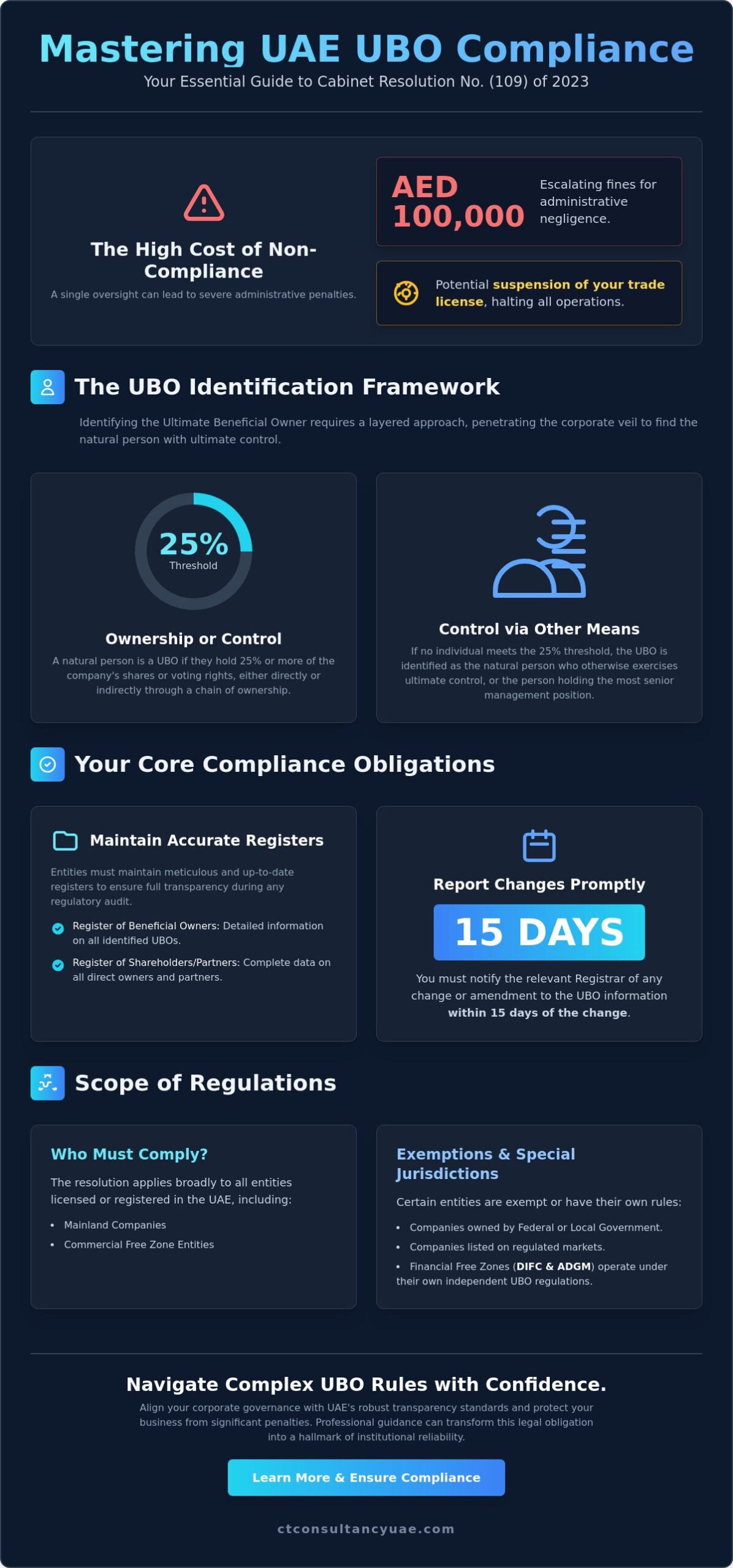
A single administrative oversight in your corporate register could now trigger a suspension of your trade license or an escalating fine reaching AED 100,000. While the Emirates remains a premier destination for global commerce, the implementation of Cabinet Resolution No. (109) of 2023 has shifted the burden of transparency directly onto the entity. We recognize that untangling multi-layered ownership structures while managing overlapping AML and ESR mandates feels like a high-stakes balancing act for even the most seasoned executive teams.
This strategic guide empowers you to master UBO compliance in the UAE by providing a precise roadmap to total regulatory alignment. You’ll gain the clarity needed to protect your operational license and transform a complex legal obligation into a hallmark of institutional reliability. We’ll explore the critical 25 percent ownership thresholds, the mandatory 15-day window for reporting changes, and the exact steps required to maintain your registers with forensic accuracy for any future regulatory audits.
Key Takeaways
- Identify the precise 25 percent ownership threshold and control criteria necessary to accurately classify natural persons under the current regulatory framework.
- Understand the statutory requirements for maintaining meticulous Registers of Beneficial Owners and Shareholders to ensure total transparency during regulatory audits.
- Protect your entity’s operational standing by mastering the 15-day reporting timeline for ownership changes, avoiding escalating fines that reach AED 100,000.
- Integrate UBO compliance in the UAE into your broader corporate governance strategy to align with international anti-money laundering and economic substance standards.
- Discover how a professional compliance framework mitigates the administrative friction of navigating complex, multi-layered ownership structures across different jurisdictions.
Table of Contents
The UAE UBO Regulatory Framework in 2026
The regulatory landscape for corporate transparency in the Emirates has transitioned into a new era of forensic scrutiny. Cabinet Resolution No. (109) of 2023 now serves as the primary governing text, effectively superseding the older 2020 regulations that many businesses still mistakenly follow. This update isn’t merely a procedural change; it represents a fundamental commitment to international transparency standards. By defining Ultimate Beneficial Ownership as the natural person who ultimately owns or controls a legal entity, the UAE authorities have created a robust mechanism to combat financial impropriety. For any enterprise operating in the mainland or commercial free zones, maintaining UBO compliance in the UAE is a critical requirement for preserving operational licenses.
The Ministry of Economy oversees this framework, ensuring that licensing authorities across the Emirates maintain accurate registers. The shift from the previous 2020 standards to the 2023 resolution reflects a move toward precision and real-time data integrity. It’s not enough to file once and forget. The law mandates that entities proactively update their registers within 15 days of any change. This proactive stance ensures that the UAE remains a secure and transparent hub for global investment, protecting the integrity of the local market from the risks associated with opaque ownership structures.
The Legal Basis for Beneficial Owner Procedures
The transition toward the 2023 framework was driven by a need for alignment with the Financial Action Task Force (FATF) recommendations. The Ministry of Economy acts as the apex supervisor, directing various registrars to enforce strict data collection protocols. This structure ensures that beneficial ownership information is not just collected but verified. Our tax services and advisory teams often observe how these requirements overlap with AML and ESR mandates, creating a multi-layered compliance environment. Continuous compliance is the only way to avoid the tiered penalty system that targets administrative negligence.
Exemptions and Special Jurisdictions
The Identification Framework: Determining Who Qualifies as a UBO
Identifying the natural person at the apex of a corporate structure requires more than a cursory glance at a shareholder certificate. Under the current mandate for UBO compliance in the UAE, the primary benchmark remains the 25 percent ownership threshold. However, complexity often arises when dealing with offshore holding companies or trust arrangements. In these scenarios, the identification process must penetrate every layer of the corporate veil to find the individual who ultimately reaps the rewards or carries the risk. This identification is a core pillar of the broader anti-money laundering framework overseen by the UAE Ministry of Justice, ensuring that every entity remains transparent and accountable within the global financial system.
Step 1: Assessing Direct and Indirect Ownership
Determining ownership involves a meticulous aggregation of shares across the entire chain of command. If an individual holds 10 percent of Company A, which in turn holds 30 percent of Company B, their indirect stake must be calculated with mathematical precision to determine if the 25 percent threshold is triggered. Indirect control occurs when a natural person exercises influence through a chain of ownership or nominee arrangements where they do not hold legal title directly but retain the ultimate benefit or decision-making power. Beyond simple share percentages, voting rights serve as a primary indicator of influence. If an individual possesses the power to sway board decisions through weighted voting rights, they may qualify as a UBO regardless of their actual shareholding percentage.
Step 2: Identifying Control by Other Means
When no single individual meets the 25 percent ownership criteria, the focus shifts to the concept of control by other means. This includes determining control through personal relationships, contractual agreements, or the specific power to appoint and dismiss the majority of the board of directors. Veto rights over strategic shifts or amendments to the company’s articles of association also play a decisive role in classification. If, after an exhaustive search, no natural person can be identified through ownership or control, the law provides a clear fallback. In such cases, the Senior Management Official must be registered as the beneficial owner. This ensures there’s never a gap in the register. For entities navigating these intricate hierarchies, engaging with specialized business advisory services can prevent the misidentification of UBOs, which is a frequent cause of administrative penalties.
This hierarchy ensures that the registrar always has a point of accountability. Whether the UBO is an investor with a significant stake or a senior executive managing the firm’s daily operations, the data must be accurate and verifiable. Identifying the correct individual is not just a filing task; it’s a strategic necessity to protect the entity’s standing in the UAE market and ensure long term stability.
Compliance Requirements: Maintaining Statutory Registers
Achieving UBO compliance in the UAE requires more than a simple identification exercise; it demands the creation and perpetual maintenance of three distinct statutory registers. These documents must be kept at the entity’s registered office and made available for inspection by the relevant registrar upon request. Failure to establish these registers is a serious violation that can result in a fine of AED 100,000 under the current administrative penalty schedule. This documentation serves as the evidentiary foundation for your corporate transparency.
The first document is the Register of Beneficial Owners, which serves as the definitive record of the natural persons who ultimately control the entity. Parallel to this, firms must maintain a Register of Partners or Shareholders, which documents the formal legal ownership structure. A frequently overlooked requirement is the Register of Nominee Directors. This register must identify any person acting on the instructions of another, ensuring that the true decision-making hierarchy and any third-party influence are transparent to the authorities. This specific register is often missed by entities using informal nominee arrangements, yet it’s a mandatory component of the compliance framework.
Data Requirements for the UBO Register
Precision is the hallmark of a compliant register. Each entry for a natural person must be comprehensive to satisfy the registrar’s standards. The following data points are essential:
-
Full legal name, nationality, and place of birth as documented in the individual’s passport.
-
Current residential address and identification document numbers, such as an Emirates ID or passport number.
-
The specific date on which the individual first acquired their status as a beneficial owner.
If an entity fails to provide this data within 14 days of a registrar’s request, they risk immediate administrative penalties. It’s not just about having the names; it’s about having the forensic detail that proves the entity’s commitment to transparency.
Managing Changes and Regular Audits
The regulatory landscape is dynamic, and your documentation must reflect this reality in real time. Under the UAE Cabinet Resolution No. (109) of 2023, entities have a strict 15-day window to update their registers following any change in UBO information. This includes shifts in shareholding percentages, changes in residential addresses, or the appointment of new directors.
To ensure these registers remain audit-ready, we recommend integrating UBO tracking with your existing VAT compliance and accounting records. Discrepancies between the ownership data held by the registrar and the information reflected in your financial filings can trigger unnecessary scrutiny. Implementing internal audit procedures allows for the early detection of inconsistencies, providing a frictionless path to total regulatory alignment and protecting your entity’s standing in the UAE market.
Risk Management: Administrative Penalties and Enforcement
The consequences of negligence regarding UBO compliance in the UAE extend far beyond mere administrative friction. UAE authorities have implemented a rigorous enforcement mechanism designed to ensure total transparency across the corporate sector. Regulatory bodies now view non-compliance not just as a clerical error but as a potential indicator of broader anti-money laundering risks. This perception can trigger enhanced due diligence or formal investigations by competent authorities. While an appeal process exists for administrative sanctions, the immediate impact of a violation can disrupt your entity’s operational momentum and erode trust with key stakeholders.
Understanding the Unified List of Violations
Cabinet Decision No. 132 of 2023 provides a clear, tiered structure for penalties that punishes both the failure to maintain internal registers and the failure to report data to the registrar. For a first violation, companies typically receive a written warning with a mandate to rectify the error within a 15 or 30 day window. Repeated or serious non-compliance leads to escalating fines. Failing to create a Register of Beneficial Owners or failing to disclose complex ownership structures carries a significant fine of AED 100,000 for a third violation. Serious infractions may result in the suspension of a trade license for up to one year. Individuals found responsible for chronic reporting failures risk being barred from holding board memberships or executive positions within any licensed entity in the UAE.
The Impact on Banking and Financial Relationships
Financial institutions in the Emirates operate under strict mandates to verify beneficial ownership as part of their Know Your Customer remediation processes. Outdated or inconsistent UBO data is a primary trigger for account freezing and the restriction of commercial credit facilities. Banks increasingly rely on the registrar’s database to validate the information provided by corporate clients. If your internal records don’t align with the official filing, the resulting friction can halt your cross-border transactions and daily treasury operations. Utilizing professional UBO filing solutions provides the strategic reassurance that your data remains accurate and synchronized across all regulatory touchpoints. This meticulous approach prevents operational bottlenecks and preserves your entity’s financial standing in a high-scrutiny environment.
Strategic Alignment: Professional Support for UBO Compliance
Transitioning from rudimentary manual tracking to a robust professional framework is the definitive step toward mitigating corporate risk. While basic spreadsheets might suffice for local startups, complex entities require a more sophisticated approach to maintain UBO compliance in the UAE without disrupting daily operations. Meticulous regulatory planning ensures that your corporate standing remains unassailable, even as the Ministry of Economy increases the frequency of its inspections. By embedding these requirements into a broader business advisory strategy, you transform a mandatory administrative burden into a pillar of institutional reliability.
Specialized consultants provide the necessary bridge between local legislation and global corporate structures. For entities with multi-layered ownership across several jurisdictions, the identification of a natural person can become a forensic challenge. Professional oversight ensures that every link in the ownership chain is documented according to the latest cabinet decisions, preventing the inconsistencies that often trigger audits. This level of precision is essential for ensuring long-term stability in a market that prioritizes transparency and financial integrity. It’s no longer enough to simply submit data; you must ensure the data’s integrity matches the high standards of the UAE’s financial regulators.
Customised Solutions for Complex Entities
Groups with international shareholders or those utilizing trust structures face unique hurdles when attempting to satisfy the registrar’s data requirements. We provide individualized solutions that address these nuances, ensuring a friction-free setup for new market entrants who must establish their registers within 60 days of license issuance. Leveraging CFO advisory services allows executive teams to maintain high governance standards while focusing on strategic growth. This alignment ensures that beneficial ownership data isn’t just recorded but actively managed as part of the firm’s broader internal controls, protecting you from the 15-day reporting trap for ownership changes.
The CTC Approach to Regulatory Precision
Our methodology begins with a comprehensive review of your existing corporate secretarial records to identify any gaps in the Register of Beneficial Owners or the Register of Nominee Directors. We manage the end-to-end filing process with the relevant licensing authorities, ensuring that your data is synchronized and accurate across all platforms. This meticulous attention to detail removes the administrative friction typically associated with UBO compliance in the UAE, allowing you to operate with total confidence. Contact us today to schedule a tailored compliance audit and secure your entity’s standing in the Emirates’ evolving regulatory landscape.
Securing Your Corporate Standing Through Proactive Governance
The landscape of corporate transparency in the Emirates has reached a state of permanent maturity. Mastering UBO compliance in the UAE is no longer a peripheral administrative task; it’s a central pillar of risk management that protects your operational license and financial reputation. By accurately identifying beneficial owners, maintaining meticulous statutory registers, and adhering to the strict 15-day reporting window for ownership changes, your entity signals its reliability to both regulators and banking partners. This proactive approach eliminates the friction of administrative penalties and ensures your business remains audit-ready in an increasingly scrutinized global environment.
Leveraging decades of international expertise in UAE regulations, CTC Tax & Accounting provides a specialized focus on SME and corporate compliance. We deliver comprehensive end-to-end regulatory filing to ensure your entity meets every requirement of Cabinet Resolution No. (109) of 2023 with forensic precision. Secure your business with expert UBO compliance services from CTC Tax & Accounting. We look forward to helping you navigate these complexities with confidence and achieve long term stability in the UAE market.
Frequently Asked Questions
What is an Ultimate Beneficial Owner (UBO) in the UAE?
An Ultimate Beneficial Owner is a natural person who ultimately owns or controls 25% or more of a company’s shares or voting rights. If no individual meets this specific ownership threshold, the UBO is identified as the person who exercises control through other means, such as the power to appoint or dismiss the majority of directors. This definition ensures that the individuals who truly benefit from the entity’s operations are transparent to the authorities.
Is UBO filing mandatory for all UAE companies?
Filing is mandatory for all legal entities registered in the UAE mainland and non-financial free zones. New companies must submit their initial UBO data within 60 days of license issuance to ensure UBO compliance in the UAE. While government owned entities and companies listed on regulated markets are generally exempt, the vast majority of private commercial enterprises must adhere to these transparency standards to maintain their operational standing.
What are the penalties for failing to comply with UBO regulations?
The UAE utilizes a tiered penalty system that begins with a formal written warning for a first violation. Subsequent or repeated infractions result in administrative fines ranging from AED 5,000 to AED 100,000, depending on the nature of the violation. For instance, failing to maintain a Register of Beneficial Owners can trigger the maximum fine of AED 100,000 for a third violation, and serious cases may lead to the suspension of a trade license.
How often should the UBO register be updated?
The UBO register must be updated immediately whenever a change occurs in the ownership or control structure of the entity. Companies are legally mandated to notify the relevant registrar within 15 days of any amendment to the beneficial owner’s information. This includes changes to residential addresses, passport renewals, or shifts in shareholding percentages that affect the UBO status.
Can a company have more than one Ultimate Beneficial Owner?
An entity can have multiple Ultimate Beneficial Owners if several individuals each meet the 25% ownership or control criteria. Every natural person who crosses this threshold or exercises significant influence through voting rights must be documented individually in the statutory registers. It’s common for joint ventures or multi-partner firms to register several individuals to ensure total regulatory alignment.
What happens if no natural person owns 25% of the company?
If no individual meets the 25% ownership threshold, the entity must identify the person who exercises control through other means, such as contractual agreements or personal influence. If no such person can be identified after an exhaustive search, the Senior Management Official must be registered as the UBO. This fallback mechanism ensures that every entity has a designated natural person accountable to the registrar.
Is UBO information made available to the public in the UAE?
UBO data is held confidentially by the registrar and is not accessible to the general public. This information is only shared with competent authorities for the purposes of law enforcement, anti-money laundering, and combating the financing of terrorism. While the registry is private, the accuracy of the data is critical for maintaining your entity’s standing during regulatory audits.
Do free zone companies have different UBO requirements than mainland firms?
Most commercial free zones follow the national standards established by Cabinet Resolution No. (109) of 2023, mirroring the mainland requirements. However, financial free zones such as the Dubai International Financial Centre (DIFC) and Abu Dhabi Global Market (ADGM) operate under their own independent UBO regulations. It’s essential to verify the specific protocols of your licensing authority to maintain seamless UBO compliance in the UAE across all jurisdictions.