
What if your UAE company filed its UBO declaration on time, but the ownership details were wrong? Timely submission alone may not remove exposure. Penalties for incorrect ubo information depend on the nature of the error, the applicable framework and how the business responds after finding a discrepancy.
It can be difficult to tell whether an inaccurate declaration is treated like missing or outdated information, especially because requirements can vary by entity type and registrar. UAE Cabinet Resolutions No. 109 and 132 of 2023 set the current framework described in this guide. Changes to UBO information generally need to be reported within 15 days, so identifying when a change occurred is an important first step.
This guide explains which errors may attract scrutiny, how inaccurate, incomplete and late information differ, and what to do when you find a discrepancy. It also covers a practical process for correcting records and keeping ownership information current, while treating UBO filing and related AML controls as connected but distinct responsibilities.
Incorrect UBO information is a material detail in a company’s beneficial ownership records or declaration that does not accurately reflect a person’s identity, ownership or control. Registrars use these records to understand who ultimately owns or controls an entity. The Ultimate Beneficial Owner (UBO) concept generally focuses on the natural person behind ownership or control, rather than simply the name shown on a share certificate.
Identify the type of record problem before deciding how to address it. Incorrect information states a fact wrongly; incomplete information leaves out a required detail; missing information means a required register or submission is absent; and outdated information was once accurate but no longer reflects a change. These categories can overlap, but they are not automatically equivalent. A factual filing error is a discrepancy to investigate, not, by itself, a conclusion about liability.
Review identifying details, direct and indirect ownership interests, voting rights, means of control and the information entered in the relevant registers or declaration. Under the general UAE framework, UBO identification can include a natural person holding 25% or more of shares or voting rights, exercising control through other means, or having authority over the appointment or dismissal of most managers. If no individual meets the criteria, the senior managing official may be recorded under the applicable rules.
For example, if a shareholder transfers part of their holding and another person becomes a qualifying owner, the register may become outdated unless the change is recorded. The entry about the former shareholder may still be factually accurate, but it no longer shows the company’s current ownership picture.
Cabinet Resolution No. 109 of 2023 replaced Resolution No. 58 of 2020, while Resolution No. 132 of 2023 addresses administrative penalties. The obligations and relevant registrar may depend on the entity’s legal form and regulatory framework, so requirements should not be assumed to apply identically to every UAE entity or jurisdiction. Before classifying a discrepancy or assessing potential penalties for incorrect ubo information, identify the authority governing the company’s records.
The consequences depend on the applicable instrument, type of violation, entity classification and competent authority. Penalty provisions should be read in context: a provision covering a missing register, for example, may not describe the outcome for a particular inaccurate entry. Check the rule that applies to the entity and the specific conduct before treating a stated amount or escalation step as relevant to a company’s case.
The instruments below have different roles and should not be treated as interchangeable. Cabinet Resolution No. 109 of 2023 replaced the earlier UBO framework, Cabinet Resolution No. 58 of 2020. Resolution No. 132 of 2023 addresses administrative penalties. For other decisions cited in connection with UBO obligations, applicability depends on the entity’s governing framework and the provision in question.
| Instrument | Period and role | Violation or consequence |
|---|---|---|
| Cabinet Resolution No. 58 of 2020 | Earlier UBO framework, replaced in 2023 | Historical reference; do not assume its provisions state the current outcome. |
| Cabinet Resolution No. 53 of 2021 | Applicability depends on the entity’s governing framework. | Assess the relevant provision before attributing a consequence. |
| Cabinet Resolution No. 109 of 2023 | Current UBO framework identified in this guide; replaced Resolution No. 58 of 2020. | Sets UBO requirements; penalty amounts are addressed separately. |
| Cabinet Resolution No. 132 of 2023 | Administrative penalties framework identified in this guide. | Applicable consequence depends on the provision and violation. |
| Cabinet Resolution No. 71 of 2024 | Applicability depends on the entity’s governing framework and the matter in question. | Assess the relevant provision before attributing a specific penalty. |
A reported maximum penalty is not necessarily the penalty for a particular case. The UAE’s Register of Beneficiaries and UBO Compliance provides historical context on the earlier framework, but that context alone does not establish which sanction applies today.
No single fine or escalation sequence should be treated as universal. Entity type and the applicable registrar can affect which requirements apply and how a violation is handled. CTC Tax & Accounting provides UBO filing support to help businesses manage accurate declarations as part of a documented compliance process.
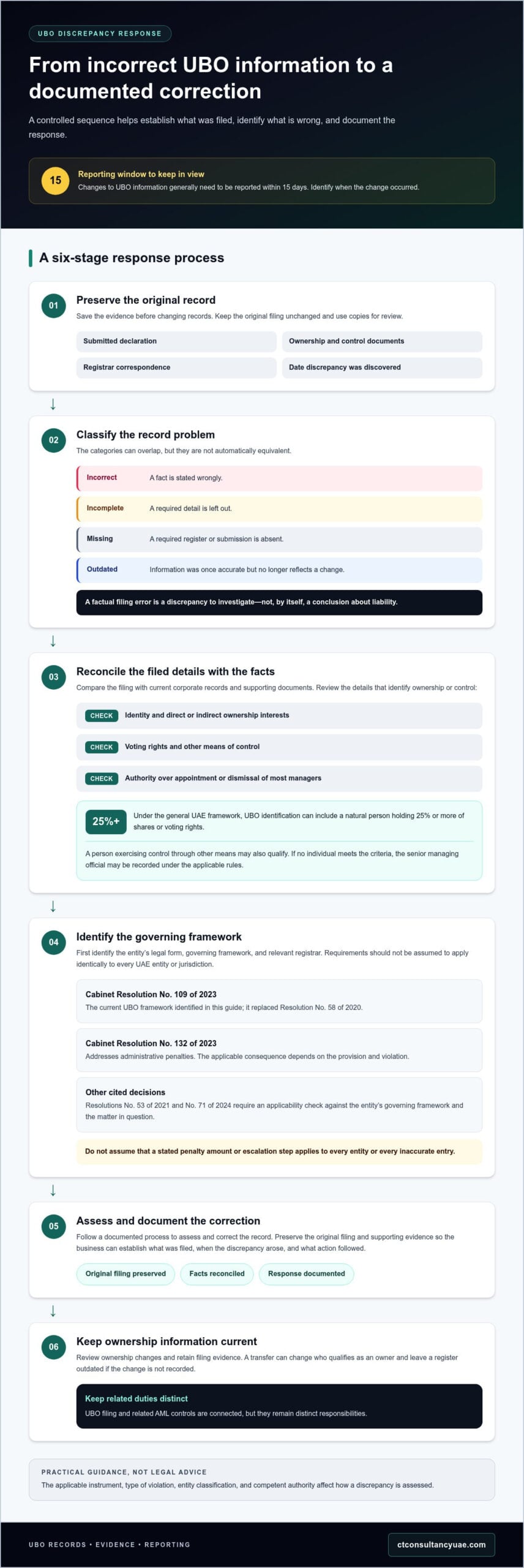
Practical guidance, not legal advice: respond in a controlled, documented sequence. Preserve the evidence before changing records so you can establish what was filed, when the discrepancy arose and what action followed.
This process helps distinguish a clerical mistake from a substantive ownership discrepancy and creates a clear audit trail. CTC Tax & Accounting provides UBO filing support to help businesses manage accurate submissions and corrections.
A dependable control process makes ownership changes visible, assigns responsibility for updates and preserves evidence of each decision. It can reduce the risk of missed filings, though no process can guarantee that a business will avoid enforcement.
Build these controls into routine company administration, with review timing suited to the entity’s obligations and registrar requirements:
These governance practices can support wider compliance, but UBO filing and AML controls remain distinct obligations. Accurate ownership records may inform AML risk assessments and customer due diligence, while AML policies, monitoring and reporting have their own requirements. Coordinate UBO reviews with other applicable duties, including Economic Substance Regulations (ESR) compliance, without treating one filing as a substitute for another.
External support can help organise ownership information, review filing materials for completeness and manage submission steps. CTC Tax & Accounting provides UBO filing and AML Services. AML support can strengthen a business’s broader controls, but it does not replace UBO filing duties. A tailored review can help identify processes that need attention without promising a particular legal outcome.
To strengthen your process and address penalties for incorrect ubo information as a governance risk, book a 20-minute free consultation to discuss UBO filing support.
Reliable UBO compliance depends on how a business records and reviews change, not just on completing an isolated filing. A clear internal owner, accessible supporting documents and a consistent approval trail can help keep beneficial ownership information aligned as the business evolves. That discipline also gives decision-makers a stronger basis for responding if a discrepancy is identified.
The potential penalties for incorrect ubo information are one reason to treat ownership records carefully. Clear, current information can also support confidence in a company’s governance and compliance processes. CTC Tax & Accounting has operated since 2015, and its team brings a combined 75 years of international finance and accountancy experience.
If you’re ready to strengthen your filing process, arrange a 20-minute free* consultation about UBO filing and compliance support. A considered next step can help make ownership recordkeeping a consistent part of your business operations.
Yes. A business can generally submit corrected information through the relevant registrar’s current correction channel. Keep the original declaration alongside the amended version, supporting evidence such as a share transfer document or company resolution, and the authority’s acknowledgement. An amendment helps establish an accurate record, but it does not automatically remove possible exposure. The circumstances and applicable rules still matter.
A genuine mistake can still require correction and may carry compliance risk, but an error alone does not determine liability. The nature of the discrepancy, applicable framework, entity and response may all be relevant. For example, a typographical error in an identity detail is not necessarily assessed like a declaration that misstates who exercises control. Do not assume that intent is irrelevant or that a prompt correction guarantees there will be no penalty for incorrect ubo information.
Not necessarily. Many companies in commercial free zones fall within the UAE’s general UBO framework, but financial free zones such as DIFC and ADGM have their own parallel frameworks. Entity classification and the competent authority determine which requirements apply. Identify the company’s registration framework and applicable registrar before relying on a deadline, filing channel or penalty summary intended for another type of entity.
Maintain records showing how the company identified and assessed its beneficial owners, including current shareholder or partner details, ownership charts, relevant transfer documents, resolutions and evidence of control arrangements. Retain declarations, amendments, submission acknowledgements and related correspondence. These materials can help explain why a person was recorded as a UBO at a particular time and make later reviews easier to trace.