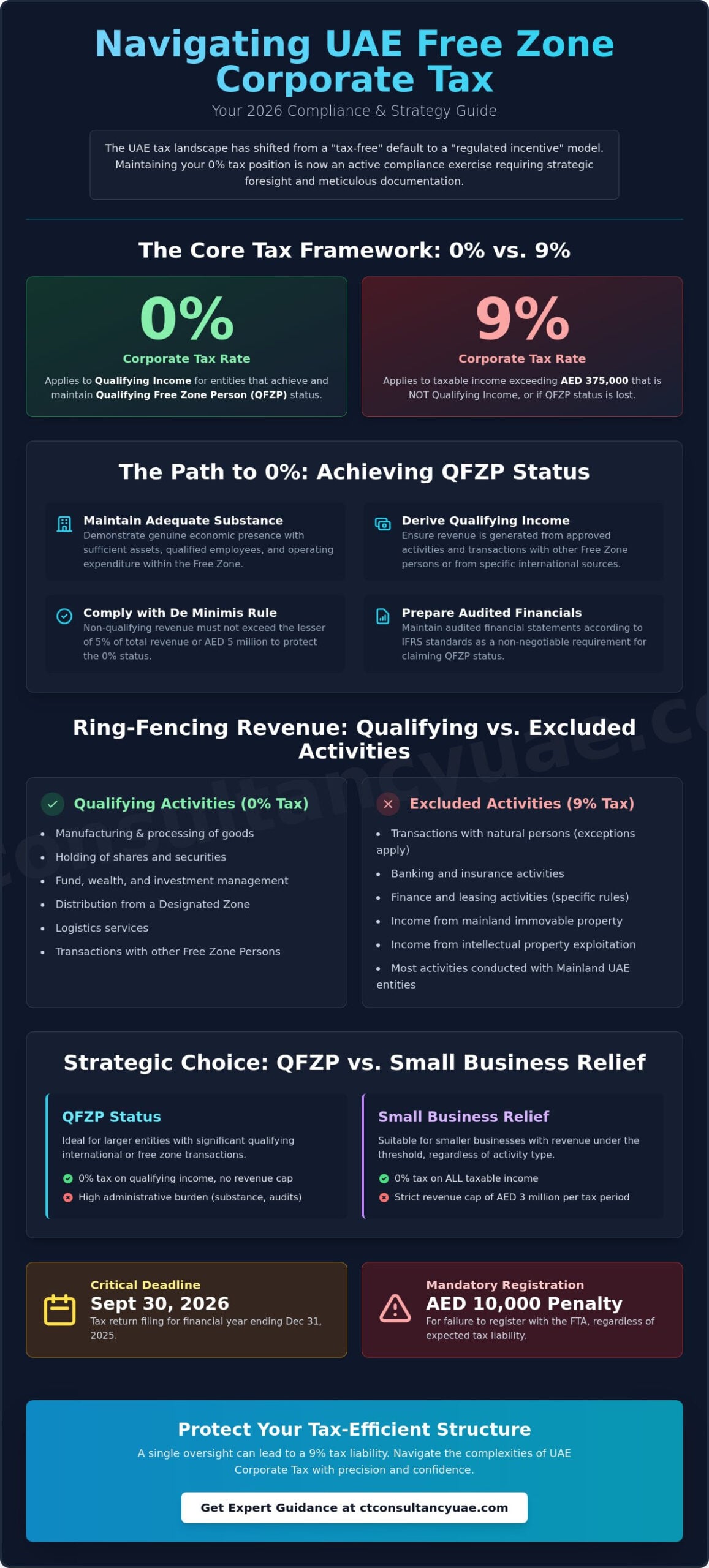
Maintaining a 0% tax position is no longer a passive benefit of your jurisdiction; it’s a rigorous compliance exercise that requires meticulous documentation and strategic foresight. The implementation of the uae corporate tax law for free zones has transformed the regional landscape, shifting the focus from simple registration to the active defense of your Qualifying Free Zone Person status. Many business owners feel a growing sense of unease regarding the precise definitions of Qualifying Income and the administrative burden of maintaining adequate substance. It’s a high-stakes environment where a single oversight could trigger an accidental 9% tax liability or significant FTA penalties.
You’ve worked hard to build a tax-efficient structure, and it’s natural to feel concerned when that stability is challenged by evolving regulatory demands. This 2026 compliance guide provides the expert strategic guidance you need to navigate these complexities with confidence and precision. We’ll examine the specific criteria for maintaining your tax incentives, the de minimis rules that protect your status, and the essential filing deadlines for the upcoming year. This article offers a clear roadmap for full compliance and the long-term protection of your corporate interests.
The landscape of Taxation in the United Arab Emirates has matured significantly since the initial implementation of Federal Decree-Law No. 47 of 2022. By 2026, the regulatory framework governing the uae corporate tax law for free zones has reached a state of sophisticated stability, reflecting the nation’s commitment to the OECD Base Erosion and Profit Shifting (BEPS) framework. This evolution signifies a fundamental shift. The traditional “tax-free” narrative has been replaced by a “regulated incentive” model. For executive decision-makers, this means that a 0% tax position is no longer a default right; it’s a strategic privilege maintained through meticulous documentation and transparency.
2026 stands as a critical year for the UAE business community. It’s the period when the first full cycle of tax returns for many entities is due, specifically by September 30, 2026, for those with a financial year ending December 31, 2025. This milestone forces a transition from theoretical planning to practical reporting. The Federal Tax Authority (FTA) now possesses a robust database of precedents, making the defense of your tax status more rigorous than in previous years. Compliance is the primary driver of long-term stability.
The FTA oversight in 2026 is characterized by digital precision through the EmaraTax portal. Legacy operations that once functioned with minimal reporting must now adopt comprehensive Corporate Tax Advisory strategies to survive. Business as usual is no longer a viable strategy. The uae corporate tax law for free zones requires entities to prove their economic contribution through documented Core Income-Generating Activities (CIGA). If your business hasn’t updated its internal controls to reflect these requirements, you’re operating under significant risk. The shift toward a regulated market ensures that only genuine economic participants benefit from the UAE’s competitive fiscal environment.
The framework remains binary yet deeply nuanced. To secure the 0% rate on Qualifying Income, a Free Zone entity must attain the status of a Qualifying Free Zone Person (QFZP). This status isn’t permanent; it must be defended every tax period. Conversely, a 9% rate applies to taxable income exceeding AED 375,000 that doesn’t meet the “qualifying” criteria or is derived from excluded activities. Consider these essential requirements for 2026:
The complexity of these regulations demands a move away from generic setups toward customized, individualized solutions. It’s about protecting your bottom line while contributing to the UAE’s transparent economic future.
Achieving the status of a Qualifying Free Zone Person (QFZP) is the primary objective for entities seeking to preserve their fiscal efficiency under the uae corporate tax law for free zones. This designation is not granted automatically; rather, it’s a status that must be actively maintained through adherence to a rigorous set of legal and operational benchmarks. The Federal Tax Authority (FTA) requires a level of transparency that moves beyond simple registration, demanding that businesses prove their economic footprint within their respective jurisdictions through documented evidence.
To secure the 0% corporate tax rate, an entity must satisfy several cumulative conditions. According to the official Corporate Tax Guide for Free Zones, these include maintaining adequate substance, deriving Qualifying Income, and strictly complying with transfer pricing rules. The arm’s length principle is particularly critical. Transactions with related parties must reflect market-standard pricing as if the parties were independent, ensuring that profits aren’t artificially shifted to avoid tax liability.
The margin for error is remarkably thin. If a Free Zone person fails to meet any of these conditions during a tax period, they lose their QFZP status for that year and the subsequent four years. This five-year “lock-out” rule represents a significant financial risk, as it subjects the entity to the standard 9% rate on all taxable income above AED 375,000 for a prolonged duration. Ensuring your operations are perpetually aligned with these standards is a fundamental requirement for long-term stability.
A frequently overlooked requirement for maintaining QFZP status is the mandate to prepare and maintain audited financial statements. Regardless of the entity’s size or revenue, the uae corporate tax law for free zones stipulates that audited accounts are a non-negotiable condition for the 0% incentive. These statements must be prepared in accordance with International Financial Reporting Standards (IFRS), providing a transparent view of the entity’s financial health and revenue split.
As you prepare for the 2026 audit cycle, establishing a relationship with professional accounting services is a proactive step toward tax readiness. These audits serve as the primary evidence for your revenue classification, distinguishing between Qualifying and Excluded income. Without this third-party verification, your claim to a 0% tax rate remains vulnerable to FTA scrutiny. For businesses aiming to mitigate risk, integrating specialized tax advisory early in the financial year ensures that all records are audit-ready and compliant with the latest regulatory updates.

Precision in revenue classification is the linchpin of a successful fiscal strategy. Under the uae corporate tax law for free zones, income is not treated as a monolithic sum; instead, it is bifurcated based on the nature of the underlying activity and the jurisdiction of the counterparty. This granular approach ensures that the 0% tax incentive is reserved for activities that contribute to the UAE’s strategic economic goals, such as manufacturing, logistics, and global headquarters services. For executive teams, the challenge lies in mapping diverse revenue streams against the specific definitions provided in Cabinet Decision No. 100 of 2023.
The distinction between qualifying and excluded activities is often the difference between a tax-neutral year and a significant liability. While manufacturing and processing are generally safe harbors, activities such as regulated banking, insurance, and retail trade with natural persons are explicitly excluded. If your business model incorporates a hybrid of these activities, meticulous bookkeeping becomes a mandatory defense mechanism. Establishing a clear audit trail that separates these streams is essential for maintaining your status as a Qualifying Free Zone Person (QFZP).
Qualifying Income primarily encompasses revenue derived from transactions with other Free Zone Persons, provided those entities are the beneficial recipients of the services. This B2B focus is a cornerstone of the uae corporate tax law for free zones. Additionally, income from “Qualifying Activities” conducted for mainland or foreign entities also qualifies for the 0% rate. These activities include the holding of shares and securities, ownership and operation of ships, and treasury and financing services to related parties. Passive income, such as dividends and capital gains from qualifying investments, generally enjoys protection, provided the entity maintains the necessary substance to manage those assets.
The De Minimis rule serves as a critical safety valve for entities that occasionally generate non-qualifying revenue. This rule allows a QFZP to earn a small amount of non-qualifying income without forfeiting its entire 0% tax status. In 2026, the threshold remains the lower of 5% of total revenue or AED 5 million in a tax period. If your non-qualifying revenue exceeds this limit, the consequences are severe: the entity loses its QFZP status for the current year and the subsequent four years, as discussed in previous sections.
To avoid this “tax cliff,” many organizations utilize Corporate Tax Advisory to implement strategic ring-fencing. This involves restructuring business lines to ensure that excluded activities, such as retail sales to individuals, are handled by separate legal entities. By isolating non-qualifying streams, you protect the core of your business and ensure that your primary revenue remains eligible for the 0% incentive. This proactive separation is not just a compliance requirement; it’s a fundamental component of long-term risk mitigation.
The concept of “adequate substance” has transitioned from a theoretical regulatory requirement to a primary focal point of Federal Tax Authority (FTA) audits. Under the uae corporate tax law for free zones, the burden of proof rests entirely with the taxpayer to demonstrate that their Core Income-Generating Activities (CIGA) are physically conducted within the jurisdiction. It’s no longer sufficient to merely hold a valid trade license; you must prove that the essential operations that drive your revenue occur through physical assets and human capital stationed within the Free Zone. This level of operational transparency is the bedrock of defending your 0% tax position in 2026.
Strategic management and control must also be localized to satisfy substance requirements. The FTA expects that key decisions are made within the UAE, typically evidenced by board meetings held locally where a quorum of directors is physically present. Maintaining a comprehensive “substance folder” is now a standard administrative necessity. This folder should contain signed board minutes, lease agreements for dedicated office space, and detailed records of qualified full-time employees. These documents serve as your primary defense during an inquiry, transforming vague operational claims into verifiable facts.
In the 2026 fiscal landscape, “adequate” office space and equipment are defined by the scale and complexity of your business activities. For a manufacturing entity, this involves documented machinery and warehouse logs; for a service-based firm, it requires a sufficient number of qualified staff and dedicated workstations. The era of “brass plate” companies, which exist only on paper without genuine economic activity, has effectively ended. The current tax law is designed to identify and disqualify such structures, subjecting them to the standard 9% rate. Tracking employee hours and matching their specific functions to your Qualifying Income streams provides the granular data necessary to justify your tax status during a compliance review.
Compliance is a continuous obligation that extends beyond internal operations to formal reporting. Every Free Zone entity must adhere to mandatory Corporate Tax registration deadlines to avoid the AED 10,000 late registration penalty. For businesses with a financial year ending December 31, 2025, the deadline to file the annual corporate tax return and settle any liabilities is September 30, 2026. It’s vital to remember that filing is mandatory even for entities that maintain a 0% tax liability. Failure to submit a return constitutes a breach of the uae corporate tax law for free zones, leading to monthly penalties that increase over time.
Securing professional tax compliance services ensures that your filings are accurate and submitted well before the deadline. If you haven’t yet verified your registration status or prepared your 2025 data for submission, now is the time to act. Contact our Corporate Tax Advisory team today to secure your 0% status and mitigate the risk of administrative penalties.
Strategic planning represents the final layer of defense for any entity operating under the uae corporate tax law for free zones. While the previous sections established the technical requirements for compliance, optimization involves a forward-looking approach to business structure and revenue management. For many smaller enterprises, the primary decision involves weighing the merits of Qualifying Free Zone Person (QFZP) status against the Small Business Relief scheme. If your revenue remains at or below AED 3 million for the relevant tax period and all prior periods, electing for Small Business Relief for financial years ending on or before December 31, 2026, can simplify your obligations by treating the business as having no taxable income. However, for entities with higher growth trajectories, the 0% incentive on Qualifying Income remains the most robust long-term fiscal strategy.
Optimizing your tax position often requires a deliberate restructuring of business lines. By isolating excluded activities, such as retail sales to individuals or certain mainland-facing services, into separate legal entities, you prevent non-qualifying revenue from breaching the de minimis threshold. This level of precision is impossible without real-time financial oversight and meticulous Bookkeeping and Accounting Services. Accurate, synchronized data ensures that your revenue split is always defensible during an audit, providing the stability needed to navigate a regulated market.
A significant risk for Free Zone entities involves the misinterpretation of Permanent Establishment (PE) rules. If your business conducts mainland operations through a fixed place of business or a dependent agent, you may inadvertently create a PE, which subjects that specific income to the standard 9% tax rate. Another frequent oversight is the neglect of Transfer Pricing documentation. All inter-company charges and transactions with related parties must be supported by contemporaneous records that prove adherence to the arm’s length principle. Inconsistent reporting across different tax types is also a major red flag. Discrepancies between your VAT filings and Corporate Tax returns often trigger automated inquiries through the EmaraTax portal, making internal consistency a non-negotiable requirement.
The intricate nature of the uae corporate tax law for free zones demands the high-level perspective provided by strategic CFO advisory. A seasoned advisor doesn’t just manage numbers; they ensure your broader business advisory strategy aligns with the Federal Tax Authority’s expectations for substance and transparency. CTC Tax & Accounting acts as a primary friction-remover, offering customized, end-to-end solutions that range from Corporate Tax Advisory to ESR compliance. By partnering with experts who possess deep regional knowledge, you secure a path to frictionless entry into new markets and maintain the long-term stability of your tax-advantaged status.
Success in 2026 hinges on your ability to prove adequate substance and meticulously categorize your revenue streams. As the Federal Tax Authority shifts toward stricter enforcement, the defense of your 0% tax position becomes a matter of precise documentation rather than a jurisdictional default. Navigating the nuances of the uae corporate tax law for free zones requires a transition from reactive reporting to proactive, strategic management. By establishing robust internal controls and maintaining audited financial statements, you transform compliance from a burden into a competitive advantage.
CTC Tax & Accounting provides the specialized SME compliance frameworks and end-to-end outsourced accounting and audit support necessary to maintain these high standards. With decades of international tax expertise, we ensure your internal processes align perfectly with regulatory expectations. Secure your Free Zone tax status with a professional CT consultation from CTC today. You’ve built a resilient business; now’s the time to protect its growth with the reliability of expert guidance and meticulous planning.
Yes, a Free Zone entity can maintain its 0% tax incentive in 2026 provided it qualifies as a Qualifying Free Zone Person (QFZP). This status requires the entity to satisfy several cumulative conditions, including the maintenance of adequate substance and the derivation of Qualifying Income as defined by Cabinet Decisions. Failing to meet even one of these criteria will subject the entity’s taxable income above AED 375,000 to the standard 9% rate.
Failing to meet substance requirements results in the immediate loss of QFZP status for the current tax period and the subsequent four years. This “lock-out” rule means the business will be subject to the standard corporate tax rate of 9% on all taxable income exceeding the AED 375,000 threshold. It’s a significant risk that underscores the importance of maintaining documented Core Income-Generating Activities within the Free Zone.
Audited financial statements are a mandatory statutory requirement for any entity claiming the 0% rate under the uae corporate tax law for free zones. Unlike mainland companies that may have higher revenue thresholds for mandatory audits, Free Zone entities must prepare IFRS-compliant audited accounts regardless of their annual turnover. This third-party verification is essential for the Federal Tax Authority to validate the classification of your income streams.
You can conduct business with mainland companies, but the tax treatment depends on the nature of the activity and the counterparty. Income from “Qualifying Activities” transacted with mainland entities can often retain the 0% rate, particularly in specific B2B sectors. However, income from “Excluded Activities” or transactions with natural persons is treated as non-qualifying revenue and must remain within the de minimis thresholds to protect your status.
The De Minimis rule allows a Free Zone entity to earn a limited amount of non-qualifying revenue without losing its preferential tax status. In 2026, this threshold is set at the lower of 5% of total revenue or AED 5 million per annum. If your non-qualifying income exceeds this limit, the entire entity is disqualified from the 0% regime for five years, emphasizing the need for precise revenue ring-fencing.
Registration is a mandatory obligation for all Free Zone companies, irrespective of their profit margins or tax liability. Even if your entity is dormant or expects to report a loss, you must register through the EmaraTax portal to obtain a Tax Registration Number. Failure to complete this registration within the specified deadlines results in a fixed penalty of AED 10,000, which the FTA enforces rigorously.
Penalties are structured to encourage timely reporting and registration. Beyond the AED 10,000 late registration fee, businesses face penalties starting at AED 500 per month for late tax return filings. Additionally, a late payment penalty of 14% per annum is applied to any outstanding tax amounts. The most severe consequence remains the multi-year loss of the 0% incentive under the uae corporate tax law for free zones.