
What if the corporate tax filing deadline UAE businesses need to meet could be managed well before the final weeks? The deadline is generally linked to the end of the taxpayer’s financial year, with returns and payments due within nine months. Start by confirming the relevant tax period and checking the applicable date against current Federal Tax Authority (FTA) guidance.
Preparation can become difficult when bookkeeping is behind, records are incomplete, or filing and payment seem like the same obligation. They are connected, but they are separate actions, and both need attention.
This guide explains what to confirm before setting a deadline and how to build a repeatable preparation and review process. You’ll find practical steps for reconciling accounting records, assigning responsibilities, and checking the return before submission through EmaraTax. You’ll also see when tailored corporate tax support may help, particularly if your team has limited capacity or your records are complex. The aim is to reduce last-minute pressure without treating compliance as a one-off task.
Unclear dates and scattered accounting records can make corporate tax compliance feel more stressful than it needs to be. Start with the tax period shown in your corporate tax registration. The filing deadline is the final date by which the relevant corporate tax return must be submitted to the Federal Tax Authority (FTA). The period’s end date is a starting point, but confirm the applicable deadline against current FTA guidance and your circumstances before relying on a calculation.
For broader background on how corporate tax fits within the country’s system, see Taxation in the United Arab Emirates. Use official FTA information to verify the requirements that apply to your business.
Compare the tax period shown in your corporate tax registration with the financial year used in your accounting records. The commonly stated rule is that a return and payment are due within nine months after the end of the relevant financial year. Verify the rule and any taxpayer-specific exception or extension with the FTA. For example, a business whose financial year ended on 31 December 2025 would generally have a 30 September 2026 deadline under that rule. Don’t assume the same calendar date applies to every business.
The corporate tax return filing deadline is the last date to submit the return. The tax payment deadline is the last date to settle any amount due.
These are separate compliance actions, even where the due dates align. Submitting a return does not, by itself, confirm that payment has been made or complete other obligations. Check the relevant dates and instructions through official FTA information, including EmaraTax, for your tax period and circumstances. Once you’ve confirmed them, record filing and payment separately so a completed return is not mistaken for a completed payment.
Deadline pressure often builds from several small gaps rather than one major problem. Unreconciled transactions can leave figures uncertain. Missing invoices or other supporting records can slow preparation, and unanswered questions about the tax period can delay decisions. If no one owns document collection or management review, even a straightforward task can stall. The preparation required will vary with each business’s records and circumstances.
Scattered records make it harder to see what is complete and what still needs attention. Reconciled books provide a more dependable starting point: they help bring recorded transactions into line with supporting account information, making it easier to identify gaps and investigate discrepancies before preparing the return. For a broader reference on the UAE regime, consult the government’s official UAE Corporate Tax information.
Instead of treating the corporate tax filing deadline UAE as the only milestone, track the work that leads up to it. Set an internal target date ahead of the official due date, with time for review and corrections. Assign one accountable owner and a backup contact for each stage, so work can continue if someone is unavailable.
Consistent bookkeeping can make document collection and review more manageable. If your team needs ongoing support to keep financial records organized, explore bookkeeping and accounting services. A clear workflow will not resolve every technical question, but it can surface issues earlier, when there is more time to address them.
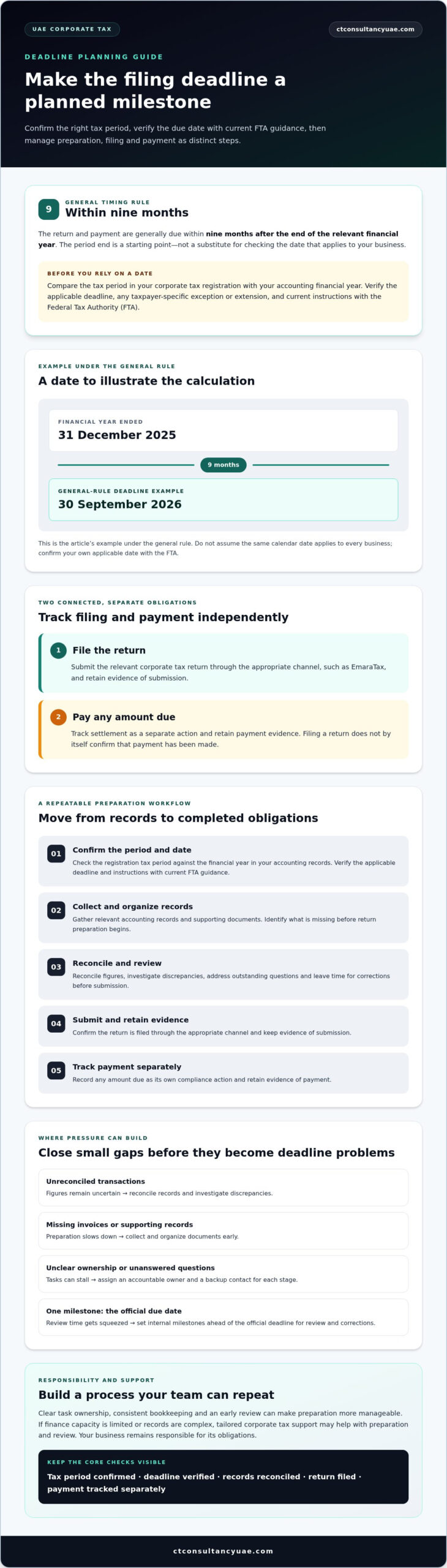
A reliable process turns the corporate tax filing deadline UAE businesses need to meet into a sequence of manageable tasks. Current Federal Tax Authority (FTA) instructions should determine the final filing date for your tax period. Verify it before setting internal milestones, since individual circumstances may affect the applicable date.
Use this workflow, adjusting the records and review steps to your business:
Set internal milestones ahead of the official deadline, allowing time for review and corrections without assuming one lead time fits every business. The official UAE Corporate Tax information is a useful reference. Keep relevant guidance with the records for that tax period.
Keep the tax period, verified due date, task, owner, reviewer, status, evidence location, and next action in one shared tracker. For example, separate the steps for collecting records, reviewing figures, submitting the return, and arranging any payment. Add reminders for preparation milestones as well as final filing and payment actions. Store official guidance and submission confirmations alongside the related period’s records, so the team can readily establish what was completed and when.
Before review, check for unreconciled transactions, missing supporting documents, and figures that differ across records. Agree with your finance lead or adviser which records are relevant to your company’s return. Consistent bookkeeping can make this process easier to manage. If you need support maintaining organized financial records, explore bookkeeping and accounting services.
External support may be useful when finance capacity is limited, records are incomplete, requirements are unfamiliar, or complex transactions raise questions during return preparation. If uncertainty about the corporate tax filing deadline UAE keeps recurring, an adviser can help clarify the preparation workflow and identify records or review steps that need attention.
Start by identifying the bottleneck. Bookkeeping gaps may call for accounting support, while questions about filing requirements should be checked against current Federal Tax Authority (FTA) guidance. Legal interpretation may require advice from qualified legal counsel. Before engaging an adviser, agree on the scope of work, the documents you’ll need to provide, who reviews the return, and which responsibilities remain with your business. An adviser can assist with preparation and review, but your business remains responsible for meeting its obligations.
Once you’ve identified the support you need, review the scope of corporate tax advisory and filing services and consider whether it fits your circumstances.
After submission, save the filing confirmation and any payment evidence with the records for that tax period. Note what caused delays, which documents were difficult to locate, and whether responsibilities were clear. When the next tax period begins, update the tracker rather than waiting for a reminder close to the due date. Businesses comparing advisory options can also consult a corporate tax consultants guide for broader evaluation criteria.
A useful process should reflect your records, internal capacity, and the questions that need resolution. CTC Tax & Accounting offers corporate tax advisory and filing support, alongside bookkeeping and accounting services. Consider which support, if any, addresses the gaps you identified.
A manageable filing process starts with confirming the tax period and checking the applicable deadline against current Federal Tax Authority guidance. Clear task ownership, organized and reconciled records, and separate tracking for return submission and payment help prevent deadline pressure from building unnoticed.
Use the corporate tax filing deadline uae as a planning point, not the moment to begin gathering information. Set internal milestones that allow your team to identify gaps, review the return, and address questions before the official due date. Then retain filing and payment evidence and carry useful lessons into the next tax period.
CTC Tax & Accounting provides corporate tax advisory and tax registration and filing support, alongside bookkeeping and accounting services that can help businesses maintain organized records. If you would like to discuss a filing process suited to your records and finance capacity, contact CTC Tax & Accounting to discuss your UAE corporate tax filing process.
With a clear owner, a current tracker, and the right support where needed, your business can approach its next filing cycle with greater confidence and control.
Generally, the return is due within nine months after the end of the relevant financial year. For example, a business with a financial year ending on 31 December 2025 would generally have a filing deadline of 30 September 2026. Confirm your tax period and applicable date against current Federal Tax Authority (FTA) guidance, as taxpayer-specific circumstances may affect the deadline.
Both the corporate tax return and any tax payment are generally due within nine months after the end of the relevant financial year, but filing and payment are separate actions. Submitting a return does not itself settle an amount due. Verify the applicable dates and instructions for both obligations through current FTA guidance, and keep submission confirmation and payment evidence as separate records.
Confirm the tax period and the corporate tax filing deadline UAE authorities apply to your business, then record the verified date in a shared tracker. Assign an owner and reviewer, set internal milestones ahead of the due date, and monitor document collection, review, submission, and payment separately. Check progress regularly so missing records or unanswered questions are identified early enough to address.
Start with organized accounting records for the relevant tax period, including transaction ledgers, bank records, invoices, reconciliations, and supporting documents for significant transactions. Check that reported figures are consistent and investigate unresolved differences before return preparation. The records needed depend on your business and circumstances, so coordinate with your finance lead or adviser to establish what is relevant and identify any gaps.
Yes. A tax adviser can help clarify preparation steps, review records, and organize filing responsibilities, particularly where finance capacity is limited, records are incomplete, or transactions are complex. Professional support can make the process more structured, but it does not transfer the business’s responsibility for its obligations. Agree on the adviser’s scope, required documents, and review responsibilities, and confirm applicable deadlines with current FTA guidance.