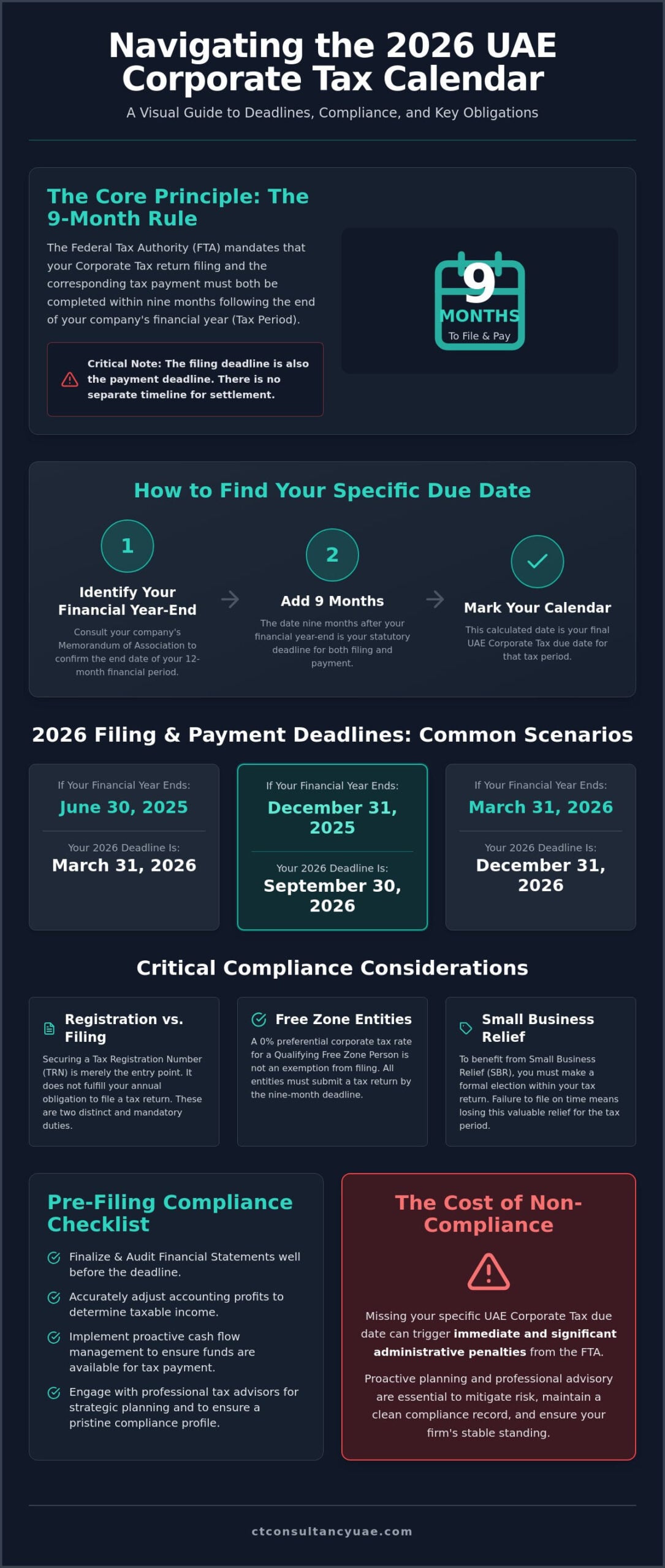
For many UAE business leaders, the most dangerous assumption is that the registration deadline and the filing deadline are the same date. It’s understandable to feel a sense of trepidation when facing the Federal Tax Authority’s structured timeline, especially when missing your specific UAE corporate tax due date can result in immediate administrative penalties. The complexity of aligning your financial year with these statutory requirements creates significant friction if not managed with professional precision by experts such as Bin Hamad Mathew Joseph and Associates Chartered Accountants.
This guide provides the strategic reassurance you require to navigate the 2026 UAE Corporate Tax calendar with absolute confidence. We’ll demystify the nine month filing window, clarify how different fiscal year ends dictate your submission timeline, and provide a professional checklist to ensure your records are audit-ready. By the end of this briefing, you’ll have a clear, calendar-based roadmap to maintain your firm’s standing as a compliant and stable entity within the evolving regional landscape.
Key Takeaways
- Master the application of the nine-month statutory window to ensure your submission aligns perfectly with the conclusion of your specific Tax Period.
- Determine your precise UAE corporate tax due date for 2026 based on your fiscal year-end, including critical considerations for entities incorporated during 2025.
- Utilize a professional compliance framework to accurately adjust accounting profits and finalize financial statements well before the filing deadline.
- Mitigate the risk of significant administrative penalties and maintain a pristine compliance profile through proactive planning and strategic advisory.
Understanding the UAE Corporate Tax Filing Cycle and the Nine-Month Rule
The Federal Tax Authority (FTA) has established a rigorous framework for corporate compliance that demands meticulous attention to timing. Under this regime, the UAE corporate tax due date is governed by the nine-month rule, a statutory requirement where both the tax return filing and the corresponding tax liability payment must be completed within nine months following the close of the relevant Tax Period. The UAE Corporate Tax Period is the Gregorian calendar year unless an alternative financial period is elected by the Taxable Person. This structure creates a clear distinction between the Tax Period, which is the twelve-month duration of your business’s financial activity, and the Filing Window, which is the subsequent nine-month grace period provided for administrative finalization.
For a broader context of how these regulations fit into the regional framework, a comprehensive Overview of UAE Taxation highlights the transition toward this modern, transparent revenue model. It’s vital to recognize that the filing deadline is simultaneously the payment deadline. Unlike jurisdictions that offer separate timelines for reporting and settlement, the UAE requires immediate liquidity to cover liabilities at the point of submission. This makes proactive cash flow management a strategic necessity rather than a mere accounting exercise.
The Relationship Between Financial Years and Filing Deadlines
To determine your specific obligations, you should first consult your company’s Memorandum of Association, which explicitly defines your financial year-end. This date is the pivot upon which your compliance cycle turns. Companies with a June 30 year-end will face their 2026 filing pressures much earlier than those aligned with a December 31 closing. Specifically, a December 31, 2025 year-end results in a UAE corporate tax due date of September 30, 2026, providing a different preparation cadence compared to mid-year closings.
Registration vs. Filing: Avoiding Common Compliance Misconceptions
Securing a Tax Registration Number (TRN) is merely the entry point into the regulatory system; it doesn’t fulfill your annual filing obligations. Many businesses mistakenly assume that registration equates to compliance. In reality, you must consistently maintain VAT registration and compliance alongside corporate tax requirements to ensure a frictionless standing with the FTA. Failing to distinguish between these distinct duties often leads to administrative friction and avoidable penalties during the 2026 cycle.
Important UAE Corporate Tax Due Dates for the 2026 Calendar Year
The 2026 calendar year represents a critical milestone for the UAE’s fiscal landscape, as many entities will be navigating their second or third submission cycle. Precision in identifying your specific UAE corporate tax due date is paramount, particularly for Free Zone entities. While a Qualifying Free Zone Person may be eligible for a 0% preferential rate, this status does not grant an exemption from filing obligations. All Free Zone companies must adhere to the same nine-month statutory timeframe as mainland businesses. Similarly, if your business intends to elect for Small Business Relief (SBR), this election must be formally declared within the tax return submitted by the relevant deadline. As outlined in the Official UAE Corporate Tax Law, failure to meet these submission windows results in immediate administrative friction and potential financial penalties.
2026 Deadline Table by Financial Year End
To assist in your strategic planning, the following table maps the filing and payment deadlines for the most common fiscal year-end scenarios occurring throughout 2026.
| Financial Year End |
2026 Filing and Payment Deadline |
| December 31, 2025 |
September 30, 2026 |
| March 31, 2026 |
December 31, 2026 |
| June 30, 2025 |
March 31, 2026 |
Special Considerations for New Businesses and Startups
For entities incorporated mid-2025, determining the "First Tax Period" is a nuanced exercise that requires careful accounting alignment. Depending on the date of incorporation and the fiscal year chosen in the Memorandum of Association, your first tax period might exceed the standard twelve-month duration. Startups must be particularly vigilant, as the UAE corporate tax due date for their inaugural filing is contingent upon the formal conclusion of this first period. Utilizing professional CFO advisory services ensures that your initial fiscal setup is optimized for long-term compliance and that your tax registration is completed within the mandatory three-month window following incorporation.
Essential Compliance Checklist for Meeting Your 2026 Tax Obligations
Meeting your 2026 obligations requires more than just awareness of the calendar; it demands a structured methodology to ensure every regulatory nuance is addressed before the UAE corporate tax due date. The following checklist serves as a high-level briefing for executive decision-makers to oversee their firm’s readiness. Precision at this stage prevents the administrative friction that often accompanies rushed filings.
- Step 1: Finalize and Audit Financial Statements. Ensure all ledgers are closed and reconciled. If your revenue exceeds the AED 50 million threshold, or if you are a Qualifying Free Zone Person, you must secure an audited financial statement as mandated by the UAE Federal Tax Authority.
- Step 2: Calculate Taxable Income. Adjust accounting profits by accounting for non-deductible expenses, such as 50% of entertainment costs, and applying interest capping rules to determine your final tax liability.
- Step 3: Evaluate Relief and Pricing. Determine if your revenue falls below the AED 3 million threshold for Small Business Relief or if your related-party transactions necessitate specific Transfer Pricing adjustments.
- Step 4: Submission via EmaraTax. Complete the formal filing and tax payment through the digital portal within the nine-month window. The final gateway is the portal itself.
The Role of Accurate Bookkeeping in Timely Filing
Administrative delays often stem from backlogged accounts, which remain the primary cause of missed tax deadlines across the Emirates. Maintaining audit-ready ledgers through professional accounting services provides the necessary transparency to move from raw data to a completed return without last-minute errors. Accurate records are the foundation of any successful tax strategy.
Transfer Pricing Documentation Deadlines
For entities engaged in domestic or international related-party transactions, the 2026 cycle introduces heightened scrutiny. You must identify if your business is required to submit a Disclosure Form alongside your return. While the return is due by your specific UAE corporate tax due date, you must be prepared to provide Master and Local files within 30 days if the FTA issues a formal request. Proactive documentation is the only way to mitigate this risk.
Secure your compliance status today by engaging our expert Corporate Tax Advisory team to review your 2026 readiness.
Mitigating Risks: Penalties for Late Filing and Professional Advisory
Adherence to the UAE corporate tax due date is not merely an administrative requirement; it’s a fundamental pillar of your firm’s regional reputation. Missing these statutory deadlines triggers a series of administrative penalties that can quickly escalate, impacting your bottom line and your standing with the Federal Tax Authority (FTA). While the immediate financial impact is significant, the long-term erosion of your compliance profile represents a more profound strategic threat. A history of late submissions or payments increases the likelihood of future audits and subjects your business to heightened scrutiny during routine FTA interactions. Precision is your only defense against these avoidable frictions.
In instances where an error is discovered after the submission window has closed, the FTA provides a mechanism for rectification through Voluntary Disclosures (VD). Utilizing this process allows you to proactively correct mistakes before they are identified during an audit, potentially mitigating the severity of associated fines. However, the most effective strategy remains the implementation of a ‘friction-free’ compliance roadmap that ensures zero-penalty submissions from the outset.
Understanding FTA Administrative Penalty Structures
The specific consequences for non-compliance are codified under Cabinet Decision No. 75 of 2023. This legislation outlines a progressive penalty structure designed to encourage timely filing and payment. For example, failing to register for corporate tax within the mandatory timeframe results in a fixed penalty of AED 10,000. Late filing of the tax return itself incurs a charge of AED 500 per month for the first twelve months, which increases to AED 1,000 per month thereafter. Late payments are subject to a monthly calculated penalty of 14% per annum. These figures illustrate why tracking your UAE corporate tax due date with absolute accuracy is a financial necessity.
Partnering with Expert Corporate Tax Consultants
Navigating the nuances of the 2026 cycle requires more than just basic accounting; it demands a sophisticated understanding of evolving regulations. Engaging a specialized tax advisor allows you to transition from reactive filing to a proactive model of business advisory and strategic planning. This partnership ensures that every deduction is optimized and every deadline is met with meticulous care. You don’t have to manage these high-stakes requirements alone. Secure your 2026 compliance with CTC Tax & Accounting and ensure your business remains a stable, compliant, and thriving entity in the UAE market.
Securing Your Fiscal Future in the 2026 UAE Tax Landscape
Navigating the complexities of the second major filing year requires a transition from reactive accounting to proactive fiscal management. We have detailed the critical nature of the nine-month statutory window and the importance of identifying your specific UAE corporate tax due date based on your firm’s fiscal year-end. By prioritizing accurate bookkeeping and understanding the progressive penalty structures, you protect your business from unnecessary administrative friction and financial loss. Compliance shouldn’t be a source of anxiety; it should be a baseline for sustainable regional growth.
Since 2015, CTC Tax & Accounting has served as a strategic partner for SMEs and entrepreneurs, leveraging decades of regulatory expertise to maintain an impeccable track record of zero-penalty compliance. Our personalized advisory services are designed to remove the burden of complex tax cycles, allowing you to focus on your core commercial objectives. Consult our Corporate Tax experts for a compliance roadmap today to ensure your 2026 submissions are handled with the precision your enterprise deserves. We look forward to supporting your continued success in the Emirates.
Frequently Asked Questions
Can I extend my UAE Corporate Tax filing deadline in 2026?
The Federal Tax Authority does not currently provide a formal mechanism for businesses to extend the statutory nine month filing window. This deadline is considered final under the Corporate Tax Law, and failure to submit within this timeframe results in immediate administrative penalties. It’s essential to align your internal accounting cycles early to ensure all financial statements are audited and ready for submission before your specific UAE corporate tax due date.
What happens if my business is eligible for Small Business Relief?
Businesses eligible for Small Business Relief must still fulfill their filing obligations by the relevant deadline. While this relief allows taxable income to be treated as zero if revenue is below AED 3 million, the status is not automatic; it must be formally elected within the tax return. You must also maintain accurate financial records for seven years to demonstrate eligibility should the authorities request documentation during a future compliance review.
Is the Corporate Tax payment due on the same day as the return filing?
Both the filing of the corporate tax return and the settlement of the corresponding tax liability are due on the same day. The UAE regime requires that payment is cleared through the EmaraTax portal within the same nine month window following the end of the Tax Period. Businesses should initiate transfers several days in advance of their UAE corporate tax due date to account for bank processing times and avoid late payment charges.
What are the penalties for missing the UAE Corporate Tax due date?
Missing the deadline triggers immediate financial consequences, including a late filing penalty of AED 500 per month for the first year, which increases to AED 1,000 per month thereafter. Additionally, a late payment penalty of 14% per annum is applied to the outstanding tax amount, calculated monthly from the day after the due date. These costs are compounded by the long term risk of increased scrutiny and potential audits from the Federal Tax Authority.
Do Free Zone companies have different filing deadlines than Mainland companies?
Free Zone entities are subject to the same nine month filing and payment deadlines as mainland companies, regardless of their eligibility for a 0% tax rate. Even if a company qualifies as a Qualifying Free Zone Person, it must register, maintain audited financial statements, and submit a formal return through the digital portal. The regulatory timeline remains uniform across all jurisdictions within the Emirates to ensure consistent administrative oversight and transparency.