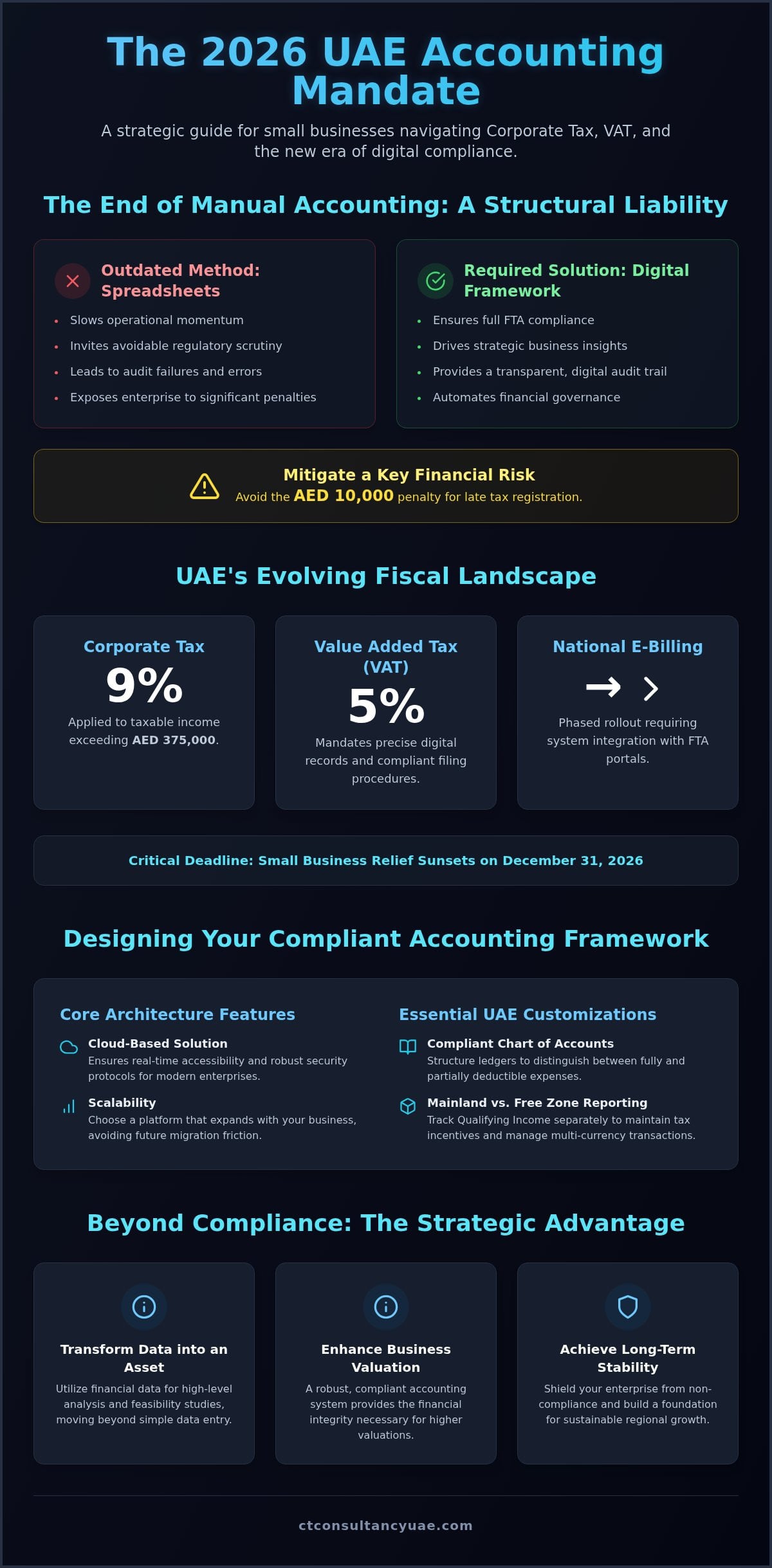
In 2026, a simple spreadsheet is no longer a viable tool for managing your firm’s financial obligations; it’s a structural liability that invites avoidable regulatory scrutiny. As the UAE’s fiscal environment continues its sophisticated maturation, many entrepreneurs feel increasingly overwhelmed by the complex integration of Corporate Tax and VAT requirements. You likely recognize that manual record-keeping isn’t just slowing your operational momentum but also exposing your enterprise to the AED 10,000 penalty for registration delays. Securing a robust small business accounting in the UAE framework is the only definitive way to mitigate these risks. This guide demonstrates how to implement a high-performance system that ensures full compliance while driving the strategic insights necessary for scaling. We’ll examine the critical sunsetting of Small Business Relief on December 31, 2026, the phased rollout of the national e-billing system, and the precise methodologies for automating your financial governance. By the end of this briefing, you’ll possess a clear roadmap to transform your accounting from a compliance burden into a powerful engine for long-term stability and regional growth.
Key Takeaways
- Navigate the 2026 regulatory landscape by implementing a structured digital framework designed to align with evolving Federal Tax Authority (FTA) reporting standards.
- Identify the essential features of a high-performance small business accounting in the UAE system, focusing on real-time accessibility and the scalability required for national expansion.
- Implement a meticulous data migration strategy that maintains audit trails and historical integrity while establishing sophisticated internal controls.
- Transform routine financial data into a strategic asset by utilizing professional oversight to conduct feasibility studies and enhance business valuations.
The Regulatory Imperative for UAE Accounting System Implementation
Accounting system implementation represents the structured deployment of specialized software and internal processes designed to analyze financial data according to precise national standards. In 2026, this isn’t a discretionary upgrade but a fundamental requirement for operational legitimacy. The Federal Tax Authority (FTA) now mandates digital records that provide a transparent audit trail for both VAT and Corporate Tax. As detailed in this UAE Taxation Overview, the fiscal landscape has evolved from a tax-free environment into a sophisticated regulatory framework that demands meticulous precision.
A professionally executed framework serves as a primary friction-remover, shielding your enterprise from the financial impact of non-compliance. Relying on fragmented manual processes often leads to audit failures and significant penalties, such as the AED 10,000 fine for late tax registrations. Transitioning to a centralized system allows for strategic financial management for SMEs, moving your focus from basic data entry to high-level analysis. This alignment ensures that small business accounting in the UAE efforts contribute directly to long-term stability rather than just meeting minimum legal thresholds.
Corporate Tax and VAT Integration
Modern tax engines must be configured to handle the dual complexities of 5% VAT filing and the 9% Corporate Tax rate applied to taxable income exceeding AED 375,000. Your system must also account for the nuanced reporting requirements of Free Zone entities, ensuring that qualifying income is correctly categorized to maintain eligibility for specific incentives. Tax-Ready Accounting is the standard for 2026 UAE business operations. By integrating these components, small business accounting in the UAE becomes a seamless part of the daily workflow, facilitating real-time liability tracking and ensuring that your enterprise remains prepared for any FTA inquiry.
Selecting and Customizing Your UAE Accounting Framework
Selecting a framework for small business accounting in the UAE requires a meticulous evaluation of technical architecture and regional relevance. While on-premise systems offer perceived control, cloud-based solutions provide the real-time accessibility and security protocols necessary for modern national enterprises. These digital environments facilitate a seamless data flow between your core accounting functions and essential external touchpoints, such as payroll modules and Federal Tax Authority (FTA) portals. Choosing a scalable platform ensures your financial infrastructure expands alongside your business, preventing the friction of a system migration as you transition from SME status to a large-scale operation.
Global software configurations often fail to address the specific nuances of small business accounting in the UAE. As highlighted by the OECD on UAE Tax Policy, the nation’s fiscal frameworks are increasingly aligned with international transparency standards. This necessitates a system capable of granular data capture to ensure compliance with both domestic laws and global reporting expectations.
Designing a Compliant Chart of Accounts
Standard ledgers rarely suffice under the current regime. Your chart of accounts must be structured to align with the specific reporting requirements often reviewed by Corporate Tax Consultants. It’s vital to categorize expenses with precision, distinguishing between fully deductible business costs and items with restricted deductibility, such as certain entertainment or non-business related expenditures.
Mainland vs. Free Zone Reporting Considerations
Entities operating within Free Zones face distinct reporting duties compared to Mainland firms. Your system must be tailored to track Qualifying Income separately to maintain tax incentives while managing multi-currency transactions common in international trade hubs. Implementing these specialized configurations early prevents audit discrepancies. For those seeking expert guidance, engaging with professional accounting services ensures your framework is optimized from day one.
The Strategic Implementation Roadmap: A Step-by-Step Approach
Transitioning to a modern small business accounting in the UAE system requires a disciplined, four-phase methodology. Phase 1 begins with a comprehensive needs assessment, where we identify specific reporting requirements and define user access levels to maintain rigorous internal controls. Phase 2 involves the meticulous migration of historical records. This step ensures that data integrity is preserved without compromising historical audit trails. During Phase 3, we focus on configuration and rigorous testing, specifically verifying that tax calculations for the 9% Corporate Tax rate and VAT returns function perfectly before the "go-live" date. Finally, Phase 4 centers on team training and deployment, empowering your staff to achieve Accounting Services excellence through the new platform.
Establishing Internal Controls
Building a resilient financial environment requires the implementation of segregation of duties within the software. This structure prevents both intentional fraud and inadvertent operational errors by ensuring no single individual has total control over a transaction lifecycle. By setting up automated audit trails, your business simplifies future Internal Audit Services, providing a transparent, immutable record of every transaction and system modification. This level of precision instills confidence during regulatory reviews and internal assessments.
Data Migration and Integrity
The integrity of your new framework depends on the quality of the information it receives. Establishing a robust small business accounting in the UAE infrastructure is a journey that demands precision; therefore, it’s essential to clean legacy data, removing redundancies and correcting inaccuracies before importing it into the national accounting framework. Verifying opening balances is a critical final step to ensure a seamless transition between fiscal periods. This meticulous approach prevents carry-over errors that could complicate future tax filings or distort financial insights. To ensure your transition is handled with expert precision, consider our comprehensive bookkeeping and accounting solutions today.
Beyond Setup: Maximizing ROI through Professional Oversight
Establishing a robust small business accounting in the UAE framework is merely the inaugural step toward achieving financial maturity. The true value emerges when executive decision-makers leverage real-time data through CFO Advisory Services to drive informed choices. Sophisticated system reports provide the empirical foundation required for accurate business valuations and comprehensive feasibility studies. Ongoing Tax Services remain essential to maintain system integrity as Federal Tax Authority (FTA) requirements evolve. A professionally implemented architecture also serves as a prerequisite for seamless Ultimate Beneficial Ownership (UBO) and Anti-Money Laundering (AML) reporting; this ensures that regulatory transparency is maintained without manual intervention.
Strategic Financial Planning
Your accounting system should function as a dynamic forecasting tool rather than a static historical record. By utilizing granular data, firms can generate predictive cash flow models and detailed national expansion budgets—incorporating Professional Service Fees for expert oversight—that reflect actual market conditions. A well-implemented system facilitates frictionless business expansion by providing the scalable data architecture necessary to support new revenue streams and operational complexities. This foresight allows entrepreneurs to navigate the 2026 fiscal landscape with a level of precision that mitigates risk while capitalizing on emerging opportunities.
Partnering with CTC for Implementation
CTC Tax & Accounting delivers a bespoke implementation process that’s meticulously tailored to your specific industry and the unique regulatory nuances of your jurisdiction. We move beyond software installation to ensure your small business accounting in the UAE setup is fully integrated with our CFO Services for maximum strategic impact. This holistic approach transforms routine bookkeeping into a high-performance asset. It provides the long-term stability and professional calm required to thrive in a competitive international market. By aligning technical proficiency with elite consulting, we remove the friction from compliance and empower your firm to focus on its core mission.
Establishing a Resilient Financial Foundation for 2026
Navigating the evolving fiscal landscape of the Emirates requires more than just meeting basic bookkeeping obligations; it demands a sophisticated, digital-first approach to small business accounting in the UAE that serves as both a compliance shield and a strategic engine. By following a structured implementation roadmap and tailoring your framework to Mainland or Free Zone requirements, you ensure your enterprise is prepared for the sunsetting of Small Business Relief and the permanent 9% Corporate Tax threshold. This transition from manual entry to automated, FTA-aligned systems removes the friction of regulatory scrutiny while unlocking the predictive data needed for national expansion. CTC Tax & Accounting provides the decades of regional financial expertise necessary to facilitate this transformation, ensuring seamless integration with all Corporate Tax and VAT requirements. Don’t leave your firm’s stability to chance in an increasingly complex environment. Secure your business with a professionally implemented accounting system from CTC Tax & Accounting today. We look forward to partnering with you on your journey toward sustained growth and meticulous financial excellence.
Frequently Asked Questions
Is it mandatory for UAE businesses to use specific accounting software?
The Federal Tax Authority (FTA) does not mandate a specific software brand, yet it requires that records are maintained in a structured digital format that facilitates seamless audits. As the national e-billing system enters mandatory phases in 2026, utilizing a certified platform becomes a practical necessity for compliance. This ensures your small business accounting in the UAE framework aligns with the PINT AE schema and Peppol-based exchange models required for modern trade.
How long does a typical accounting system implementation take in the UAE?
A standard implementation typically spans four to eight weeks, depending on the complexity of your historical records and specific reporting requirements. This duration encompasses the strategic needs assessment, the meticulous migration of legacy data, and a rigorous testing phase to verify tax engine accuracy. Meticulous planning during this period is essential to prevent operational friction and ensure your new system is fully operational before critical tax filing deadlines.
Can my accounting system automatically handle UAE VAT and Corporate Tax?
A properly configured system can automate the calculation and reporting of both 5% VAT and 9% Corporate Tax. However, this functionality depends on the precise setup of your tax engine to recognize the AED 375,000 threshold and distinguish between deductible and non-deductible expenses. Professional oversight during the configuration phase ensures these automated processes remain compliant with the Federal Decree-Law No. 47 of 2022 and all current FTA updates.
What are the risks of using basic spreadsheets instead of a formal accounting system?
Relying on manual spreadsheets exposes your enterprise to significant risks, including data integrity failures and the lack of an immutable audit trail. Such inefficiencies often lead to non-compliance penalties, such as the AED 10,000 fine for late registration or inadequate record-keeping. A formal small business accounting in the UAE system provides the structural security and internal controls necessary to mitigate these high-stakes regulatory risks while supporting long-term stability.
Do I need to train my staff if I hire a professional for implementation?
Comprehensive staff training is a critical component of any successful deployment, even when partnering with elite consultants for the initial setup. Your team must understand how to navigate the new interface, maintain segregation of duties, and execute accurate data entry to preserve system integrity. Effective training ensures that the sophisticated internal controls established during implementation continue to function correctly, safeguarding your firm against operational errors and fraud.