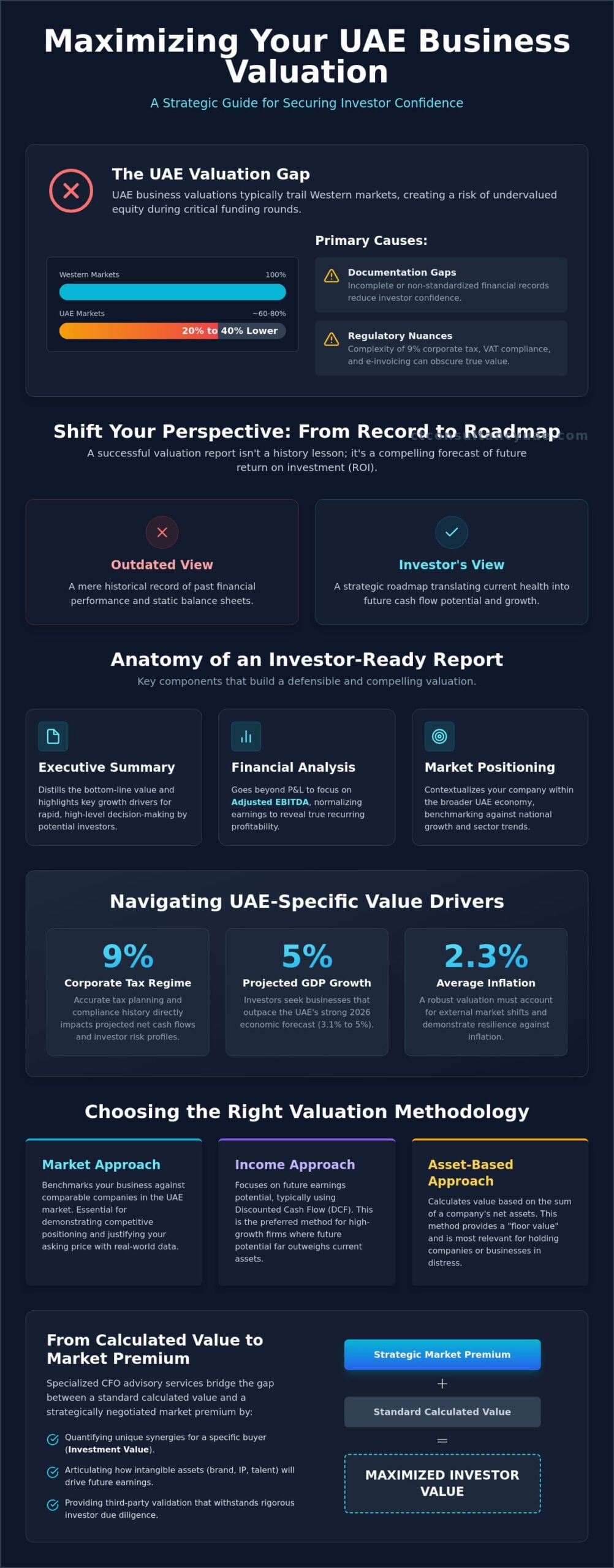
Did you know that business valuations in the UAE typically trail Western markets by 20% to 40% because of documentation gaps and local regulatory nuances? For many entrepreneurs, this discrepancy creates a legitimate fear of undervalued equity during critical funding rounds. It’s understandable to feel overwhelmed by the complexity of the 9% corporate tax rate or the recent shift toward mandatory e-invoicing. You likely seek a defensible number that stands up to the most rigorous scrutiny while instilling absolute confidence in your potential backers.
This guide demonstrates how to transform raw financial data into a compelling business valuation report for investors that maximizes your company’s perceived market worth. By aligning your strategic narrative with the 2026 regulatory landscape, you’ll learn to navigate the intricacies of Federal Decree-Law No. 20 of 2025 and select the most advantageous valuation methodologies for your specific sector. We’ll explore the EBITDA multiples currently driving the SME market and provide a meticulous roadmap for a frictionless transition from initial assessment to a successful close.
Key Takeaways
- Understand how to position your valuation as a forward-looking roadmap for future ROI rather than a mere historical record of financial performance.
- Discover the essential components of a professional business valuation report for investors, focusing on an executive summary that highlights your key growth drivers for rapid decision-making.
- Identify the specific influence of the UAE corporate tax regime and VAT compliance history on your company’s projected net cash flows and investor risk profiles.
- Explore how specialized CFO advisory services bridge the gap between a standard calculated value and a strategically negotiated market premium.
- Master the process of refining financial analysis through adjusted EBITDA and balance sheet optimization to present a defensible and compelling valuation.
A business valuation report for investors serves as a formal, comprehensive document that estimates the total economic value of an entire enterprise or a specific business unit. While some entrepreneurs view these documents as mere compliance requirements, sophisticated institutional backers treat them as a strategic roadmap for future return on investment (ROI). Instead of functioning solely as a historical record of past performance, the report translates current operational health into future cash flow potential. This transition is vital for securing capital in the competitive UAE market, where investors prioritize long-term stability and growth trajectory over static balance sheet figures.
Understanding the distinction between different standards of value is essential for any founder preparing for a capital raise. Fair Market Value represents the price at which a business would change hands between a hypothetical willing buyer and a willing seller in an open market. However, a business valuation report for investors often targets ‘Investment Value’, which accounts for the specific synergies a strategic buyer might realize. This distinction allows sellers to negotiate from a position of strength by quantifying the unique advantages their enterprise offers to a particular acquirer; it effectively bridges the gap between what a business is worth to the market and what it’s worth to a specific partner.
Third-party validation plays a critical role in reducing investor skepticism. When an independent advisor conducts the assessment, it adds a layer of precision and reliability that internal calculations lack. This objective distance is crucial during high-stakes negotiations, as it provides a defensible baseline that stands up to the most rigorous due diligence processes.
Bridging the Gap Between Operations and Market Value
A professional report transforms raw financial data into a structured narrative that highlights the Core Components of a Valuation Report, such as intellectual property, market positioning, and management depth. The report justifies the premium over net asset value by articulating how intangible assets and operational efficiencies will drive future earnings. There is a significant psychological impact when presenting a professionally branded document; it signals that the leadership team is meticulous, transparent, and ready for the rigors of institutional scrutiny. By aligning technical data with a clear growth story, you ensure that your company’s perceived market worth reflects its true potential.
Beyond the report itself, maintaining a high-quality digital brand through professional video and social content—such as that produced by Kynda Creative—further validates your company’s market positioning and operational excellence to prospective backers.
An investor-ready report moves beyond the static book value found in standard accounting to present a dynamic investor value that reflects future earnings potential. The Executive Summary serves as the critical gateway; it distills the bottom-line value and identifies the primary growth drivers that make the acquisition attractive for a quick decision-making process. Within the Financial Analysis, we provide a granular examination of historical P&L and balance sheets, but the centerpiece is often the adjusted EBITDA. This metric normalizes earnings by removing one-time expenses or non-market salaries, providing a clearer picture of recurring profitability that institutional backers demand.
Positioning your enterprise within the broader UAE economic landscape is equally vital for a successful capital raise. With the UAE’s real GDP projected to grow between 3.1% and 5% in 2026, investors look for businesses that outpace national averages and demonstrate resilience. A robust The Strategic Role of a Business Valuation Report includes a risk assessment that quantifies internal operational vulnerabilities and external market shifts, such as inflation, which is expected to average 2.3% in 2026. If you’re unsure how your current financials stack up against these regional benchmarks, our business advisory team can help refine your market positioning.
Choosing the Right Valuation Methodology
Investors rarely rely on a single calculation to determine worth. While the Asset-Based Approach provides a floor value based on tangible holdings—an essential consideration for specialized service firms like Eurotech Automotive that invest heavily in technical infrastructure—the Income Approach, specifically Discounted Cash Flow, is preferred for high-growth firms. However, the Market Approach is indispensable for benchmarking against industry peers, utilizing EBITDA multiples that typically range from 2x to 8x for UAE SMEs. We often apply a weighted average of these methods to produce a robust, defensible conclusion that minimizes negotiation friction.
Financial Modeling and Cash Flow Projections
A business valuation report for investors must include detailed 3-to-5-year forward-looking financial statements. These projections are not mere guesswork; they require rigorous justification for every growth assumption, from customer acquisition costs to capital expenditure requirements. Maintaining strong financial management for smes provides the necessary data integrity to ensure these models withstand investor scrutiny and the subsequent due diligence process.
The introduction of the 9% corporate tax rate on taxable income exceeding AED 375,000 has fundamentally altered how a business valuation report for investors is structured. It’s no longer sufficient to project gross margins without accounting for tax leakage. Buyers now model post-acquisition returns with a sharp focus on tax-adjusted cash flows. Aligning your internal reporting with international standards, such as those found in the IRS Business Valuation Guidelines, ensures your methodology remains globally competitive while addressing specific local nuances. Investors will aggressively discount your company’s value if they perceive your compliance framework as a "messy" liability rather than a structured asset.
Maintaining a clean VAT registration and compliance history serves as a primary friction-remover during the due diligence process. Professional backers view past filings as a reliable proxy for your operational discipline. Any ambiguity in your VAT returns suggests potential hidden liabilities that could emerge during the five-year audit window. Similarly, proving corporate legitimacy through Economic Substance Regulations (ESR) and Ultimate Beneficial Ownership (UBO) filings is non-negotiable. These documents act as essential trust signals, confirming that your enterprise possesses the necessary substance to operate within the UAE’s modernized legal framework.
Regulatory Compliance as a Value Driver
Robust Anti-Money Laundering (AML) protocols protect an investor from future legal exposure and reputational damage. When these systems are meticulously documented and ready for corporate tax consultants in Dubai to review, the valuation assumptions gain immediate technical authority. Audit readiness isn’t just a defensive measure; it’s a strategic move that adds immediate value by reducing perceived risk. If your current compliance framework needs a professional review to secure a higher market premium, our tax advisory services provide the specialized rigor required for high-stakes negotiations.
A significant gap exists between a purely "calculated" value derived from financial models and the "negotiated" value realized during a transaction. While automated tools provide a baseline, they lack the strategic nuance required to defend a premium in high-stakes meetings with venture capital or private equity firms. Engaging professional support ensures that your business valuation report for investors is not just a static document but a dynamic advocacy tool. An expert advisor acts as a vital intermediary, translating complex operational successes into the specific financial language that institutional backers prioritize.
Strategic preparation begins long before the first meeting. Utilizing CFO advisory services allows founders to optimize their capital structure and internal controls during the "pre-valuation" phase. This meticulous planning removes operational friction that might otherwise lead to a valuation discount. When the report is eventually delivered, your advisor remains by your side to handle technical pushback on growth assumptions, ensuring that the narrative remains consistent and defensible throughout the entire negotiation process.
From Valuation Report to Final Term Sheet
The transition from a business valuation report for investors to a signed term sheet is often fraught with rigorous due diligence. Sophisticated business advisory helps founders anticipate common negotiation pitfalls, such as failing to justify normalized EBITDA adjustments or overlooking the impact of the UAE’s 2026 tax regulations. By treating the valuation report as a shield during due diligence, you can maintain your price floor and avoid "re-trading" attempts by the buyer.
Before entering the final Q&A session, ensure your team is prepared for the following technical inquiries:
-
Assumption Sensitivity: Can you demonstrate how a 1% shift in discount rates affects the terminal value?
-
Regulatory Resilience: How does your model account for mandatory e-invoicing costs or the Domestic Minimum Top-up Tax for large entities?
-
Market Benchmarking: Why does your company command a higher multiple than the 3x to 5x average seen in the local retail and F&B sectors?
To secure your company’s future and maximize your market worth, consult with CTC’s valuation experts for a customized approach to your capital raise.
Transitioning from a theoretical figure to a successful capital raise requires more than just spreadsheets; it demands a synthesis of financial rigor and regulatory foresight. By prioritizing audit readiness and selecting the most appropriate valuation methodologies, you position your enterprise as a low-risk, high-reward opportunity within the UAE’s evolving corporate landscape. A robust business valuation report for investors acts as the definitive bridge between your operational achievements and an investor’s requirement for a defensible ROI. When your financial narrative is backed by technical precision, skepticism is replaced by confidence.
Navigating these complexities alone often leads to undervalued equity or prolonged due diligence cycles. We leverage decades of international financial expertise and a specialized focus on UAE SME regulatory compliance to provide end-to-end CFO and valuation support. Our team ensures that every assumption is validated and every tax implication is meticulously accounted for, removing the friction from your path to growth. Book a Strategic Business Valuation Consultation today to ensure your company’s worth is fully realized and protected during your next funding round. Your vision deserves a valuation that reflects its true potential.
How long is a business valuation report valid for investors?
A business valuation report for investors is typically considered current for a period of six to twelve months. This timeframe assumes that no material changes have occurred within the company’s internal operations or the broader UAE economic landscape. Significant shifts, such as a major deviation from projected cash flows or new regulatory mandates, may necessitate an earlier update to ensure the data remains defensible during active negotiations.
Which valuation method is most preferred by UAE venture capitalists?
UAE venture capitalists generally prioritize a combination of the Discounted Cash Flow (DCF) method and the Market Approach using EBITDA multiples. While the DCF highlights long-term growth potential in a diversifying economy, multiples provide essential benchmarking against regional peers. For instance, tech and SaaS entities in the region often see multiples between 8x and 15x, whereas the healthcare sector typically ranges from 6x to 10x EBITDA.
How does the 9% UAE Corporate Tax affect my company’s valuation?
The introduction of the 9% corporate tax rate on taxable income exceeding AED 375,000 directly impacts a company’s valuation by reducing the net cash flows available to investors. When utilizing income-based valuation models, buyers now adjust their terminal value calculations to reflect these tax liabilities. This shift has made it essential for founders to present tax-optimized financial models that account for both the 9% rate and any applicable Small Business Relief for revenues under AED 3 million.
Can I create a business valuation report myself using software?
While basic software can generate a preliminary "calculated" value, it often lacks the strategic depth required for a professional business valuation report for investors. Automated tools don’t possess the nuance to articulate a company’s unique market positioning or defend complex adjustments during institutional due diligence. Professional advisors provide the technical authority and regional expertise necessary to justify a premium price and navigate the specific legal requirements of Federal Decree-Law No. 20 of 2025.
What is the difference between a business valuation and a financial audit?
A financial audit is a retrospective process focused on verifying the accuracy of historical financial statements and ensuring regulatory compliance. In contrast, a business valuation is a forward-looking analysis designed to estimate the total economic worth of an enterprise. While audited financials provide a reliable foundation for the valuation process, the valuation itself incorporates market trends, intangible assets, and risk assessments to determine the price a strategic buyer is willing to pay for future earnings.

