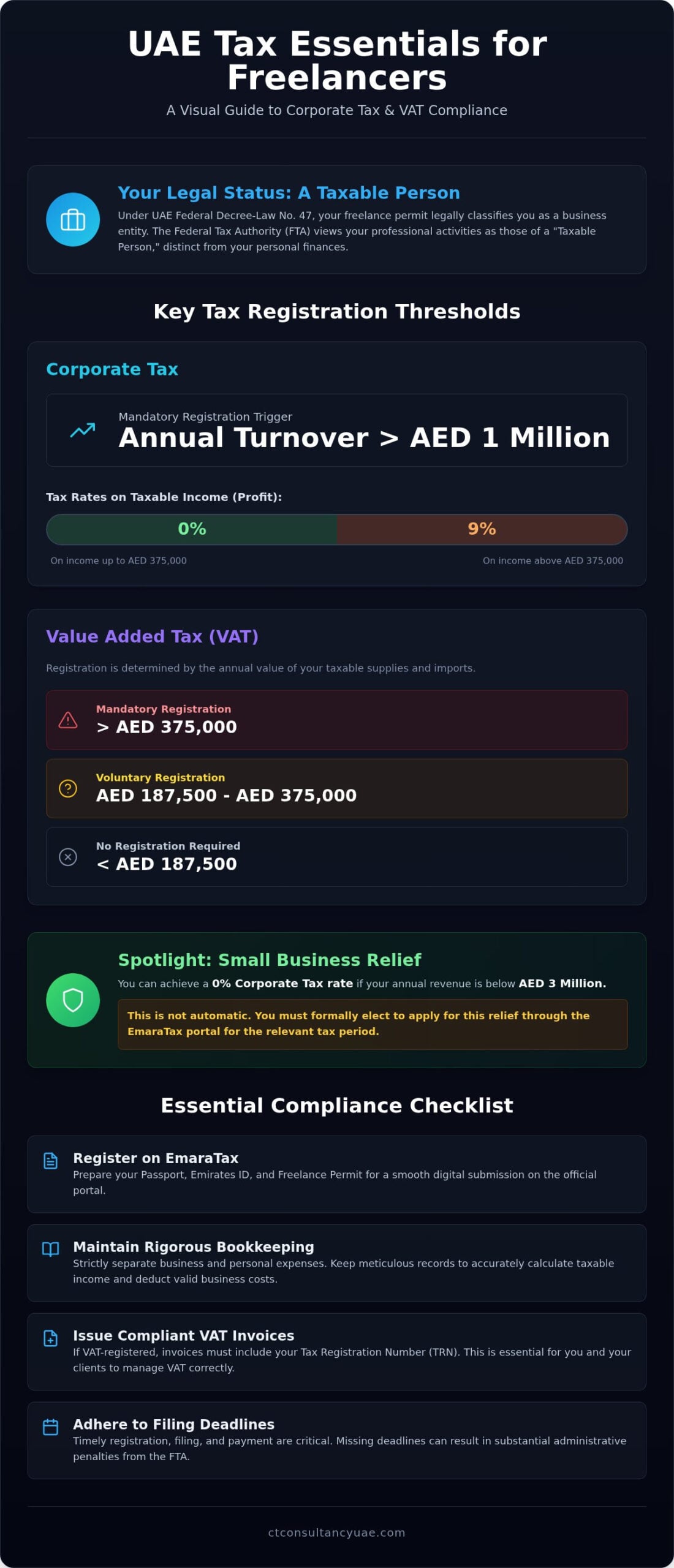
Under current UAE regulations, your status as an independent professional no longer exempts you from the rigorous tax frameworks typically associated with major corporations. Every freelancer operating within the Emirates is now legally viewed as a business entity, making a comprehensive understanding of tax for freelancers in the UAE a fundamental requirement for operational stability. Whether you’re managing a solo consultancy or a creative studio, the distinction between your personal earnings and business turnover has become a critical focal point for the Federal Tax Authority. Precision in these matters is the only way to ensure long-term growth securely.
You likely feel the weight of administrative pressure as registration deadlines approach and the technical nuances of the EmaraTax portal seem increasingly opaque. This guide provides the strategic clarity you need to manage UAE Corporate Tax and VAT obligations with precision. We’ll examine the mandatory AED 1 million turnover threshold for corporate registration, the specific mechanics of Small Business Relief for revenues under AED 3 million, and the essential bookkeeping standards required to safeguard your professional future against avoidable penalties.
Key Takeaways
- Identify how your freelance permit classifies you as a ‘Taxable Person’ under Federal Decree-Law No. 47, requiring a precise separation of personal and business financial records.
- Determine the exact turnover thresholds for mandatory VAT and Corporate Tax registration to ensure you navigate tax for freelancers in the UAE with absolute legal precision.
- Gain clarity on the administrative protocols of the EmaraTax portal, ensuring all documentation and filing deadlines align with Federal Tax Authority standards.
- Discover the strategic process for electing Small Business Relief to benefit from a 0% tax rate on revenues up to AED 3 million for eligible tax periods.
Defining the Freelancer’s Legal Status as a Taxable Person
The implementation of UAE Federal Decree-Law No. 47 has fundamentally altered how independent professionals are viewed by the state. While you operate as an individual, the law distinguishes between your private life as a "Natural Person" and your professional output as a "Taxable Person." This legal designation is not optional. It’s triggered the moment your annual turnover from business activities exceeds AED 1 million. For many, understanding tax for freelancers in the UAE starts with recognizing that the Federal Tax Authority (FTA) views your freelance permit as a gateway to commercial regulation.
Tax Residency for UAE-Based Freelancers
Establishing tax residency is a prerequisite for compliance. You’re typically classified as a UAE tax resident if you maintain a primary residence here or spend at least 183 days in the country over a consecutive twelve-month period. This status is foundational to Taxation in the United Arab Emirates, as it defines the scope of your local tax obligations. For self-employed individuals, tax residency provides the legal basis to apply for Tax Residency Certificates, which are essential for avoiding double taxation on international contracts.
Licensing vs. Taxation: Clearing the Confusion
A common point of friction involves the relationship between a trade license and actual tax liability. Holding a freelance permit in sectors like media, technology, or education doesn’t mean you owe tax from day one. Instead, the permit serves as the legal authorization to generate the turnover that might eventually exceed the AED 1 million threshold. It’s vital to maintain separate records because the FTA focuses on gross revenue, not just profit, when determining registration requirements. Utilizing specialized tax services ensures that your business activities are categorized correctly, providing a clear path for managing tax for freelancers in the UAE.
Corporate Tax and VAT Thresholds for 2026
Understanding the financial boundaries of 2026 is vital for any independent professional. The UAE’s tax framework operates on distinct tiers that dictate your registration obligations and net profitability. Mandatory VAT registration is triggered once your taxable supplies and imports exceed AED 375,000 annually. For those with a turnover between AED 187,500 and AED 375,000, voluntary registration often makes strategic sense to recover input tax on business overheads. Parallel to this, the UAE Government Corporate Tax regime applies a 0% rate on taxable income up to AED 375,000; any profit exceeding this figure is subject to a 9% rate. It’s essential to monitor these figures closely, as missing registration deadlines can lead to substantial administrative penalties. Managing tax for freelancers in the UAE requires a proactive approach to these shifting benchmarks.
Calculating Taxable Income as a Freelancer
Determining your liability requires a precise calculation of taxable income rather than just gross revenue. The FTA permits the deduction of legitimate business expenses, such as professional software and marketing costs, provided they’re incurred wholly for business purposes. You must maintain a strict separation between personal and professional expenditures to avoid audit complications. Engaging professional accounting services provides the necessary oversight to categorize these costs accurately and ensure your financial records remain beyond reproach.
VAT Compliance for the Independent Professional
Once registered, your administrative responsibilities increase significantly. You’re required to issue valid Tax Invoices for all local transactions, which must include specific details like your Tax Registration Number (TRN). Effective management of these documents allows you to utilize input tax recovery, effectively offsetting the VAT you pay on business purchases against the VAT you collect from clients. This mechanism is a powerful tool for maintaining cash flow while staying fully compliant with federal mandates.
Essential Compliance: Registration, Bookkeeping, and Deadlines
Registration for corporate tax is conducted exclusively through the EmaraTax portal, a sophisticated digital interface requiring meticulous attention to detail. You must prepare a comprehensive digital dossier including your valid Passport, Emirates ID, and Freelance Permit to facilitate a frictionless submission. According to the Federal Tax Authority guidelines on Corporate Tax for individuals, failure to register by the designated 2027 deadline for 2026 activities can result in severe administrative penalties. Beyond registration, the law mandates a seven-year record-keeping period for all financial transactions, ensuring that every dirham earned is backed by a verifiable audit trail. This level of administrative rigor is now a permanent feature of managing tax for freelancers in uae, where precision in documentation is your strongest defense against fiscal liability.
Best Practices for Freelance Bookkeeping
Relying on rudimentary spreadsheets often proves insufficient under the scrutiny of an FTA audit. We recommend transitioning to professional accounting services to ensure your ledgers remain compliant with international standards. Establishing a dedicated business bank account is equally vital; it prevents the commingling of personal and professional funds, which is a primary red flag for regulators. A clear separation of accounts provides the transparency needed to justify deductible expenses and maximize your tax efficiency.
Navigating the 2026 Tax Calendar
Maintaining operational continuity requires a proactive approach to the 2026 tax calendar. You must account for quarterly VAT return cycles while preparing for your annual Corporate Tax filing, which is due by September 30, 2027, for the 2026 tax year. Pre-empting these milestones allows you to manage cash flow effectively and avoid the stress of last-minute submissions. If you require assistance with your registration, our team can secure your compliance status through tailored advisory solutions.
Small Business Relief and Strategic Tax Planning
Small Business Relief (SBR) serves as a vital instrument for eligible independent professionals to mitigate their fiscal burden during their initial growth phases. Under current regulations, freelancers with a gross turnover below AED 3 million can elect for this relief, effectively maintaining a 0% corporate tax rate for tax periods ending on or before December 31, 2026. It’s crucial to understand that SBR isn’t granted automatically; you must actively elect to apply it within your tax return filing via the EmaraTax portal. While this provides immediate liquidity, it comes with specific trade-offs, such as the inability to carry forward business losses or net interest expenditure to subsequent periods. Balancing these factors is a core component of managing tax for freelancers in the UAE as you scale your operations toward the next tier of commercial success.
Strategic Advisory for Growing Freelancers
As your revenue approaches the AED 3 million threshold, the complexity of your financial structure necessitates a more sophisticated approach to governance. Transitioning from a solo practitioner to a formal SME requires foresight to ensure long-term stability and regulatory alignment. Utilizing specialized CFO services allows you to forecast future tax liabilities with precision, while comprehensive business advisory helps in restructuring your entity for maximum tax efficiency. These strategic interventions ensure that your professional expansion doesn’t lead to unexpected regulatory friction or cash flow disruptions.
Avoiding Common Compliance Pitfalls
Compliance risks often stem from nuanced misunderstandings of VAT classifications and reporting requirements. Distinguishing between ‘exempt’ supplies and ‘zero-rated’ supplies is essential, as the former limits your ability to recover input tax on business overheads. Miscalculations in these categories can lead to significant financial leakage and trigger a professional audit by the authorities. Securing professional tax services provides an objective layer of security, ensuring that your filings are meticulously accurate and your business remains fully compliant with the evolving legal landscape in the Emirates.
Mastering Your Fiscal Obligations in the Emirates
As the 2026 tax landscape matures, your ability to distinguish between personal earnings and business turnover remains the foundation of a sustainable professional practice. We’ve established that exceeding the AED 1 million threshold for corporate tax or the AED 375,000 benchmark for VAT necessitates immediate administrative action through the EmaraTax portal. While Small Business Relief offers a strategic 0% bracket for those earning under AED 3 million, the active election process and strict record-keeping rules require meticulous attention to detail. Managing tax for freelancers in the UAE shouldn’t be a source of operational friction; it’s a structured component of your growth strategy.
Our team leverages decades of international financial experience to provide expert guidance on UAE Federal Decree-Law No. 47 and end-to-end VAT management. By aligning with these regulatory standards today, you ensure long-term stability and avoid the high stakes of non-compliance. Secure your freelance future with a professional tax consultation from CTC Tax & Accounting. Focus on your craft while we manage the federal tax system on your behalf.
Frequently Asked Questions
Do I need to pay tax if I am a freelancer in a UAE Free Zone?
Yes, freelancers operating within UAE Free Zones are subject to the federal Corporate Tax regime. While certain entities may qualify for a 0% rate on "Qualifying Income," every individual whose business turnover exceeds AED 1 million must complete the registration process. Your Free Zone status doesn’t grant an automatic exemption from federal filing requirements or the necessity of maintaining rigorous financial records for audit purposes.
Can I register for Corporate Tax without a VAT number?
You may certainly register for Corporate Tax without possessing a VAT number. These systems are governed by separate regulations with unique turnover thresholds. While VAT registration becomes mandatory at AED 375,000, Corporate Tax registration is only required once your turnover from business activities surpasses AED 1 million. Understanding this distinction is essential for the efficient management of tax for freelancers in the UAE.
What are the penalties for late tax registration for freelancers in 2026?
The primary penalty for failing to register for Corporate Tax within the prescribed timeline is a fixed administrative fine of AED 10,000. Additional penalties may accrue for late filings or the submission of inaccurate data. Maintaining a proactive compliance calendar is the most effective way to safeguard your professional practice against these significant financial liabilities as the 2026 regulatory environment continues to evolve.
Are my international clients subject to UAE VAT?
Services exported to clients located outside the UAE are typically treated as zero-rated for VAT purposes. While you don’t collect the 5% tax from these clients, you must still maintain comprehensive documentation to justify the zero-rating during a potential audit. These transactions must be accurately reflected in your VAT returns to ensure your overall tax for freelancers in the UAE remains fully compliant with federal standards.
How do I claim Small Business Relief on the EmaraTax portal?
You claim Small Business Relief by making a formal election within your annual Corporate Tax return on the EmaraTax portal. This relief isn’t applied automatically by the Federal Tax Authority. If your gross revenue for the relevant tax period is below AED 3 million, you must actively choose to apply for the relief to benefit from the 0% tax rate on your business profits.