True regulatory certainty isn’t engineered in the tense days before a statutory deadline; it’s established months earlier inside your general ledger. For executive leadership teams operating across the UAE, achieving stress-free tax filing in the UAE standards often feels compromised by overlapping periodic VAT cycles, ambiguous qualifying Free Zone criteria, and the persistent threat of an AED 10,000 administrative penalty.
You already understand the core problem: when internal accounts fail to reconcile cleanly with statutory tax categories, routine returns quickly transform into severe audit vulnerabilities. Fulfilling your standard 9% Corporate Tax liabilities alongside quarterly VAT shouldn’t derail daily commercial operations or trigger administrative panic. By following this guide, you’ll master an executive pre-filing framework that eliminates compliance friction and shields your business from costly errors. We’ve outlined a systematic checklist to align internal books directly with the EmaraTax portal, ensuring seamless, audit-ready submissions for 2026.
Key Takeaways
- Understand the critical structural distinctions between quarterly VAT returns and annual Corporate Tax filings to avoid cross-reporting discrepancies on the EmaraTax portal.
- Deploy a systematic pre-submission checklist to achieve the stress-free tax filing in the UAE corporate leaders require to mitigate audit exposure and administrative penalties.
- Assess the hidden organizational costs and compliance vulnerabilities of managing complex statutory filings through single-employee internal accounting departments.
- Establish continuous ledger reconciliation processes that streamline statutory submissions and maintain flawless corporate records throughout the 2026 fiscal cycle.
Deconstructing UAE Tax Compliance: Core Obligations for Modern Businesses
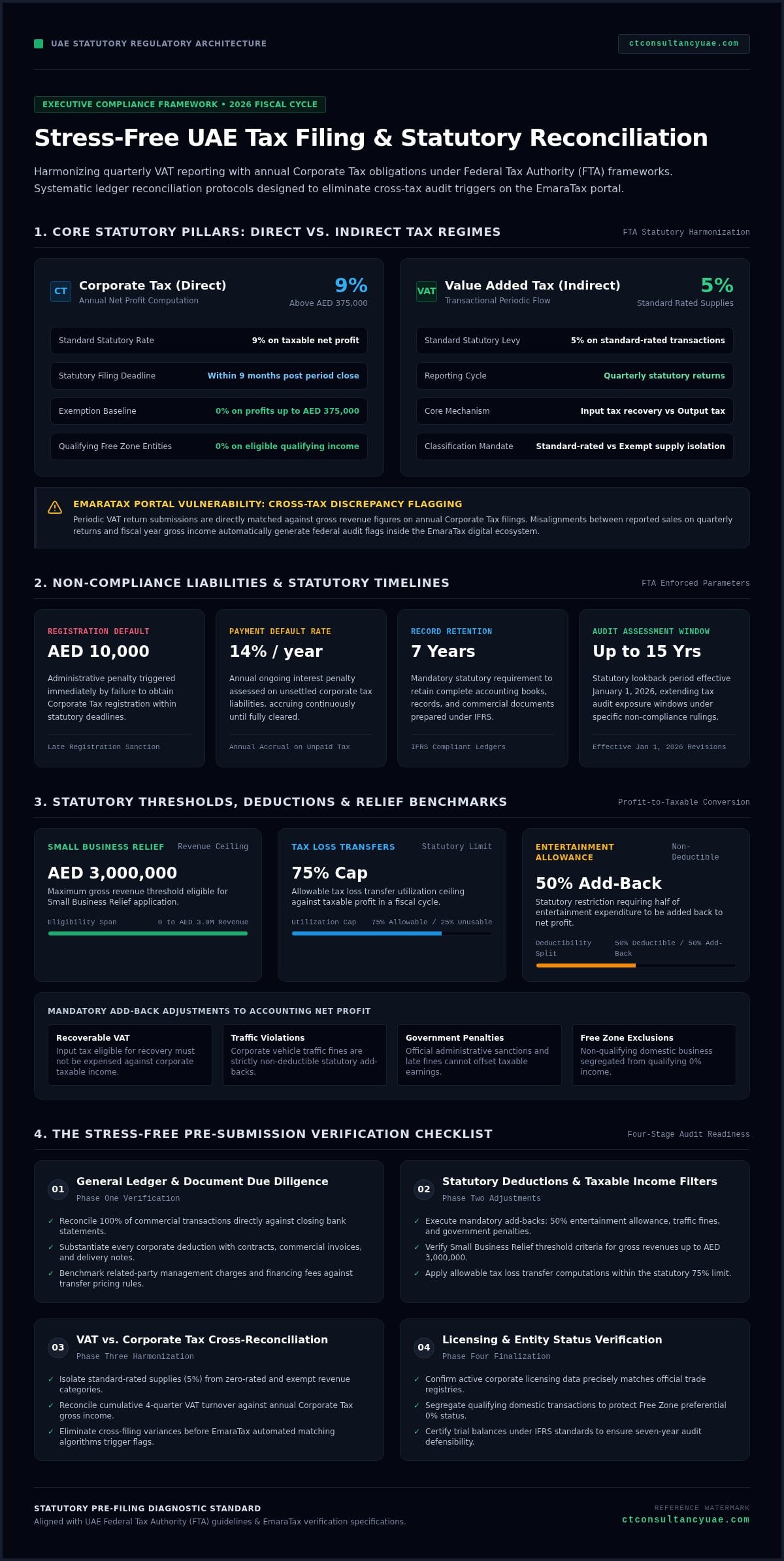
Navigating the statutory tax architecture administered by the Federal Tax Authority (FTA) requires strict operational discipline. Under the framework governing Taxation in the United Arab Emirates, corporate compliance extends beyond simple revenue figures. Taxable income is taxed at 9% once net profits surpass AED 375,000, while transactions under Value Added Tax face a standard 5% levy. True exposure rarely emerges from calculation errors; it stems from unverified deductions, unsupported expense write-offs, and arbitrary adjustments that collapse under federal scrutiny.
Corporate Tax and VAT: Harmonizing Two Distinct Regulatory Regimes
Achieving a reliable standard of stress-free tax filing in the UAE leaders expect requires mastering the structural divide between ongoing indirect levies and annual direct taxes. While VAT relies on transactional quarterly filings tracking input and output tax, Corporate Tax demands a holistic computation of fiscal net profit within nine months following period close. Misalignments between reported sales on periodic VAT returns and gross revenue on annual Corporate Tax submissions automatically generate audit flags within the EmaraTax portal. Securing dedicated tax services eliminates these cross-tax discrepancies before submissions are finalized.
The Baseline Requirement: Audit-Ready Financial Statements
Statutory returns cannot rely on unverified internal spreadsheets. Registered entities must maintain complete accounting records for at least seven years, prepared under International Financial Reporting Standards (IFRS). Pristine trial balances serve as the vital operational bridge between general ledgers and official filings, preventing severe compliance defaults:
- Late Registration Sanctions: Failing to obtain a corporate tax registration within statutory deadlines incurs a direct AED 10,000 penalty.
- Payment Default Penalties: Unsettled corporate tax liabilities attract an ongoing 14% annual penalty until cleared.
Maintaining synchronized ledgers ensures stress-free tax filing in the UAE businesses rely on to protect capital and prevent procedural disputes.
The Stress-Free Tax Filing UAE Checklist: Pre-Submission Verification
Achieving stress-free tax filing** **in the UAE leaders demand requires moving past ad-hoc calculations toward a systematic, four-stage pre-submission review. Before accessing the portal, companies must execute four core checks: reconcile every commercial transaction against closing bank statements, map VAT categories to isolate standard-rated supplies from exempt items, calculate statutory add-backs, and confirm that corporate licensing records match active trade registries.
Phase One: General Ledger and Documentation Due Diligence
Under procedural revisions effective January 1, 2026, tax audit assessment windows can extend up to fifteen years under specific non-compliance determinations. Every corporate deduction requires substantiating commercial invoices, contracts, and delivery notes. Related-party transactions demand particular vigilance; intercompany management charges, shared services, and financing fees must align with statutory transfer pricing benchmarks. Partnering with established accounting services guarantees that month-end trial balances withstand rigorous FTA verification.
Phase Two: Statutory Deductions and Taxable Income Adjustments
Converting net accounting profit into taxable income involves strict statutory filters outlined on the UAE Government’s official corporate tax page:
- Non-Deductible Add-backs: Adjust ledgers for recoverable VAT, traffic violations, governmental penalties, and the non-deductible 50% entertainment allowance.
- Tax Relief Applications: Confirm Small Business Relief thresholds for gross revenues up to AED 3,000,000, or apply allowable tax loss transfers within the statutory 75% cap.
- Free Zone Allocations: Segregate qualifying domestic transactions from non-qualifying business to preserve the preferential 0% rate on eligible operations.
To eliminate pre-submission discrepancies before your filing date, you can consult CTC Tax & Accounting to conduct an objective diagnostic review of your statutory returns.
Evaluating Tax Compliance Models: In-House Management vs. Professional Advisory
Relying on a solitary internal accountant creates an acute organizational bottleneck. As regulatory updates accelerate under published Federal Tax Authority corporate tax guides, individual bookkeepers often lack the specialized bandwidth to monitor evolving transfer pricing rules, qualifying Free Zone exemptions, and anti-abuse provisions simultaneously.
Direct Overhead and Technical Competency Constraints
The visible salary of an internal accountant masks substantial hidden overhead. Sponsoring, training, and retaining a dedicated in-house tax specialist demands significant recurring capital without providing institutional checks and balances. When a sole employee departs or misinterprets statutory adjustments, the enterprise inherits immediate regulatory exposure. Transitioning to an outsourced advisory model converts volatile overhead into a scalable operational structure backed by collective industry expertise.
Strategic Advisory and Financial Risk Mitigation
Deploying fractional financial leadership through specialized CFO services bridges the operational divide between routine bookkeeping and executive risk mitigation:
- Systemic Redundancy: Multidisciplinary advisory teams conduct peer-reviewed reconciliations, catching classification errors before submission.
- Enterprise Valuation Shielding: Audit-ready ledgers satisfy commercial banks, institutional investors, and licensing bodies during financing or structural audits.
- Strategic Continuity: Ongoing quarterly oversight neutralizes the compliance panic typical of unmonitored annual filing cycles.
Achieving the true standard of stress-free tax filing in the UAE executives require demands continuous regulatory oversight rather than last-minute corrections. Partner with CTC Tax & Accounting today to secure senior advisory expertise and protect your business against administrative liabilities.
Executing Your Regulatory Strategy with CTC Tax & Accounting
Achieving institutional compliance demands a disciplined operational transition. By partnering with CTC Tax & Accounting, enterprise leadership institutes structured workflows that convert complex federal mandates into seamless filing cadences. Every mandate is managed comprehensively, synchronizing statutory VAT submissions with corporate returns while orchestrating Economic Substance Regulations (ESR), Ultimate Beneficial Ownership (UBO), and Anti-Money Laundering (AML) reporting.
A Meticulous Approach to Corporate Filings and Compliance
Our engagements initiate with a rigorous diagnostic onboarding review. Senior specialists execute a forensic gap analysis across historical ledgers, unmasking hidden exposure in deductible expenditure, transfer pricing allocations, and intercompany balances. Operating across the Emirates since 2015, our advisory practice combines decades of international tax acumen with local procedural precision. Executive decision-makers can examine our corporate credentials on our about us page to evaluate our multidisciplinary capabilities.
Long-Term Strategic Value Beyond Basic Return Submissions
Statutory compliance yields its highest return when it actively informs corporate growth. Through strategic business advisory engagements, transactional records transform into actionable commercial intelligence:
- Customized Filing Timelines: Individualized schedules prevent cross-tax data collisions between quarterly VAT declarations and annual corporate return deadlines.
- Jurisdictional Optimization: Structural governance models protect Qualifying Free Zone Person status while ring-fencing mainland operational units.
- Governance Resilience: Standardized internal controls defend enterprise valuation and establish seamless transaction pathways for institutional audits.
Sustained commercial growth requires the structural certainty of stress-free tax filing** **in the UAE enterprises depend on. CTC Tax & Accounting delivers the operational architecture necessary to secure complete statutory alignment, eliminating administrative friction and safeguarding your balance sheet across every fiscal year.
Mastering Your Statutory Tax Posture for 2026
Achieving regulatory confidence doesn’t happen by chance; it requires harmonizing periodic VAT returns with annual net profit calculations long before statutory deadlines arrive. By maintaining structured general ledgers, validating transfer pricing benchmarks, and conducting systematic pre-submission reviews, corporate leaders protect balance sheets from audit exposure and steep administrative penalties.
Operating across the Emirates since 2015, CTC Tax & Accounting combines decades of international experience to provide a robust multidisciplinary framework covering Corporate Tax, VAT, ESR, and AML. Whether you oversee a qualifying Free Zone entity or a dynamic mainland enterprise, our advisory practice removes regulatory friction to deliver the reliable standard of stress-free tax filing** **in the UAE organizations depend on for sustained growth.
Take control of your fiscal obligations today. Schedule a Strategic Tax Consultation with CTC Tax & Accounting to fortify your corporate governance framework with complete peace of mind.
Frequently Asked Questions
What documents are required to ensure stress-free tax filing in the UAE?
Ensuring the stress-free tax filing in the UAE businesses rely on requires audited or verified financial statements, trial balances, and commercial ledgers matching closing bank statements. In addition, companies must compile detailed sales invoices, input VAT receipts, valid contracts, customs clearance paperwork, and formal intercompany transfer pricing agreements. Retaining these organized records for at least seven years provides the verifiable baseline necessary to defend corporate deductions during an FTA audit.
Can Free Zone companies utilize simplified tax filing mechanisms?
Free zone businesses must file a full annual corporate tax return regardless of whether their tax liability is zero. While qualifying entities benefit from a 0% rate on qualifying income, they don’t bypass regulatory scrutiny. They must maintain audited financial records, satisfy economic substance criteria, and track transactions with mainland parties carefully. Failing to meet these strict statutory standards disqualifies an entity, subjecting its entire income to the standard 9% rate.
How do Corporate Tax deadlines interact with quarterly VAT submission dates?
Corporate Tax and VAT operate on independent submission timelines that require strict synchronization. Periodic VAT returns are submitted within 28 days following each tax period, while Corporate Tax returns must be filed within nine months of the financial year close. Because the FTA cross-references transactional revenue figures declared on periodic VAT returns against annual Corporate Tax disclosures, reconciling both ledgers continuously prevents automated discrepancies on the EmaraTax portal.
What are the consequences of submitting incorrect corporate tax declarations?
Filing inaccurate returns triggers immediate administrative exposure and operational friction. Errors often prompt comprehensive FTA tax audits, where assessment periods can extend up to fifteen years for non-compliant entities under updated procedural laws. Beyond the automatic AED 10,000 late registration fine, unsettled tax liabilities accumulate an ongoing penalty rate of 14% per annum. Unverified claims also jeopardize corporate bank relationships and complicate future enterprise financing.
How does outsourcing tax filing protect businesses from administrative penalties?
Outsourcing financial compliance to seasoned corporate advisors establishes multi-tiered internal verification that individual employees cannot match. Professional firms reconcile transactional VAT entries with annual profit computations, systematically applying allowable deductions and statutory add-backs before return submission. This disciplined oversight ensures total alignment with FTA mandates, transforming annual reporting into the stress-free tax filing in the UAE leadership requires to preserve capital and maintain clean corporate governance.