
Scaling commercial operations without strategic financial steering doesn’t just invite operational friction; it rapidly accelerates enterprise vulnerability. As an executive, you already recognize that traditional bookkeeping cannot resolve unpredictable cash flow volatility, nor can backward-looking ledgers protect your business against increasingly rigorous Corporate Tax, ESR, and AML frameworks. Securing a reliable cfo advisory for growth bridges this critical capability gap, arming decision-makers with institutional-grade forecasting, disciplined capital allocation models, and strategic clarity without the prohibitive overhead of a full-time C-suite executive.
This comprehensive buyer’s guide shows you exactly how to evaluate, select, and deploy high-tier CFO advisory services to scale your organization sustainably. You’ll discover the core structural distinctions between basic accounting and fractional executive leadership, explore the governance architecture required to maintain effortless compliance across national jurisdictions, and gain a vetted evaluation framework to identify an advisory partner capable of securing your multi-year commercial expansion.
Historic statutory reporting simply records historical transactions to fulfill baseline compliance mandates. In contrast, strategic executive steering actively engineers future commercial performance. While traditional bookkeeping reconciles ledgers after month-end closing, an experienced Chief Financial Officer (CFO) systematically optimizes working capital, defends operational margins, and evaluates high-stakes capital investments. Establishing a reliable cfo advisory for growth ensures your enterprise translates operational metrics into predictive models that de-risk aggressive scaling decisions.
Sustainable scaling requires forward-looking governance rather than reactive statutory accounting filings. Three strategic pillars protect corporate viability:
Transitioning beyond founder-led financial oversight to structured governance demands sophisticated executive direction. Introducing commercial debt facilities, institutional equity, or cross-border trade lines mandates standardized fiscal controls, transparent board reporting, and audited underwriting packets. Partnering with seasoned professionals through comprehensive business advisory structures and dedicated CFO services delivers a reliable cfo advisory for growth, equipping leadership teams with elite corporate stewardship calibrated precisely to enterprise velocity.
Selecting an external advisory firm requires assessing technical precision rather than generic commercial consulting claims. Scaling enterprises face unique friction points as organizational footprints expand across national commercial zones. Securing a reliable cfo advisory for growth demands a partner possessing verifiable cross-industry execution experience, sophisticated risk-adjusted modeling, and deep familiarity with statutory enforcement architectures.
Rapid expansion introduces immediate exposure to corporate tax filing mandates, transfer pricing documentation, Value Added Tax reconciliations, Economic Substance Regulations (ESR), and Anti-Money Laundering (AML) standards. Failing to integrate these frameworks can lead to crippling administrative penalties that drain working capital. Enterprise leaders seeking institutional stability can integrate structured fiscal controls through comprehensive business advisory engagements that align tax exposure with operational scaling.
A capable advisory partner transcends basic monthly variance reporting by engineering predictive, dynamic financial architectures. Grounded in the rigorous disciplines of Strategic Financial Management, reliable financial leadership should deliver bespoke, cross-functional visibility that replaces rigid off-the-shelf templates:
Deploying a reliable cfo advisory for growth transforms these disparate operational inputs into a unified fiscal command structure, empowering corporate boards to deploy capital decisively during volatile market cycles.
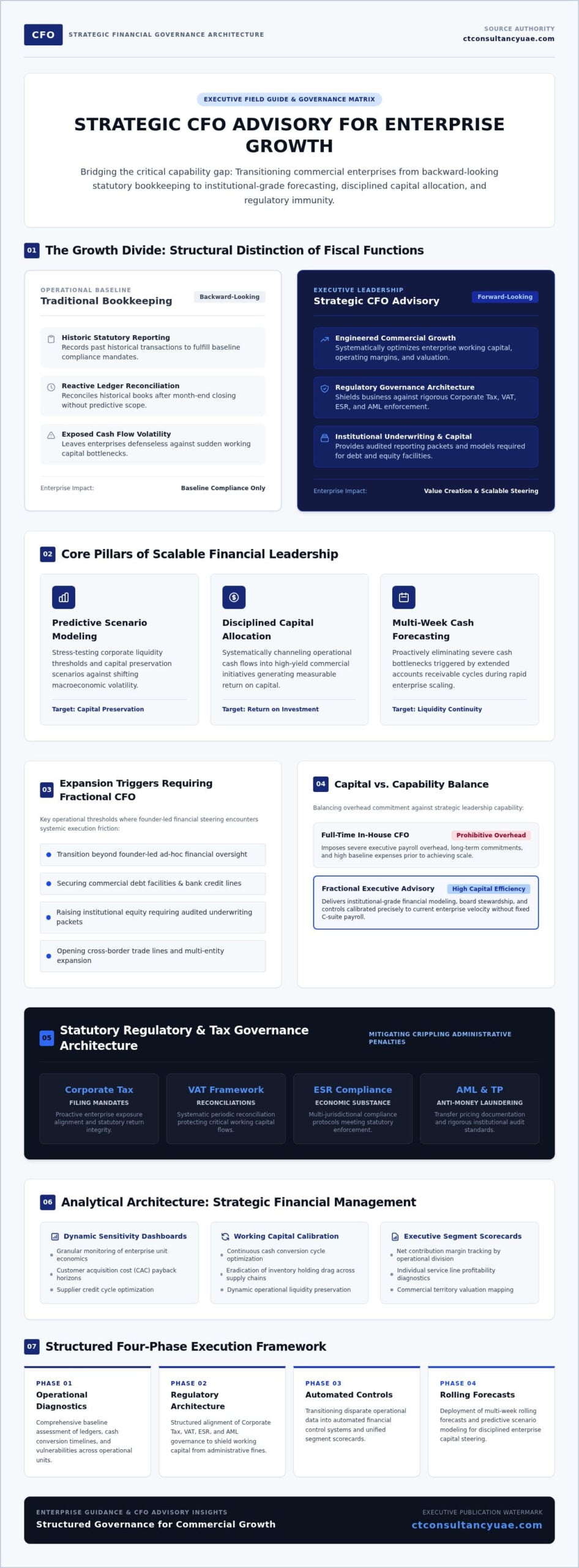
Recruiting a permanent, tier-one executive introduces onerous financial commitments, including executive search fees, equity allocations, and substantial recurring payroll burdens. For mid-market companies scaling across diverse commercial sectors, committing massive fixed overhead to a single internal hire restricts operational agility. Engaging a reliable cfo advisory for growth eliminates this capital drain by delivering institutional-grade financial stewardship calibrated precisely to your enterprise velocity.
Direct C-suite employment creates considerable key-person vulnerability and long-term liabilities if strategic priorities shift. An outsourced model bypasses protracted hiring cycles, granting immediate access to seasoned financial leadership backed by specialized tax, valuation, and audit practitioners. Instead of depending on one individual’s isolated career background, executives tap into collective intelligence gained across dozens of commercial scaling environments. This external perspective guarantees rigorous, independent counsel completely free from corporate politics and organizational bias.
Optimized advisory engagements avoid open-ended commitments by anchoring retainers to concrete commercial milestones. Whether orchestrating cross-border debt facilities, rationalizing subsidiary cost centers, or preparing for high-value equity transactions, the scope scales alongside corporate expansion. Review our firm’s executive background on about us to assess our institutional track record. When your enterprise requires agile financial leadership without excessive overhead, partner with our specialists through dedicated CFO services to accelerate your strategic trajectory.
Successful integration of external financial leadership relies on a methodical implementation roadmap rather than disjointed advisory meetings. Securing a reliable cfo advisory for growth involves a systematic four-stage methodology:
The engagement begins by auditing historical financial statements, operational cost centers, and regulatory exposure across all operating entities. Addressing unrecorded tax liabilities and eliminating working capital friction requires pristine source records. Pairing strategic financial steering with professional accounting services restores absolute data integrity, ensuring subsequent dynamic models rest upon fully reconciled, audit-ready fiscal foundations.
Long-term commercial resilience demands structured board-level oversight. Your advisory team facilitates monthly operational reviews that dissect gross margin variances, divisional profitability, and treasury liquidity. Supplying institutional-grade underwriting packages to commercial banks and potential equity partners streamlines capital access. Retaining a reliable cfo advisory for growth ensures corporate leadership continuously adapts five-year predictive roadmaps to market realities while rigorously preserving enterprise liquidity.
Scaling a resilient enterprise requires moving beyond backward-looking ledgers toward dynamic fiscal steering. By transitioning from transactional record-keeping to forward-looking financial modeling, leadership teams safeguard working capital, establish disciplined capital allocation, and seamlessly manage statutory obligations. Retaining a reliable cfo advisory for growth provides your executive team with high-impact strategic acumen and regulatory certainty so you don’t absorb the fixed overhead of a full-time corporate officer.
Backed by decades of combined international financial leadership and technical regulatory mastery, CTC Tax & Accounting delivers comprehensive nationwide advisory spanning strategic planning, corporate taxation, and internal audit. Our proven executive frameworks are customized to drive sustained profitability, eliminate balance-sheet friction, and establish institutional resilience across every stage of commercial expansion. Position your organization for lasting market advantage: Secure Strategic CFO Advisory for Your Enterprise Growth and lead your sector with complete fiscal confidence.
A financial controller focuses on historical accuracy, closing ledgers, and maintaining accounting compliance, whereas a strategic CFO advisor directs future enterprise value creation. While controllers ensure internal compliance and transaction integrity, CFO advisors design dynamic capital allocation models, manage balance-sheet risk, and guide commercial scaling decisions. Controllers look backward at what already happened; CFO advisors architect where the business is heading next.
Securing a reliable cfo advisory for growth protects your organization by embedding proactive compliance controls into everyday financial workflows. Instead of reacting after deadlines pass, advisors continuously align your operations with Corporate Tax mandates, VAT rules, Economic Substance Regulations, and Anti-Money Laundering frameworks. This institutional oversight prevents severe statutory fines, rectifies tax exposure early, and ensures reporting remains fully compliant across all national authorities.
Yes, external CFO advisors integrate directly with your internal staff to enhance existing operational capabilities rather than replacing them. Your in-house bookkeepers continue managing daily transactions, invoicing, and routine reconciliations under structured executive supervision. The advisory team establishes rigorous internal controls, introduces standardized reporting templates, and elevates your team’s output, transforming transactional accounting records into executive-grade financial intelligence for strategic decision-making.
Measurable operational value typically emerges within the initial thirty to sixty days following the baseline diagnostic review. Immediate wins often include eliminating working capital bottlenecks, resolving latent regulatory compliance exposures, and implementing rolling cash forecasts. Within ninety days, businesses gain sophisticated visibility over unit economics, customer acquisition payback periods, and divisional profitability, allowing leadership to make high-stakes commercial expansion decisions with complete analytical certainty.
Fractional leadership is exceptionally well suited for mid-market organizations managing complex commercial transitions. Rapid expansion often creates cash flow volatility and structural friction that traditional bookkeeping can’t resolve. Retaining a reliable cfo advisory for growth provides scaling enterprises with institutional-grade financial modeling, debt structuring capabilities, and board-level governance. This structure provides the exact strategic firepower of a seasoned corporate executive without committing to full-time payroll overhead.