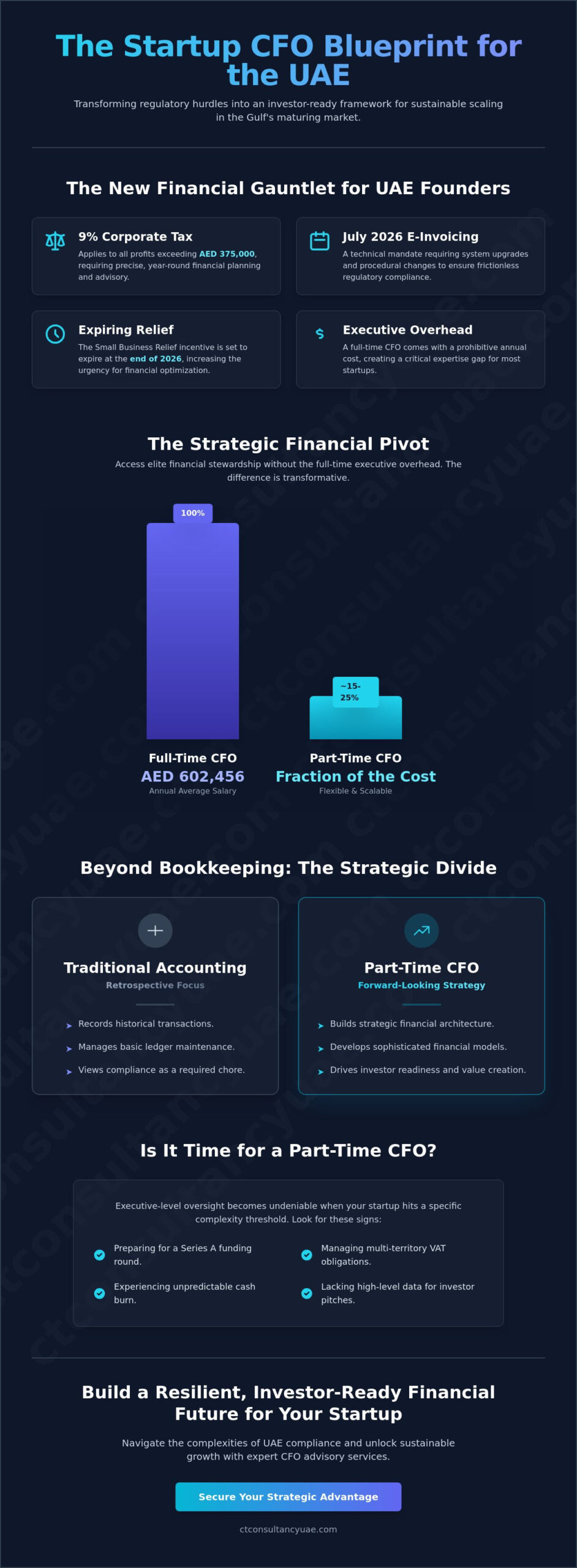
For many UAE founders, the transition from a lean operation to a fully compliant entity feels like a high-stakes gamble against evolving regulatory deadlines. With the Small Business Relief incentive set to expire at the end of 2026 and the 9% Corporate Tax rate applying to profits over AED 375,000, your financial visibility isn’t just a preference; it’s a survival requirement. Engaging a part-time CFO for startups is the strategic pivot that allows you to secure elite financial stewardship without the AED 602,456 annual overhead of a full-time executive.
It’s natural to feel concerned about unpredictable cash burn or the technicalities of the July 2026 e-invoicing mandate. This guide demonstrates how a fractional advisor transforms these regulatory hurdles into a streamlined, investor-ready framework. You’ll learn how to master the nuances of Corporate Tax advisory and build the sophisticated financial models necessary for sustainable scaling in the Gulf’s maturing market.
Key Takeaways
- Learn how to differentiate between retrospective accounting and the forward-looking strategic architecture that a part-time CFO for startups provides.
- Discover how sophisticated financial modeling converts volatile burn rates into precise, investor-ready growth projections.
- Gain actionable insights on managing 2026 UAE Corporate Tax and VAT mandates to ensure frictionless regulatory compliance.
- Identify the specific technical benchmarks and industry experience required to select a CFO partner who aligns with your startup vision.
Defining the Role: What is a Part-Time CFO for Startups?
The UAE’s commercial ecosystem has matured rapidly, shifting from a historically tax-free haven to a sophisticated regulatory environment that demands precision. In this context, a part-time CFO for startups serves as a high-level strategic architect rather than a mere record-keeper. This role provides the executive-level fiscal stewardship necessary to navigate complex requirements like Corporate Tax and VAT without the prohibitive expense of a full-time C-suite salary. To understand the foundational concept of this flexible leadership, one might ask: What is a Part-Time CFO for Startups? At its core, it’s a model of shared expertise where an elite consultant manages the financial strategy of multiple entities on a recurring, flexible basis.
Distinguishing between fractional, interim, and part-time roles is essential for founders who want to optimize their leadership structure. While an interim CFO fills a temporary gap during a leadership transition, a fractional or part-time CFO maintains a long-term, ongoing relationship with the startup. This distinction is vital in the UAE, where the introduction of the 9% Corporate Tax on income exceeding AED 375,000 requires consistent, year-round planning rather than a one-off audit. The transition from basic ledger maintenance to sophisticated financial architecture allows a business to move beyond survival and into a phase of calculated, data-driven expansion.
The Fractional Model vs. Traditional Employment
Startups often find themselves in a fiscal "no man’s land" where their needs exceed basic bookkeeping but their budget cannot sustain a full-time executive. The average salary for a full-time CFO in Dubai reaches approximately AED 602,456 annually, a figure that is often out of reach for early-stage ventures. By utilizing CFO advisory services, founders access the same level of precision and strategic foresight at a fraction of the cost. This model offers the flexibility to scale engagement as the business grows, providing a fresh pair of eyes with cross-industry experience that identifies hidden risks before they become liabilities.
When Should a Startup Consider This Hire?
The decision to hire a part-time CFO for startups usually coincides with a specific complexity threshold. If your startup is preparing for a Series A funding round, managing multi-territory VAT obligations, or navigating the transition from pre-revenue to profitability, a simple ledger is no longer sufficient. Founders should look for signs such as unpredictable cash burn or a lack of high-level financial data for investor pitches. When financial data becomes a tool for strategic decision-making rather than just a compliance chore, the need for executive-level oversight becomes undeniable. This strategic transition ensures that your business model is not just functional but truly investor-ready.
The Strategic Value: How a Fractional CFO Drives Startup Scaling
Scaling a venture in the Emirates requires a shift from reactive accounting to proactive financial engineering. While many founders view a part-time CFO for startups as a cost-reduction measure, the true ROI lies in value creation and risk mitigation. In a high-growth environment, cash is the oxygen of your business. Without a precise burn rate calculation and a forward-looking financial model, rapid growth can quickly become a liability rather than an achievement. A fractional CFO provides the architectural integrity needed to ensure your runway is grounded in 2026 market realities, such as the new Wage Protection System (WPS) compliance thresholds.
Sophisticated financial modeling goes beyond basic spreadsheets; it involves stress-testing your business model against various economic scenarios. By developing KPI dashboards that track more than just profit and loss, an advisor helps you identify the specific levers that drive sustainable revenue. This data-driven approach allows you to make informed operational decisions regarding marketing spend or talent acquisition, ensuring every dirham spent contributes to long-term stability.
Fundraising and Investor Readiness
Investors in the MENA region have become increasingly discerning, requiring more than just a compelling pitch deck. They demand a professional "data room" that withstands the rigors of due diligence during Seed or Series A rounds. A part-time CFO translates complex financial data into a narrative that demonstrates fiscal discipline and market understanding. By conducting a detailed business valuation, they ensure your equity is protected and your startup isn’t undervalued during negotiations. This level of preparation signals to VCs that your entity is a low-risk, high-reward investment.
Performance Management and KPI Tracking
Identifying your "North Star" metric is essential for maintaining focus during the chaos of scaling. Whether it’s Customer Acquisition Cost (CAC) or Lifetime Value (LTV), a CFO implements rigorous monthly reporting cycles to monitor these benchmarks. This discipline allows you to identify operational bottlenecks before they impact your bottom line. Consulting with an expert in CFO advisory services ensures your scaling efforts are backed by verified data, allowing you to pivot with confidence when market conditions shift. This strategic oversight transforms financial data from a historical record into a roadmap for future profitability.
Part-Time CFO vs. Traditional Accounting: Understanding the Distinction
Many entrepreneurs mistakenly believe that a robust accounting department is synonymous with strategic financial leadership. While an accountant ensures that your ledgers are balanced and your VAT filings are submitted on time, a part-time CFO for startups operates on an entirely different plane of business intelligence. Accounting is inherently historical, focusing on the systematic recording of past transactions to ensure accuracy. In contrast, CFO advisory is forward-looking, utilizing those records to architect the future of the enterprise. It’s the difference between keeping the books and designing the business model itself.
Relying solely on an accountant for high-level decision-making is a frequent pitfall for early-stage companies. An accountant is a specialist in precision and compliance, whereas a CFO is a strategist who understands capital structure and risk management. Without this distinction, a founder might have perfect books but a business model that is fundamentally unscalable. These two roles must collaborate to create a robust financial ecosystem where data integrity meets strategic foresight.
While building this ecosystem, choosing a partner that specializes in small business needs is key.
The Accountant’s Role: Compliance and Accuracy
The primary mandate of an accountant is the preservation of data integrity. This involves meticulous ledger maintenance and ensuring that all transactions align with the latest Federal Tax Authority (FTA) regulations. In the UAE’s 2026 regulatory climate, accurate accounting services are the bedrock of corporate stability. Without this foundation of clean data, any strategic forecasting becomes speculative. The accountant ensures that VAT registration and monthly reconciliations remain frictionless, providing the raw material that the CFO eventually refines into a growth strategy. They record the past so the business can prove its legitimacy.
The CFO’s Role: Strategy and Growth
A part-time CFO for startups takes the historical data provided by the accountant and translates it into actionable business intelligence. While the accountant reports on what was spent, the CFO analyzes how that spending impacts the long-term capital structure. Through CFO advisory services, founders can identify which product lines offer the highest margins and where operational efficiencies can be harvested. This role is about designing the business model to withstand market volatility and preparing the entity for eventual valuation. The CFO designs the future by interpreting the patterns of the past.
UAE-Specific Financial Governance: Compliance as a Competitive Advantage
In the maturing regulatory climate of 2026, compliance has shifted from a back-office obligation to a core pillar of business valuation. For founders, the introduction of federal corporate tax and the tightening of VAT enforcement represent a fundamental shift in how business is conducted. A part-time CFO for startups provides the specialized oversight needed to navigate these changes, ensuring that regulatory friction doesn’t stall your growth trajectory. By integrating Anti-Money Laundering (AML) frameworks and managing Economic Substance Regulations (ESR) from the outset, you position your startup as a reliable partner for international banks and global investors. This level of governance is no longer optional; it’s a prerequisite for institutional trust.
Strategic financial leadership is particularly critical when managing the nuances of the UAE’s tax regime. With the Small Business Relief (SBR) set to expire for tax periods ending after December 31, 2026, startups currently benefiting from the AED 3 million revenue threshold must prepare for a transition to the standard 9% corporate tax rate. A fractional CFO ensures that your financial architecture is ready for this shift, preventing sudden shocks to your cash flow. They also manage the implementation of mandatory e-invoicing for B2B transactions, which begins its phased rollout in July 2026, ensuring your operations remain uninterrupted by technical non-compliance.
Corporate Tax and VAT Optimization
Positioning your startup to benefit from available incentives requires a deep understanding of the distinction between free zone and mainland tax treatments. While qualifying income in free zones may offer specific advantages, the rules are complex and require meticulous documentation. A part-time CFO for startups optimizes your VAT position by ensuring that refund claims are filed within the strict five-year limit that became effective on January 1, 2026. Secure your fiscal future with our Corporate Tax Advisory to ensure every regulatory requirement is met with precision.
Risk Mitigation and Internal Audits
Establishing internal controls is essential for preventing fraud and ensuring the accuracy of financial reporting. Regular internal audits serve as a dress rehearsal for the external scrutiny required by banks or regulators, maintaining a high level of investor confidence. By implementing rigorous oversight through CFO advisory services, you ensure that your startup is always audit-ready. This proactive approach to risk management protects your reputation and ensures that your path to scaling remains frictionless and secure.
Selecting the Right Partner: Implementing CFO Advisory in Your Startup
Selecting a part-time CFO for startups is a decision that extends beyond technical verification; it’s an exercise in strategic alignment. While technical proficiency in International Financial Reporting Standards (IFRS) is a baseline requirement, the most effective partners demonstrate deep, industry-specific experience within the UAE’s unique economic sectors. A founder must evaluate whether a potential advisor shares their vision for scaling, as a CFO serves as a primary bridge between operational data and the investor narrative. This cultural fit ensures that the advisor doesn’t just provide reports but actively champions the startup’s long-term objectives.
The onboarding process should be structured to minimize friction and maximize immediate impact. It begins with a comprehensive diagnostic of the entity’s current financial health, followed by the integration of the CFO into the executive decision-making loop. This transition requires a commitment to a more disciplined financial culture, where data integrity is prioritized across all departments. By establishing clear communication channels and shared KPIs, the founder and the CFO can work in tandem to navigate the complexities of the 2026 fiscal landscape, from e-invoicing mandates to tax optimization strategies.
The CTC Advantage: Global Expertise, National Precision
CTC Tax & Accounting offers a unique synthesis of global financial standards and local regulatory precision. With decades of experience navigating the UAE’s financial evolution, our team provides a seamless integration of high-level strategy and technical compliance. Choosing a single partner for both bookkeeping and accounting services and executive advisory eliminates the silos that often lead to financial mismanagement. Our seasoned consultants possess the local expertise required to manage the nuances of the Federal Tax Authority’s latest resolutions. You can learn more about our commitment to professional excellence on our About Us page.
Next Steps for Your Startup
Transitioning to a sophisticated financial framework begins with a few practical steps. First, conduct a preliminary financial health check to identify immediate vulnerabilities in your current reporting or tax compliance. Second, prepare your team for the transition by emphasizing the value of data-driven decision-making. This cultural shift is essential for the successful implementation of any advisory service. When you’re ready to transform your financial chaos into a strategic roadmap for sustainable scaling, we invite you to book a consultation for CFO Advisory and secure the expert stewardship your venture deserves.
Architecting Your Path to Institutional Excellence
The transition from a lean operation to a scalable, investor-ready enterprise requires more than just operational grit; it demands the precision of high-level financial architecture. By integrating a part-time CFO for startups, you ensure that your entity isn’t merely reacting to the 2026 UAE Corporate Tax and VAT mandates but is actively leveraging compliance as a competitive advantage. This strategic oversight transforms historical data into a forward-looking roadmap, allowing you to manage cash burn with surgical accuracy while preparing for rigorous investor scrutiny.
Founded in 2015, CTC Tax & Accounting brings decades of international experience to the local market, offering customized financial solutions for high-growth SMEs. Our experts specialize in navigating the complexities of UAE Corporate Tax Advisory and VAT compliance, providing the strategic reassurance needed to scale with confidence. Secure Your Startup’s Financial Future with CTC CFO Advisory. Your vision deserves a financial foundation that’s as ambitious as your growth targets. We’re ready to help you build it.
Frequently Asked Questions
What is the difference between a part-time CFO and a virtual CFO?
A part-time CFO refers to the fractional nature of the professional engagement, whereas a virtual CFO specifically describes a remote delivery model. While a virtual CFO operates exclusively through digital channels, a part-time advisor often provides a more integrated presence, offering both remote strategic oversight and occasional on-site consultations to better align with the startup’s internal culture.
How many hours a month does a part-time CFO typically work for a startup?
Engagement levels typically range from 10 to 30 hours per month, depending on the complexity of the business and its current growth phase. A startup navigating a funding round or a complex multi-territory expansion will require a higher volume of hours to ensure that financial modeling and regulatory compliance are managed with absolute precision.
Can a part-time CFO help my startup with fundraising and VC pitches?
Yes, a CFO is essential for translating complex operational data into a compelling narrative that resonates with venture capitalists. They manage the preparation of the data room, conduct rigorous business valuations, and ensure that all financial projections withstand the intense due diligence processes common in the UAE’s maturing investment landscape.
Is a part-time CFO responsible for my company’s tax filings?
The CFO provides the high-level strategic framework for tax planning, but the transactional execution of filings is usually handled by the accounting team. The CFO’s role is to ensure that your Corporate Tax advisory and VAT compliance strategies are optimized to protect cash flow and minimize long-term liabilities under the latest Federal Tax Authority regulations.
Does a startup need a CFO if it is still pre-revenue?
Engaging a part-time CFO for startups during the pre-revenue phase is a strategic move to establish a sound financial architecture from day one. This early intervention helps founders avoid structural fiscal errors, manage initial capital injections efficiently, and build the sophisticated models required to secure their first major round of external funding.
How does a part-time CFO interact with my existing accounting team?
The CFO serves as an executive layer above the accounting team, transforming raw transactional data into actionable business intelligence. They provide strategic direction to your accountants, ensuring that ledger maintenance and VAT reconciliations serve the broader goal of sustainable scaling rather than just historical record-keeping.
What qualifications should I look for in a part-time CFO in the UAE?
You should prioritize candidates with recognized professional certifications such as ACCA, CPA, or CFA, combined with deep localized experience. In 2026, it is critical that they demonstrate a masterly understanding of the UAE’s specific regulatory environment, including the EmaraTax portal, the Wage Protection System updates, and the nuances of Economic Substance Regulations.
How much does a part-time CFO for a startup cost in the UAE?
The cost of a fractional advisor is a fraction of the AED 602,456 average annual salary required for a full-time CFO in Dubai. Fees are generally structured as a monthly retainer based on the specific scope of services and the level of strategic involvement required to maintain your entity’s financial health and regulatory standing.