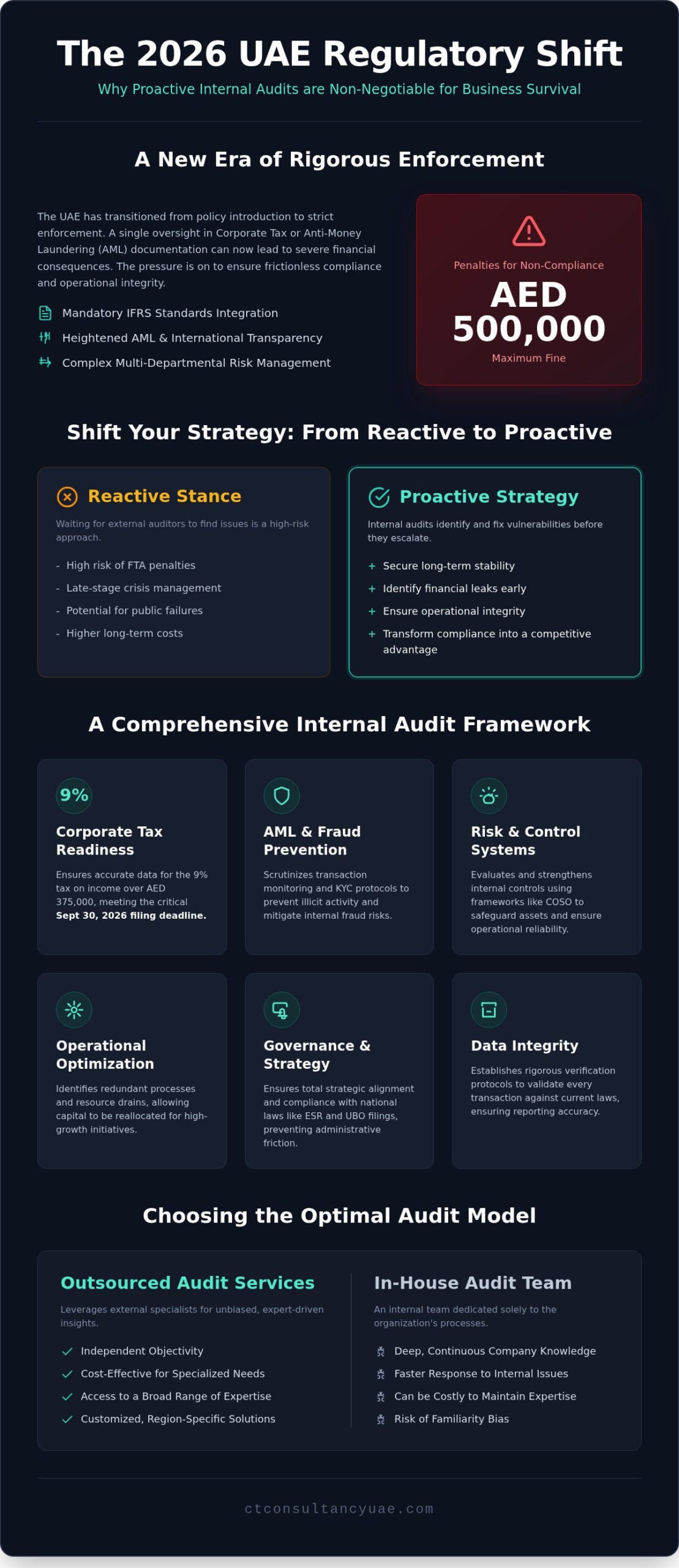
In 2026, the UAE regulatory landscape has transitioned from a period of policy introduction to one of rigorous enforcement, where a single oversight in Corporate Tax or AML documentation can result in penalties reaching up to AED 500,000. You likely feel the mounting pressure of managing multi-departmental risks while striving for the frictionless compliance required by the Federal Tax Authority’s latest mandates. It’s a high-stakes environment where precision isn’t just a preference; it’s a requirement for business survival.
This article demonstrates how leveraging professional internal audit services in Dubai can transform these complex regulatory burdens into a distinct competitive advantage for your national enterprise. By shifting from a reactive stance to a proactive strategy, you can secure your organization’s long-term stability and operational integrity. We’ll explore the integration of mandatory IFRS standards, the critical nuances of the September 2026 Corporate Tax filing deadlines, and the methods for identifying internal financial leaks before they compromise your excellence. Discover how a structured internal control framework acts as the ultimate friction-remover in an increasingly complex and sophisticated market.
Key Takeaways
- Understand how the 2026 shift toward stricter regulatory enforcement makes internal auditing a critical requirement for maintaining Corporate Tax and AML compliance.
- Discover how utilizing professional internal audit services in Dubai provides the independent objectivity necessary to identify financial leaks and operational inefficiencies.
- Learn to implement sophisticated control frameworks that safeguard your enterprise’s assets and ensure the accuracy of multi-departmental reporting.
- Compare the strategic advantages of outsourced versus in-house audit models to determine the most cost-effective solution for your organization’s growth.
- Explore a meticulous four-stage audit process that replaces generic checklists with customized solutions tailored to your specific regional requirements.
Navigating the UAE Regulatory Landscape: Why Internal Audits are Essential in 2026
An effective internal audit is defined as an independent, objective assurance and consulting activity designed to add value and improve an organization’s operations. In the context of the UAE’s maturing financial environment, engaging a comprehensive internal audit process allows a business to systematically evaluate risk management and governance. Unlike external audits that focus on historical accuracy for stakeholders, internal audit services in Dubai prioritize foresight. They identify operational inefficiencies and compliance vulnerabilities before they manifest as public failures or financial liabilities.
These audits also act as a primary defense against Anti-Money Laundering (AML) compliance risks. With the UAE’s heightened focus on international transparency in 2026, internal auditors scrutinize transaction monitoring systems and "Know Your Customer" protocols to prevent illicit activity. This level of scrutiny provides the strategic reassurance that your enterprise isn’t just profitable, but also legally resilient. It’s about building a framework that supports long-term stability rather than just meeting a seasonal requirement.
The Shift from Reactive to Proactive Compliance
Waiting for an external auditor to identify discrepancies is a high-risk strategy that often leads to late-stage crisis management. In 2026, the UAE has moved toward stricter enforcement of existing regulations, making the cost of negligence significantly higher than the cost of prevention. Professional internal audit services in Dubai serve as a primary friction-remover; they identify control gaps and procedural weaknesses before they escalate into Federal Tax Authority (FTA) penalties. These fines can range from AED 50,000 to AED 500,000 for specific compliance failures, making proactive review a financial necessity.
Internal Audit and Federal Tax Requirements
The introduction of the 9% Corporate Tax rate for income exceeding AED 375,000 has placed immense pressure on national business reporting. For companies with a financial year ending December 31, 2025, the filing deadline of September 30, 2026, requires verified and accurate data. Utilizing specialized tax services alongside internal reviews ensures that VAT inputs and Corporate Tax calculations align with Cabinet Decision No. 105 of 2023. Internal audits ensure the integrity of financial data by establishing rigorous verification protocols that validate every transaction against current tax laws before final filing.
The Strategic Framework: What a Comprehensive Internal Audit Evaluates
A sophisticated evaluation of an organization’s internal architecture goes far beyond basic accounting checks. It requires a rigorous assessment of risk management processes to safeguard national business assets against volatile market shifts. By utilizing the COSO framework, specialized internal audit services in Dubai ensure that internal control systems are robust, reliable, and capable of supporting complex operations. This methodology serves as a strategic shield for business excellence, providing the transparency that modern stakeholders and international partners demand.
Compliance with national laws, including Economic Substance Regulations (ESR) and Ultimate Beneficial Ownership (UBO) filings, is a core component of this framework. Meticulous verification of these filings prevents the administrative friction that often hinders corporate expansion. It’s about establishing a culture of accountability where every regulatory requirement is viewed as a benchmark for excellence rather than a hurdle.
Operational Optimization and Fraud Prevention
Governance and Strategic Alignment
Total strategic alignment is achieved only when departmental activities mirror the enterprise’s high-level objectives. The data harvested during an audit provides the foundational evidence needed for CFO advisory services to drive informed decision-making. This synergy ensures that short-term operational tactics always support long-term stability and growth. If you’re seeking to strengthen your organization’s internal oversight, our business advisory experts can help you design a framework tailored to your specific industry needs.
Outsourced vs. In-House Internal Audit: Choosing the Optimal Model
Determining whether to establish a dedicated in-house department or engage professional internal audit services in Dubai is a pivotal decision for any growing enterprise. While an internal team offers immediate proximity to operations, it carries substantial overhead, including the recruitment of specialized talent and continuous investment in training to keep pace with shifting UAE regulations. In contrast, outsourcing provides a level of independent objectivity that is difficult to replicate internally. External consultants are unburdened by corporate politics, allowing them to deliver the unbiased, critical assessments necessary for high-stakes compliance.
Access to specialized technical knowledge remains a primary driver for the outsourcing model in 2026. As Federal Decree-Law No. 16 of 2025 and new AML enforcement protocols introduce tighter rules, a generalist in-house auditor may struggle to maintain the required depth of expertise. Professional internal audit services in Dubai bring a wealth of international best practices tailored specifically to the regional landscape, ensuring that your organization benefits from the most current regulatory insights.
The Advantages of Professional Outsourcing
Outsourcing eliminates the significant administrative burden of training and retaining senior-level audit staff. By leveraging an external partner, national businesses can scale their audit activities based on current needs, utilizing a co-sourcing model to supplement existing internal teams during peak periods or for complex, multi-departmental reviews. This flexibility allows leadership to focus on core business objectives while maintaining a rigorous oversight framework.
Selecting the Right Audit Partner in the UAE
The selection of an audit partner should prioritize industry experience and a demonstrable track record of providing strategic reassurance. It’s essential to choose a firm that understands tax services and accounting services holistically, as internal controls are inextricably linked to the accuracy of financial reporting. This integrated perspective ensures that your audit function serves as a catalyst for growth rather than a mere administrative exercise. To secure your organization’s future, consider how our specialized internal audit solutions can provide the precision your enterprise requires.
The CTC Approach: Meticulous Internal Auditing for Long-Term Stability
CTC Tax & Accounting utilizes a sophisticated, four-stage methodological framework comprising Planning, Fieldwork, Reporting, and Follow-up. This structured approach ensures that internal audit services in Dubai are executed with the absolute precision required to navigate the UAE’s evolving regulatory landscape. We explicitly reject the standardized, one-size-fits-all compliance models that fail to account for individual corporate complexities. Instead, our team designs customized audit plans that address the specific high-stakes challenges of your industry, from AML protocols to Corporate Tax documentation.
Our approach is designed to be a precursor to successful annual external audits. By identifying and resolving discrepancies early, we act as a primary friction-remover for the organization. This proactive coordination facilitates a smoother final certification of financial statements, instilling confidence in shareholders and regulatory bodies alike.
Phase 1: Risk Assessment and Planning
Every engagement begins with a comprehensive risk assessment designed to map the unique risk profile of your national enterprise. This initial phase ensures that the audit is meticulously targeted and remains non-disruptive to your core business functions while focusing on the most critical areas of regulatory exposure. By establishing this foundation, we ensure that resources are allocated efficiently to the departments where they’re most needed.
Phase 2: Actionable Reporting and Implementation
The reporting phase at CTC moves beyond basic observation to provide strategic, actionable recommendations for operational improvement. We don’t just identify control gaps; we provide the continuous support needed to ensure that enhancements are successfully integrated into your daily operations. This rigorous process positions the internal audit as the essential foundation for broader business advisory and long-term strategic growth. Our goal is to ensure that your organization doesn’t just meet the 2026 mandates but thrives as a model of corporate excellence in the region.
Fortifying Your Enterprise for the 2026 Regulatory Horizon
The 2026 enforcement climate in the UAE necessitates a shift from reactive compliance to proactive strategic defense. A comprehensive oversight mechanism identifies vulnerabilities before they transform into financial liabilities, ensuring that your organization remains resilient against evolving Corporate Tax and AML mandates. By leveraging professional internal audit services in Dubai, you transform mandatory reporting into a catalyst for operational optimization and stakeholder trust. It’s about establishing a framework where stability and growth aren’t mutually exclusive but are instead mutually reinforcing.
Transitioning to this level of excellence requires a partner with deep regional roots and a meticulous approach to corporate governance. With over a decade of regional financial leadership and a specialized team dedicated to UAE Corporate Tax and AML compliance, CTC Tax & Accounting provides the personalized, executive-level advisory your enterprise deserves. We reject one-size-fits-all models in favor of customized strategies that secure your assets and drive sustainable growth. Secure your business with strategic internal audit services from CTC Tax & Accounting and lead your organization toward a future of uninterrupted excellence. Step forward with the reassurance that your internal controls are prepared for the high-stakes environment of 2026.
Frequently Asked Questions
Is an internal audit mandatory for private companies in the UAE?
Internal audits aren’t universally mandatory for all private enterprises under UAE law; however, they’ve become a practical necessity for maintaining compliance with the rigorous 2026 enforcement regime. While listed companies and financial institutions face strict mandates, other national businesses utilize this function to mitigate risks associated with Federal Decree-Law No. 16 of 2025. It’s a strategic tool that prevents the administrative friction and heavy penalties often associated with Corporate Tax and AML oversight.
How often should a national business conduct an internal audit?
A national business should ideally conduct a comprehensive review at least once per fiscal year to align with annual reporting and tax cycles. Organizations operating in high-risk sectors or those with complex, multi-departmental structures often find that semi-annual or quarterly audits provide better visibility into emerging inefficiencies. This regular cadence ensures that internal control frameworks remain resilient and adaptive to the rapid regulatory updates occurring throughout 2026.
What is the difference between an internal audit and a UAE tax audit?
An internal audit is a proactive, independent assurance activity designed by the business to improve operations and identify control gaps internally. A UAE tax audit, conversely, is a formal examination conducted by the Federal Tax Authority to verify the accuracy of VAT and Corporate Tax filings. While the internal process acts as a protective shield to ensure readiness, the tax audit is a regulatory enforcement action that can lead to significant financial penalties if discrepancies are found.
How long does a typical internal audit process take for an SME?
The duration for a typical SME audit generally ranges from two to four weeks, depending on the complexity of the organization’s financial transactions and departmental structure. This timeframe covers the entire four-stage process including planning, fieldwork, and the delivery of actionable reporting. Utilizing professional internal audit services in Dubai ensures the process is efficient and non-disruptive, allowing your leadership team to focus on growth while we fortify your compliance framework.
Can internal audit services help with UAE Corporate Tax preparation?
Internal audits are foundational to successful Corporate Tax preparation because they verify the integrity and accuracy of financial data before the final filing. For businesses facing the September 30, 2026, deadline for the 2025 financial year, these services identify discrepancies in record-keeping that could trigger FTA inquiries. By leveraging internal audit services in Dubai, you ensure that your financial statements comply with IFRS standards and Cabinet Decision No. 105 of 2023, providing a frictionless path to tax compliance.