A financial loss is a signal to reassess the business, not a verdict on its future. To recover from business financial losses, first identify where cash is going, then review debts, assets and essential expenses before deciding what to change. Recovery begins with a clear financial picture and practical steps to protect the business’s ability to operate.
When revenue falls, immediate cost cuts may seem like the obvious response, but they do not always address the cause or create a path to sustainable performance. This guide explains how to define a business financial loss, review profit and loss statements, cash flow and balance sheets, and assess debts, assets and near-term expenses. It also looks at how strategic innovation, such as refining services or adding value, can support recovery when it meets a genuine business need. The aim is to help you make informed decisions for your UAE business rather than simply react to losses.
Key Takeaways
- Identify whether losses stem from cash-flow pressure, falling profitability, or operational weaknesses before choosing a response.
- Use profit and loss statements, cash-flow analysis, and balance sheets together to locate pressure points and assess the business’s financial position.
- Prioritise debts, assets, and immediate expenses so decisions protect essential operations while addressing commitments.
- Consider operational changes and targeted innovation, and use business valuation when a clearer view of the company’s financial position would inform recovery decisions.
What is Financial Loss in Business?
Financial difficulties can arise when a business struggles to cover its costs or meet its commitments. In the UAE, owners’ duties depend on the entity’s legal form and applicable rules. Financial distress can increase exposure when creditor, tax or operating commitments go unpaid. Keep financial records current, and seek UAE-specific legal advice promptly if insolvency risks arise.
- Identify the source before restructuring. Separate falling sales, rising costs, delayed customer payments and operational weaknesses. A business may generate cash but still lose profitability if its operating model no longer supports healthy margins. Map which activities generate revenue, where costs accumulate and which management decisions need to change. This diagnosis helps target the underlying problem rather than its symptoms.
- Protect liquidity during growth. More orders can increase cash pressure when suppliers, staffing or delivery costs must be paid before customers pay. Forecast the timing of incoming and outgoing cash alongside planned growth. If fulfilling new orders requires spending before receipts arrive, review payment schedules, operating capacity and expansion commitments before accepting more work.
- Release cash tied up in stock and receivables. Excess inventory can tie up cash needed for overheads and operations. Review stock movement and purchasing decisions, then align replenishment with customer demand. Check overdue invoices and payment arrangements. Clear terms and timely follow-up can reduce payment delays. A large order book, for example, may still strain liquidity if invoices remain unpaid.
- Address debt and tax obligations early. List lender repayments, trade-creditor balances, tax commitments and due dates together. Where possible, contact creditors before missing a payment to discuss workable terms or restructuring options. Include tax records and planned payments in cash forecasts. Treating tax funds as available operating cash can deepen a shortfall when payment is due.
- Manage the crisis through operational decisions. Prioritise cash for essential operations, staff costs and immediate commitments. Review roles, workflows and management controls to identify avoidable expenses or delays. For example, a revised approval process may reduce unnecessary purchasing. Track how each change affects cash flow and customer service, then adjust operations if the measures do not stabilise the business.
Owners’ legal duties depend on the business’s legal form and applicable UAE rules. Financial distress can increase exposure when creditor, tax or operating commitments go unpaid. Keep records current, and seek UAE-specific legal advice promptly if insolvency risks arise.
Reviewing profit and loss statements, cash flow, and balance sheets
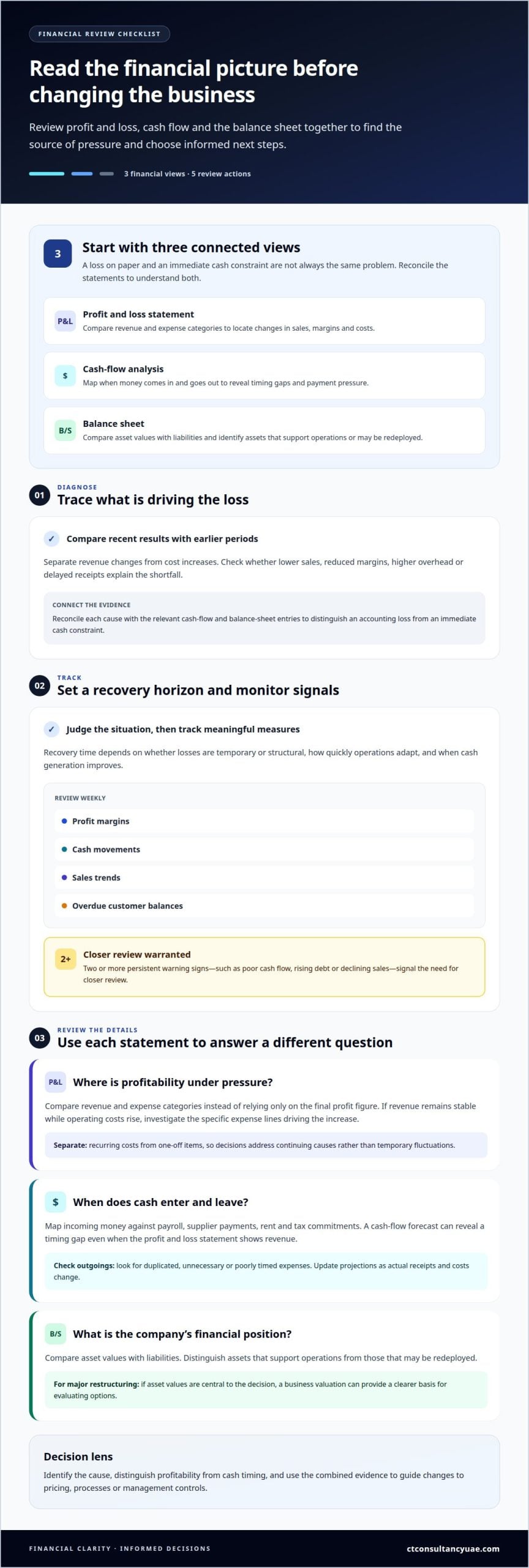
- Trace the causes and extent of the loss. Compare recent profit and loss statements with earlier periods, separating revenue changes from cost increases. Identify whether lower sales, reduced margins, higher overhead or delayed receipts explain the shortfall. Reconcile each cause with the relevant cash-flow and balance-sheet entries to distinguish an accounting loss from an immediate cash constraint.
- Set a recovery horizon and track meaningful measures. Recovery time depends on whether losses are temporary or structural, how quickly operations adapt, and when cash generation improves. Track weekly profit margins, cash movements, sales trends, and overdue customer balances. Two or more persistent warning signs, such as poor cash flow, rising debt, or declining sales, indicate that closer review is warranted.
- Use the profit and loss statement to locate pressure. Compare revenue and expense categories instead of relying only on the final profit figure. If revenue remains stable while operating costs rise, investigate the specific expense lines driving the increase. Separate recurring costs from one-off items so decisions address continuing causes rather than temporary fluctuations.
- Analyse cash flow and outgoing payments. Map when money enters and leaves the business, including payroll, supplier payments, rent and tax commitments. A cash-flow forecast can reveal a timing gap even when the profit and loss statement shows revenue. Review outgoing payments for duplicated, unnecessary or poorly timed expenses, then update projections as actual receipts and costs change.
- Read the balance sheet as a decision tool. Compare asset values with liabilities to understand the company’s financial position, while distinguishing assets that support operations from those that may be redeployed. Financial losses can prompt changes to pricing, processes, or management controls. If asset values are central to a major restructuring decision, a business valuation can provide a clearer basis for evaluating options.
- Build a complete obligations schedule. Record each lender, supplier, landlord, employee-related commitment and tax payable, alongside due dates and payment terms. Separate overdue balances from amounts not yet due. This shows which obligations need immediate attention and which can be discussed ahead of their due dates. Include recurring commitments, since several manageable payments can combine into a serious cash burden.
- Classify assets by availability and business purpose. List bank balances, receivables, inventory, equipment and other business assets. Note which support operations, which are tied up and which could potentially be redeployed. Unused equipment, for example, may not generate revenue, while essential production machinery keeps customer orders moving. Do not treat an asset’s recorded value as cash available for immediate expenses.
- Separate essential expenses from deferrable spending. Identify payments required to keep the business operating, such as core supplier costs, rent, payroll and essential systems. Then flag discretionary or postponable expenses for review. A subscription unused by any active team member may be a candidate for cancellation, while removing a system needed to process customer orders could disrupt revenue.
- Match available funds to payment timing. Compare expected receipts with obligations falling due, using realistic collection dates rather than invoice dates. An unpaid customer invoice cannot cover tomorrow’s supplier payment. Flag shortfalls early, then consider whether customer follow-up, revised payment timing or a creditor discussion can ease pressure without interrupting essential operations.
- Set priorities and document decisions. Rank commitments by urgency, operational impact and the consequences of delay. Record agreed payment changes and update the schedule as circumstances shift. If commitments to lenders and trade creditors exceed funds available for immediate operations, escalate the assessment promptly. A current, itemised view helps decision-makers distinguish temporary timing pressure from a deeper solvency concern.
Strategic innovation after business losses
- Choose innovation that addresses a proven revenue gap. A business can increase revenue and improve margins by developing services, adding value, or launching products customers have a reason to buy. Compare each idea’s sales potential with delivery costs and available capacity. A practical part of how to recover from business financial losses is prioritising changes that strengthen contribution margins without adding unnecessary complexity.
- Start with customer demand and existing strengths. Review customer feedback, repeat purchases and requests the business cannot currently meet. A consultancy, for example, might adapt an established capability for a customer segment it understands. Building on existing expertise may be more practical than entering an unfamiliar market that requires new capabilities and additional operating costs.
- Test the offer before committing substantial resources. Define the customer, problem, proposed solution and delivery process. Trial a revised service with a limited customer group, then assess enquiries, conversions, delivery effort and feedback. If customers value the change but fulfilment takes too much time, refine the scope or process before expanding it.
- Connect the idea to operational execution. Assign responsibility for development, sales, delivery and financial monitoring. Update team handoffs, retrain staff when processes change, and introduce system checks to catch errors early. In one business example, profitability exceeded its pre-loss level five months after restructuring, rebuilding handoffs, retraining staff and installing system checks.
- Review results and adapt deliberately. Compare actual revenue, direct costs and customer response with each initiative’s assumptions. Continue changes that support profitable demand; revise or stop those that absorb cash without improving performance. If you are considering how to recover from business financial losses, treat setbacks as information about business habits and adaptability, not as a reason to innovate without discipline. Consider company value as part of strategic decision-making.
CTC Tax & Accounting: Business Valuation
CTC Tax & Accounting provides Business Valuation to help owners understand a company’s value when assessing recovery options, restructuring or planning a strategic change. A valuation can add context to decisions involving business assets, future direction or a potential transaction, alongside the financial reviews discussed above.
Accurate records support a clearer assessment. CTC Tax & Accounting’s Bookkeeping and Accounting Services help maintain reliable financial information, while Internal Audit Services examine internal processes and controls. These services can be useful when financial reporting or operational weaknesses complicate recovery planning.
Consider Business Valuation when a decision depends on an informed view of the company’s worth, rather than revenue or cash flow alone. Contact CTC Tax & Accounting to discuss your business valuation needs.
Turn Financial Insight Into a Resilient Next Step
A sound plan for how to recover from business financial losses turns financial insight into measured decisions, with priorities aligned to operating capacity and customer needs. Treat recovery as an ongoing management discipline: assign responsibility for each change, review its effect on performance and revise the approach as business conditions shift. This keeps innovation grounded in financial evidence rather than instinct alone.
Reliable records and controls can support those decisions. CTC Tax & Accounting offers Bookkeeping and Accounting Services, Internal Audit Services, and VAT Registration and Compliance to help businesses address financial recordkeeping, internal controls, and VAT compliance needs. Choose the support that fits the issue your business is working through. Contact CTC Tax & Accounting to discuss a suitable next step, and move forward with a clearer basis for rebuilding stability.
Frequently Asked Questions
What are the first steps to take after a business suffers financial losses?
First, establish the immediate cash position and identify payments that could interrupt essential operations. Assign a decision-maker to coordinate updated records, communications and near-term decisions. Keep invoices, bank statements, contracts and creditor correspondence together in one organised file. This provides a dependable basis for internal discussions and helps prevent teams from acting on inconsistent financial information.
How can a business create a cash flow forecast and recovery budget?
Build the forecast around expected receipt and payment dates, not accounting profit alone. Separate confirmed customer receipts from estimates, then record payroll, supplier invoices, rent, tax payments and planned spending by due date. Create a recovery budget that distinguishes essential operating costs from proposed changes. Update it when orders, collections or supplier terms change, and compare actual results with projections.
What expenses should a struggling business cut or renegotiate first?
Start with costs that have little operational impact and can be changed without undermining revenue or customer service. Review unused software seats, optional external support, nonessential travel and purchasing commitments that exceed current demand. Before cancelling a contract, assess exit terms and replacement costs. Renegotiate recurring services if usage has changed, while retaining spending that protects delivery, safety or critical customer relationships.
How can a business negotiate payment plans with lenders, suppliers, and landlords?
Approach each creditor early with a concise proposal based on expected cash receipts and essential expenses. Explain what the business can pay, the proposed dates and how it will keep future payments current. A supplier discussion may focus on staged settlement, while a lender or landlord may consider revised timing. Record agreed changes in writing and update the forecast.
What financing options are available to businesses recovering from losses, and what do they cost?
Possible routes include owner funding, reinvested cash, revised supplier terms or borrowing through a loan or credit facility. Compare each option’s interest, fees, security requirements, repayment schedule and effect on future cash flow. Costs depend on the lender, facility structure, business risk and repayment terms. Avoid adding debt unless projected cash generation can support repayments alongside existing commitments.
What tax relief, grants, or government support are available to struggling businesses in the UAE?
Support depends on the programme, business activity, eligibility criteria and applicable UAE requirements. Financial losses alone do not establish eligibility. Review official programme terms before relying on a grant or relief in a recovery budget. Separately, assess tax obligations and filing records under the rules that apply to the business. Treat anticipated support as uncertain until approval and timing are established.
