
A non-resident founder can pursue UAE funding, but a credible case depends on clear financial records, a persuasive plan and evidence of traction. Preparing for a funding round in the UAE typically takes 4-8 weeks; the wider process from first connection to funds received typically takes 4-8 months. A business plan may take 2 weeks in some cases and can run 20-35 pages, depending on the business’s complexity.
It’s understandable to focus first on finding investors, particularly when you’re building a business from outside the country. But investors also need to understand how the business earns revenue, what the funding will achieve, and whether its financial story holds up to scrutiny.
This guide explains how to organise historical financials and supporting evidence, shape a business plan and projections, and assess traction for a funding discussion in the UAE. It also covers how to make the pitch coherent, plan your preparation, and bring financial and CFO advisory support into the process.
Reduce funding risk by reconciling financial records, documenting liabilities, and matching the funding request to business needs. Common mistakes include unsupported forecasts, undocumented founder loans, and inconsistent figures across investor materials.
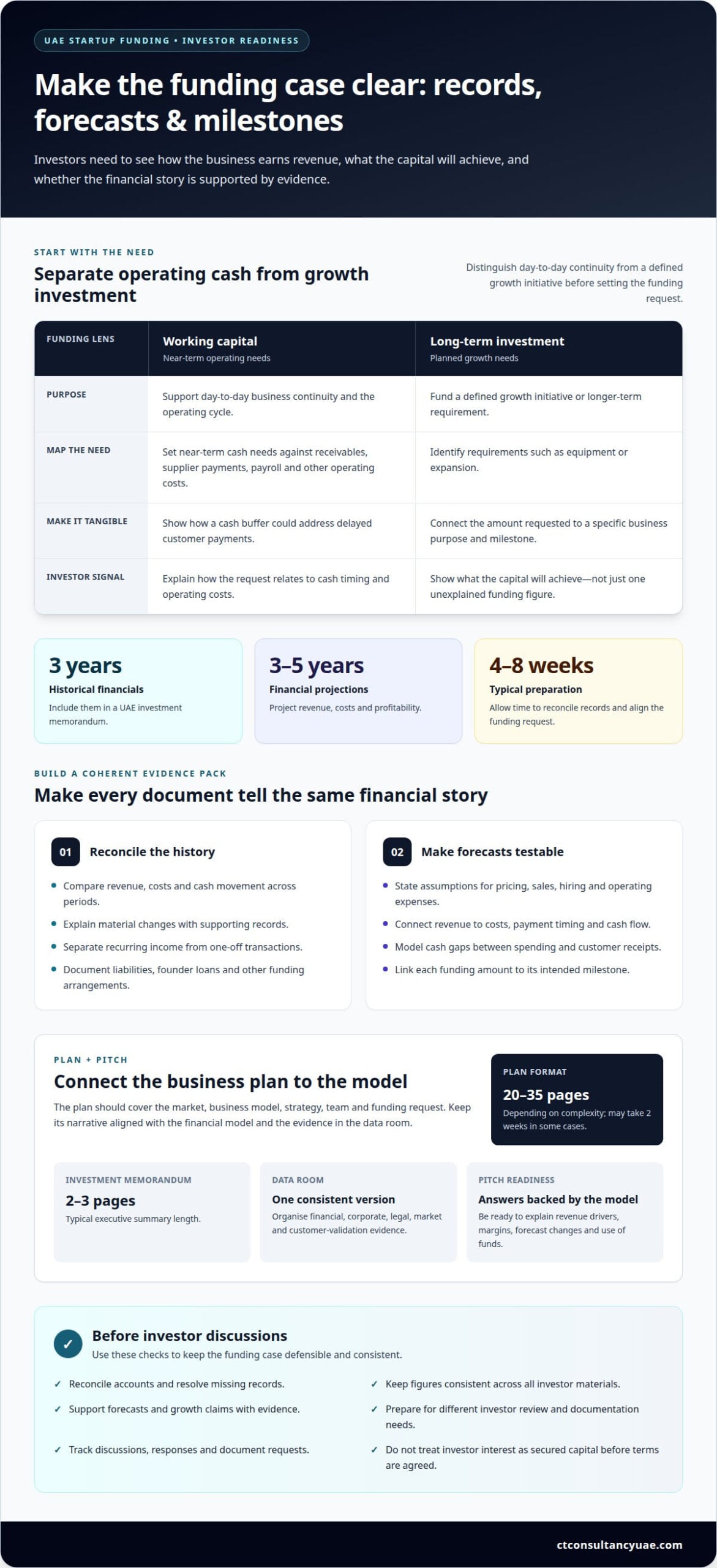
Separate working capital from long-term investment before approaching angel investors, family offices, or venture capital funds. Map near-term cash needs against receivables, supplier payments, payroll, and other operating costs. Then identify longer-term requirements, such as equipment or expansion. This distinction shows whether capital will support day-to-day continuity or a defined growth initiative.
Prepare a funding schedule that links each requested amount to a business purpose and milestone. For example, distinguish a cash buffer for delayed customer payments from investment in new equipment. Avoid presenting one unexplained figure: investors need to understand how the request relates to the company’s operating cycle and strategy.
Assemble financial statements, corporate and legal documents, market research and customer validation evidence in an organised data room. A UAE investment memorandum should include 3 years of historical financials, with an executive summary typically spanning 2-3 pages. Keep a consistent version of each document so investors receive matching figures and explanations.
Document every funding arrangement, including money provided by friends and family, in formal agreements. Requirements vary by investor or lender, so prepare core records and tailor supporting material to the reviewer. In investor communications, explain the business model, use of funds, and key assumptions plainly. Avoid conflicting figures or claims that the documents cannot support.
Begin preparation before outreach, allowing time to reconcile accounts, resolve missing records and align management on the funding request. UAE fundraising preparation typically takes 4-8 weeks. An internal audit can help identify control weaknesses and inconsistencies that may become difficult questions during due diligence.
Prepare for the distinct priorities of angel investors, family offices, and venture capital funds, whose review focus and documentation needs can differ. A common mistake is treating investor interest as secured capital before terms are agreed, or overlooking liabilities and informal funding arrangements. Keep a clear timeline of discussions, responses, and document requests, and ensure every update matches the company’s financial records.
Turn financial records into a plan investors can test against the startup’s operating model. Connect forecasts, unit economics, and management explanations so the funding case remains consistent.
Reconcile historical results before using them as the foundation for forecasts. Compare revenue, costs and cash movement across periods, and explain material changes with supporting records. A UAE investment memorandum should include 3 years of historical financials, giving investors a basis for assessing performance rather than relying on unsupported claims.
Separate recurring income from one-off transactions, and identify costs that may change as the business grows. Be ready to explain differences between management accounts and forecast assumptions. Avoid treating an unusual past result as though it reflects normal trading.
Model how each sale contributes to operating costs, then assess how timing affects available cash. Compare customer acquisition and delivery costs with revenue per customer, using actual business records where possible. Unit economics help angel investors assess whether growth can strengthen the venture’s underlying model.
Connect projected sales to payment timing, supplier obligations, hiring, and other operating expenses. A startup can forecast a profit yet need funding before customers pay. Model that cash gap directly and show how the requested capital supports operations until receipts arrive. Explain the assumptions behind any runway estimate.
Develop a business plan that sets out the market, business model, strategy, team and funding request. A UAE business plan may be completed within 2 weeks in some cases and may run 20-35 pages, depending on complexity. Keep its narrative aligned with a financial model projecting revenue, costs and profitability over 3-5 years.
Make assumptions about pricing, sales, hiring and operating expenses understandable, then link requested capital to milestones. A feasibility study can test whether planned expansion fits the sector and the company’s resources. For tailored business planning and feasibility analysis, explore business advisory services.
Rehearse concise answers about revenue drivers, margins, forecast changes, and use of funds. Assign each topic to a management lead, and keep the supporting model available during investor discussions. A pitch deck can cover the problem, solution, market, traction, team, growth potential, and funding request.
Explain how innovation or a free-zone operating setup affects the business model only when relevant to the company’s actual plans. Investors assess whether the strategy and assumptions fit the sector. Avoid conflicting answers between founders or presenting projections without being able to explain their underlying drivers.
Investors in the UAE look for evidence of demand and the business’s ability to execute locally. Due diligence commonly covers financial statements, legal documents, market research, and customer validation. The European Commission notes that venture capitalists assess market, strategy, and management before financial position.
Show direct evidence through UAE revenue, customer retention, signed pilots or repeat purchases. In 2025, more than 78% of successful UAE funding rounds involved startups with UAE revenue, local corporate pilots or major accelerator acceptance. The same year, founders with active Dubai or Abu Dhabi operations had a 32% close rate on funding introductions, compared with 10% for remote founders.
Map evidence to the customer segment and explain what each signal demonstrates. Connect relevant commercial relationships to demand, rather than presenting general interest as confirmed sales.
Match the funding proposal to the investor type, business stage, and traction. Angel investors may provide capital in exchange for equity or convertible debt, while venture and private equity investors examine growth prospects and the company’s route to scale. Present a valuation rationale linked to operating performance, market demand, and credible milestones.
Review proposed terms as a whole, including dilution, conversion mechanics, governance, and investor rights. Explain how the chosen instrument affects ownership and future financing instead of focusing only on headline valuation. A clear comparison helps founders understand the trade-offs before agreeing to terms.
Organise a due diligence file that links claims to evidence: financial statements, corporate and legal records, market research, customer validation, and material agreements. Investors use these materials to test whether reported revenue matches customer activity and whether management’s strategy reflects market evidence.
For a startup in a regulated sector, prepare relevant regulatory approvals for review. Keep document versions consistent and answer investor questions with evidence, not estimates presented as fact. Explain material gaps directly, including their effect on revenue, operations, or valuation, to keep diligence discussions focused and reliable.
Compare funding structures by stage, dilution, and governance, not headline valuation alone. Terms in the UAE vary by instrument and investor expectations.
CTC Tax & Accounting can help organise the financial information behind a funding valuation through bookkeeping and accounting, internal audit, VAT compliance, and Corporate Tax Advisory. These services support a clearer view of historical performance, financial controls, and tax records that investors may examine when assessing a company.
Consider this support when records need reconciliation, controls require review, or tax matters need to be reflected accurately in funding materials. Valuation discussions are more useful when their financial foundations are organised and consistent with the company’s operating results. CTC Tax & Accounting can help address these preparation needs in the context of your business.
Contact CTC Tax & Accounting to discuss financial preparation for your funding round.
A funding round is also an opportunity to strengthen financial decision-making beyond the immediate raise. As the business develops, maintain clear accountability for reporting, controls, and tax records so future investor discussions can build on a dependable financial picture. Preparing for a funding round in the UAE can be part of disciplined growth, rather than a one-off exercise before investor outreach.
CTC Tax & Accounting provides Bookkeeping and Accounting Services, Internal Audit Services, and VAT Registration and Compliance. These services help businesses organise financial records, review controls, and manage VAT compliance as they prepare for investor scrutiny.
For support tailored to your funding preparation, contact CTC Tax & Accounting. A considered next step can help you move forward with greater clarity and focus.
Yes, non-resident founders can approach UAE investors; being based overseas does not prevent investor outreach. Investors will assess how the company can serve customers in the UAE and execute its plans. Explain the operating model, customer access, and intended local presence clearly. A remote founder can strengthen the case by showing credible market demand and a practical plan for delivering products or services in the UAE.
A UAE fundraising process from first connection to funds received typically takes 4-8 months, although there is no fixed closing timetable. Investor introductions, due diligence, negotiation and documentation all affect the pace. A straightforward review may progress differently from a round involving multiple investors or unresolved diligence questions. Treat the timeline as a planning guide, and maintain momentum by responding promptly and keeping materials organised.
Traction is evidence that customers want the product and the business can deliver it. Examples include paid sales, repeat orders, renewals, customer referrals, or a pilot that has progressed into a commercial relationship. For a UAE-focused startup, local customer revenue or a corporate pilot can demonstrate market fit. Explain what each signal shows, and distinguish completed transactions from expressions of interest.
Before investor discussions, prepare current financial records, company and ownership documents, material agreements, market research, and evidence supporting customer demand. Include written agreements for founder, friends-and-family, or other existing funding so the terms and repayment or conversion arrangements are clear. Organise files by topic and record updates. This makes it easier to respond consistently when an investor requests specific evidence.
Preparing for a funding round in the UAE means getting the company ready to explain and evidence its investment case. Align the funding request with business priorities, prepare management to discuss performance, and organise records for investor review. Decide which investor types fit the company’s stage and objectives, then ensure communications accurately reflect its current position.
There is no single entity structure that suits every UAE funding round; the choice depends on business activity, investor requirements and intended operating location. Mainland UAE LLCs can have 100% foreign ownership in most sectors, while DIFC offers 100% foreign ownership. ADGM and DIFC operate under common law. Consider how the structure supports governance, investor participation and future operations before selecting one.