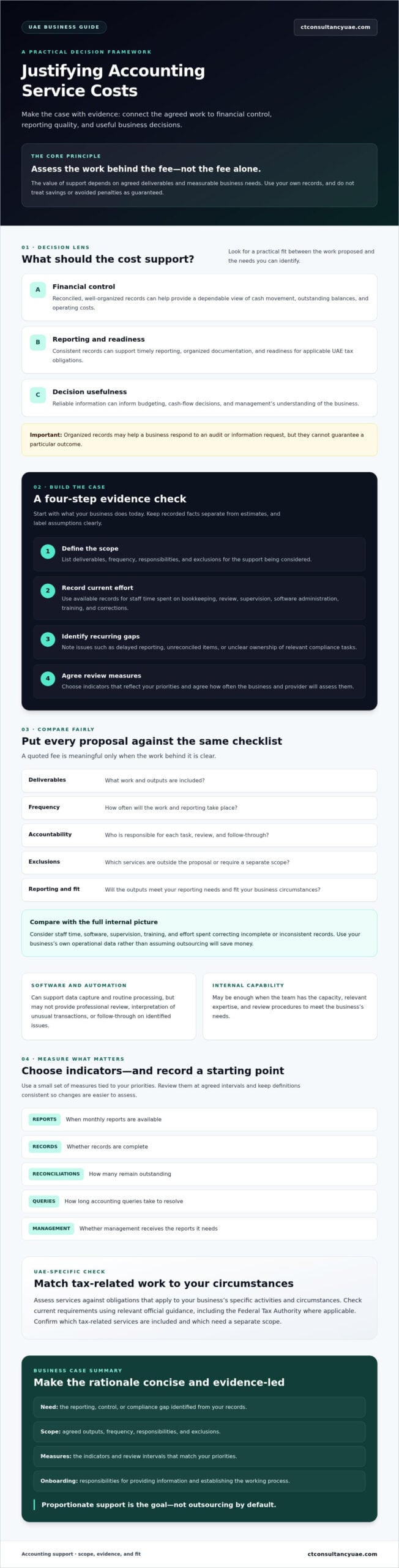
What if the strongest case for accounting support isn’t a promise of savings, but clearer financial control and fewer compliance blind spots? For UAE businesses asking how to justify accounting service costs, the distinction matters: providers may define their scope differently, and the value of accurate records is not always visible on an invoice.
You should be able to see what you’re paying for and how the work supports your business. This guide explains how to build an evidence-based case, compare proposals on equal terms, and decide whether the support matches your reporting and compliance needs.
You’ll learn how consistent bookkeeping supports reliable financial reporting and readiness for applicable UAE tax obligations, what to check in a provider’s scope, and how accounting information can inform budgeting, cash flow, and business decisions. The aim is to assess accounting as a practical part of risk management and decision support, not simply an administrative expense.
Key Takeaways
- Learn how to justify accounting service costs by linking the agreed scope to risk control, reporting quality, and decision usefulness.
- Use your business’s own records to compare external fees with the time and resources required to manage accounting internally.
- Assess proposals consistently by checking deliverables, frequency, exclusions, accountability, and fit for your UAE business.
- Prepare a concise business case that sets out the need, expected outputs, review measures, and onboarding responsibilities.
How to justify accounting service costs as a business investment
Recurring professional fees need a clear business rationale. To assess how to justify accounting service costs, compare the documented scope with the controls it supports, the quality of reporting it produces, and the usefulness of that information for decisions. Look beyond the fee to include internal staff time, accounting software, supervision, training, and effort spent correcting incomplete or inconsistent records. Use your own operational data rather than assuming outsourcing will save money.
For a UAE business, assess tax-related work against obligations that apply to its specific activities and circumstances. Check current requirements using relevant official guidance, including the Federal Tax Authority where applicable. Make sure each proposal explains which services are included and which need a separate scope.
Why accounting can be more than transaction processing
Reconciled, well-organized records give management a more dependable view of cash movement, outstanding balances, and operating costs. That information can support timely reporting and more informed budgeting or cash-flow decisions. This is the practical connection to Management accounting principles: financial information can inform internal decisions, not just record past transactions. Organized documentation can also help a business respond to an audit or information request, although it cannot guarantee a particular outcome.
Addressing the objection that software or existing staff is enough
Software can automate data capture and routine processing, but automation alone may not provide professional review, interpretation of unusual transactions, or follow-through on identified issues. An internal team may be enough if it has the capacity, relevant expertise, and review procedures to meet the business’s needs.
Test the current process against practical questions. Are reconciliations completed on schedule? Can management access reliable reports when needed? Is someone responsible for reviewing exceptions and tracking applicable compliance work? If gaps recur, compare the cost and scope of bookkeeping and accounting services with the internal resources needed to address them. The goal is proportionate support, not outsourcing by default.
Build a measurable case for accounting service costs
A practical business case starts with evidence, not an assumed return. Use this four-step method to assess how to justify accounting service costs for your business:
- Define the scope: List the deliverables, frequency, responsibilities, and exclusions under consideration.
- Record current effort: Document staff time spent on bookkeeping, review, supervision, software administration, training, and corrections.
- Identify exposure: Note recurring gaps, such as delayed reporting, unreconciled items, or unclear ownership of relevant compliance tasks.
- Agree review measures: Select indicators and decide how often the business and provider will assess them.
Compare proposals with your internal records, including the time and systems needed to maintain the current process. Keep recorded data separate from estimates, and label assumptions clearly. “The value of accounting support depends on agreed deliverables and measurable business needs, not the fee alone.”
Which indicators can demonstrate value over time?
Choose a small set of measures that reflects your priorities, and record the starting point before work begins. For example, track when monthly reports are available, whether records are complete, how many reconciliations remain outstanding, and whether management receives the reports it needs. You might also monitor how long accounting queries take to resolve. Review the same measures at agreed intervals and use consistent definitions, so changes are easier to assess.
How to document the business case without overstating returns
Build the case from timesheets, system costs, review logs, correction records, and reporting dates. State what you observed and what you assumed; don’t present avoided penalties or savings as guaranteed outcomes. For a wider planning perspective, connect accounting information to strategic financial management for SMEs, particularly where it informs budgeting or cash-flow decisions. A tailored accounting services scope can then be assessed against the measures that matter to your business.
Compare accounting proposals by scope, accountability, and fit
A quoted fee is meaningful only when the work behind it is clear. To compare proposals fairly and understand how to justify accounting service costs, place them side by side against the same criteria: deliverables, frequency, responsible parties, exclusions, reporting, and how issues are escalated. A lower fee may reflect a narrower scope, while a higher one may include work your business doesn’t need.
Separate recurring bookkeeping from work that may be scoped independently, such as VAT or Corporate Tax support, year-end accounts, internal audit, and CFO advisory. As demonstrated by practices like Stewart Accounting Services, comprehensive year-end reporting involves specific statutory preparations that address different needs and shouldn’t be assumed to come with a routine bookkeeping engagement. For further guidance, consult the related guide on defining an outsourced bookkeeping service scope.
Questions that reveal what a quoted fee actually covers
Ask each provider to document the assumptions behind its proposal, including transaction volumes, entities, reporting frequency, reconciliations, and tax-related responsibilities. Clarify who supplies and reviews source documents, what happens when records are missing, how queries are handled, and how the scope can change as the business grows.
- Which deliverables and reporting outputs are included, and how often are they provided?
- What must the client prepare or approve?
- Which services are excluded, and how is out-of-scope work agreed?
- Who handles review, communication, and escalation?
Match the engagement model to the business need
Recurring bookkeeping may suit an ongoing need to maintain records. A defined tax project may suit a specific compliance requirement, while CFO advisory may be relevant when management needs support with budgeting, cash flow, or planning. Confirm applicable UAE obligations using current official guidance, and verify the exact inclusions in each proposal. CTC Tax & Accounting’s accounting services and deliverables can be reviewed as one reference point when assessing fit. Compare the scope with your requirements before deciding.
Turn the accounting cost case into a clear next step
Bring your evaluation together on one page before approving an engagement. State the business’s current need, the agreed scope, expected outputs, measures for reviewing performance, and when those measures will be assessed. This record makes it easier to explain how to justify accounting service costs and revisit the decision if reporting needs or business activity change.
A practical checklist before approving the engagement
Confirm the arrangements in writing before onboarding. Identify the accountable contacts on both sides, the client’s document and approval responsibilities, the reporting schedule, and how questions or urgent issues will be escalated. Agree on secure document-transfer practices and a communication cadence. Finally, check that the proposed services fit the entity’s accounting requirements and applicable UAE compliance obligations, using current official guidance to verify the latter.
How to move from evaluation to a tailored discussion
For a useful initial discussion, prepare a concise overview of your business structure, transaction profile, reporting needs, and current accounting process. Note where records, review capacity, or management information may need support. CTC Tax & Accounting provides tailored bookkeeping and accounting, tax compliance, and advisory support for SMEs and freelancers; the appropriate scope depends on the business’s requirements. If broader financial guidance is relevant to planning, explore CFO advisory support for planning.
Use your documented needs to decide which deliverables should be included and what should be reviewed separately. Confirm the proposed scope and responsibilities before proceeding.
Make your next accounting decision with confidence
A defensible case for accounting support starts with a clearly documented scope, not a promise of automatic savings. To understand how to justify accounting service costs, compare the proposed deliverables with the time and resources your current process requires, then agree on practical measures such as reporting timeliness and record completeness. Assess proposals consistently, including their exclusions, responsibilities, and review process.
For UAE SMEs and freelancers, the appropriate support depends on the business’s reporting and applicable compliance needs. CTC Tax & Accounting provides bookkeeping, tax compliance, internal audit, and CFO advisory services. These options can be considered individually or in combination, based on the scope required; confirm the precise inclusions before proceeding.
Bring your business structure, transaction profile, and current accounting process into the discussion to clarify what support may fit. Discuss an accounting scope tailored to your business. A measured, evidence-based approach can help you make a confident decision and establish a clearer foundation for the next stage of growth.
Frequently Asked Questions
How do you justify the cost of an accounting service?
Compare the written service scope with your business’s workload, reporting needs, and applicable compliance responsibilities. To assess how to justify accounting service costs, record internal staff time, supervision, systems, and recurring process issues, then agree on relevant measures such as reporting timeliness and reconciliation status. Use your own figures, label assumptions clearly, and avoid treating potential savings or improved outcomes as guaranteed.
What should accounting services include to justify their fees?
There’s no single standard package, so assess the proposal’s specific deliverables. Check whether it covers maintaining records, reconciliations, reports, reviews, tax-related tasks, and routine communication, then identify what’s excluded and what your team must provide. Ask who reviews completed work and how additional services are approved. Confirm the scope, responsibilities, and review process in writing before the engagement begins.
Is outsourcing accounting cheaper than hiring an accountant?
Not necessarily; the more useful comparison is the full cost and capacity of each model. Consider internal staff time, supervision, recruitment, systems, training, and continuity alongside the provider’s defined scope. Then assess whether you need ongoing transaction processing, specialist review, or periodic advice—for instance, specialist practices like Performance Accountancy illustrate how tailored firms support specific reporting and payroll needs. Compare equivalent responsibilities using your own operational data, rather than deciding from a salary or quoted fee alone.
How can a small business measure the value of accounting services?
Set a baseline before the engagement and choose a few measures linked to your needs. These could include when reports are ready, whether reconciliations are complete, how clearly cash flow is visible, and how much time is spent resolving record queries. Review the same measures at agreed intervals. Document assumptions, and don’t attribute wider business results to the provider without evidence.
What questions should I ask before accepting an accounting services proposal?
Ask what work is included, how often it’s completed, who reviews it, and what information your team must provide. Clarify exclusions, tax-related responsibilities, reporting formats, communication channels, document-handling practices, and how extra work is approved. Request written deliverables and a review process so you can compare proposals consistently. For UAE obligations, verify which requirements apply to your business using current official guidance.