
What if the biggest obstacle to investor confidence isn’t your forecast, but the records behind it? If you’re asking how to get investor-ready financial statements, start with traceable historical results. Inconsistencies between bookkeeping, reports and forecasts can raise questions before investors assess your growth potential. Clear, well-supported reporting also helps UAE businesses manage financial and tax compliance.
Investors need more than a polished profit and loss statement. They need reliable figures, supporting schedules and a concise explanation of performance, cash flow and key assumptions. This guide covers how to organise and reconcile historical statements, document the records behind them, and build a forecast connected to actual results. It also explains how to present the information clearly and prepare for follow-up questions, so investor discussions can focus on the business rather than avoidable gaps in the records.
Investor-ready financial statements are complete, internally consistent, traceable and understandable records that help a prospective investor assess a business’s financial position and performance. They support due diligence, but they don’t guarantee funding. Understanding how to get investor-ready financial statements starts with strengthening the historical evidence, not simply polishing a forecast or presentation.
Historical statements report what has already happened. Forecasts set out what management expects to happen, based on stated assumptions, while an investment presentation explains the opportunity, strategy and funding request. These materials should connect, but they serve different purposes. Investors use reliable reporting to assess performance, cash position and risks, then compare management’s assumptions with the evidence. Financial statements commonly include an income statement, balance sheet and cash flow statement. The precise presentation and supporting information depend on the business and the investor’s review.
The profit and loss statement shows revenue, expenses and the resulting profit or loss over a period. The balance sheet presents assets, liabilities and equity at a particular date. The cash flow statement explains movements in cash across operating, investing and financing activities. Together, they provide a more complete view than any one report alone. Investors may request different reporting periods or supporting schedules depending on the transaction and diligence process. Consistent reporting, such as monthly accounting and financial reporting, makes those records easier to assemble.
If reported revenue doesn’t align with underlying records, or the cash balance can’t be traced to reconciled accounts, investors need to ask why. Missing schedules and unexplained differences can prolong review and make it harder to distinguish timing issues from deeper reporting concerns. Clear, supportable statements help investors assess the business on a consistent basis. They can improve the quality of that assessment, but the investment decision still depends on the opportunity, risk and investor’s own criteria.
A disciplined close turns bookkeeping records into statements that investors can trace and compare. If you’re learning how to get investor-ready financial statements, work through this sequence and retain evidence for each adjustment.
Keep a clear trail from each reported balance to its source. For example, a receivables total should agree with customer-level ageing and the general ledger, with invoices or other relevant records supporting significant balances. Payables ageing, bank reconciliations, payroll summaries and schedules for material assets or liabilities help reviewers understand how figures were built. Consistent file names and period labels make records easier to retrieve during follow-up.
Financial reporting and tax filing serve different purposes, but both should draw on consistent underlying transaction data. Maintain organised records for the accounting close, then prepare tax calculations and filings as a distinct process. Document adjustments between accounting profit and taxable income so tax work does not obscure reported operating performance. A recurring close supported by monthly accounting and reporting helps keep reconciliations, schedules and source documents organised as investor requests arise.
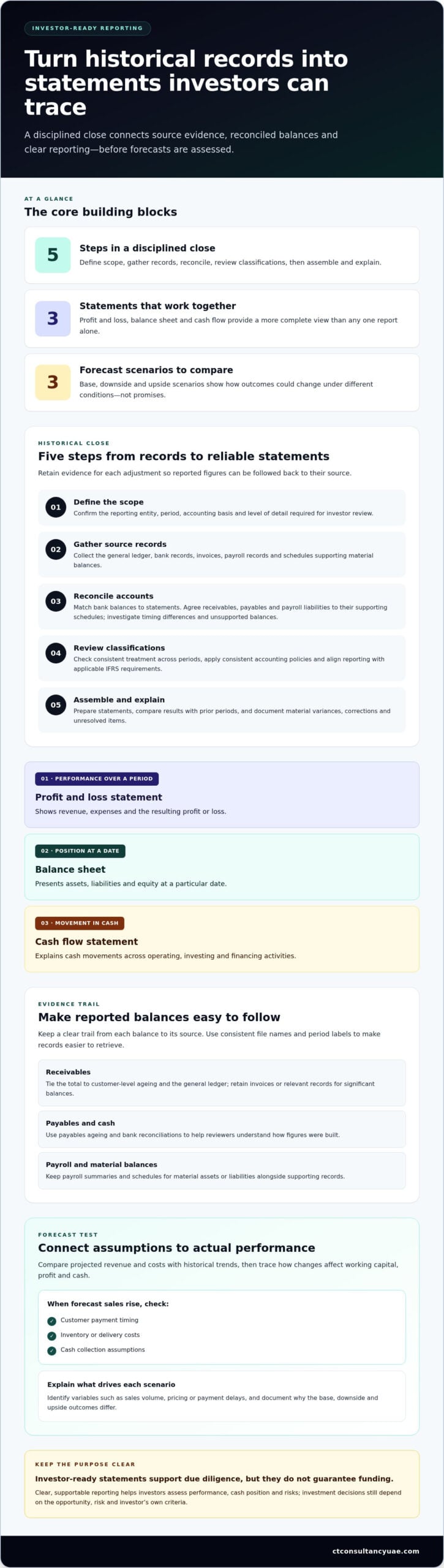
A forecast is more persuasive when its logic can be traced to actual performance. Compare projected revenue and costs with historical trends, then check how changes flow through working capital, profit and cash. For example, if forecast sales rise, review whether assumptions for customer payment timing, inventory or delivery costs, and cash collection reflect how the business operates. CFO advisory and forecasting support can connect historical reporting with projections and management decisions.
Prepare base, downside and upside scenarios to show how results could change under different conditions. Treat these as sensitivity analyses, not promises. Identify the variables that drive each outcome, such as sales volume, pricing or payment delays, and explain why the scenarios differ.
Prioritise unexplained movements between reporting periods, unreconciled balances, unusual one-off items and inconsistent period definitions. Record each correction, its evidence and the reason for it. If an item remains unresolved, document its status and potential effect rather than allowing it to pass into the investor pack without explanation.
Separate actual results from estimates, label forecast periods clearly and state the evidence behind each material assumption. Assign an owner who can explain it, and note what conditions could change it. A forecast should show how revenue, costs, working capital and cash movements relate, rather than presenting them as disconnected figures.
Traceability turns a forecast from a set of figures into a reasoned account of how the business may perform. Before sharing, use this readiness check:
CTC Tax & Accounting’s forecasting support connects reporting, cash-flow forecasts and management analysis.
Investor preparation is more manageable when reporting is part of the regular finance cycle, rather than a one-off exercise that begins with fundraising. Set a recurring timetable for closing the books, reviewing reconciliations and balances, and sharing management reports. Monthly profit and loss and balance sheet reports help reveal trends, such as changing margins or growing receivables, while there is still time to investigate and explain them.
In the UAE, keep accounting records and tax working papers organised around consistent underlying transaction data, while distinguishing financial reporting from tax calculations and filings. This supports a clearer view of business performance and a more coordinated approach to financial management. Use regular reporting to inform operational decisions as well as investor review.
Support can help when bookkeeping has fallen behind, reconciliations are incomplete, or management needs a consistent reporting rhythm. CTC Tax & Accounting provides accounting support that includes bookkeeping, monthly reporting and audit preparation. Its CFO services connect financial dashboards and cash-flow forecasting with management decisions. The scope can be tailored to the business’s records and reporting needs. Strong financial organisation supports investor assessment, but it can’t guarantee an investment outcome.
Before investor discussions, assemble the historical statements, source records and schedules behind material balances. Confirm that bank and control accounts reconcile, document unusual movements, and test whether forecast revenue, costs, working capital and cash movements follow logically from actual results. Keep assumptions clearly labelled, with evidence and explanations ready for follow-up. These steps turn how to get investor-ready financial statements into a repeatable reporting discipline, rather than a last-minute document exercise.
CTC Tax & Accounting offers a 20-minute free consultation to discuss your reporting needs.
Investor readiness is best treated as an ongoing management discipline, not a document sprint triggered by fundraising. Decide who owns the monthly close, how exceptions are recorded, and when leadership reviews results against the forecast. That rhythm helps your team respond to investor questions with evidence while keeping decisions grounded in current financial information.
If internal capacity is constrained, tailored support can provide practical continuity. CTC Tax & Accounting’s accounting services include monthly bookkeeping, financial reporting and audit preparation. CFO services can bring together dashboards, cash-flow forecasting, KPI analysis and financial reporting. The scope can be shaped around your business’s requirements. Strong reporting supports investor assessment, but doesn’t determine an investment decision.
To discuss a practical path for how to get investor-ready financial statements, book a 20-minute free consultation. A clear process begins with one deliberate next step, and your business can build that foundation steadily.
Investors commonly request a profit and loss statement, balance sheet and cash flow information, plus schedules relevant to the business and transaction. The period and level of detail can vary with the company’s age, stage and deal context. Prepare reports using consistent periods, identify whether they are management accounts or independently audited statements, and be ready to explain material movements, such as a change in revenue mix.
No, an audit isn’t required in every investor review, but requirements depend on the investor, transaction, jurisdiction and applicable obligations. If you present unaudited management statements, label them clearly and retain records that support the figures. Don’t describe them as audited or assured. Establish whether the relevant investor, lender or statutory context requires a particular format.
There’s no single historical period that applies to every fundraising process. An early-stage company may have a shorter operating record than an established business, and an investor may request periods suited to the transaction. Prepare the records available on a consistent basis, explain gaps such as a change in accounting system, and clarify the requested period with the investor or transaction adviser before finalising the review pack.
No. Historical statements record past results; a forecast estimates possible future performance. Investors need to distinguish evidence of what the business has achieved from management’s expectations. For example, if a forecast includes a planned expansion that hasn’t yet affected historical costs or revenue, identify it as a future assumption and explain its expected effect. Keep projections clearly labelled so estimates aren’t mistaken for established results.
To get investor-ready financial statements, make each material figure easy to verify and explain. Retain clear links between reports and their supporting records, use consistent reporting periods, and investigate differences before sharing. Compare the figures in the investor pack with the approved reporting version so outdated drafts or mismatched schedules aren’t circulated. Good preparation supports assessment, but can’t guarantee investment approval.