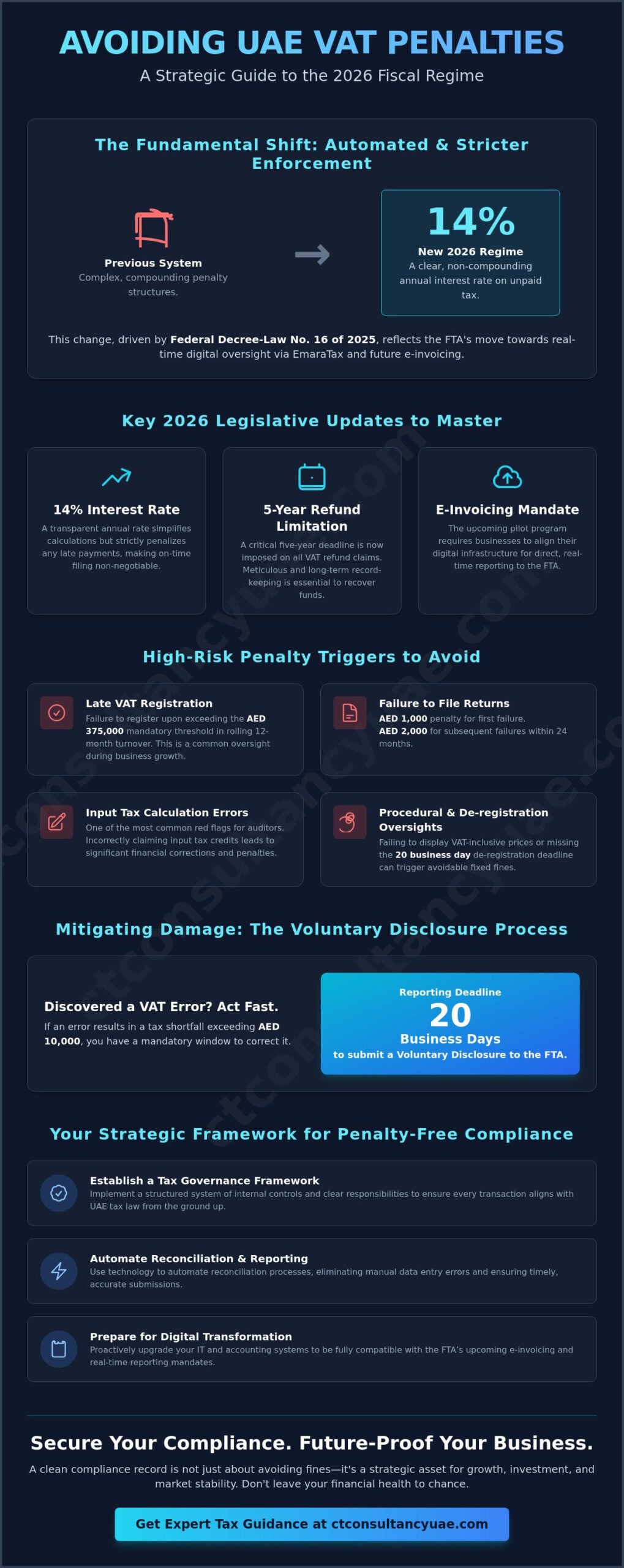
A single administrative oversight under the updated 2026 fiscal regime can now trigger a non-compounding 14% annual interest rate on unpaid tax, effectively transforming a minor clerical error into a significant corporate liability. It’s understandable if the recent legislative overhaul, including the implementation of Federal Decree-Law No. 16 of 2025, has left your executive team feeling exposed to the heightened risk of Federal Tax Authority (FTA) audits. You likely recognize that maintaining a clean compliance record is no longer just about meeting deadlines; it’s about mastering a complex digital ecosystem where the margin for error has narrowed significantly. This guide demonstrates exactly how to avoid VAT penalties in the UAE by establishing a sophisticated tax governance framework that safeguards your operations from the ground up. We’ll provide a strategic roadmap through the new e-invoicing mandates, the revised AED 10,000 voluntary disclosure thresholds, and the critical five-year refund claim deadlines. By aligning your internal controls with these rigorous standards, you’ll secure the peace of mind that comes with a zero-penalty audit record and a streamlined, future-proof filing process.
Key Takeaways
- Analyze the 2026 legislative updates, including the shift to a 14% non-compounding interest rate and the critical five-year limitation on VAT refund claims.
- Identify high-risk triggers such as delayed mandatory registration and input tax errors to understand exactly how to avoid VAT penalties in the UAE.
- Establish a sophisticated tax governance framework that integrates automated reconciliation and a structured internal calendar to eliminate filing delays.
- Navigate the Voluntary Disclosure process with precision by mastering the 20-business-day reporting rule for errors exceeding the AED 10,000 threshold.
- Prepare for the upcoming e-invoicing pilot program by aligning your digital infrastructure with the Federal Tax Authority’s evolving reporting requirements.
The UAE VAT Penalty Landscape: Understanding the Cost of Non-Compliance
The Federal Tax Authority (FTA) has initiated a significant pivot toward automated oversight, marking 2026 as a year of rigorous fiscal discipline. For executive decision-makers, understanding the evolving taxation system in the UAE is no longer an elective exercise but a core component of corporate risk management. The introduction of Cabinet Decision No. 129 of 2025 has fundamentally altered the penalty regime, moving away from complex compounding structures toward a transparent, albeit strictly enforced, 14% annual interest rate on late payments. This shift reflects a broader trend of digital enforcement, where the EmaraTax portal and the 2026 e-invoicing pilot program provide the FTA with real-time audit capabilities. Businesses must adapt their internal workflows immediately to ensure they remain compliant with these high-stakes requirements. Learning how to avoid VAT penalties in the UAE requires a proactive shift from reactive filing to a sophisticated framework of internal controls.
Fixed vs. Percentage-Based Administrative Penalties
The current framework distinguishes between fixed fines for procedural lapses and percentage-based penalties for financial shortfalls. As of April 14, 2026, a first-time failure to file a VAT return results in a fixed AED 1,000 penalty, which doubles to AED 2,000 for subsequent failures within a 24-month period. However, the most significant financial impact often stems from the 14% non-compounding interest applied to late tax payments. This replaces the previous tiered accrual system, simplifying the calculation while maintaining a strong deterrent against delayed remittances. Procedural oversights, such as failing to display prices inclusive of VAT, also carry fixed administrative fines that can quickly erode profit margins. These costs are entirely avoidable through meticulous VAT compliance and real-time reconciliation of accounting records.
The Long-term Strategic Risks of an FTA Audit
Beyond the immediate financial drain, a history of administrative penalties negatively alters a company’s risk profile within the FTA’s database, often triggering more frequent and granular audits. This heightened scrutiny can become a significant hurdle during corporate restructuring or business valuation exercises, as potential investors view tax non-compliance as a red flag for internal mismanagement. Strategic reassurance in the marketplace depends on a clean regulatory record that demonstrates long-term stability. Tax Governance is the primary shield against financial loss, representing a structured framework of internal controls designed to ensure every transaction aligns with current UAE law. By prioritizing these governance standards, entrepreneurs can ensure a frictionless experience when expanding into new markets or seeking external investment.
Critical Pitfalls: Where Most UAE Businesses Trigger Fines
Operational expansion frequently masks underlying compliance risks that only surface during a rigorous audit. While many leaders focus on high-level strategy, the UAE Federal Tax Authority (FTA) increasingly identifies administrative lapses in routine procedures as the primary source of penalty assessments. These pitfalls aren’t merely clerical inconveniences; they represent significant fiscal vulnerabilities that can disrupt cash flow and damage institutional credibility. Understanding these technical nuances is essential for any executive seeking how to avoid VAT penalties in the UAE while maintaining an aggressive growth trajectory. Precision in record-keeping remains the most effective deterrent against the scrutiny of a tax inspector.
Registration and De-registration Deadlines
The transition from a developing enterprise to a major market player often triggers the mandatory VAT registration threshold of AED 375,000. It’s a common misconception that registration is only required upon reaching this figure; in reality, businesses must monitor their rolling 12-month turnover to anticipate this milestone. Failure to register within the prescribed timeframe results in immediate administrative fines that accumulate over time. Similarly, the obligation to de-register within 20 business days of ceasing taxable activities or falling below the voluntary threshold is frequently overlooked. This is particularly relevant for entities navigating the complex distinctions between Mainland operations and specific Free Zone regulations, where the nature of "Designated Zones" continues to evolve under 2026 standards.
Invoicing Errors and the 2026 Digital Mandate
As the UAE transitions toward a digitized economy, the requirements for a valid Tax Invoice have become more stringent. A single missing element, such as a clearly displayed Tax Registration Number (TRN) or the correct date of supply, can render an entire input tax claim invalid. This risk is amplified by the upcoming E-Invoicing mandate, with the pilot program scheduled for July 1, 2026. Businesses with revenue exceeding AED 50 million must appoint an Accredited Service Provider by July 31, 2026, to avoid a monthly penalty of AED 5,000. Relying on manual data entry is no longer a viable strategy in this high-stakes environment. Implementing a robust VAT compliance framework ensures that your digital infrastructure automatically aligns with these evolving standards, eliminating the friction of technical non-compliance. By shifting toward automated reconciliation, you safeguard your business against the AED 100 penalty per non-compliant e-invoice that will become mandatory for large-scale filers in 2027.
Strategic Framework for Penalty-Free VAT Compliance
A sophisticated tax governance framework is the only sustainable method for high-growth entities to maintain a frictionless relationship with the FTA. While identifying pitfalls is necessary, the transition to a penalty-free environment requires a structured internal control system that pre-empts errors before they reach the EmaraTax portal. This proactive stance is central to how to avoid VAT penalties in the UAE, moving your finance department away from end-of-month panic toward a steady state of fiscal readiness. By integrating professional VAT registration and compliance services, you ensure that your corporate strategy is always aligned with the latest regulatory nuances. Implementing these controls is the definitive answer for leadership teams questioning how to avoid VAT penalties in the UAE while scaling their operations.
Automating the Compliance Lifecycle
The 2026 digital mandate necessitates a shift toward FTA-accredited accounting software capable of real-time data synchronization. Manual reconciliation between internal ledgers and tax portals is the most frequent point of failure for UAE businesses. Digital document management systems now provide granular visibility into output tax liabilities, allowing for immediate corrections rather than waiting for an audit cycle to reveal discrepancies. This level of automation doesn’t just save time; it serves as a primary friction-remover in your reporting workflow. It’s vital to select a platform that can handle the specific technical requirements of the e-invoicing pilot program, which begins on July 1, 2026. You need a system that alerts you long before a deadline passes. It’s a dynamic environment, and your software must reflect that reality.
The Role of Internal Audits in Tax Readiness
Conducting a periodic internal audit functions as a strategic defense mechanism against unforeseen liabilities. These health checks verify the accuracy of Tax Agency numbers (TAN) and ensure that all zero-rated and exempt supplies are categorized with precision. It’s often the subtle misclassification of international services or local real estate transactions that triggers significant fines. A professional gap analysis identifies these weaknesses early, allowing for a structured correction plan that protects your business valuation and long-term stability. Your audit should also confirm that all supporting documents, such as contracts and proof of export, are archived in accordance with the five-year retention rule. This meticulous approach transforms compliance from a burden into a competitive advantage.
Mitigating Damage: The Voluntary Disclosure and Waiver Process
Even with the most robust internal controls, clerical discrepancies can occasionally manifest in complex tax environments. When a business discovers a historical error in its VAT reporting, the priority shifts from prevention to strategic mitigation. The Voluntary Disclosure (VD) mechanism, facilitated via Form 211 on the EmaraTax portal, serves as the primary instrument for self-correction. Understanding the tactical timing of this submission is a critical component of how to avoid VAT penalties in the UAE, as it allows entities to rectify errors before they are identified during an official FTA audit. Proactive disclosure often results in a significantly lower penalty exposure compared to errors discovered by the authority, which typically trigger a 15% penalty on the unpaid tax amount. Success in these scenarios depends on a swift, transparent response that demonstrates a commitment to fiscal integrity.
The Voluntary Disclosure Mechanism
The requirement to file a Voluntary Disclosure is mandatory whenever a discovered error results in a tax difference exceeding AED 10,000. Under current regulations, taxpayers must submit Form 211 within 20 business days of the error’s discovery to maintain compliance. For discrepancies falling below this AED 10,000 threshold, corrections may generally be integrated into the subsequent VAT return, providing a streamlined path for minor adjustments. It’s imperative that a VD is submitted before an audit notification is received to be most effective, as the FTA’s leniency regarding administrative fines is contingent upon the taxpayer’s transparency. If you’ve identified a discrepancy in your previous filings, our experts can guide you through the VAT compliance and disclosure process to minimize financial impact.
Navigating the Waiver Application
Securing a penalty waiver requires a formal petition for reconsideration, supported by a compelling "reasonable excuse" for the non-compliance. The FTA evaluates these requests on a case-by-case basis, typically looking for evidence of unforeseen circumstances or technical failures that were beyond the taxpayer’s control. Providing a detailed narrative alongside corroborating documentation is essential for a successful outcome. Once a reconsideration request is lodged, the FTA generally provides a response within 40 business days, though complex cases may involve the Tax Disputes Resolution Committee. This committee acts as an intermediary body for businesses seeking to contest a penalty assessment before escalating the matter to the UAE judicial system. Success in these proceedings depends on a meticulous presentation of facts and a deep understanding of the prevailing legislative framework. This structured approach is the final safeguard for those seeking how to avoid VAT penalties in the UAE after a compliance lapse has been identified.
Partnering for Precision: How CTC Tax & Accounting Secures Your Compliance
In an era defined by rapid legislative shifts and the FTA’s transition toward digital-first enforcement, the burden of maintaining perpetual compliance can distract executive leadership from core growth objectives. Mastering how to avoid VAT penalties in the UAE requires more than just timely filing; it demands a sophisticated integration of tax strategy into the broader corporate infrastructure. CTC Tax & Accounting serves as a strategic partner, providing the meticulous oversight necessary to eliminate regulatory friction. Our approach moves beyond basic bookkeeping to offer a comprehensive suite of solutions that safeguard your business valuation and operational stability. By positioning our firm as your primary tax advisor, you gain access to a seasoned team that understands the nuances of the local regulatory landscape.
We provide end-to-end management of the VAT lifecycle, from initial registration and quarterly filing to complex advisory on input tax recovery. For large enterprises navigating the 2026 e-invoicing pilot program or SMEs managing the AED 375,000 registration threshold, our customized frameworks ensure that internal controls are both scalable and precise. By aligning our CFO advisory services with your tax obligations, we transform compliance from a reactive necessity into a strategic advantage. This high-level synchronization ensures that every financial decision is evaluated through the lens of tax efficiency and risk mitigation.
Comprehensive Tax Governance Solutions
Our monthly retainer models are designed for continuous oversight, ensuring that your tax position is reconciled in real-time against the latest FTA mandates. We leverage decades of regional expertise to navigate the nuances of the UAE’s fiscal landscape, including the critical overlap between VAT and the Corporate Tax regime. This holistic perspective allows us to identify potential gaps in your reporting before they escalate into administrative penalties. Whether you require expert representation during a formal audit or assistance with a complex reconsideration request, our team provides the professional authority needed to secure a favorable resolution. We act as a protective layer between your business and the authority, ensuring that your interests are represented with precision.
Secure Your Financial Future Today
Transitioning from a reactive accounting model to a state of strategic financial management is essential for long-term success in the UAE market. A bespoke compliance review evaluates your current risk profile and identifies immediate opportunities for process optimization. You shouldn’t wait for an audit notification to discover vulnerabilities in your tax governance framework. Proactive planning is the only definitive way to ensure your business remains resilient in the face of 2026’s regulatory challenges. Contact CTC Tax & Accounting for a bespoke VAT compliance review to establish a zero-penalty record and secure your corporate legacy.
Mastering Your Corporate Compliance Framework for 2026
The 2026 regulatory shift represents a definitive move toward digital transparency, making it imperative for executive teams to move beyond reactive filing. By establishing a robust internal control framework and leveraging the voluntary disclosure mechanism for historical errors, you can secure a frictionless relationship with the Federal Tax Authority. Understanding the nuances of the 14% non-compounding interest rate and the upcoming e-invoicing mandate is the cornerstone of how to avoid VAT penalties in the UAE. It’s no longer enough to simply report; businesses must now demonstrate a sophisticated, real-time grasp of their fiscal obligations.
Since 2015, CTC Tax & Accounting has provided the regional regulatory expertise required to navigate these high-stakes complexities with precision. We specialize in providing end-to-end tax and CFO advisory services tailored specifically for SMEs and freelancers, ensuring that your financial future remains secure and unburdened by administrative fines. It’s time to transition from manual uncertainty to a state of professional calm through individualized compliance solutions that prioritize your long-term stability.
Secure your business with expert VAT compliance services from CTC Tax & Accounting. Your commitment to precise tax governance today ensures the continued growth and resilience of your enterprise in the competitive UAE market.
Frequently Asked Questions
What is the penalty for late VAT registration in the UAE?
Failure to submit a registration application within the timeframe specified by the FTA results in a fixed administrative penalty of AED 10,000. This fine is triggered once a business exceeds the mandatory threshold of AED 375,000 and fails to notify the authority within the prescribed 30-day window. Monitoring your rolling 12-month turnover is the most effective strategy for how to avoid VAT penalties in the UAE related to registration lapses.
How much is the fine for an incorrect VAT return submission?
The financial impact depends on whether the error is self-corrected or discovered by the authority during a formal review. If the FTA identifies an error during an audit, a penalty of 15% of the unpaid tax amount is applied. However, submitting a Voluntary Disclosure before being notified of an audit reduces this to 1% per month on the unpaid tax, which demonstrates the strategic value of proactive self-correction.
Can I apply for a waiver of VAT penalties in the UAE?
Yes, businesses may submit a reconsideration request to the FTA to seek a waiver or reduction of administrative penalties. This application must be lodged within 40 business days of the penalty notification and must be supported by a "reasonable excuse," such as a technical system failure or unforeseen circumstances beyond the taxpayer’s control. Success in these proceedings depends on the quality of your corroborating evidence and the formal logic of your narrative.
What is the deadline for filing a VAT return in 2026?
The standard deadline for filing VAT returns and making the associated payment is the 28th day following the end of your tax period. For quarterly filers, these dates typically fall on April 28, July 28, October 28, and January 28. It’s vital to ensure that funds are cleared in the FTA’s account by this date to avoid the new 14% non-compounding annual interest rate on late payments effective from April 2026.
What happens if I fail to keep proper financial records for VAT?
Failure to maintain the required financial records results in significant administrative fines, typically starting at AED 10,000 for the first instance. This can escalate to AED 50,000 for repeated violations within a 24-month period. The FTA requires businesses to retain all tax invoices, credit notes, and supporting documents for a minimum of five years to ensure compliance with audit readiness standards.
How does the FTA notify a business of a pending tax audit?
The Federal Tax Authority typically issues an official audit notification via email or formal letter at least five business days before the scheduled commencement date. This notification specifies the scope of the audit, the specific tax periods under review, and the location where the inspection will take place. Maintaining a digitized and organized record-keeping system ensures a frictionless experience once this notification is received.
Is there a penalty for not issuing a valid Tax Invoice?
Yes, failing to issue a valid Tax Invoice or an equivalent document results in an administrative penalty of AED 2,500 per instance. Under the 2026 digital mandate, non-compliance with e-invoicing standards carries a penalty of AED 100 per non-compliant e-invoice, with a monthly cap of AED 5,000. Establishing automated invoicing workflows is a primary method for how to avoid VAT penalties in the UAE as digital enforcement becomes mandatory for large-scale filers.
What is the difference between a tax assessment and a tax penalty?
A tax assessment is an official determination by the FTA of the amount of tax a business is legally required to pay, often issued after an audit or a failure to file a return. In contrast, a tax penalty is a separate administrative fine imposed as a punishment for violating specific tax laws or procedural requirements. While an assessment covers the principal tax amount, the penalty represents the additional fiscal consequence of the compliance failure.