
A timely UAE Corporate Tax return can still contain errors. The corporate tax pitfalls to avoid in 2026 include inaccurate income calculations, missed registration or filing duties, and overlooking transfer pricing documentation requirements. According to the UAE Federal Tax Authority, corporate tax returns and payments may be due nine months after the end of a business’s financial year.
It is easy to focus on the filing deadline, but an accurate return also depends on the records and decisions behind it. Reconcile accounting figures, apply the correct tax treatment and retain supporting documents to reduce avoidable errors and make any necessary corrections easier.
This guide covers practical steps for preparing a reliable UAE Corporate Tax filing, correcting return errors, meeting registration and submission obligations, and assessing transfer pricing documentation requirements. It also explains why free zone status and available relief need careful review, helping you spot potential compliance issues early.
Use a documented review process to align registration, accounting records and tax calculations. The corporate tax pitfalls to avoid in 2026 often begin when businesses treat registration, tax liability and other tax obligations as one issue.
Confirm the entity’s Corporate Tax position, then reconcile accounting income to taxable income using applicable adjustments. According to the UAE Federal Tax Authority, the standard Corporate Tax rate is 9%; the taxable-profit threshold is AED 375,000. Keep bank statements, trade licence details, registration records and ledger entries together so reported figures can be traced to supporting documents.
Businesses generally must register even when no Corporate Tax is payable. Record the filing deadline for the relevant tax period. Large multinational groups with global revenues exceeding EUR 750 million fall within the UAE’s Domestic Minimum Top-Up Tax scope, which applies at 15%; assess this separately from ordinary Corporate Tax registration.
Determine whether the entity meets a formal exempt category; low revenue or nil taxable income alone does not establish exemption. The UAE Federal Tax Authority’s “Excluded Entities and Investment Entities | TTGEIE1” guide addresses these classifications. Retain records that support the entity’s status.
Small Business Relief requires revenue of AED 3 million or less in both the current and all previous tax periods, plus an election in the tax return. It cannot be combined with Qualifying Freezone Person status. Review eligibility and the election before filing.
Reconcile each expense to invoices, bank records and its accounting classification before calculating taxable income. For business entertainment expenses provided to anyone other than employees, 50% is disallowed in the Corporate Tax calculation. Apply the required adjustment rather than claiming the full accounting expense.
Keep VAT and Corporate Tax checks distinct. VAT registration is mandatory when a business reaches AED 375,000, and the standard VAT rate is 5%. Treat VAT, Corporate Tax and group arrangements as separate assessments. Applying these distinctions helps address corporate tax pitfalls to avoid in 2026, including overlooked registration, relief and expense adjustments.
For 2026, map registration and filing dates to the entity’s licence and tax period. Amendments to the UAE Tax Procedures Law and its Executive Regulations took effect on 1 April 2026; the UAE Federal Tax Authority says returns and payments may be due nine months after the financial year ends.
Keep VAT duties on a separate calendar. Registration is mandatory at the AED 375,000 threshold, and VAT returns are quarterly. Coordinate both schedules through VAT registration and compliance, while preserving distinct return records for each tax period.
Schedule filing and payment against the financial year-end, then track each obligation separately. Under the penalty framework effective 14 April 2026, a late Corporate Tax return attracts AED 500 per month or part-month. Late registration, late filing and late payment penalties are separate and can apply simultaneously. Late payment interest is 14% per annum, applied monthly to unpaid tax balances.
Update the compliance calendar for the 2026 procedural changes and retain evidence of each EmaraTax submission. For a financial year ending 31 December 2025, the return is due on 30 September 2026. A year ending 30 June 2026 has a 31 March 2027 deadline. For other year-ends, calculate the deadline from that entity’s period, not the calendar year.
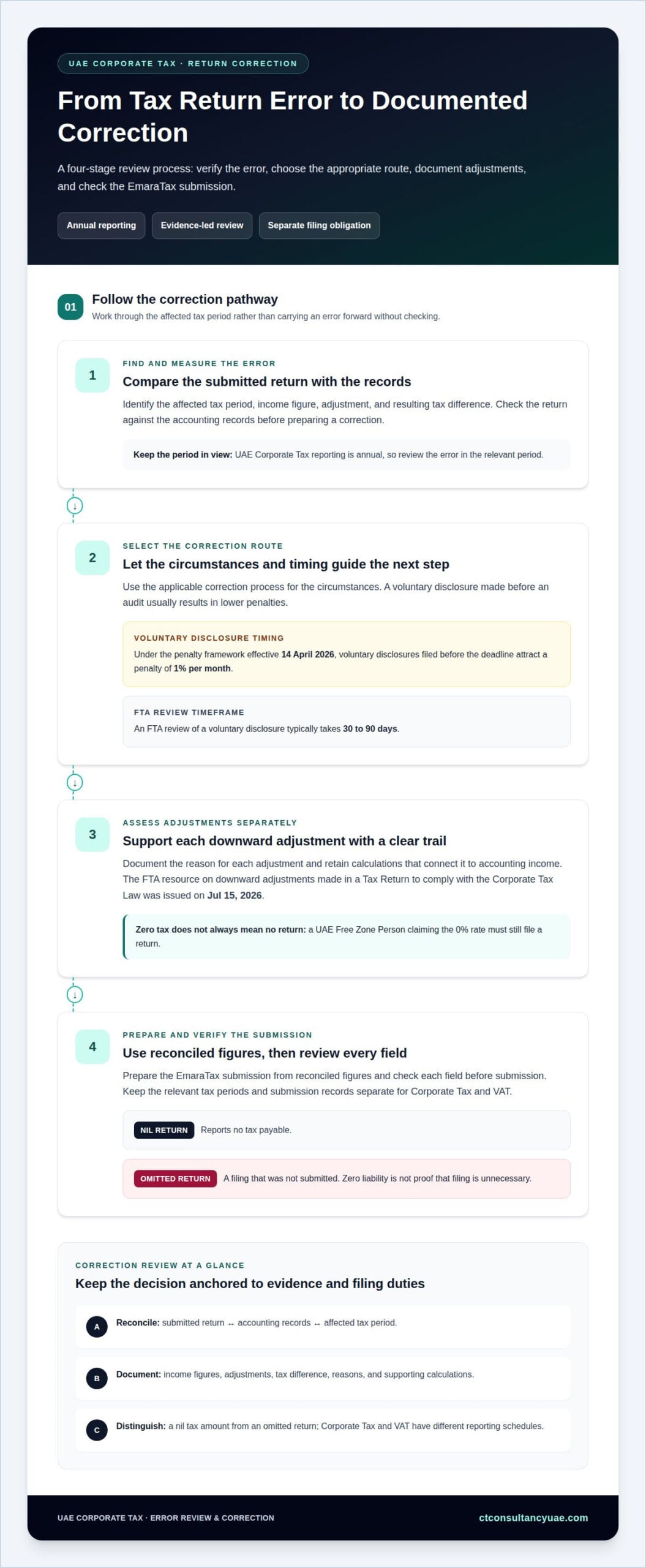
Strengthen the supporting records through bookkeeping and accounting support before an audit request arrives.
CTC Tax & Accounting provides Corporate Tax Advisory for UAE businesses reviewing filing errors, tax adjustments or transfer pricing documentation. This support is useful when accounting records need to align with a return or when you need to assess registration and filing obligations.
Accounting Services can help organise the financial records used in tax calculations, while Internal Audit Services support reviews of internal processes and documentation. Tax Services also cover VAT Registration and Compliance when VAT obligations need attention alongside Corporate Tax reporting. The right support depends on the compliance issue your business needs to address.
For tailored assistance with your UAE Corporate Tax requirements, contact CTC Tax & Accounting.
Corporate Tax compliance is not only a filing task; it is an ongoing part of sound financial governance. Build tax review into routine decisions about bookkeeping, related-party transactions and changes to business activity, so the next return reflects a consistent, well-supported record. A disciplined process is a practical way to address the corporate tax pitfalls to avoid in 2026 and strengthen your organisation’s readiness for future reporting periods.
CTC Tax & Accounting offers Bookkeeping and Accounting Services, Internal Audit Services and VAT Registration and Compliance to support connected financial and compliance needs. These services can help bring accounting records, internal controls and VAT obligations into a more coordinated view alongside Corporate Tax Advisory.
For support in assessing your business’s next compliance steps, contact CTC Tax & Accounting. Clear, deliberate planning can help you move forward with greater confidence.
CTC Tax & Accounting provides Corporate Tax Advisory to help businesses assess their tax obligations and avoid common compliance pitfalls. Turn to the team for guidance on Corporate Tax matters or a review of your approach.
For related needs, CTC Tax & Accounting also offers Bookkeeping and Accounting Services, VAT Registration and Compliance, Internal Audit Services, and CFO Advisory Services.
The standard UAE Corporate Tax rate is 9% on taxable income above AED 375,000, according to the UAE Federal Tax Authority. Taxable income is calculated from accounting income after applicable tax adjustments. Small Business Relief is a separate election for eligible businesses, not a different tax rate; assess eligibility across the relevant tax periods before relying on it. Keep the calculation and supporting schedules with the filed return.
Late registration carries an AED 10,000 penalty, while late return filing attracts AED 500 per month or part-month. Late payment interest is 14% per annum, applied monthly to unpaid tax balances. These obligations can arise separately, so a business that has registered should still monitor filing and payment dates. Record submission confirmations and payment evidence to help identify which obligation has been met.
A UAE Qualifying Freezone Person may apply the 0% rate to qualifying income only if it meets the applicable conditions. Income from mainland UAE or excluded activities may instead be subject to the standard 9% rate. A common risk is treating all free zone revenue as qualifying without analysing its source and activity. Failure to meet the conditions can affect the 0% status for that year and the subsequent four years.
Record each payment according to its actual purpose, such as a service charge, loan movement or owner distribution, and retain the relevant contracts, invoices and approval records. A shareholder payment’s label alone does not determine its tax treatment. Related-party services can also have VAT implications: UAE businesses must charge VAT at the market rate on services provided to related parties, even when no cash changes hands.
Retain accounting records, financial statements, invoices, contracts, bank evidence and tax calculations that support reported income and adjustments. UAE businesses generally must keep Corporate Tax records for at least seven years from the end of the relevant tax period. Organised digital files make it easier to trace a return figure to its source, particularly for related-party transactions or entries recorded across several accounts.
Businesses in a formally exempt category may qualify for exemption; low revenue or nil taxable income alone does not establish it. Keep records that support the basis for any claimed exemption.