
What makes stakeholders trust a business’s figures: the headline results, or the records that explain how they were reached? Gaining credibility with professional accounting starts with accurate, consistent information that can be traced and clearly understood. If records are incomplete or difficult to explain, investors, lenders and business partners may question the reliability of the numbers, while owners have less clarity for important decisions. In the UAE, businesses also need to manage financial reporting alongside VAT and Corporate Tax responsibilities.
This guide explains how sound accounting can strengthen stakeholder confidence, improve financial oversight and support better-informed decisions. You’ll learn what dependable records look like, how regular reporting helps reveal the business’s financial position, and why clear documentation matters when meeting regulatory responsibilities. It also explains how bookkeeping and accounting, internal audit and CFO advisory support can contribute to stronger oversight, and how to assess whether your current accounting routine is working. The aim is practical: financial information your business can explain, use and present with confidence.
Accounting credibility is stakeholder confidence that a business’s financial information is accurate, consistent and supported by records that can be explained. Owners use it to understand performance and manage cash flow. Lenders and investors may rely on financial information when assessing a business, while suppliers and regulators need clear, dependable records for their respective decisions and reviews.
Credibility doesn’t come from company size, polished branding or optimistic projections. It comes from evidence that connects reported figures to real business activity. A forecast can describe what a company hopes to achieve, but it can’t replace a reliable record of what has happened.
Credible information is complete, consistent, traceable and recorded promptly. Completeness means transactions haven’t been overlooked; consistency means they’re recorded using the same methods over time; and traceability means a figure can be followed back to its source. For example, a supplier expense should be supported by documents such as an invoice and payment record, so its amount and business purpose can be checked.
This supporting material contributes to the body of Audit Evidence considered when assessing financial information. Organized records help owners and reviewers understand how figures were prepared, rather than relying on unexplained totals. Professional bookkeeping and accounting can help establish a dependable basis for that information.
Clear accounts support everyday management, whether an owner is reviewing costs, monitoring cash flow or deciding where resources are needed. As a business develops, consistent records also make it easier to explain its financial position during discussions with lenders, investors or suppliers, and to support its UAE reporting responsibilities.
Reliable accounting can strengthen confidence, but it can’t guarantee funding, investment or growth. Those outcomes depend on multiple factors. The value of gaining credibility with professional accounting is a clearer, more supportable account of the business, useful for routine decisions as well as external scrutiny.
Reliable reporting is built through a sequence, not a single year-end exercise. Source documents such as invoices, receipts and bank records support transaction entries. Those entries are classified in ledgers, checked through reconciliations and brought together in financial statements. Each step should preserve a clear connection between the underlying business activity and the figures ultimately reported.
Bookkeeping captures and categorizes transactions. Financial reporting organizes that information into statements, while interpretation helps owners assess what the figures mean for cash flow, costs or upcoming decisions. For example, recording supplier invoices shows amounts owed; reviewing payables alongside cash balances helps management plan when to settle them. Structured professional accounting services can support consistent records and reporting suited to a business’s needs.
Regular reconciliations compare accounting records with independent evidence, such as bank statements or supplier balances. Differences can point to a missing entry, duplicate transaction, timing issue or error. Reconciliations increase confidence in reported balances by showing that recorded amounts have been checked against supporting evidence and that differences have been investigated. Documenting the review and any adjustment creates a trail that can be followed later.
Practical controls make transactions easier to verify. A business can retain invoices with expense entries, record who approved a payment, and periodically review unusual or incomplete items. These steps show what was recorded, what supporting documents exist and how exceptions were addressed, without assuming that one process suits every organization.
Consistent accounting policies also matter. If revenue or expenses are classified differently from one period to the next, comparisons may become misleading even when individual entries are accurate. Applying documented methods consistently makes trends easier to interpret. Internal audit can assess whether controls are operating as intended, identify gaps in documentation or review, and recommend improvements. Together, these processes turn bookkeeping records into management information stakeholders can examine with greater confidence, supporting the aim of gaining credibility with professional accounting.
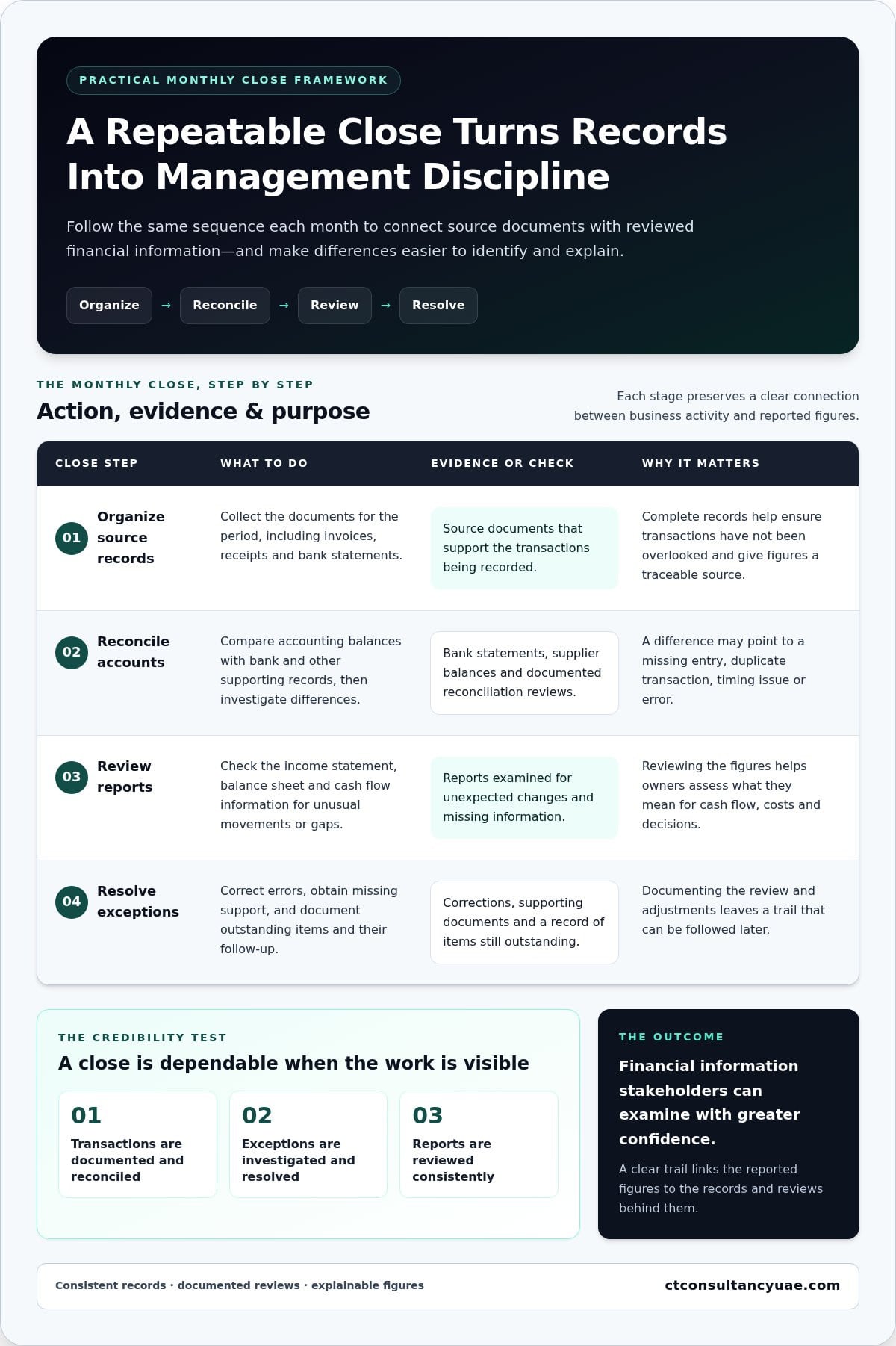
A repeatable close turns accounting from a catch-up task into a management discipline. Use a clear sequence each month:
Credibility grows when documented transactions are reconciled, exceptions are resolved and reports are reviewed consistently. Assign responsibility for each task and record who completed and reviewed it, so the process remains clear even as roles change.
At each close, confirm that reconciliations are complete, investigate unexpected changes in income or expenses, and follow up on missing documentation. Compare current results with prior periods and the business’s expectations, then note the reason for significant differences. Cash flow information can help owners assess whether available funds align with upcoming operating needs, while financial statements provide a structured view of performance and position. Neither predicts results on its own; together, they support more informed planning. This reporting discipline can feed into strategic financial management as business priorities develop.
Orderly records can make tax preparation and compliance workflows more manageable by keeping transaction details and supporting documents organized for review. Maintain clear records for transactions relevant to VAT and Corporate Tax, and keep supporting documents connected to the entries they explain. A regular accounting routine helps make information easier to review when preparing returns and managing compliance responsibilities.
For businesses seeking a more structured approach, professional accounting support can help establish consistent bookkeeping and reporting processes. CTC Tax & Accounting provides bookkeeping and accounting, VAT registration and compliance, and Corporate Tax advisory. Explore accounting services to strengthen the routine behind gaining credibility with professional accounting.
Ad hoc record-keeping can suit a business with limited activity and straightforward reporting needs, provided records remain complete and reviews happen consistently. As transactions, staff or reporting demands increase, a structured professional relationship can clarify who maintains records, when accounts are reviewed and how management information is prepared. The useful comparison is not simply cost or company size, but continuity, internal capacity and the level of oversight the business requires.
Recurring bookkeeping helps keep ledgers current, while periodic reviews and tailored reports give owners a clearer basis for monitoring performance and financial position. A consistent working rhythm can also help surface incomplete records or unusual items before they become harder to resolve. CTC Tax & Accounting provides VAT and Corporate Tax support alongside bookkeeping and accounting. Its internal audit services can assess controls, and CFO advisory services can support higher-level financial planning.
Consider transaction volume, the reports decision-makers need, the time and skills available internally, and how frequently balances and results should be reviewed. A business with changing activity or limited in-house capacity may need a different arrangement from one with established finance processes. Define responsibilities and reporting expectations so the relationship complements, rather than obscures, internal oversight.
CTC Tax & Accounting provides bookkeeping and accounting, internal audit and CFO advisory support for businesses across the UAE. Its approach is personalized, with support shaped around a business’s circumstances and needs. These services can help create continuity in the processes behind gaining credibility with professional accounting. To discuss an accounting support model that fits your priorities, contact CTC Tax & Accounting.
Financial credibility is built through habits that remain dependable as your business changes. Start by identifying where your current process needs more structure: perhaps records are difficult to assemble, reports arrive too late to inform decisions, or financial responsibilities are unclear. Addressing a specific gap can make improvement more manageable than attempting to overhaul every process at once.
For UAE businesses, gaining credibility with professional accounting means establishing a financial process that supports clear oversight and can adapt to changing operational and reporting needs. The right support should be shaped around your business, with responsibilities and reporting expectations aligned to how you work. CTC Tax & Accounting provides bookkeeping and accounting, internal audit and CFO advisory services, with an approach tailored to business requirements.
Take a practical next step by discussing the support that fits your priorities. Discuss tailored accounting support for your business and move forward with greater confidence in the information behind your decisions.
Yes, professional accounting can improve a small business’s credibility by making its financial activity easier to understand and assess. Organized records help an owner explain a margin change or supplier balance without relying on memory. Consistent reporting can strengthen stakeholder confidence, though their response also depends on other factors. Gaining credibility with professional accounting is a process, not a guaranteed outcome.
No, professional accounting doesn’t guarantee financing. Reliable records can help a lender assess a business’s financial position and understand how it manages income, expenses and existing commitments. The lender still makes an independent decision based on its own criteria, which may include factors beyond the accounts. Clear reporting can support the assessment, but it can’t determine its result.
Choose a review cadence that reflects transaction activity, operational changes and reporting needs. A monthly review can suit businesses that need regular visibility, while a business with simpler activity may set a different routine. Review records promptly after a major change, such as a new financing arrangement or a substantial shift in sales, so decisions rely on current information rather than outdated assumptions.
Yes. Start by gathering available evidence, such as bank statements, invoices, contracts and payment confirmations, then identify periods or transactions that remain unclear. Document gaps rather than presenting unsupported figures as certain, and keep notes on how any reconstruction was made. Establishing a reliable process from the current period onward gives stakeholders a clearer basis for understanding both the business’s history and its present position.
Bookkeeping is essential, but transaction entry alone may not answer the questions stakeholders or owners need to resolve. A business might record sales accurately yet still need to assess whether reported income has been collected or whether one-off costs distort comparisons. Reconciliations, review and reporting tailored to the decision at hand help turn recorded activity into useful financial insight.