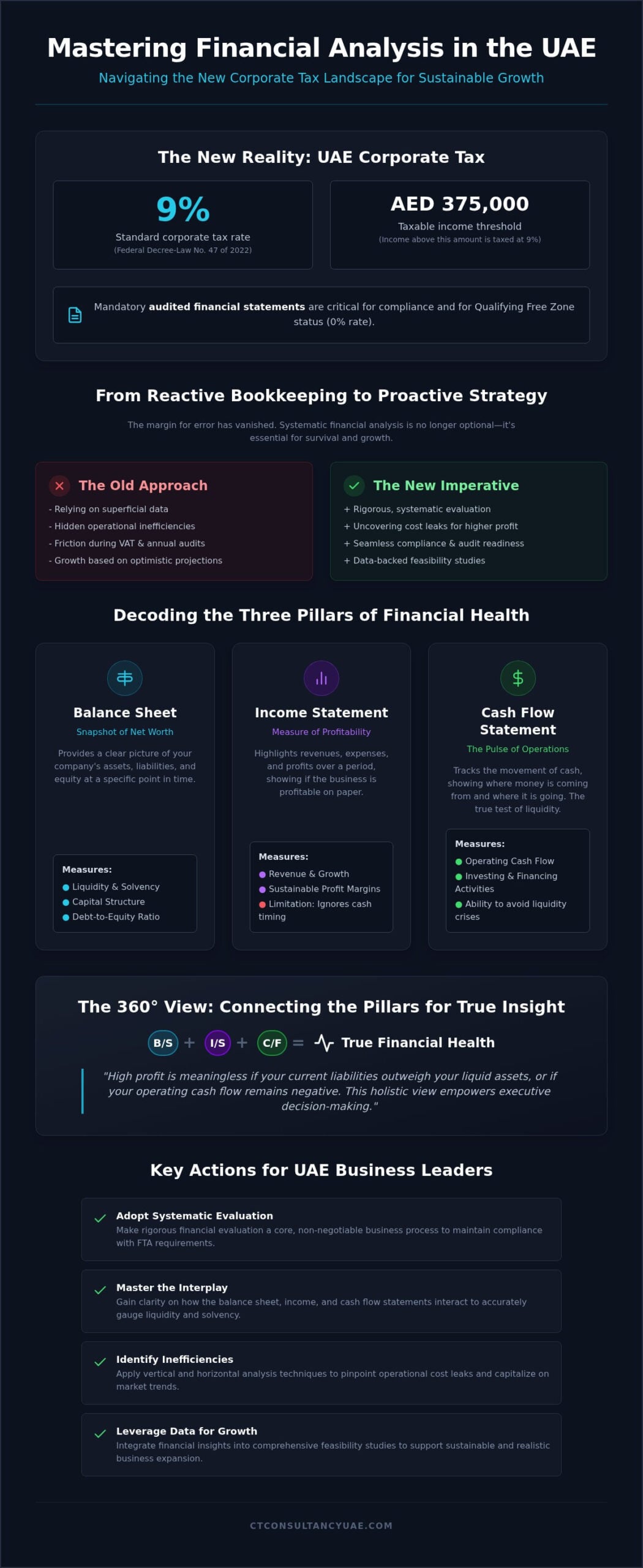
Could your enterprise be reporting healthy profits while simultaneously facing a critical cash flow shortage that threatens your operational stability? For many entrepreneurs in the Emirates, the shift from a tax-neutral environment to a sophisticated regulatory framework necessitates a more rigorous approach to financial statements analysis. With the standard corporate tax rate of 9% now applicable to taxable income exceeding AED 375,000, the margin for error in financial reporting has effectively vanished. You likely feel the mounting pressure of tracking these figures accurately while ensuring your business remains compliant with Federal Decree-Law No. 47 of 2022.
We recognize that the complexity of new e-invoicing pilots and the requirement for audited financials to maintain Qualifying Free Zone status can feel like significant administrative burdens. This guide will empower you to master the art of interpreting your financial data to drive profitability, ensure seamless compliance, and secure a competitive advantage in the UAE market. We’ll examine the specific metrics that differentiate mere bookkeeping from strategic advisory, providing a clear roadmap for data-backed growth and audit readiness as you approach the September 2026 filing deadlines.
Key Takeaways
- Recognize the necessity of systematic financial evaluation for maintaining seamless compliance with Federal Tax Authority requirements and the UAE’s evolving corporate tax landscape.
- Gain clarity on the interplay between the balance sheet, income statement, and cash flow to accurately gauge your organization’s liquidity and solvency.
- Master the application of vertical and horizontal financial statements analysis to identify operational inefficiencies and capitalize on emerging market trends.
- Leverage expert CFO advisory to integrate financial insights into comprehensive feasibility studies that support sustainable business expansion.
The Strategic Role of Financial Statements Analysis in the UAE
Financial statement analysis serves as the systematic evaluation of an organization’s fiscal health by scrutinizing its historical and current financial records. While once viewed as a secondary management function, this process has become an essential pillar for any enterprise operating within the Emirates. The introduction of the UAE Corporate Tax framework means that businesses can no longer rely on superficial data. They must instead adopt a rigorous approach to ensure every entry aligns with the Federal Tax Authority’s (FTA) stringent requirements.
The transition from basic bookkeeping to advanced financial statements analysis represents a fundamental shift in the local business environment. By proactively evaluating performance, companies effectively remove friction during annual audits and VAT inspections. This structured oversight ensures that discrepancies are identified and rectified long before a regulatory body initiates a review, instilling a sense of professional calm and operational security. The margin for error has vanished.
Beyond Compliance: Why SMEs Need Deep Financial Insights
Small and medium-sized enterprises often struggle with hidden operational inefficiencies that erode profit margins. Strategic analysis uncovers these cost leaks, allowing for precise adjustments that stabilize the bottom line. When preparing for national market expansion, data-driven forecasting becomes indispensable. Utilizing Feasibility Studies backed by robust financial data ensures that growth strategies are grounded in reality rather than optimistic projections. It’s the difference between guessing and knowing.
The Impact of UAE Corporate Tax on Financial Reporting
With the standard corporate tax rate of 9% applying to taxable income exceeding AED 375,000, the accuracy of your financial reporting directly dictates your tax liability. Precise analysis is the only way to differentiate between qualifying and non-qualifying income, especially for those seeking the 0% rate as a Qualifying Free Zone Person. The consistent maintenance of audited financial statements provides the necessary transparency to satisfy FTA auditors while securing your firm’s long-term stability. The rigorous alignment of audited financial records with tax returns serves as the definitive benchmark for corporate transparency and regulatory integrity in the UAE.
Decoding the Three Pillars: Balance Sheet, Income, and Cash Flow
To achieve a comprehensive financial statements analysis, you must look beyond isolated figures. True business stability is revealed through the intricate interplay of three core documents. These records don’t exist in silos; they tell a unified story of your enterprise’s past performance and future potential. Financial statement analysis involves evaluating these pillars to determine if your business can sustain its growth or if it’s becoming dangerously over-leveraged.
Analyzing the Balance Sheet for Solvency
The balance sheet serves as a professional snapshot of your company’s net worth at a specific point in time. It’s here that we analyze liquidity, solvency, and capital structure. High debt-to-equity ratios often indicate a reliance on external financing that might become problematic under the new UAE Corporate Tax regime. Utilizing professional Internal Audit Services ensures that your asset valuations are accurate and that your reported solvency reflects fiscal reality. It’s a critical step in removing friction before annual reporting deadlines.
Income and Cash Flow: The Pulse of Operations
While the income statement highlights revenue and sustainable profit margins, it doesn’t account for the timing of cash receipts. Rapidly growing UAE firms often discover that high profitability on paper doesn’t always translate to liquid cash. It’s vital to distinguish between operating, investing, and financing cash flows to understand where your capital is actually going. Maintaining real-time data accuracy through Monthly Accounting Services allows you to monitor this pulse effectively and avoid sudden liquidity crises.
These three pillars interact to provide a 360-degree view of your organization. A high profit margin is meaningless if your current liabilities outweigh your liquid assets or if your operating cash flow remains negative. This holistic view is what empowers executive decision-makers to act with confidence. For those seeking to fortify their market position, engaging with seasoned financial experts provides the necessary clarity to navigate these complexities with precision.
Moving from high-level data to granular metrics requires a disciplined approach to financial statements analysis. Vertical analysis allows you to view each line item as a percentage of total revenue, which reveals cost leaks that might otherwise remain obscured. Horizontal analysis, by contrast, tracks year-on-year growth to help you distinguish between seasonal fluctuations and genuine operational anomalies. These methods provide the precision needed to maintain stability in a competitive market.
Liquidity ratios, specifically the Current Ratio, provide a clear indication of whether your business can meet short-term obligations without liquidating long-term assets. Profitability ratios like the Net Profit Margin allow you to benchmark your performance against national industry standards. If you’re ready to transform your data into a strategic asset, consider our specialized CFO Advisory Services to refine your performance metrics.
Comparative Analysis and Benchmarking
Comparing internal data isn’t enough; you must understand where you stand against industry peers in Dubai or Abu Dhabi. If you’re preparing for future investment rounds, a precise Business Valuation provides the necessary credibility to attract high-value partners. This benchmarking process ensures your strategic roadmap is aligned with broader market realities.
Leveraging Ratios for Financing and Credit
UAE banks scrutinize specific indicators when evaluating loan applications for national enterprises. They prioritize the Debt Service Coverage Ratio (DSCR) to ensure you possess sufficient cash flow to manage repayment schedules without stressing operational budgets. A robust debt-coverage ratio facilitates business growth by signaling fiscal reliability and long-term solvency to potential creditors.
From Data to Strategy: Leveraging Expert CFO Advisory
Raw data provides a necessary foundation, but strategic interpretation transforms isolated metrics into a comprehensive roadmap for sustainable growth. Engaging in expert financial statements analysis allows executive leadership to transition from reactive management to proactive planning. This level of oversight is particularly critical when conducting Feasibility Studies for new capital ventures or market entries. CTC Tax & Accounting serves as the primary partner for SMEs, delivering the high-level corporate expertise required to navigate the UAE’s increasingly complex fiscal environment with precision.
Strategic Planning and Risk Management
Effective CFO Advisory Services provide the rigorous structure needed for sophisticated budgeting and cash flow management. This meticulous planning mitigates operational risk by anticipating liquidity requirements well before they manifest as crises. By aligning your financial goals with real-time data, you’re ensuring that every expansion effort is backed by fiscal reality. For a deeper exploration of these methodologies, we invite you to review our guide on Strategic Financial Management for SMEs: A Comprehensive Guide for UAE Success.
Ensuring Frictionless Compliance and Audit Readiness
Regular financial statements analysis simplifies the VAT registration and compliance process by ensuring that all transactions are categorized with absolute accuracy. This ongoing diligence creates a state of permanent audit readiness, removing the friction and anxiety often associated with Federal Tax Authority inspections. Our approach doesn’t rely on one-size-fits-all solutions, opting instead for individualized strategies that prioritize long-term stability and meticulous planning. CTC Tax & Accounting remains committed to providing the professional reassurance and technical proficiency your business needs to thrive in a regulated market. Reach out to our team to secure a partner dedicated to your organization’s precision and enduring success.
Empowering Your Strategic Vision through Financial Precision
Master the complexities of the UAE’s new fiscal landscape by shifting your perspective from simple bookkeeping to rigorous financial statements analysis. We’ve examined how the interplay between the balance sheet, income statement, and cash flow provides the 360-degree view necessary for long-term stability. By applying vertical and horizontal techniques, you don’t just identify cost leaks; you unlock the data-backed insights required for sustainable market expansion. It’s about moving beyond basic reporting to embrace a culture of strategic foresight.
Our team of specialized UAE Corporate Tax experts brings decades of international financial experience to your enterprise. We provide customized solutions for SMEs and freelancers that prioritize meticulous planning over quick fixes. This professional partnership ensures your organization remains audit-ready while maintaining the organized momentum needed to thrive in a regulated environment. We’re dedicated to removing the friction from your financial operations so you can focus on executive leadership.
Secure your business growth with expert CFO advisory and financial analysis today.
Your journey toward frictionless compliance and enhanced profitability begins with a single, strategic decision. We’re here to ensure that every step you take is grounded in precision, reliability, and expert guidance.
Frequently Asked Questions
What is the primary objective of financial statements analysis for a UAE business?
The primary objective of financial statements analysis is to evaluate an organization’s profitability, liquidity, and solvency to ensure long-term operational stability. In the current regulatory environment, this process serves as a critical tool for maintaining alignment with Federal Tax Authority requirements. It transforms raw accounting data into a strategic roadmap that allows executive leadership to make informed, data-backed decisions regarding market expansion and capital allocation.
How often should an SME perform a comprehensive analysis of its financials?
SMEs should ideally conduct a high-level review of their financial performance on a monthly basis to monitor cash flow and operational efficiency. A more comprehensive, deep-dive analysis is recommended at the end of each quarter to adjust strategic goals and identify emerging trends. This frequency ensures that the business remains agile and fully prepared for annual corporate tax filings and potential internal audits.
Can financial statements analysis help in reducing UAE Corporate Tax liability?
Yes, meticulous analysis helps in identifying all eligible deductible expenses and ensuring the accurate classification of qualifying versus non-qualifying income. By maintaining precise records, businesses can legally optimize their tax position under the 9% corporate tax framework. This proactive approach prevents the overpayment of taxes that often results from accounting discrepancies or a lack of clarity regarding taxable income thresholds.
What is the difference between vertical and horizontal financial analysis?
Vertical analysis evaluates each line item on a financial statement as a percentage of a base figure, such as total assets or total revenue, to pinpoint specific cost leaks. Horizontal analysis, meanwhile, compares financial data across multiple reporting periods to identify long-term growth patterns and year-on-year anomalies. Both techniques are essential components of financial statements analysis, providing a multidimensional view of a company’s fiscal trajectory.
Why do UAE banks require audited financial statements for business loans?
UAE banks mandate audited financial statements to obtain an independent, verified assessment of a company’s fiscal health and repayment capacity. These documents allow creditors to accurately calculate the Debt Service Coverage Ratio and evaluate the risk associated with the credit facility. Providing audited records instills confidence in lenders, signaling that the enterprise adheres to high standards of corporate governance and financial transparency.