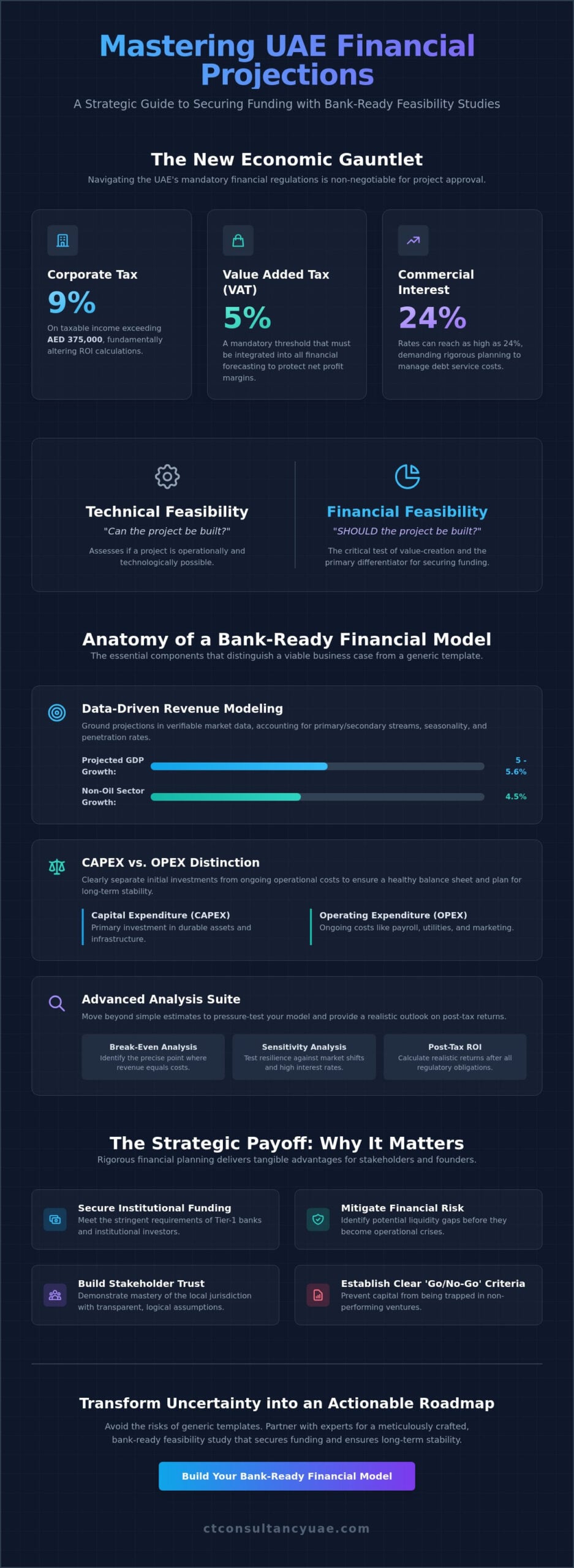
In the current UAE economic climate, a business plan lacking rigorous data isn’t just a minor oversight; it’s a strategic liability that could trigger immediate rejection from Tier-1 banks. You likely recognize that the transition to a tiered 9% Corporate Tax regime has fundamentally altered the math behind long-term ROI. It’s natural to feel concerned about how these regulatory shifts, alongside a 5% VAT and commercial interest rates that can reach 24%, impact your bottom line. Developing robust financial projections for feasibility study purposes has become the primary differentiator between projects that secure funding and those that stall in the boardroom.
This guide provides the strategic framework you need to master these complexities, ensuring your project remains both viable and fully compliant with national standards. We’ll examine the mechanics of bank-ready modeling, clarify break-even analysis under new tax laws, and provide the precision required for executive decision-making. By the end of this article, you’ll understand how to transform uncertainty into a clear, actionable roadmap for growth in a competitive national market.
Key Takeaways
- Understand why rigorous financial projections for feasibility study serve as the quantitative backbone of a viable business case, distinguishing your project from mere operational concepts.
- Learn to integrate the 9% UAE Corporate Tax and mandatory VAT thresholds into your forecasting to protect net profit margins and ensure full regulatory alignment.
- Identify the precise break-even point and utilize sensitivity analysis to pressure-test your project’s resilience against shifting market conditions and high interest rates.
- Recognize the strategic necessity of a bank-ready financial model to secure funding and avoid the inherent risks associated with generic, one-size-fits-all templates.
The Role of Financial Projections in a Feasibility Study
A project may be technically brilliant and operationally sound, yet it can still fail if the underlying economics are flawed. Within the UAE’s sophisticated market, financial projections for feasibility study documentation serve as the quantitative backbone that transforms a visionary concept into a bankable business case. While technical feasibility assesses whether a project can be built, financial feasibility determines if it should be built from a value-creation perspective. This distinction is critical for entrepreneurs navigating a high-stakes environment where commercial interest rates can range from 7% to 24%. Accurate forecasting doesn’t just predict success; it acts as a primary risk-mitigation tool by identifying potential liquidity gaps before they manifest as operational crises.
Defining Financial Feasibility in a Modern Context
Modern feasibility modeling has moved beyond simple estimations. In the 2026 fiscal environment, projections must be data-driven and grounded in current market benchmarks, such as the projected 5% to 5.6% GDP growth. A comprehensive Feasibility study now requires a clear distinction between short-term cash flow budgeting and long-term viability. As the UAE’s regulatory framework matures, including the 9% Corporate Tax on income exceeding AED 375,000, your models must reflect these specific obligations to provide a realistic outlook on post-tax ROI. This shift toward precision ensures that your project remains compliant with the evolving demands of the Ministry of Finance while maintaining its competitive edge.
Strategic Benefits for Stakeholders and Investors
Transparent, logical assumptions are the currency of trust when engaging with shareholders or UAE financial institutions. By utilizing rigorous financial projections for feasibility study purposes, you establish clear ‘Go/No-Go’ criteria that prevent capital from being trapped in non-performing ventures. These projections provide a baseline for future performance monitoring and professional business advisory engagement. When stakeholders see a model that accounts for inflation forecasts and non-oil sector growth trends, they gain the strategic reassurance needed to commit significant capital. This level of detail demonstrates that you’ve mastered the nuances of the local jurisdiction and are prepared for the meticulous planning required for long-term stability.
Critical Components of Robust Financial Forecasting
Constructing a resilient financial framework requires more than optimistic spreadsheets; it demands a granular dissection of every fiscal variable that could influence your project’s trajectory. Developing precise financial projections for feasibility study documentation involves aligning internal ambitions with external market realities. You must move beyond surface-level estimates to create a multi-layered model that addresses revenue volatility, capital constraints, and the necessity of maintaining liquidity. This methodical approach ensures that your project remains viable even when subjected to the scrutiny of institutional lenders or private equity partners.
Revenue Modeling and Market Assumptions
A reliable revenue model serves as the engine of your financial forecast. It’s essential to identify both primary and secondary revenue streams while grounding your growth percentages in verifiable market data. For instance, your assumptions should reflect the UAE’s projected non-oil sector growth of 4.5% to ensure they aren’t detached from the broader economic environment. When you draft these financial projections, you must also account for regional seasonality, such as the fluctuations in consumer activity during the summer months or major international events. Utilizing historical benchmarks allows you to justify your market penetration rates with a level of logic that builds immediate credibility with stakeholders.
CAPEX vs. OPEX: Planning for Long-Term Stability
Distinguishing between initial investments and ongoing operational costs is vital for maintaining a healthy balance sheet. Capital Expenditure represents the primary investment in durable assets and infrastructure necessary to facilitate the project’s operational commencement and long-term utility. Beyond these upfront costs, your Operating Expenditure (OPEX) must be meticulously detailed to include everything from payroll and utilities to marketing and outsourced bookkeeping. With the UAE’s inflation rate forecasted between 1.8% and 2.8% for 2026, building a buffer into your recurring cost projections is a prudent strategy for risk mitigation. This level of foresight prevents the common pitfall of underestimating the "burn rate" during the project’s early stages.
Liquidity management remains the final, critical piece of the puzzle. A projected cash flow statement allows you to monitor the timing of inflows and outflows, ensuring you can meet obligations despite the high interest rates that currently characterize the lending market. If you find the complexity of these models challenging, engaging with specialized CFO Advisory Services can provide the technical proficiency required to refine your forecasting into a bank-ready asset. This professional oversight ensures that every component of your model is logically sound and strategically aligned with your growth objectives.
Navigating UAE Regulatory Impacts on Financial Models
The UAE’s transition into a more structured fiscal environment means that financial projections for feasibility study reports can no longer rely on tax-neutral assumptions. It’s a fundamental shift that requires you to look beyond simple top-line growth. You’ve got to integrate the nuances of federal mandates directly into your project’s DNA to ensure long-term viability. From the 9% Corporate Tax to the complexities of Value Added Tax (VAT), every regulatory layer impacts your liquidity and your ultimate return on investment. Ignoring these factors doesn’t just lead to inaccurate forecasting; it creates a significant compliance risk that could jeopardize the entire venture.
Integrating UAE Corporate Tax Requirements
With federal corporate tax now a permanent fixture, your financial models must accurately distinguish between accounting profit and taxable income. For the 2026 tax period, the 9% rate applies to taxable income exceeding AED 375,000, though you should verify if your project qualifies for Small Business Relief if revenues remain under AED 3 million. This isn’t just a line item on an expense sheet; it’s a variable that fundamentally alters your project’s Internal Rate of Return (IRR). Consulting with specialized corporate tax consultants is a strategic necessity to validate these assumptions. They help ensure your projections account for deductible expenses and tax-loss carry forwards, providing the precision that institutional investors demand.
VAT Implications on Cash Flow Projections
VAT management is often underestimated in early-stage planning, yet it creates a distinct "cash flow gap" that can strain a new project’s resources. When you pay 5% VAT on setup costs but haven’t yet reached the mandatory registration threshold of AED 375,000 in supplies, your liquidity is directly affected. Your pricing strategy must remain competitive while incorporating these tax obligations to avoid margin erosion. Engaging professional VAT registration services early ensures you’re positioned to claim input tax credits as soon as possible. This proactive approach smooths the transition into operational status and prevents unexpected hits to your working capital during the critical first year.
Beyond tax, your projections must reflect the costs associated with Economic Substance Regulations (ESR) and Anti-Money Laundering (AML) compliance. These represent recurring operational expenses that vary depending on whether you’re based in a Free Zone or the Mainland. While Free Zones often offer specific incentives, the requirement to maintain adequate substance within the jurisdiction carries a price tag that must be modeled. By factoring in these specialized costs, you demonstrate to stakeholders that your business plan is grounded in the reality of the UAE’s evolving legal landscape.
Advanced Analysis: Sensitivity, Break-even, and ROI
Advanced modeling requires more than just static figures; it demands a dynamic interrogation of how your project responds to external shocks. Robust financial projections for feasibility study documentation must incorporate sophisticated analytical tools to validate long-term resilience. By calculating metrics like Net Present Value (NPV) and the Payback Period, you provide potential investors with the quantitative assurance that their capital is protected. These analyses move your business case from a theoretical exercise to a strategic roadmap that accounts for the inherent volatility of a competitive national market. It’s about moving beyond "if" a project can profit to exactly "under what conditions" it will thrive.
Stress-Testing with Sensitivity Analysis
Sensitivity analysis serves as a primary friction-remover by identifying which variables have the most profound impact on your bottom line. In the current market, where business loan interest rates can fluctuate between 7% and 24%, testing your model against interest rate hikes is essential. You’ve got to establish a ‘Margin of Safety’ that accounts for the 2.8% inflation forecast or sudden shifts in raw material costs. Sensitivity analysis prevents project failure by revealing the specific thresholds where a venture ceases to be profitable before any capital is actually deployed. This proactive approach allows you to adjust your strategy or secure additional contingencies before a minor market shift becomes a major fiscal crisis.
Calculating ROI and Internal Rate of Return (IRR)
Calculating the Internal Rate of Return (IRR) allows you to compare your project’s potential against the prevailing cost of capital in the UAE. Clear ROI timelines are vital for building trust with financial partners who value meticulous planning over quick fixes. These metrics shouldn’t exist in a vacuum; they should be integrated into professional CFO advisory services to ensure ongoing performance tracking against your initial feasibility baseline. Using Net Present Value (NPV) further justifies the project’s long-term value by discounting future cash flows back to today’s terms, providing a realistic picture of wealth creation. If you’re seeking to validate your project’s potential with a bank-ready model, you can consult our experts for a comprehensive feasibility study that ensures your projections are both accurate and persuasive.
Partnering with Experts for Bank-Ready Feasibility Studies
Relying on generic templates for high-stakes UAE projects is a gamble that few executive decision-makers can afford. While the components of financial projections for feasibility study documentation are standardized in theory, their application within this specific jurisdiction requires deep local expertise. Independent validation isn’t merely a formality; it’s a prerequisite for securing multi-million dirham financing from local institutions. Banks and private equity partners require a level of precision that demonstrates a project is grounded in reality, not just aspiration. This professional scrutiny ensures that your financial model serves as a reliable roadmap rather than a collection of optimistic guesses.
The Risks of Inaccurate Financial Modeling
Over-optimistic revenue forecasts remain a primary cause of early-stage insolvency in the national market. Without a professional lens, it’s easy to overlook the cumulative impact of local regulatory fees, licensing renewals, and compliance mandates that can erode margins. Utilizing professional accounting services provides the baseline data necessary to ensure your model reflects actual market benchmarks rather than best-case scenarios. This meticulous attention to detail prevents the "capital gap" that often stalls projects before they reach their break-even point. When you fail to account for the granular costs of doing business in the UAE, you risk losing the trust of your most vital financial stakeholders.
How CTC Tax & Accounting Secures Project Viability
Our approach prioritizes customized financial modeling that aligns with your specific industry sector and growth objectives. By leveraging our deep proficiency in tax services, we optimize your project’s fiscal structure to account for the latest corporate tax and VAT requirements. We provide the professional authority needed to present your case to regulators and financial institutions with total confidence. Our goal is to facilitate a frictionless transition from your initial business advisory consultation to a full-scale operational setup that values long-term stability. Partnering with us means you aren’t just getting a report; you’re gaining a strategic ally dedicated to your project’s enduring success.
Moving from a feasibility study to an operational reality requires more than just data; it requires a commitment to meticulous planning. As your project evolves, the assumptions made during the forecasting stage will be tested by market realities. Having a robust, professionally validated model allows you to pivot with precision, ensuring that your venture remains self-sustaining and compliant within the UAE’s evolving economic landscape. This level of strategic reassurance is what distinguishes market leaders from those who merely participate.
Securing Strategic Viability in the UAE Market
The evolution of the UAE’s economic landscape demands a transition from speculative estimates to rigorous, data-driven modeling. Mastering the complexities of financial projections for feasibility study documentation is no longer just an operational requirement; it’s a strategic imperative for any project seeking long-term stability and institutional funding. By integrating the nuances of the 9% Corporate Tax and performing granular sensitivity analysis, you transform potential risks into manageable variables. This level of precision ensures that your venture isn’t just compliant but is also positioned for sustained growth within a competitive national market.
With decades of international and local financial experience, we provide tailored financial modeling for SMEs and entrepreneurs that bridges the gap between vision and bank-ready reality. Our deep expertise in UAE Corporate Tax and VAT compliance acts as a primary friction-remover, allowing you to navigate complex regulatory setups with absolute confidence. Secure your project’s future with a professional feasibility study from CTC Tax & Accounting. We look forward to helping you build a resilient foundation for your next major venture.
Frequently Asked Questions
What is the most critical part of financial projections for a feasibility study?
The most critical component is the underlying logic of the revenue assumptions and the timing of cash flows. Robust financial projections for feasibility study documentation must reflect realistic market penetration rates rather than best-case scenarios. Without precise data on the 5% VAT and 9% Corporate Tax impacts, a model fails to provide the strategic reassurance required by institutional lenders and private investors.
How many years of financial projections should a feasibility study include?
A standard feasibility study typically spans three to five years. This duration allows for a comprehensive view of the initial setup phase, the transition into operational status, and the eventual realization of the break-even point. For large-scale infrastructure projects within the UAE, extending the model to seven or ten years may be necessary to account for longer payback periods and capital recovery cycles.
Does the UAE Corporate Tax affect feasibility studies for existing businesses?
Yes, the UAE Corporate Tax significantly impacts feasibility modeling for both new ventures and existing business expansions. Projections must account for the 9% tax on income exceeding AED 375,000 to accurately determine the post-tax Internal Rate of Return. Failing to integrate these fiscal obligations can lead to overestimating net profit margins and creating misaligned expectations for shareholders and financial partners.
Can I conduct a feasibility study without professional help?
While entrepreneurs can draft their own models, doing so carries substantial risk regarding bank-ready credibility and regulatory accuracy. Professional financial projections for feasibility study reports require an objective distance that internal teams often lack. Independent validation ensures that your model accounts for technical nuances like Economic Substance Regulations and Anti-Money Laundering compliance costs that are often overlooked by non-experts.
What is the difference between a business plan and a feasibility study?
A feasibility study is a diagnostic tool used to determine if a project is viable, whereas a business plan is a tactical roadmap for execution. The feasibility study asks "should we proceed?" by analyzing technical, financial, and market constraints. Conversely, the business plan focuses on "how we will operate" once the project’s viability has already been confirmed through rigorous quantitative modeling.
How do I calculate the break-even point for a new project in the UAE?
To calculate the break-even point, you must divide your total fixed costs by the contribution margin per unit. In the UAE context, your fixed costs must include regulatory fees and interest on business loans, which can range from 7% to 24%. This calculation identifies the exact volume of sales required to cover all operational and capital expenditures before the project begins generating a net profit.
Why do UAE banks require an independent feasibility study?
UAE banks demand independent studies to mitigate their exposure to credit risk through impartial, third-party analysis. An independent report provides an objective assessment of the project’s ability to service debt under various economic conditions. This external validation instills confidence in the bank’s credit committee by ensuring that revenue forecasts are grounded in market benchmarks rather than internal optimism.
How often should financial projections be updated after the project starts?
Financial projections should be reviewed quarterly and updated formally at least once per year. Regular updates allow you to adjust for real-time economic shifts, such as the 1.8% to 2.8% inflation forecast or changes in the 5% to 5.6% GDP growth rate. This iterative process ensures that your strategic planning remains relevant as the project moves from a theoretical model into an operational reality.