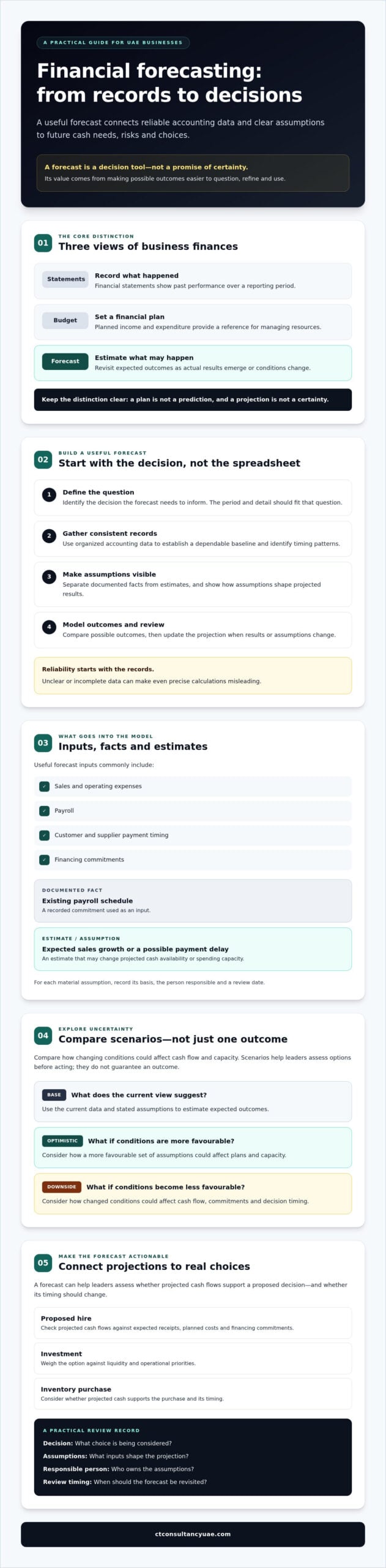
A detailed forecast can still lead to a poor decision if its assumptions are unclear or its figures aren’t connected to day-to-day operations. For businesses across the UAE, the value of financial forecasting is a clearer view of future cash needs, risks and choices, not simply a polished spreadsheet. Historical results explain what has happened, but they can’t show on their own whether upcoming commitments are manageable.
A useful forecast is a decision tool, not a promise of certainty. This article explains how forecasts differ from budgets and historical reporting, which accounting data and assumptions make projections more dependable, and how scenario planning can help leaders assess options before acting. It also covers why regular updates matter as conditions change, and how CFO advisory and strategic planning can help turn projections into practical decisions. With a disciplined approach, forecasts are easier to question, refine and use.
Key Takeaways
- Use consistent accounting records as a dependable starting point, then make the assumptions behind each projection clear.
- Choose financial forecasting support in the UAE that connects data to a specific business decision, not just a detailed spreadsheet.
- Compare base, optimistic and downside scenarios to understand how changing conditions could affect cash flow and capacity.
- Make projections actionable by recording the decision, its assumptions, who is responsible and when the forecast should be reviewed.
Financial forecasting services dubai: what to assess
When comparing financial forecasting services dubai, look for a process that starts with the decision you need to make and explains how the forecast is built. Ask how CTC Tax & Accounting uses your accounting records, separates confirmed figures from estimates, and updates projections when results or assumptions change. A useful forecast should make its inputs understandable and show how different outcomes could affect your plans. The right level of detail depends on the decision, your available information and how quickly conditions may change.
What financial forecasting reveals that historical accounts cannot
Past accounts show what a business has earned and spent. On their own, they can’t show whether cash will be available when future obligations fall due. A financial forecast estimates future performance using historical and current data alongside explicit assumptions. It can help leaders assess likely cash availability, planned spending and the timing of decisions, without guaranteeing a particular outcome. A financial forecast is forward-looking, and its usefulness depends on the quality of its inputs and the clarity of its assumptions.
A budget sets a financial plan; a forecast estimates what may happen as actual results and assumptions change. Using both tools helps businesses avoid treating a plan as a prediction or a projection as a certainty.
How a forecast differs from a budget and financial statements
Financial statements record past performance over a reporting period. A budget sets out planned income and expenditure, often as a reference for managing resources. A forecast revisits expected outcomes as new results emerge or conditions shift. For example, if customer payments arrive later than assumed, an updated projection can show the effect on available cash even if recorded sales remain unchanged.
Which business decisions can forecasting inform?
Forecasts can help leaders consider whether projected cash flows support a proposed hire, investment or inventory purchase, and whether the timing should change. The answer depends on expected receipts, planned costs and financing commitments. A projection makes these dependencies more visible, helping decision-makers weigh options against liquidity and operational priorities.
For businesses across the UAE, dependable accounting records offer a more useful starting point than estimates built on inconsistent data. CFO advisory and strategic financial planning can also help interpret projections in the context of wider business objectives. Learn more about CFO advisory services as part of that planning process.
How financial forecasts are built from business data and assumptions
A useful forecast starts with a decision, not a spreadsheet. First, identify what you need to assess. Then gather relevant records, set assumptions, model possible outcomes and review the results. The forecast period and level of detail should fit the question. A near-term cash review may need close attention to payment dates, while a longer-range investment decision may call for broader projections.
Forecast reliability depends on the quality and consistency of the source data. Unclear or incomplete records can make even precise calculations misleading. Useful inputs commonly include sales, operating expenses, payroll, customer and supplier payment timing, and financing commitments.
Which financial records provide a useful starting point?
Organized bookkeeping gives decision-makers a consistent view of historical revenue, costs, receivables and payables. These records help establish a baseline and reveal timing patterns that can inform future estimates. Businesses seeking to strengthen this foundation can explore bookkeeping and accounting services as a practical way to improve financial recordkeeping.
How assumptions shape projected results
Separate documented facts from estimates. An existing payroll schedule is a recorded commitment; expected sales growth or a possible delay in customer payments is an assumption. Make the distinction visible because changing an estimate can alter projected cash availability or spending capacity. Harvard Business School Online outlines several financial forecasting methods, including quantitative and qualitative approaches. The appropriate method depends on the decision and the information available.
For each material assumption, record its basis, the person responsible for it and a review date. This creates a clear trail for checking whether the forecast still reflects current conditions. When evaluating financial forecasting services dubai, look for a process that makes inputs and assumptions understandable rather than relying on a generic template whose logic is difficult to assess.
How to manage uncertainty with scenarios and regular forecast updates
A forecast is a conditional estimate, not a guarantee. Its value is in showing how different assumptions could affect cash availability and plans, so leaders can prepare for change rather than treat one projection as certain. Build clearly labelled base, optimistic and downside scenarios, adjusting assumptions such as sales volume, customer payment timing or operating costs. Don’t assign probabilities unless there’s a sound basis for doing so.
| Scenario |
Example assumption |
Potential effect to assess |
Management question |
| Base |
Expected sales and payment timing hold |
Cash follows the current plan |
Does liquidity support planned commitments? |
| Optimistic |
Sales exceed expectations |
More capacity may be available |
What investment would best support priorities? |
| Downside |
Sales soften or receipts arrive later |
Cash may tighten |
Which spending or timing decisions need review? |
These are illustrative assumptions, not predictions. Harvard Business School Online’s overview of financial forecasting methods provides further context on approaches for developing projections.
What should a business do when actual results differ?
Use variance analysis to compare actual results with forecast figures, then investigate the cause before changing plans. A late customer payment may be a timing effect; a sustained change in demand may point to a lasting shift. Review forecasts at a cadence suited to the business’s complexity and decision urgency, and update them when material assumptions change.
How do UAE tax and compliance obligations fit into planning?
Where applicable, include expected VAT payments and Corporate Tax obligations in cash-flow assumptions, using the business’s relevant filing and payment schedule. Keep compliance estimates distinct from confirmed liabilities, and review them when underlying figures change. For separate support with UAE tax compliance, explore UAE tax services. Businesses assessing financial forecasting services dubai can also seek individualized CFO advisory to connect scenario outputs with planning decisions. Discuss CFO advisory for your planning needs.
Turning financial forecasts into clearer business decisions
A projection becomes useful when it is tested against decision criteria, not simply reviewed as a set of figures. Before approving a hire, for example, leaders can assess whether projected liquidity covers the added commitment, whether the team has the capacity to use the role effectively, and whether the hire supports strategic priorities. If one scenario weakens cash headroom, the decision may need to be deferred, phased or reconsidered.
A useful forecast connects its assumptions to projected outcomes and a defined management decision. Record the decision made, the assumptions relied on, the responsible owner and the event or date that should trigger a review. This creates accountability and makes it easier to revisit the choice when conditions change.
When can an external adviser add value?
External CFO advisory may be useful when internal finance capacity is limited, material uncertainty makes projections difficult to interpret, or a major investment requires careful comparison of outcomes. An adviser can help leaders connect financial analysis with operational priorities without treating any forecast as a guaranteed result. Explore CFO advisory services for support with financial planning.
A practical next step for improving forecast quality
Start by checking whether key records are complete and consistent. Then define the decision the forecast needs to support and document the assumptions that could materially affect its outcome. This focused review helps leaders identify where further analysis is needed before committing resources.
Businesses considering financial forecasting services dubai can assess whether tailored CFO advisory or business guidance would help translate projections into action. Discuss tailored financial guidance if individualized support would be useful.
Make your next business decision with greater clarity
A reliable forecast doesn’t promise a particular outcome. It helps leaders understand how documented data and explicit assumptions may affect future cash availability, then compare scenarios against practical priorities. Keep the forecast useful by updating it as results change and recording the decisions, owners and review triggers connected to its projections.
For businesses considering financial forecasting services dubai, the aim is to turn financial information into a clearer basis for action. Consistent accounting records provide a stronger starting point, while CFO advisory can help interpret projections alongside business priorities. CTC Tax & Accounting provides CFO advisory, accounting, business valuation and feasibility study services.
If your business needs support interpreting financial information or planning its next steps, discuss your financial planning requirements. With dependable records, transparent assumptions and thoughtful review, you can approach decisions with greater confidence and adapt as circumstances evolve.
Frequently Asked Questions
What is financial forecasting?
Financial forecasting is a data-informed estimate of future financial performance based on stated assumptions. Unlike financial statements, which record past activity, a forecast considers what may happen under specified conditions. It supports planning rather than promising a particular result. Its usefulness depends on the decision being examined, the quality of available inputs and whether material assumptions are reviewed as circumstances change.
How is a financial forecast different from a budget?
A budget usually sets out planned income and spending for a period, while a forecast estimates likely outcomes using current information. They complement each other: a business can compare actual results with both its plan and its projections, then update the forecast as conditions change. For example, a change in expected customer payment timing may alter the forecast even if the original budget remains the reference plan.
Can a small business create a useful financial forecast with limited data?
Yes. A small business can begin with available bookkeeping records, known commitments and clearly labelled assumptions, without suggesting the figures are more precise than the inputs allow. Separate verified information from estimates, then refine the model as records improve. A search for “financial forecasting services dubai” should lead businesses to assess the adviser’s approach. Specialist input can help when a high-stakes decision depends on uncertain or incomplete data.
How often should a business update its financial forecast?
There’s no single review frequency that suits every business. Update timing should reflect how volatile conditions are, when decisions are due and how quickly reliable new information becomes available. Revisit the forecast when a material assumption changes, such as expected sales or payment timing. Comparing actual results with projections helps identify whether a variance is temporary or calls for revised expectations or decisions.
Are financial forecasts guaranteed to be accurate?
No. A forecast is an estimate, and actual results can differ when assumptions or business conditions change. Reliable records, transparent assumptions, multiple scenarios and periodic reviews make projections more useful, but they can’t remove uncertainty. Treat a forecast as decision support, not a promise. Before committing resources, examine downside exposure and consider whether the business could manage if key assumptions don’t hold.