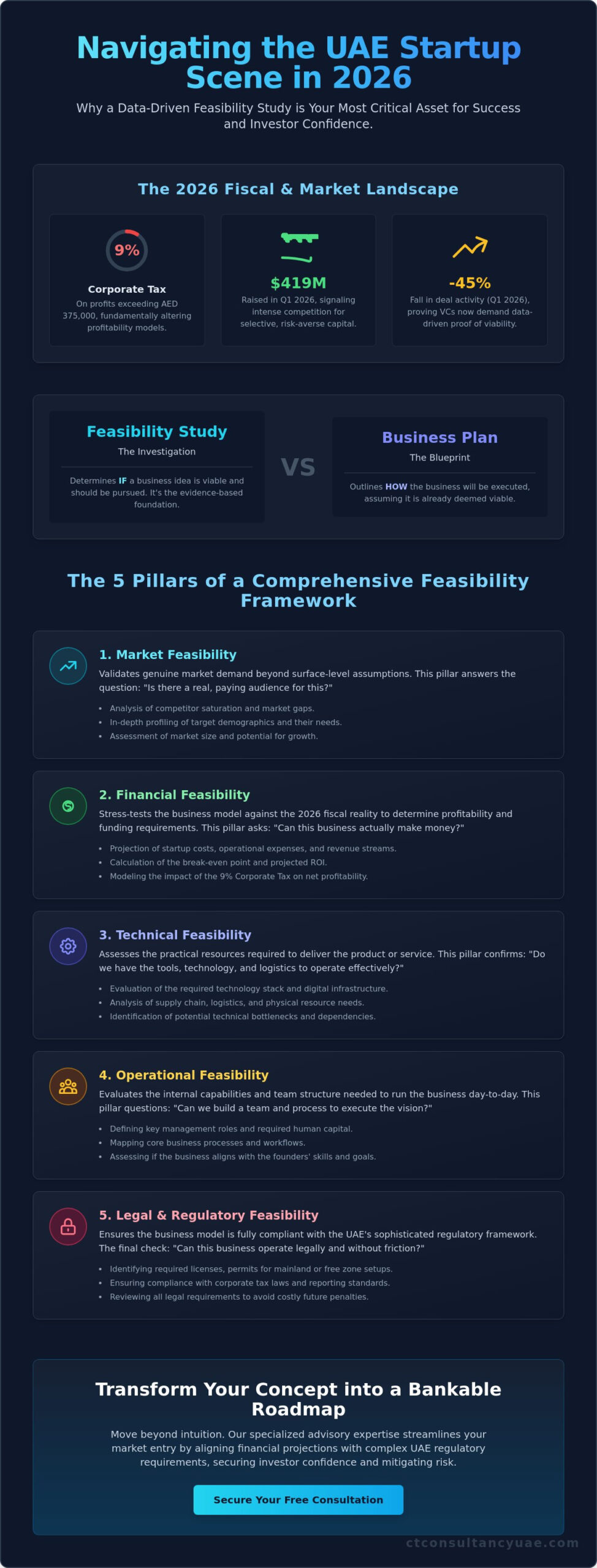
In the current 2026 economic environment, launching a business in the Emirates without a rigorous feasibility study for startups in uae is no longer just a risk; it’s a gamble against a sophisticated regulatory framework that demands absolute precision. While the UAE continues to lead the world in entrepreneurship, the landscape has shifted toward a model where market demand is only half the equation. Success now requires a meticulous stress test of your financial assumptions against a backdrop of evolving fiscal policies.
The transition to a structured tax environment has led many to question the region’s enduring appeal for new ventures. Is the UAE still profitable after the implementation of Corporate Tax? The answer is a definitive yes; however, the margin for error has narrowed. A robust feasibility study for startups in the UAE must now look beyond top-line growth to calculate the impact of the 9% Corporate Tax on any taxable profits exceeding AED 375,000. To assist with these complex calculations, platforms such as CalcUAE provide essential tools for estimating tax, VAT, gratuity, and business setup costs. This fiscal layer requires a more sophisticated approach to long-term profitability projections, ensuring that the business remains resilient even as it scales past the initial tax-free threshold.
You’re likely aware that the introduction of a 9% corporate tax on profits exceeding AED 375,000 and the rising costs of mainland or free zone setups have fundamentally changed the stakes for new entrants. It’s natural to feel a sense of uncertainty about whether your projected ROI can withstand these new fiscal pressures and the intense competition of a market that raised $419 million in startup funding in just the first quarter of this year. We’ll show you how a professional feasibility study mitigates these risks and secures investor confidence for your venture in this new era.
This guide provides a comprehensive roadmap for navigating the 2026 regulatory landscape, ensuring your business plan is both bankable and fully compliant with the latest tax requirements. We’ll explore how to validate market demand and build a strategic foundation that turns regulatory complexity into a clear competitive advantage.
Key Takeaways
- Understand why a multi-dimensional assessment is critical for navigating the high-stakes 2026 economic environment and moving beyond intuition-based decision-making.
- Identify the core pillars of a comprehensive feasibility study for startups in the UAE, specifically focusing on validating market demand and establishing realistic break-even points.
- Evaluate the direct impact of the 9% Corporate Tax on your projected profitability to ensure your business model remains resilient under the current fiscal regime.
- Learn the systematic, step-by-step process for transforming a preliminary business concept into a bankable roadmap that secures investor confidence.
- Discover how specialized advisory expertise can streamline your market entry by aligning financial projections with complex regulatory and compliance requirements.
The Strategic Importance of Feasibility Studies for UAE Startups
A comprehensive feasibility study serves as a multi-dimensional diagnostic assessment, designed to evaluate the technical, financial, and operational potential of a commercial project before resources are permanently deployed. For entrepreneurs entering the Middle Eastern market, a feasibility study for startups in the UAE acts as a critical filter, separating viable business models from high-risk ventures that might otherwise fail under the weight of unforeseen overheads. It provides the objective evidence needed to justify a project’s existence; this ensures that every dirham spent is an investment rather than a sunk cost.
In a region where the startup ecosystem raised $419 million in Q1 2026, the competition for capital is fierce. Investors and traditional banks have moved away from speculative lending. They now demand a bankable roadmap that proves a project can withstand market volatility. Identifying potential deal-breakers early, such as a lack of genuine market demand or prohibitive logistics costs, allows founders to pivot or abandon a concept before significant capital is committed. It’s about building a foundation of strategic reassurance.
Why 2026 is a Turning Point for Startup Viability
The UAE reached a pivotal milestone in 2026, transitioning into a fully structured fiscal environment where the 9% corporate tax is a fixed reality for any entity exceeding the AED 375,000 profit threshold. With over 57,714 startups currently active in the country, the market has matured significantly. This saturation means that gut feeling no longer suffices for market entry. Data-driven insights are the new currency. They allow founders to navigate a landscape where deal activity fell by 45% in Q1 2026, signaling that venture capitalists are becoming increasingly selective and risk-averse. Precision is no longer optional; it is a prerequisite for survival.
Feasibility Study vs. Business Plan: Understanding the Difference
It’s vital to distinguish between these two critical documents. While a business plan outlines the tactics of how a company will operate, the feasibility study for startups in the UAE addresses the more fundamental question of if the project should exist at all. It serves as the evidentiary foundation upon which a credible business plan is built. Without this preliminary validation, a business plan is merely a collection of assumptions. For those seeking professional business advisory, the feasibility report is the primary document that financial institutions require to verify that a concept has been stress-tested against local market realities. It provides the necessary evidence to make your subsequent business plan credible and persuasive to external stakeholders.
The Five Pillars of a Comprehensive Startup Feasibility Framework
A sophisticated market entry requires an interconnected framework that scrutinizes a venture from five critical angles. By utilizing a structured feasibility study for startups in the UAE, founders can ensure that lean resource allocation doesn’t lead to premature failure. This diagnostic process moves beyond basic projections to provide a holistic view of the project’s viability. Each pillar must be weighted equally to create a balanced assessment that satisfies both internal stakeholders and external investors.
- Market Feasibility: This involves validating genuine demand while analyzing competitor saturation and target demographics. It’s not enough to know a market exists; you must understand the specific segment your startup will occupy.
- Financial Feasibility: High-level projections of startup costs and operational expenses are essential to determine the all-important break-even point. This pillar must account for the 2026 fiscal environment, including the 9% Corporate Tax.
- Technical Feasibility: Assessing the required technology stack, logistics, and physical infrastructure ensures the business can physically deliver its promise. This includes evaluating digital connectivity and supply chain resilience.
- Operational Feasibility: Evaluating the team structure and the organization’s ability to execute the business model is vital. It answers whether the right human capital is in place to drive growth.
- Legal & Regulatory Feasibility: Navigating licensing, ownership structures, and national compliance is the final safeguard. This ensures the business is built on a legally sound foundation from day one.
Market Validation in a National Context
The UAE startup ecosystem is thriving, yet it remains increasingly nuanced. While secondary research provides a broad overview, primary research; such as direct consumer surveys and local focus groups; is essential to identify underserved niches within a saturated national market. Cultural alignment is a significant factor in product-market fit. A concept that succeeds in Europe or North America may require significant localization to resonate with the UAE’s diverse, multi-national demographic. Precision in these early stages prevents costly misalignments later.
Financial Modelling for Sustainable Growth
Sustainable growth is rarely linear. We advocate for the development of three distinct financial scenarios: conservative, moderate, and aggressive. This approach allows founders to visualize how their cash flow might fluctuate under different market conditions. Detailed cash flow forecasting is perhaps the most critical tool in preventing early-stage failure, as it highlights potential liquidity gaps before they become terminal. Integrating a professional Business Valuation during this phase can also provide a realistic baseline for future funding rounds. Consulting with a specialist in business advisory can help bridge the gap between a raw concept and a validated, high-performance financial framework.
Regulatory and Tax Viability: The 2026 X-Factor
The transition to a structured tax environment has led many to question the region’s enduring appeal for new ventures. Is the UAE still profitable after the implementation of Corporate Tax? The answer is a definitive yes; however, the margin for error has narrowed. A robust feasibility study for startups in the UAE must now look beyond top-line growth to calculate the impact of the 9% Corporate Tax on any taxable profits exceeding AED 375,000. This fiscal layer requires a more sophisticated approach to long-term profitability projections, ensuring that the business remains resilient even as it scales past the initial tax-free threshold.
Pricing strategies must also account for Value Added Tax (VAT). With a standard rate of 5% and a mandatory registration threshold of AED 375,000 in annual turnover, startups need to determine how this affects their competitive positioning. If your target market is price-sensitive, absorbing the VAT cost might be necessary to maintain market share, which directly impacts your break-even analysis. Furthermore, operational feasibility is now inextricably linked to Anti-Money Laundering (AML) compliance. Without a clear AML framework, securing a corporate bank account; a fundamental requirement for any startup; becomes an insurmountable hurdle.
Navigating the 2026 Corporate Tax Landscape
Corporate Tax doesn’t just affect the bottom line; it influences the entire capital structure of a startup. Early-stage ventures must analyze how these obligations impact their net profit margins and their ability to reinvest in growth. Engaging a professional Tax Advisory during the feasibility phase is essential to identify legitimate ways to optimize your tax position. While the 0% rate for profits below AED 375,000 offers a significant cushion for micro-entities, scaling businesses must prepare for the 9% reality from day one. National sector-specific incentives may also be available, but these require precise identification and rigorous documentation to be utilized effectively.
Compliance as a Competitive Advantage
In the 2026 market, being "compliance-ready" is a significant differentiator that makes a startup more attractive to institutional investors. Sophisticated capital providers look for entities that have already addressed Economic Substance Regulations (ESR) and established robust internal controls. This proactive stance signals that the business is built for long-term stability rather than quick, unregulated wins. Integrating AML Compliance into your initial feasibility planning ensures that you meet the stringent requirements of the UAE’s financial regulators. It transforms a regulatory burden into a strategic asset, proving to stakeholders that your venture is a secure and reliable investment in a complex global economy.
Building a Bankable Roadmap: A Step-by-Step Feasibility Process
Building a bankable roadmap requires more than just optimistic projections; it demands a clinical examination of every operational facet. A feasibility study for startups in the UAE isn’t a static document. It’s a dynamic stress test designed to reveal the structural integrity of your business model before you commit significant capital. This systematic approach ensures that every variable, from supply chain logistics to tax liabilities, is accounted for before you approach institutional investors or local financial institutions.
The process follows a logical progression that moves from high-level concepts to granular data. Step 1 involves a Preliminary Analysis, where the core business concept is screened for immediate deal-breakers. Step 2 transitions into Market Research and Competitive Intelligence, providing a deep dive into the national landscape to identify underserved niches. Step 3 focuses on Financial Stress-Testing. Here, we build robust models that incorporate the 9% Corporate Tax and local inflation variables to ensure the break-even point remains realistic. Step 4 is a comprehensive Risk Assessment, identifying potential black swan events or regulatory shifts. Finally, Step 5 culminates in Final Reporting and Strategic Recommendations, synthesizing all data into an actionable roadmap.
As you move toward implementing your roadmap, you can discover The CEO Creative to learn how net-30 apparel vendors can help your startup build business credit while fulfilling its initial branding and supply requirements.
Data Collection and Market Intelligence
Reliable data in the Emirates can often feel fragmented, particularly for emerging industries like FinTech or AI-integrated logistics. This makes the use of local experts essential. They possess the nuanced understanding of national regulatory shifts that global data sets often overlook. Gathering ‘boots on the ground’ insights is particularly critical for technical feasibility; it allows founders to verify infrastructure availability and local supplier reliability in real-time. Precision is paramount. Without accurate local data, your financial assumptions will lack the credibility required to secure high-level funding.
Synthesizing Findings for Executive Decision-Makers
An investor-ready report in 2026 must be as concise as it is comprehensive. Busy stakeholders prioritize the Executive Summary, which should clearly articulate the project’s viability and the proposed mitigation strategies for identified risks. This report shouldn’t gather dust on a shelf. It serves as the primary reference point for future CFO Advisory, guiding your financial decision-making as you scale. By treating the feasibility study as a living document, you ensure that your startup remains agile and responsive to the evolving UAE market.
If you’re ready to validate your vision with a data-driven foundation, our specialists can help you develop a professional feasibility report that meets the highest standards of institutional investors.
Partnering for Success: How CTC Validates Your Startup Vision
CTC Tax & Accounting operates as a primary friction-remover in the UAE’s high-stakes business environment. We recognize that entrepreneurs require more than just a document; they need a strategic partner who can transform complex regulatory requirements into a clear path for growth. Our multidisciplinary team combines deep expertise in tax, audit, and advisory to provide a holistic validation of your commercial concept. We reject one-size-fits-all templates in favor of a boutique approach. Every feasibility study for startups in the UAE we produce is a customized diagnostic tool, built from the ground up to address the specific nuances of your industry and target market.
Precision is our hallmark. We understand that a single miscalculation in a financial model or a misunderstood regulatory requirement can jeopardize an entire venture. By integrating real-time market intelligence with a rigorous problem-solution framework, we instill confidence in our clients. This professional reassurance allows you to move away from uncertainty and toward a data-backed strategic launch. We don’t just identify risks; we engineer the solutions required to mitigate them before they impact your bottom line.
End-to-End Support from Concept to Compliance
Our commitment to your success extends far beyond the initial planning phase. A meticulously crafted feasibility study for startups in the UAE transitions naturally into our comprehensive Accounting Services. This ensures that the financial assumptions made during the study are accurately tracked and managed once operations begin. Having a partner who understands the long-term tax implications of your startup from day one is a significant competitive advantage. We’ve been helping SMEs navigate the UAE’s regulatory evolution since 2015, providing the stability and meticulous planning required to thrive in a mature economy. We ensure that your compliance framework is robust enough to support rapid scaling without attracting regulatory friction.
Next Steps: Securing Your Business Future
Securing your business future starts with a clinical assessment of your current vision. We encourage you to book a consultation to discuss your specific project scope and the unique challenges you face in the 2026 landscape. There is an immense sense of peace of mind that comes from holding a professional, bankable feasibility report that has been stress-tested by seasoned experts. It is the difference between a speculative gamble and a calculated investment. Our team is ready to provide the clarity and formal logic your venture deserves. Contact CTC Tax & Accounting today for a tailored feasibility study.
Mastering Your Market Entry in 2026
The complexity of the current fiscal landscape necessitates a shift from speculative planning to rigorous validation. A professional feasibility study for startups in the UAE is the primary tool for ensuring your venture can withstand the 9% Corporate Tax threshold while maintaining sustainable growth. By prioritizing data-driven financial modelling and a clear understanding of VAT and AML requirements, you establish a foundation of stability that resonates with institutional investors. This structured approach moves beyond basic market research to provide a comprehensive stress test of your entire business model.
At CTC Tax & Accounting, we leverage decades of international financial experience and specialized expertise in UAE Corporate Tax and VAT compliance to validate your vision. Our customized approach ensures that your roadmap is both bankable and resilient in a competitive market. Secure your startup’s future with a professional feasibility study from CTC. Your journey toward a frictionless and successful launch begins with the right strategic partner by your side.
Frequently Asked Questions
Is a feasibility study mandatory for a business license in the UAE?
A feasibility study isn’t strictly mandatory for most standard commercial licenses issued by the Department of Economy and Tourism (DET) or various Free Zone authorities. However, it’s a prerequisite for specialized sectors such as industrial manufacturing, healthcare, and education. Regulatory bodies require these assessments to ensure the proposed infrastructure meets national standards and that the venture is sustainable within its specific economic vertical.
How much does a professional feasibility study for a startup cost?
The investment required for a professional feasibility study for startups in the UAE depends on the project’s scale and the depth of primary market intelligence required. Factors such as the complexity of the technical infrastructure and the specific industry vertical influence the total scope of work. Engaging a specialist ensures your report meets the stringent criteria of institutional investors and local financial regulators while avoiding the risks associated with generic templates.
How long does it take to complete a comprehensive feasibility study?
Completing a comprehensive feasibility study generally requires between four and eight weeks of intensive research and diagnostic analysis. This timeframe allows for the collection of primary data, technical infrastructure assessments, and the development of multi-scenario financial models. Highly complex industrial or multi-location projects may require additional time to ensure every regulatory and logistical variable is meticulously examined before final reporting.
Can I use a feasibility study to secure a bank loan in the UAE?
Yes, a professionally prepared feasibility study is a fundamental requirement for securing bank financing or venture capital in the Emirates. Local credit committees and institutional investors rely on these reports to evaluate a project’s ability to generate sufficient cash flow for debt servicing. A bankable report provides the objective evidence needed to demonstrate that the startup is a viable and low-risk investment for the lender.
Does a feasibility study include Corporate Tax projections for 2026?
Every modern feasibility study for startups in the UAE must integrate the 9% Corporate Tax rate into its long-term financial projections. Since the 2026 fiscal landscape demands absolute precision, the study should account for the AED 375,000 profit threshold and any relevant sector-specific exemptions. This ensures that the projected net profit margins reflect the actual fiscal obligations the business will face as it matures and scales.
What is the difference between a feasibility study and market research?
Market research is a specialized component that focuses primarily on consumer demand, target demographics, and competitor saturation within a specific niche. In contrast, a feasibility study is a holistic assessment that incorporates market data alongside financial, technical, and operational analysis. It answers the broader question of whether the entire business model is viable, whereas market research only confirms that an audience exists for the product.
Should I conduct a feasibility study before or after choosing a Free Zone?
You should ideally conduct the study before finalizing your jurisdiction choice to ensure the selected zone aligns with your specific operational requirements. Different Free Zones and Mainland options offer varying cost structures, ownership rules, and logistical advantages. A preliminary feasibility assessment identifies which setup provides the most efficient technical and financial foundation for your business activity, preventing costly relocations or restructuring later.
How often should a startup update its feasibility findings?
Startups should review and update their feasibility findings at least once a year or whenever a significant shift occurs in the national regulatory landscape. Changes in Corporate Tax laws, VAT registration thresholds, or major economic developments can fundamentally alter your original business assumptions. Regular updates ensure your strategic roadmap remains accurate and that your financial projections continue to reflect the current market reality in the Emirates.