
For many UAE executives, the search for the latest esr report filing deadline uae ends with a surprising discovery; the regime as you knew it has fundamentally shifted. While Cabinet Decision No. 98 of 2024 effectively cancelled filing requirements for financial years ending after 31 December 2022, your historical obligations remain a high-stakes priority. You aren’t alone if you feel concerned about how these changes impact your standing with the Federal Tax Authority, especially as substance requirements integrate into the Corporate Tax framework.
This guide provides the strategic clarity required to navigate these 2026 compliance nuances, ensuring your entity remains insulated from retroactive penalties that can reach AED 400,000. We’ll outline the critical record retention requirements for the 2019 to 2022 period and explain how to align your substance documentation with the new standards for Qualifying Free Zone Persons. By mastering these complexities now, you can secure your business against audit risks and ensure a seamless transition into the current tax era.
The UAE regulatory environment underwent a seismic shift with the enactment of Cabinet Decision No. 98 of 2024; this legislation effectively suspended the requirement to submit notifications or reports for any financial year ending after 31 December 2022. While this change suggests a simplified compliance path, the esr report filing deadline uae remains a critical focal point for entities managing historical data. The Federal Tax Authority (FTA) has assumed the role of the National Assessing Authority, wielding the power to scrutinize filings from the 2019 to 2022 period. This look-back authority means that in 2026, your previous submissions are not just archived records; they’re active subjects of potential audit and verification.
Understanding your classification is the first step in managing this legacy risk. A Licensee is any UAE business entity that performs a Relevant Activity, whereas an Exempt Licensee meets specific criteria, such as being a government-owned entity or an investment fund, which removes the obligation to demonstrate substance while still requiring a notification. This distinction is vital because the FTA prioritizes accuracy in these classifications during their review cycles. The entire framework is built upon the global economic substance doctrine, which prevents the artificial shifting of profits to low-tax jurisdictions by requiring firms to have a genuine commercial presence where their income is generated.
The Sunset Clause is defined as the cessation of Economic Substance Regulations for all new financial years beginning after the 2022 reporting cycle. Although new filings aren’t required for 2023 onwards, the 2026 audit landscape is heavily concentrated on the final active years of the regime. The FTA’s ability to issue penalties for non-compliance or inaccurate reporting during the 2019-2022 window remains fully intact. Businesses that failed to meet their original esr report filing deadline uae or provided insufficient evidence of substance are now facing rigorous retrospective examinations as the tax authority streamlines its data before fully transitioning to the Corporate Tax era.
The regulations target nine specific Relevant Activities, including Banking, Insurance, Investment Fund Management, Lease-Finance, Shipping, and Headquarters Business. Intellectual Property and Distribution and Service Centre Businesses also face high levels of scrutiny. Holding Company Business remains a particularly high-risk category for 2026 audits because the substance requirements for these entities are often misunderstood. You can find detailed support for classifying your historical operations through our specialized tax services. Ensuring that your activity was correctly identified in previous years is essential, as misclassification is a primary trigger for the heavy administrative penalties currently being enforced by the FTA.
Precise timing is the cornerstone of regulatory compliance in the Emirates. To determine the correct esr report filing deadline uae, you must first identify your entity’s financial year-end as specified in your Memorandum of Association or trade license. For the historical reporting cycles of 2019 through 2022, the Ministry of Finance established a two-tier submission process. The initial tier requires a Notification to be submitted within six months of the financial year-end. This is followed by the comprehensive Economic Substance Report, which must be finalized within 12 months of the same year-end date. These timelines were designed to align with the OECD BEPS Action 5 requirements, ensuring that the UAE maintains its status as a transparent and cooperative jurisdiction in the global tax landscape.
The Notification serves as a prerequisite that signals your entity’s status to the National Assessing Authority. Attempting to submit a Report without a successfully processed Notification will result in portal errors and potential compliance failures. If your business engaged in multiple Relevant Activities during a single financial period, a single consolidated Notification and Report are typically required, though the data must be segmented by activity. For a standard financial year ending 31 December 2022, the final esr report filing deadline uae was 31 December 2023. Missing these dates often triggers an automatic penalty of AED 20,000 for notifications and AED 50,000 for reports.
In 2026, many firms are navigating remediation for historical gaps discovered during Corporate Tax transitions. If you receive a Request for Information (RFI) from the Federal Tax Authority (FTA), the response window is typically strict, often limited to five or ten business days. Similarly, if an administrative penalty is issued, you have a 40-business-day window from the date of the penalty notice to file an appeal via the Ministry of Finance portal. Voluntary disclosures can sometimes mitigate the severity of penalties if filed before an audit commences. It is advisable to conduct a thorough review of your 2022 filings now to ensure no technical errors remain. Our experts in ESR compliance can assist in identifying these historical discrepancies before they escalate into formal audits.
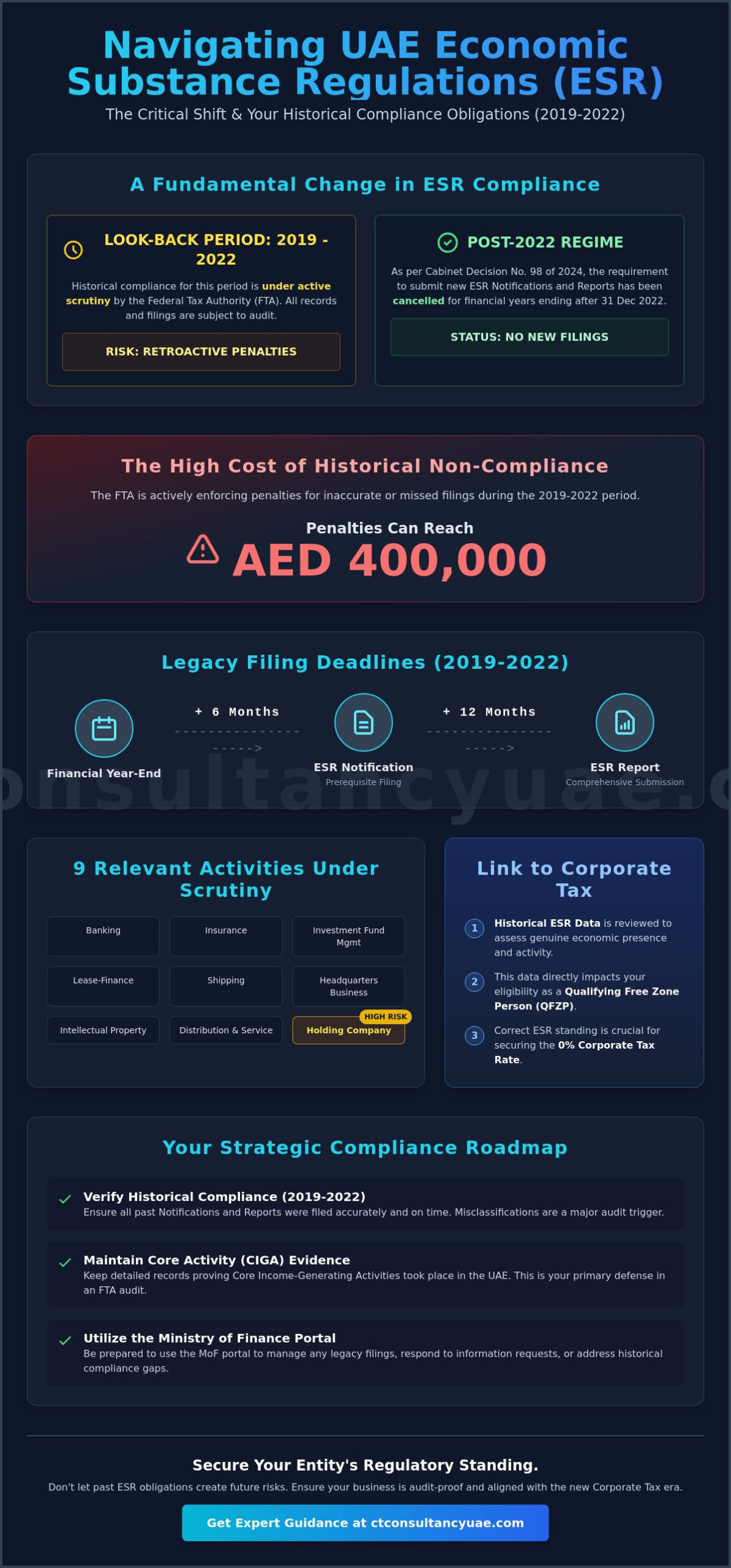
Although the active esr report filing deadline uae has passed for the final reporting cycles of 2022, the data submitted remains a primary reference point for the Federal Tax Authority (FTA) in the Corporate Tax era. The FTA doesn’t view these regimes in isolation; instead, they utilize historical ESR filings to validate an entity’s eligibility for specific tax incentives. For instance, a Free Zone entity seeking “Qualifying Free Zone Person” (QFZP) status must demonstrate that it maintains “adequate substance” within the UAE, a concept that mirrors the requirements previously established under the ESR framework. If your historical filings don’t support your current tax claims, your eligibility for the 0% tax rate could be compromised.
This evolution reflects a broader transition toward “Pillar Two” global minimum tax standards, where the focus moves beyond mere physical presence to the global allocation of profits. Reconciling your financial statements across both the ESR and Corporate Tax portals is no longer an administrative option; it’s a strategic necessity to ensure that the revenue and expenditure reported for legacy substance purposes align perfectly with the figures presented in your tax returns. Engaging with Corporate Tax Consultants Dubai allows for a comprehensive synergy analysis, ensuring that your historical substance disclosures don’t inadvertently undermine your current tax-saving strategies.
The integration of the ESR and Corporate Tax databases has empowered the FTA to employ automated data exchange protocols that instantly flag discrepancies. If the employee counts, operational expenditures, or core income-generating activities reported in your legacy ESR filings contradict the data in your current tax filings, it creates a high-probability audit trigger. Inconsistent reporting is the #1 cause of tax audits in 2026. These automated cross-checks mean that a simple clerical error from a 2022 filing, perhaps made before the final esr report filing deadline uae, can lead to a comprehensive examination of your current tax position.
Businesses must now pivot from viewing ESR as a periodic filing obligation to maintaining an integrated framework of tax and accounting oversight. Leveraging outsourced bookkeeping ensures that your records remain audit-ready and that every financial transaction is categorized with both substance and tax implications in mind. For group companies with complex cross-border relevant activities, this integration is even more vital. It allows for the proactive management of transfer pricing and global minimum tax risks within a single, unified compliance strategy that respects both historical substance and modern tax obligations.
Navigating the Ministry of Finance (MoF) portal in 2026 requires a focused approach to credential management and data integrity. While the active cycles for new filings have concluded, the portal remains the critical interface for remediation of historical gaps and responding to formal audit inquiries. For entities that discovered a missed esr report filing deadline uae during a recent internal review, the portal provides the necessary infrastructure for late submissions and voluntary disclosures. Success in this environment depends on your ability to present a cohesive narrative backed by verifiable evidence that satisfies the rigorous standards of the Federal Tax Authority.
Proving that your entity was “Directed and Managed” within the UAE for the 2019 to 2022 period requires more than just a physical office. You must maintain an archive of signed board meeting minutes that clearly demonstrate strategic decisions were debated and finalized by a quorum of directors physically present in the Emirates. To satisfy the “Adequate Personnel” and “Expenditure” criteria, your records should include specific documentation:
Clerical precision is vital to avoid automatic system rejections that can lead to unnecessary penalties. A frequent error involves entering incorrect financial year start or end dates, which often causes the portal to block subsequent reporting steps or miscalculate the applicable esr report filing deadline uae. Another common pitfall is the misclassification of “Exempt Licensee” status. Many firms assume they’re exempt without possessing the specific government certificates or fund registration documents required to meet the FTA’s burden of proof. Technical glitches can occur during high-traffic periods; it’s recommended to complete legacy filings well in advance of any remediation deadlines provided in a Request for Information. If you’re facing technical hurdles or uncertainty regarding your historical data, you can secure your historical compliance through our ESR advisory services to ensure your submissions are flawless.
While understanding the technicalities of the esr report filing deadline uae is essential for any executive, implementing a bulletproof strategy requires a partner with deep regional expertise and a focus on long-term stability. CTC Tax & Accounting provides customized ESR health checks designed specifically to identify and rectify historical compliance gaps from the 2019 to 2022 period. Our team manages the end-to-end process of Federal Tax Authority audits, ensuring that every information request is met with precise, evidence-backed responses that reflect your entity’s true economic presence. We don’t just file reports; we build a defensible narrative that protects your corporate reputation and financial interests.
Our approach involves a seamless integration of ESR, VAT, and Corporate Tax data to prevent the automated triggers that often lead to costly investigations. Through our CFO Advisory Services, we provide the high-level oversight needed to reconcile cross-border activities with local substance requirements, ensuring that your financial statements tell a consistent story across all regulatory portals. Adopting a specialized Business Advisory approach is essential for maintaining market stability as the UAE transitions into a more complex tax era. We serve as a strategic partner, helping you navigate these shifts with confidence and precision.
CTC Tax & Accounting acts as a primary friction-remover within the complex UAE tax landscape, simplifying the transition between legacy regulations and modern tax obligations. Precision in reporting is a critical financial safeguard, as the risk of an AED 50,000 penalty for a single reporting failure can quickly escalate to AED 400,000 for consecutive substance failures. Our established track record since 2015 demonstrates our commitment to securing the regulatory standing of our clients through meticulous internal audit and compliance protocols. We ensure that every document, from board minutes to expenditure receipts, meets the highest standards of the National Assessing Authority.
Securing your entity’s future requires moving beyond reactive filing toward proactive financial planning that anticipates regulatory shifts. Our elite consultants navigate city-neutral national regulations with a global perspective, allowing your business to thrive despite the cessation of the active esr report filing deadline uae cycles. We focus on creating a robust compliance culture that supports your growth objectives while minimizing exposure to retroactive audits. By aligning your historical substance data with current tax strategies, we help you unlock the full benefits of the UAE’s competitive tax environment. Request a strategic compliance briefing today to insulate your business from historical risks and prepare for the next phase of UAE corporate governance.
Maintaining a flawless regulatory profile requires a transition from reactive filing to proactive strategic oversight. While the standalone ESR regime has been integrated into the Corporate Tax framework, the Federal Tax Authority continues to scrutinize historical data to verify eligibility for high-value tax incentives. Ensuring that your previous submissions align perfectly with your current tax position is the most effective way to insulate your entity from retrospective penalties and automated audit triggers.
At CTC Tax & Accounting, we leverage decades of international expertise in UAE finance to provide bespoke compliance solutions for both SMEs and Free Zone entities. Our proven track record in FTA audit representation ensures that your business remains resilient in the face of rigorous regulatory examinations. By meticulously managing the legacy esr report filing deadline uae and auditing historical substance documentation, we help you maintain long-term stability and operational growth.
Secure your business with expert ESR compliance support today. We’re here to ensure your transition into the new tax landscape is both profitable and friction-free.
Missing the esr report filing deadline uae for financial years between 2019 and 2022 results in an administrative penalty of AED 50,000. Additionally, failure to submit a mandatory notification incurs a penalty of AED 20,000. These fines are enforced by the Federal Tax Authority and can escalate to AED 400,000 for consecutive failures to demonstrate sufficient economic substance during an audit.
Economic Substance Regulations no longer apply for new filings regarding the 2024 and 2025 financial years. Cabinet Decision No. 98 of 2024 effectively cancelled these requirements for any financial period ending after 31 December 2022. However, businesses must maintain their records for six years to ensure they can defend historical filings during potential retrospective examinations.
You can amend a previously filed ESR report through the Ministry of Finance portal if you identify discrepancies during your 2026 internal reviews. Correcting historical data is a strategic move to ensure your legacy filings align with the information provided in your Corporate Tax returns. Proactive amendments can often mitigate the risk of the FTA initiating a formal inquiry into your entity’s substance.
The Economic Substance Test requires a Licensee to be directed and managed in the UAE, possess adequate personnel and expenditure, and conduct its Core Income Generating Activities (CIGAs) domestically. Your entity must demonstrate that board meetings were held with a physical quorum in the UAE and that all primary business operations were supported by local assets and qualified employees.
A company is classified as an Exempt Licensee if it is an investment fund, a government-owned entity, or a UAE resident entity that is not part of a multinational group and only operates domestically. You must provide specific documentary evidence, such as a Tax Residency Certificate from another jurisdiction, to claim this status. Failing to provide this proof often results in the FTA rejecting the exemption claim.
The Federal Tax Authority (FTA) serves as the National Assessing Authority responsible for monitoring compliance and issuing penalties. While the Ministry of Finance manages the filing portal, the FTA conducts the actual audits and verifies the substance demonstrated in your reports. This centralized oversight ensures that substance requirements are consistently applied across the UAE’s evolving tax landscape.
Filing a notification without following up with the required Economic Substance Report leads to a penalty of AED 50,000. The notification is merely a preliminary declaration; the report is the primary document where you prove your entity meets the substance criteria. This oversight is frequently flagged by the FTA’s automated systems, triggering immediate administrative fines.
A separate ESR filing is generally not required for each branch of a UAE company. Instead, the parent company or the main head office submits a single consolidated notification and report that includes the activities of all its UAE-based branches. This consolidated approach simplifies the esr report filing deadline uae management for large organizations while ensuring all relevant activities are accounted for under one license.