
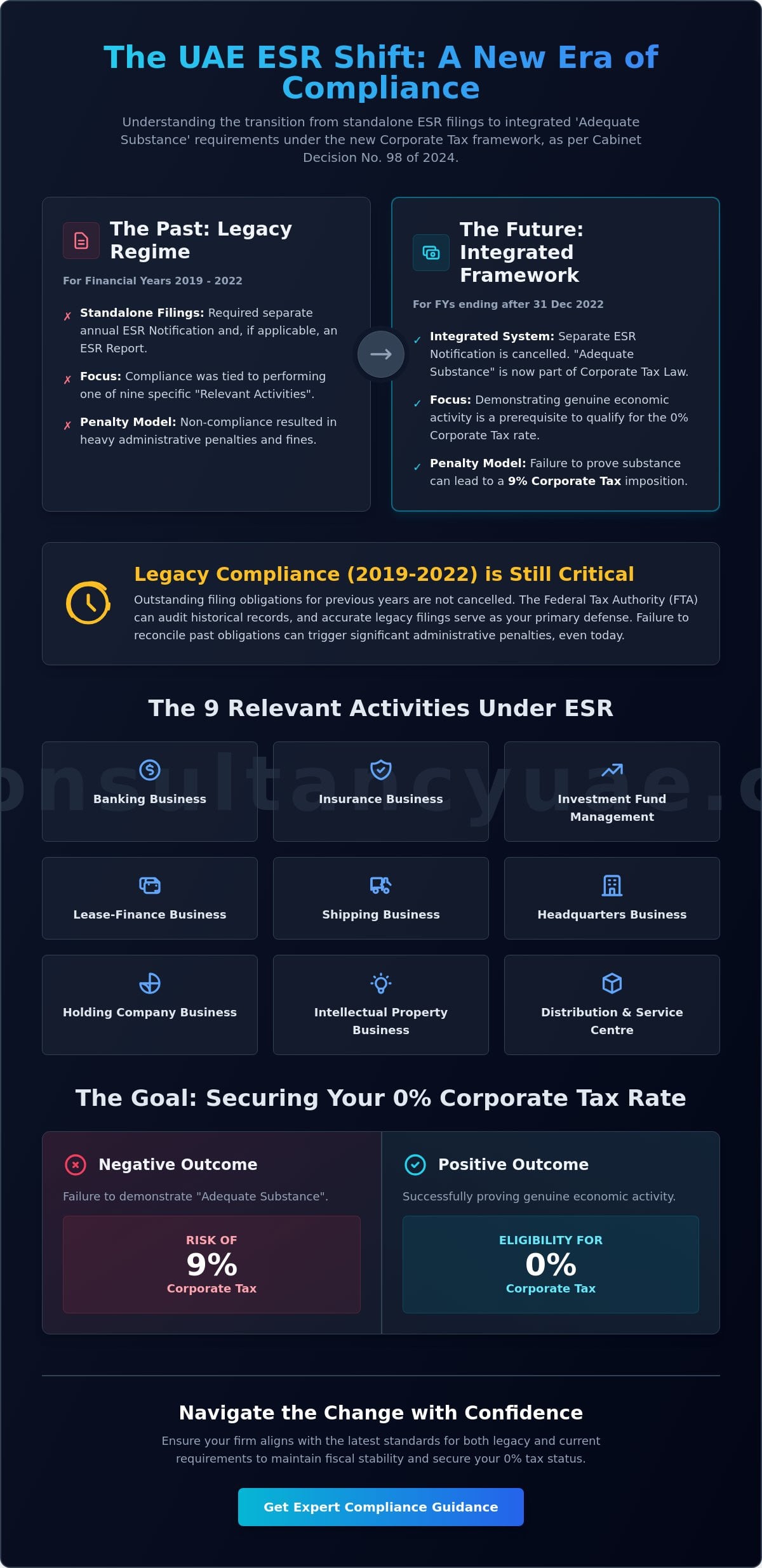
What if the most critical update for your 2026 compliance strategy isn’t how to file your ESR notification, but the fact that the filing itself no longer exists? You’ve likely spent years meticulously tracking deadlines to avoid the heavy administrative penalties historically associated with esr notification filing uae. It’s natural to feel a sense of ambiguity as the regulatory landscape shifts; however, the cancellation of ESR filing for financial years ending after 31 December 2022 doesn’t signal an end to oversight. Instead, Cabinet Decision No. 98 of 2024 marks a sophisticated integration of economic substance directly into the UAE Corporate Tax framework.
This guide clarifies the transition from the legacy ESR regime to the “adequate substance” requirements under the current Corporate Tax Law, ensuring you maintain your 0% tax status without error. We’ll examine the repeal of standalone filings, the strategic importance of legacy compliance for the 2019 to 2022 period, and the specific substance tests Free Zone entities must now satisfy to mitigate the risk of a 9% tax imposition. By understanding these nuances, you can secure your firm’s operational legitimacy and ensure long-term fiscal stability in a changing market.
The regulatory landscape of the United Arab Emirates has undergone a significant transformation, moving from a standalone compliance framework to a sophisticated, integrated tax ecosystem. In the 2026 context, the strategic importance of understanding your esr notification filing uae obligations lies in the transition between historical requirements and the new federal Corporate Tax regime. While Cabinet Decision No. 98 of 2024 officially cancelled the requirement to file new ESR Notifications for financial years ending after 31 December 2022, the legacy of these filings remains a critical pillar of corporate governance. Entities must recognize that accurate historical documentation serves as a primary defense against federal audits, especially as the Federal Tax Authority (FTA) synchronizes data across multiple compliance platforms.
The UAE’s commitment to the OECD’s Base Erosion and Profit Shifting (BEPS) framework remains the driving force behind these regulations. By ensuring that companies demonstrate genuine economic activity within the jurisdiction, the UAE maintains its standing as a transparent global financial hub. Distinguishing between the annual Notification and the more intensive Economic Substance Report is vital; the former acts as a preliminary declaration of “Relevant Activities,” while the latter provides the granular data required to prove actual substance. Failing to reconcile these historical filings can trigger significant administrative penalties, even years after the fiscal period has closed.
The evolution of Economic Substance in the UAE is anchored in a series of Cabinet Decisions, most recently amended by Cabinet Resolution No. 98 of 2024. This specific update refined the filing requirements by shifting the burden of substance demonstration from a separate ESR filing to the broader Corporate Tax Advisory framework. For mainland and free zone entities, this means that while the “Notification” as a separate task is a thing of the past for current years, the principles of “adequate substance” are now a prerequisite for accessing the 0% tax rate. The integration ensures that tax compliance isn’t just about numbers, but about the physical and operational reality of the business.
The primary objective of the esr notification filing uae was to provide Regulatory Authorities with early-stage data regarding an entity’s Relevant Activities. By establishing an entity’s “Substance” status early in the fiscal cycle, the Ministry of Finance could categorize businesses based on their risk profile and economic footprint. The Ministry continues to prioritize digital-first submissions via its National Portal for any outstanding legacy filings. This centralized approach allows for real-time data sharing between regulatory bodies, ensuring that any entity claiming tax incentives under the new regime has a verifiable history of compliance.
Determining whether a business falls within the scope of Economic Substance Regulations is not a mere administrative review of a trade license. It’s a nuanced evaluation of actual income-generating activities. While the UAE has integrated substance tests into its federal tax system, the obligation to rectify historical esr notification filing uae remains a high-priority task for many corporate structures. The “Substance Over Form” principle dictates that the actual operations of an entity take precedence over the commercial activities listed on its legal documentation. If your business performed any of the nine specified activities between 2019 and 2022, and earned income from them, compliance is mandatory regardless of your license’s literal wording.
The UAE Ministry of Economy & Tourism ESR Guide categorizes the sectors subject to these regulations into nine distinct “Relevant Activities.” High-intensity sectors like Banking, Insurance, and Investment Fund Management are primary focuses, given their central role in the financial ecosystem. Lease-Finance and Shipping businesses also face rigorous scrutiny, particularly regarding the location of their core income-generating activities. For most corporate groups, the classifications of Headquarters, Holding Company, and Intellectual Property businesses are the most common triggers for filing. Distribution and Service Center activities often capture entities that purchase goods from foreign group members for resale or provide specific services to connected persons abroad. Each category requires a specialized assessment to ensure that the entity’s economic footprint aligns with its reported status.
The “Substance Over Form” test is the definitive tool for evaluating whether an entity was truly in scope. It’s common for a business to hold a “General Trading” license while its primary revenue actually derives from providing Lease-Finance services or acting as a Regional Headquarters. In such cases, the regulatory authority ignores the license title and focuses on the nature of the income. Diversified groups with multiple revenue streams must conduct a strategic assessment for each individual license holder within the group. If you’re uncertain about your historical exposure, seeking a professional Economic Substance Regulations (ESR) Compliance review can prevent the inadvertent omission of a required filing.
To evaluate your status effectively, consider this three-step framework:
Accurate classification is the cornerstone of successful compliance. By looking beyond the trade license and focusing on operational reality, businesses can ensure their historical filings are robust and defensible against future federal inquiries.
Executing a successful esr notification filing uae requires a methodical approach that prioritizes data integrity and technical precision. While the requirement for new filings has been repealed for current fiscal periods, the Ministry of Finance National Portal remains the active gateway for rectifying legacy omissions from the 2019 to 2022 period. A strategic roadmap ensures that your entity’s historical record is beyond reproach, effectively closing potential gaps that federal auditors might otherwise exploit. This process begins with a rigorous internal audit of your corporate structure and ends with a formal confirmation that secures your compliance standing.
Precision at the preparatory stage is the most effective way to remove friction during the actual upload. You must gather your valid trade license, precise fiscal year start and end dates, and comprehensive ownership details, including Ultimate Beneficial Ownership (UBO) information. Identifying the specific Core Income Generating Activities (CIGA) performed within the UAE is the most critical technical step in this phase. The Core Income Generating Activities (CIGA) represent the operational heart of the filing, serving as the definitive evidence that the entity’s primary value creation occurs within the UAE jurisdiction. Without clearly documented CIGAs, an entity risks failing the substance test regardless of its physical presence.
The Ministry of Finance (MoF) National Portal is a sophisticated interface designed for digital-first regulatory transparency. Creating and managing your portal account requires professional precision; any discrepancy in the initial registration can lead to systemic errors in subsequent filings. Once the account is active, you must enter financial and operational data points with absolute consistency, ensuring they align with your historical VAT returns and audited financial statements. Linking your historical esr notification filing uae to your broader tax services strategy ensures holistic compliance and prepares your organization for the rigors of the current Corporate Tax environment.
To finalize your submission, follow these verification protocols:
A structured submission process transforms a complex regulatory hurdle into a manageable administrative task. By focusing on the granular details of the MoF portal requirements, you establish a foundation of reliability that supports your firm’s long-term growth and stability in the region.
Precision in timing is the hallmark of a well-governed entity, especially as the UAE transitions from legacy Economic Substance Regulations to the current Corporate Tax framework. Historically, the 6-month rule served as the definitive temporal boundary for esr notification filing uae, requiring entities to submit their declarations within half a year of the financial year-end. While Cabinet Decision No. 98 of 2024 has officially cancelled these obligations for financial years ending after 31 December 2022, the 6-month logic remains a vital benchmark for any entity rectifying outstanding obligations from the 2019 to 2022 period. Failure to address these legacy windows creates a persistent regulatory shadow that can obstruct modern tax registrations and audits.
Effective compliance requires a synchronization of your regulatory calendar with your internal accounting services. For entities with a standard December 31st year-end, the historical deadline was June 30th; those with a June 30th close were required to file by December 31st. Adopting an early filing strategy for legacy corrections is essential to avoid the portal congestion and technical delays that often occur near major cut-off dates. This proactive approach allows for a meticulous review of data accuracy, ensuring that your historical record remains consistent with your current federal tax filings.
The cost of non-compliance has shifted from fixed administrative fines to more severe fiscal consequences. Under the legacy regime, failure to submit a notification resulted in an AED 20,000 penalty, while providing inaccurate information could trigger an AED 50,000 fine. In the 2026 landscape, the stakes are significantly higher. If a Free Zone entity fails to demonstrate “adequate substance,” it risks losing its “Qualifying” status, thereby forfeiting the 0% tax rate and becoming subject to the standard 9% Corporate Tax on all income for five years. This “Cascade Effect” extends further, as ESR failures often trigger secondary investigations into Ultimate Beneficial Ownership (UBO) and Anti-Money Laundering (AML) standing, potentially compromising your operational trade license.
If you discover an error in a previous submission or receive a penalty notice, consider these steps for administrative recourse:
Protecting your firm from these financial risks requires a forward-looking strategy that bridges past obligations with future tax liabilities. You should engage with specialized Corporate Tax Advisory to ensure your historical ESR data and current substance documentation are perfectly aligned to mitigate any risk of federal audit or tax status revocation.
In an era where regulatory oversight is increasingly automated and interconnected, the margin for error in your historical esr notification filing uae has effectively vanished. CTC Tax & Accounting serves as a primary friction-remover, providing a sophisticated end-to-end support model that spans from initial activity classification to the final confirmation on the Ministry of Finance portal. Our methodology is rooted in the conviction that compliance isn’t a static checkbox but a dynamic component of your firm’s operational legitimacy. By conducting a professional ESR audit before any submission, we identify and rectify discrepancies that could otherwise trigger federal scrutiny or jeopardize your tax standing.
Long-term stability in the UAE’s evolving market requires more than just reactive filing; it demands a proactive integration of substance requirements with your broader business advisory strategy. Our consultants provide the strategic reassurance necessary to navigate these high-stakes transitions, ensuring that your corporate structure is both globally minded and locally expert. We reject the one-size-fits-all approach, opting instead for customized compliance plans that reflect the unique operational footprint of your entity. This meticulous planning ensures that your historical records support, rather than undermine, your future growth objectives.
Decades of local and international expertise allow our team to provide a level of precision that remains unmatched in the region. We understand that a “Holding Company” in one jurisdiction may have vastly different substance requirements than one in a UAE Free Zone; it’s this nuance that defines our service. This technical proficiency is why executive decision-makers trust us to conduct comprehensive regulatory health checks that safeguard their assets. If you’re uncertain about your historical exposure, contacting our consultants for a detailed assessment is the first step toward professional calm.
Our approach ensures that your ESR status is perfectly synchronized with your broader ESR Compliance in the UAE framework. Aligning your historical data with current requirements is essential for maintaining a seamless transition into the 2026 tax landscape. Ensuring your filing supports your Corporate Tax Consultants strategy prevents the “Cascade Effect” of penalties and audits discussed previously. Secure your business compliance with CTC Tax & Accounting today and ensure your operations are built on a foundation of reliability and security.
The transition from standalone Economic Substance Regulations to a unified Corporate Tax framework requires a meticulous reconciliation of historical data with current operational realities. While current filing obligations have been repealed, the strategic importance of your legacy esr notification filing uae can’t be overstated; it serves as the evidentiary foundation for your firm’s tax status. Maintaining precise documentation for the 2019 to 2022 period is essential to mitigate the risk of administrative penalties and to ensure your eligibility for the 0% Corporate Tax rate remains undisputed.
Founded in 2015 with deep UAE regulatory mastery, CTC Tax & Accounting provides specialized support for both SMEs and multinational groups seeking a seamless transition into this new era. Our comprehensive integration of AML, UBO, and Tax compliance ensures that every facet of your regulatory footprint is secure and defensible. Consult with our ESR experts for a frictionless filing experience and position your business for long-term fiscal stability. It’s our priority to help you achieve a future of organized momentum and professional calm.
There is no filing deadline for the 2026 period because the requirement for esr notification filing uae was officially cancelled for financial years ending after 31 December 2022. This change was formalized by Cabinet Decision No. 98 of 2024. Businesses should instead focus on satisfying the “adequate substance” requirements under the UAE Corporate Tax Law to maintain their tax eligibility. Legacy filings for the 2019 to 2022 period remain mandatory and should be completed if outstanding.
An entity qualifies as an “Exempted Licensee” if it meets specific criteria, such as being a UAE-resident company that isn’t part of a multinational group or being wholly owned by the UAE government. Investment funds and branches of foreign companies that pay tax on their Relevant Activity income outside the UAE also qualify for exemptions. You must provide specific documentary evidence to the Ministry of Finance to formalize this status and avoid standard reporting obligations.
Submitting inaccurate or misleading data in a historical notification traditionally triggered an administrative penalty of AED 50,000. In the current regulatory environment, such errors can create a discrepancy that alerts the Federal Tax Authority to potential substance failures. This often leads to a comprehensive audit of your “adequate substance” status, which could result in the loss of the 0% Corporate Tax rate for Free Zone entities.
A dormant company is required to file if it performed a Relevant Activity and generated any amount of gross income during the legacy reporting years. If the entity was entirely inactive and earned no income, it generally fell outside the scope of the Economic Substance Regulations. It’s essential to verify that no passive income, such as bank interest or intellectual property royalties, was credited to the company during the fiscal year.
The notification is a preliminary declaration used to inform the Regulatory Authority whether an entity performed a Relevant Activity during the financial year. The Economic Substance Report is a far more detailed submission required only if the entity actually earned income from that activity. While the notification identifies the activity, the report provides the granular evidence of employees, assets, and Core Income-Generating Activities (CIGAs) within the UAE.
Selecting the correct Regulatory Authority depends on your trade license type and your physical location. Mainland commercial companies typically report to the Ministry of Economy, while banks and insurance providers fall under the Central Bank’s jurisdiction. If your entity is registered within a Free Zone, you must select that specific Free Zone Authority to ensure your esr notification filing uae is correctly routed and processed.
Missing a legacy deadline for an ESR notification resulted in a fixed penalty of AED 20,000, while failure to submit the more detailed Economic Substance Report incurred a fine of AED 50,000. Beyond these financial costs, repeated non-compliance could lead to the suspension of your trade license. Under new tax laws, failing the substance test now carries the much larger risk of a 9% tax imposition on all income.
The fundamental substance principles were identical for both, but the strategic stakes are now significantly higher for Free Zone entities. To qualify for the 0% Corporate Tax rate, a Free Zone company must maintain “adequate substance” as a “Qualifying Free Zone Person.” While mainland companies generally pay the standard 9% tax, Free Zone businesses rely on their substance documentation to protect their tax-free status, making accuracy a critical financial priority.