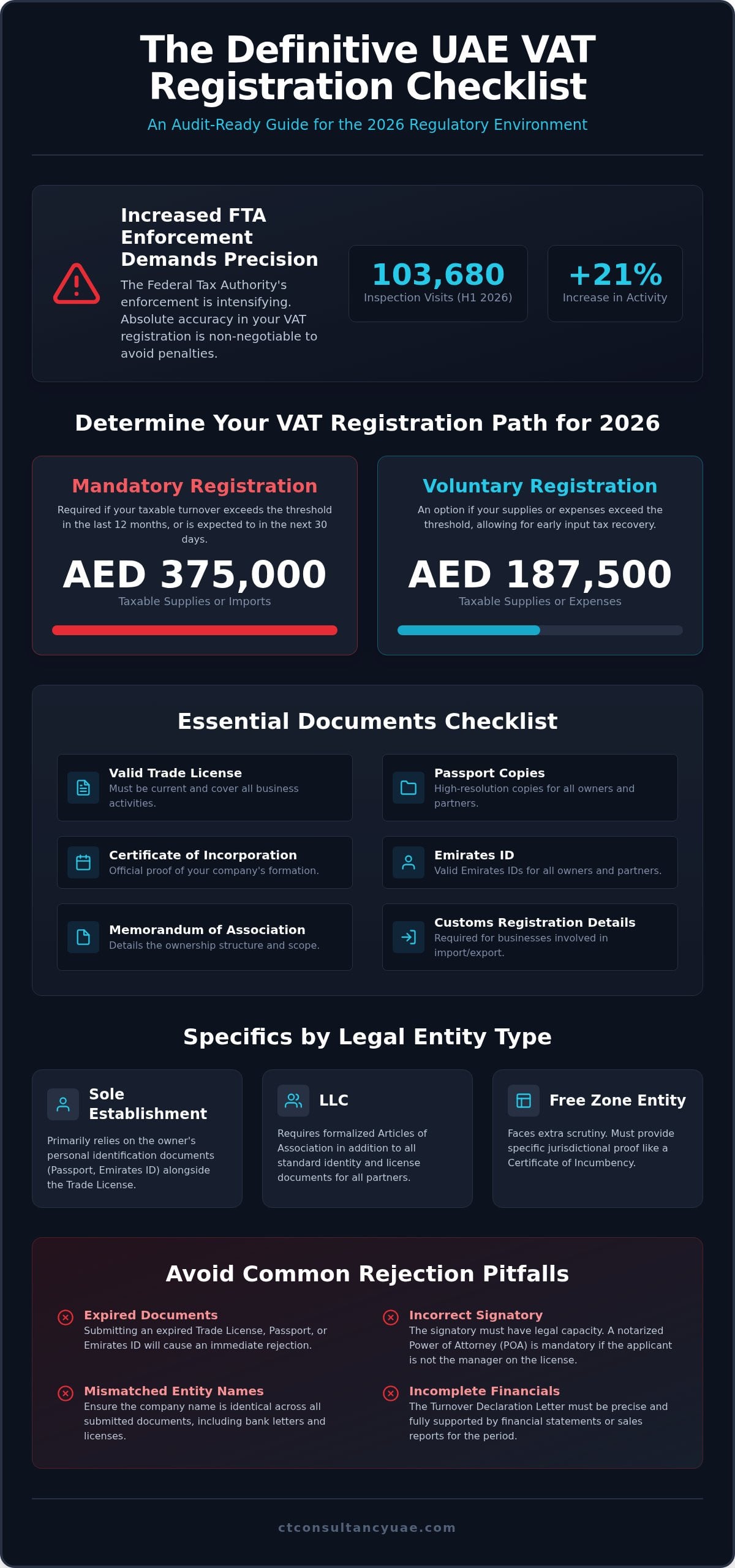
The Federal Tax Authority conducted 103,680 inspection visits in the first half of 2026, which is a 21% increase in enforcement activity that demands absolute precision in your tax strategy. You’re likely focused on the strict 20-business-day processing window while attempting to decipher the complex list of documents required for VAT registration in the UAE. It’s natural to feel concerned about how a single missing file or a misunderstanding of your legal entity’s requirements could trigger a rejection or lead to significant administrative penalties.
We’ve designed this guide to eliminate that uncertainty and provide you with a definitive, audit-ready compliance checklist. By following this structured approach, you’ll master the FTA requirements. You can secure your Tax Registration Number (TRN) without the typical friction associated with national tax filings. We’ll examine the specific documentation needed for various corporate structures and provide the clarity you need for a successful, stress-free registration process in the current regulatory environment.
Key Takeaways
- Determine your 2026 regulatory obligations by evaluating your taxable turnover against the mandatory AED 375,000 and voluntary AED 187,000 registration thresholds.
- Compile an audit-ready file of the essential documents required for VAT registration in the UAE, ensuring your trade license and legal trail documentation meet current Federal Tax Authority standards.
- Master the technical requirements for drafting a turnover declaration letter that precisely details your taxable supplies, imports, and expenses from the previous 12 months.
- Mitigate the risk of registration delays by identifying common clerical pitfalls, such as expired identification or mismatched entity names, before submitting your application via the EmaraTax portal.
The UAE VAT Regulatory Framework: Determining Your Registration Path
The current regulatory environment in the UAE necessitates a precise understanding of the thresholds governing tax liability. For the 2026 fiscal year, businesses must evaluate their position based on these specific metrics:
- Mandatory Threshold: AED 375,000 in taxable supplies or imports over the preceding 12 months.
- Voluntary Threshold: AED 187,500 in taxable supplies or expenses, offering a path for early-stage recovery.
- Anticipatory Rule: A 30-day window for businesses expecting to exceed the mandatory limit.
Beyond compliance, VAT registration functions as a strategic pivot. It enhances B2B credibility and facilitates the recovery of input tax, which directly impacts cash flow optimization. This data foundation is increasingly critical as VAT records now serve as the primary evidentiary source for Taxation in the United Arab Emirates, specifically regarding Corporate Tax obligations.
Mandatory vs. Voluntary Registration
Determining when to submit the documents required for VAT registration in the UAE depends on your specific financial trajectory. Mandatory action is required once you hit the AED 375,000 mark to avoid penalties. However, the voluntary threshold of AED 187,500 offers a distinct advantage for startups. It’s a strategic move that allows these entities to reclaim VAT on significant setup expenses, such as leasing professional workspace at Orion Star Business Center, effectively reducing the net cost of market entry.
Tax Group Registration Considerations
Related parties with shared control may find efficiency in forming a single tax entity. This structure simplifies compliance by consolidating multiple branches or subsidiaries under one Tax Registration Number. Establishing a tax group requires a comprehensive set of documents required for VAT registration in the UAE that prove legal and financial interconnectedness. For specialized guidance, our VAT Registration Services provide the necessary technical oversight to ensure a frictionless FTA approval.
Core Identity and Legal Documentation for VAT Registration
Precision in identity verification is the bedrock of a successful application. The FTA requires a valid Trade License that encompasses all current business activities and branches. This document serves as the primary evidence of your legal right to conduct taxable transactions within the national territory. Without a currently valid license, the registration process cannot proceed, as the portal will reject any expired documentation during the initial screening phase.
Beyond the license, the Federal Tax Authority VAT Registration portal demands a comprehensive legal trail. This includes the Certificate of Incorporation and the Memorandum of Association (MOA), which delineate the ownership structure and operational scope of the entity. You must also provide high-resolution passport copies and valid Emirates IDs for all owners and partners. These are essential components of the documents required for VAT registration in the UAE, ensuring that the FTA can verify the ultimate beneficial ownership of the enterprise. Businesses involved in international trade must also supply their Customs Registration details to link their import-export activities with their tax profile.
Legal Entity Specifics
Documentation requirements diverge significantly based on your corporate structure. While a Sole Establishment may rely heavily on the owner’s personal identification, a Limited Liability Company (LLC) must present formalized articles of association. Free Zone entities face additional scrutiny regarding their offshore status and must provide specific certificates of incumbency or similar jurisdictional proof. These variations underscore why understanding the specific documents required for VAT registration in the UAE is vital for different legal frameworks.
Authorized Signatory Protocols
The designated signatory must have the legal capacity to represent the firm. If the manager listed on the license is not the individual handling the application, a notarized Power of Attorney (POA) is mandatory. It’s vital that the signatory’s contact details align perfectly with official records to prevent automated portal flags. For businesses seeking a frictionless registration experience, ensuring this alignment is a critical step in the pre-submission phase.
Financial Evidence: Preparing the Turnover Declaration
The Turnover Declaration Letter represents the most scrutinized element of the documents required for VAT registration in the UAE, serving as the formal evidentiary basis for your tax liability. To comply with 2026 FTA standards, you must meticulously aggregate all taxable supplies and imports across the preceding 12-month period. This calculation must include both standard-rated (5%) and zero-rated supplies, while specifically omitting exempt income such as certain financial services or residential rents. The FTA frequently requests audited financial statements or certified management accounts to substantiate these declarations. Meticulous attention is also required for banking details. You must provide a corporate bank account statement; the use of personal accounts leads to immediate application rejection.
Projecting Future Turnover
The anticipatory rule permits registration if you expect your taxable turnover to exceed the mandatory threshold within the next 30 days. Taxable supplies are defined as all goods and services supplied in the UAE that are subject to VAT at either the standard 5% rate or the 0% rate. To validate this projection, the portal requires tangible evidence. Uploading signed contracts, formal purchase orders, or verified tenders provides the necessary proof of impending growth and justifies an early TRN acquisition.
Supporting Financial Records
Maintaining consistent bookkeeping and accounting is now a non-negotiable prerequisite for regulatory peace of mind. These internal records ensure your turnover declaration remains defensible during an audit and aligns perfectly with your Corporate Tax base. Discrepancies between VAT turnover and corporate income are a primary trigger for FTA inquiries. If you don’t want to risk a rejection due to clerical errors, our VAT Registration and Compliance team can perform a pre-submission audit of your financial data pack.
Ensuring a Successful Submission: Avoiding Common Pitfalls
The final phase of securing your TRN demands a level of precision that transcends simple data entry. The Federal Tax Authority (FTA) currently maintains a 20-business-day review period, though this timeline is frequently compromised by "Clarification" requests. These formal inquiries occur when the EmaraTax portal detects inconsistencies, such as expired Emirates IDs or entity names that don’t align perfectly across your legal trail. Submitting a flawless set of documents required for VAT registration in the UAE is the most effective strategy to avoid these delays. Common rejection triggers include insufficient financial evidence or clerical errors in the turnover declaration. Partnering with a seasoned tax consultant provides the technical oversight needed to navigate the portal’s nuances and prevent costly registration setbacks.
Authorized Signatory and POA Nuances
The Authorized Signatory must have the documented legal capacity to represent the firm in fiscal matters. If the person managing the application doesn’t appear as a manager on the trade license, a notarized Power of Attorney (POA) is essential. This document must be legally valid within the UAE and explicitly grant the right to bind the company for tax purposes. Failure to provide this verified link is a primary cause for application returns during the initial screening phase.
Final Checklist Before Hitting Submit
Navigating the Federal Tax Authority’s requirements in 2026 requires more than a simple administrative checklist; it demands a strategic approach to corporate documentation and financial reporting. By ensuring your trade license is current and your turnover declaration is backed by rigorous accounting, you protect your business from the friction of clarification requests and potential penalties. Mastering the specific documents required for VAT registration in the UAE is the first step toward building a compliant tax profile that integrates seamlessly with your broader Corporate Tax obligations.
Leveraging decades of international financial experience, our team provides end-to-end EmaraTax portal management to remove every obstacle from your path. Secure your business compliance with our expert VAT registration services today. With the right documentation pack and professional oversight, you can transform a complex regulatory hurdle into a stress-free launchpad for your next phase of national growth.
Frequently Asked Questions
What is the mandatory VAT registration threshold in the UAE for 2026?
The mandatory VAT registration threshold remains AED 375,000 for taxable supplies and imports over the preceding 12 months. Businesses must also register if they anticipate exceeding this limit within the next 30 days. For startups seeking early input tax recovery, the voluntary threshold is set at AED 187,500. Accurately evaluating these figures is vital when determining when to prepare the documents required for VAT registration in the UAE.
Can I register for VAT in the UAE without a corporate bank account?
No, the Federal Tax Authority requires a valid corporate bank account for all VAT registration applications. Personal bank accounts are consistently rejected during the review process because they don’t represent a separate legal financial entity. You must provide a formal bank statement or a letter from your financial institution confirming your IBAN and corporate account details to ensure your application moves through the EmaraTax portal without friction.
How long does the FTA take to process a VAT registration application?
The Federal Tax Authority (FTA) typically takes 20 business days to process a VAT registration application once a completed submission is received. However, this timeline depends heavily on the accuracy of your uploaded files. Any mismatch in data or missing documents required for VAT registration in the UAE will trigger a "Clarification" request, which resets the review clock and extends the total time needed to acquire your Tax Registration Number.
Is a Memorandum of Association (MOA) always required for VAT registration?
A Memorandum of Association (MOA) is mandatory for legal entities like Limited Liability Companies (LLCs) to establish the ownership structure and legal trail. While sole establishments don’t typically have an MOA, they must provide equivalent proof of legal status, such as a valid trade license and the owner’s identification. The FTA requires these documents to verify the authority of the signatory and the scope of the business’s taxable activities.
What happens if I fail to register for VAT on time?
Failure to register for VAT by the specified deadline results in significant administrative penalties imposed by the FTA. With inspection visits reaching 103,680 in the first half of 2026, the authority is actively identifying non-compliant entities. Beyond immediate fines, late registration can disrupt your ability to issue valid tax invoices, which damages B2B relationships and prevents you from reclaiming input tax on your business expenses during the non-compliant period.