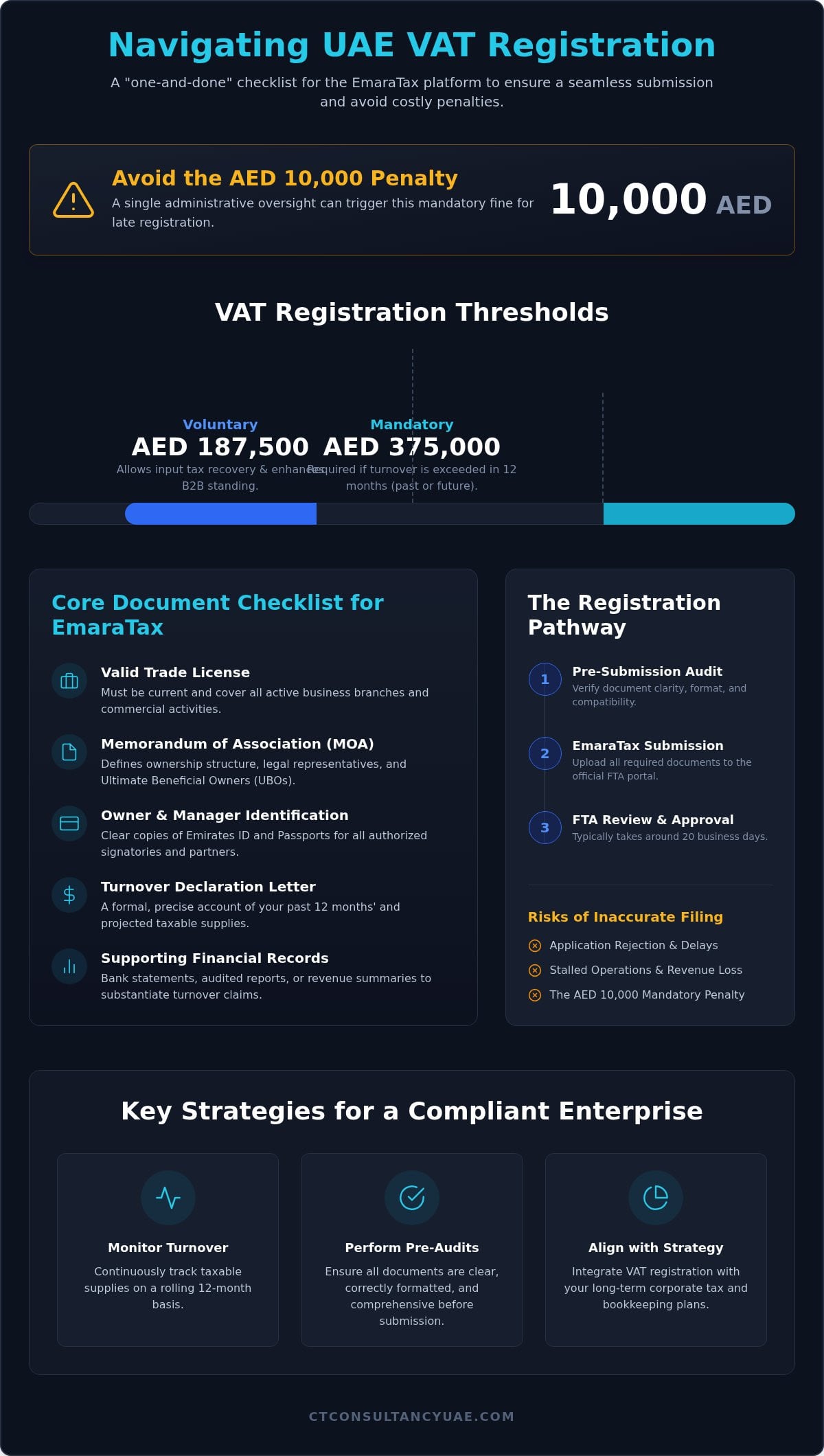
A single administrative oversight during your Federal Tax Authority application can trigger a mandatory AED 10,000 penalty before your business even issues its first tax invoice. In the current regulatory environment, identifying the exact documents required for VAT registration in the UAE is not merely a clerical task; it’s a foundational element of your firm’s compliance architecture. We understand that the transition to the EmaraTax platform and the 2026 legislative amendments have introduced new layers of complexity that often lead to the frustration of repeated application rejections and stalled operations.
This article provides a comprehensive, expert-verified checklist designed to facilitate a "one-and-done" registration process. You’ll gain a clear understanding of the turnover declaration requirements for the AED 375,000 mandatory threshold and the specific evidence needed for various legal structures. By following this structured briefing, you can secure professional assurance that your entity is fully compliant with the latest FTA standards. This guide ensures you navigate the submission process with precision, allowing you to focus on strategic growth without the looming threat of avoidable fines or administrative delays.
Key Takeaways
- Determine your specific filing obligations by identifying whether your business meets the mandatory AED 375,000 or voluntary AED 187,500 registration thresholds.
- Consolidate the essential documents required for VAT registration in the UAE, ensuring your trade license and Memorandum of Association are correctly formatted for the EmaraTax portal.
- Master the nuances of the Turnover Declaration Letter to provide the Federal Tax Authority with a precise account of your past and projected taxable supplies.
- Implement a rigorous pre-submission audit to verify document clarity and file compatibility, mitigating the risk of administrative delays or application rejections.
- Align your initial registration with long-term corporate tax and bookkeeping strategies to foster a stable and compliant fiscal environment for your enterprise.
Understanding the Regulatory Framework for UAE VAT Registration
The UAE fiscal landscape in 2026 is defined by a mature, digital-first approach overseen by the Federal Tax Authority (FTA). Following the legislative amendments effective January 1, 2026, the emphasis on transparency has never been higher. For entrepreneurs, understanding the broader context of Taxation in the United Arab Emirates is the first step toward building a resilient corporate structure. This framework requires every business to vigilantly monitor their taxable turnover on a rolling 12-month basis rather than a standard calendar year. It’s a continuous obligation that demands precise internal record-keeping.
The mandatory registration threshold remains fixed at AED 375,000. If your taxable supplies or imports exceeded this amount in the previous year, or if you expect them to do so in the coming 30 days, registration is a legal imperative. Proactive compliance is a strategic advantage. It prevents the retroactive application of taxes and penalties that can severely disrupt cash flow. By securing your Tax Registration Number (TRN) early, you position your enterprise as a stable participant in the regional economy.
Mandatory vs. Voluntary Registration: Making the Strategic Choice
Choosing to register voluntarily once your turnover exceeds AED 187,500 offers distinct fiscal benefits. It allows your business to reclaim input tax on capital expenditures and operational costs, which is vital for early-stage growth. Beyond the balance sheet, being VAT-registered enhances your standing in B2B relationships. Many Tier-1 vendors and government entities prioritize partnerships with tax-compliant firms. Utilizing professional VAT registration and compliance services can help you determine the optimal timing for this transition to maximize your tax recovery potential.
The Risks of Non-Compliance and Inaccurate Documentation
The FTA maintains a rigorous enforcement policy to ensure market integrity. A failure to register within the legal timeframe results in a fixed penalty of AED 10,000. However, the hidden cost of compliance often lies in the "resubmission cycle." If you fail to provide the exact documents required for VAT registration in the UAE, the FTA may reject the application, forcing you to restart a process that typically takes 20 business days. This delay prevents you from charging VAT on your sales, potentially leading to significant revenue loss or the need to absorb the tax cost yourself to remain competitive during the interim.
Core Corporate and Identification Documents Required
Preparing the core documents required for VAT registration in the UAE involves more than a simple digital upload; it requires a strategic audit of your firm’s legal identity. At the center of this requirement is a valid Trade License. It’s not enough for the license to be current. It must encompass all active branches and commercial activities. If your business operates across multiple emirates under a single legal umbrella, the UAE Federal Tax Authority requires documentation that reconciles these various locations to ensure the tax net covers the entire enterprise.
Your Memorandum of Association (MOA) or Articles of Association serves as the definitive guide for the FTA to understand your ownership structure. This document is critical because it identifies the Ultimate Beneficial Owners and establishes the legal capacity of the individuals representing the firm. For international firms, these documents often require notarization or legal translation to meet local standards. Precision here is paramount, as the FTA uses these records to cross-reference your application against the National Economic Register.
Legal Entity Specifics: Natural Persons vs. Legal Persons
The documentation path diverges significantly based on your legal status. A sole establishment, classified as a "Natural Person," primarily relies on the personal identification of the owner. Conversely, a "Legal Person," such as a Limited Liability Company, must provide comprehensive corporate governance records. International companies operating through a UAE branch face additional scrutiny, often requiring parent company documents and proof of local establishment. To navigate these nuances, many firms leverage professional VAT registration and compliance services to ensure their specific legal structure is accurately represented.
Validation of Authorized Signatories
One of the most common causes for application rejection is the failure to properly validate the authority of the signatory. If the person signing the tax application isn’t the manager explicitly named on the Trade License, you must provide a legally binding Power of Attorney (POA). This POA must clearly grant the individual the right to represent the business before federal authorities. When uploading these documents required for VAT registration in the UAE to the EmaraTax portal, ensure files are in high-resolution PDF or JPEG format. Any blurriness or cropping of the Emirates ID or passport edges can lead to a "Return to Draft" status, delaying your TRN issuance by weeks. If you’re looking to streamline your broader fiscal obligations, aligning your registration with expert accounting services can provide the necessary oversight to avoid these administrative pitfalls.
Financial Records and the Turnover Declaration
Your financial activity is the ultimate arbiter of your tax status. While corporate documents establish your identity, financial evidence determines exactly when your legal obligations began. Central to this is the Turnover Declaration Letter (TDL), a high-stakes document that remains a frequent cause for application rejection. This letter must be drafted on formal company letterhead and signed by the authorized signatory identified in your corporate records. It provides a month-by-month breakdown of your revenue, serving as a formal attestation that you’ve surpassed the thresholds managed through the Federal Tax Authority VAT Registration portal.
Calculating Taxable Supplies for the Last 12 Months
You must distinguish between standard-rated supplies, zero-rated supplies, and exempt supplies. Only the first two categories contribute to your registration threshold. For example, local consulting services and international exports both count toward the limit, whereas exempt activities, such as specific financial services, don’t. Maintaining meticulous bookkeeping is the only way to ensure these figures withstand FTA scrutiny. If your records are disorganized, the risk of miscalculating your "effective date" of registration increases, which can lead to significant late penalties.
Projected Revenue: The 30-Day Outlook
If your business hasn’t yet generated historical revenue, you can register based on future expectations. This requires proof that your taxable supplies will exceed the threshold in the next 30 days. The FTA doesn’t accept verbal estimates. You must provide tangible documents required for VAT registration in the UAE such as signed contracts, formal purchase orders, or binding quotes. These records must clearly state the transaction value and the expected date of supply to justify your entry into the tax system before reaching the mandatory turnover mark.
Beyond revenue, your application must include a valid UAE bank account IBAN. This is a mandatory requirement for receiving future VAT refunds. Additionally, if your entity engages in international trade, linking your Tax Registration Number to your Customs Registration Number is a critical step for a frictionless import process. To ensure your financial records meet these rigorous standards, consider a professional review of your VAT registration and compliance profile before final submission.
Achieving a Frictionless Registration Process
Navigating the EmaraTax portal requires more than just an active account; it demands a systematic approach to data entry. Once you’ve compiled the documents required for VAT registration in the UAE, the digital submission involves a multi-stage workflow encompassing entity details, financial declarations, and communication preferences. A meticulous pre-submission audit is your primary defense against delays. You must verify that every attachment is legible and adheres to specific file formats like high-resolution PDF or JPEG. Even a minor discrepancy in a file name or a low-quality scan of an Emirates ID can trigger a manual review, extending the standard 20-business-day processing window.
Successful registration is merely the beginning of your tax journey. Upon receiving your TRN, your business must immediately issue VAT-compliant tax invoices and implement a record-keeping system capable of archiving data for at least five years. In the 2026 regulatory environment, it’s essential to align your VAT data with your broader Corporate Tax strategy. This synergy ensures that your revenue reporting is consistent across all federal filings, minimizing the risk of audits triggered by conflicting financial statements.
The Role of a Professional Tax Consultant
Engaging an expert consultant transforms a complex regulatory hurdle into a streamlined transition. A specialist doesn’t just check the documents required for VAT registration in the UAE; they anticipate potential FTA clarifications and manage the entire correspondence cycle. This oversight allows your executive team to focus on growth while ensuring that every monthly or quarterly filing reflects a precise and compliant fiscal position. It’s about building a relationship that values long-term stability over quick fixes.
Preparing for the First VAT Return
Your first return is the moment your compliance architecture is tested. You must configure your accounting software to capture VAT-compliant data from day one of your registration. The timeline for this first submission depends on your FTA-assigned tax period, which could be monthly or quarterly. Early preparation prevents the last-minute scramble for data, ensuring that your first interaction with the tax system is both accurate and timely. By establishing these protocols now, you protect your business from the friction of future audits.
Securing Your Fiscal Foundation for 2026
The transition to a tax-compliant structure is a prerequisite for sustained growth in the Emirates. Achieving a successful Federal Tax Authority application depends on the meticulous collation of the documents required for VAT registration in the UAE, ranging from valid trade licenses to precise turnover declarations. By aligning your registration with a broader corporate tax strategy, you don’t just avoid the AED 10,000 late penalty; you establish a transparent financial history that facilitates long-term stability and market credibility.
Our firm has provided personalized compliance solutions for SMEs and freelancers since 2015, ensuring that every submission is optimized for immediate approval. We specialize in creating a seamless synergy between your VAT obligations and Corporate Tax requirements, removing the administrative friction that often stalls entry into new markets. Secure your business compliance with our expert VAT registration services today to ensure your enterprise remains agile and fully protected. With the right professional partner, the UAE’s regulatory landscape becomes a strategic advantage rather than an operational burden. Your journey toward frictionless business growth starts with a single, compliant step.
Frequently Asked Questions
How long does the VAT registration process take in the UAE in 2026?
The Federal Tax Authority typically concludes the review of a VAT registration application within 20 business days. This duration is contingent upon the initial submission being complete and error-free. Any requests for additional information or clarification from the authority will reset this processing clock, emphasizing the necessity of a precise first-time application to maintain your firm’s operational momentum.
Can I register for VAT without a corporate bank account?
While you can begin the application, providing a valid UAE bank account IBAN is a mandatory field within the EmaraTax portal. This account is essential for the disbursement of any future tax refunds and serves as a verified financial link between your entity and the authority. Completing your corporate banking setup prior to submission ensures a frictionless path to obtaining your Tax Registration Number.
What happens if my VAT registration application is rejected by the FTA?
An application rejection or a "Return to Draft" notification requires immediate corrective action based on the FTA’s specific feedback. Most complications arise when the documents required for VAT registration in the UAE fail to meet clarity standards or legal validation criteria. Failure to rectify these issues within the prescribed timeframe may result in a late registration penalty of AED 10,000, impacting your firm’s initial fiscal standing.
Is the Memorandum of Association (MOA) mandatory for all business types?
The Memorandum of Association is mandatory for "Legal Persons," such as Limited Liability Companies, but it’s not required for sole establishments. For entities where an MOA exists, it serves as the definitive proof of ownership and the legal capacity of authorized signatories. If your business structure is unique, such as a branch of a foreign company, alternative constitutional documents must be provided to satisfy the authority’s requirements.
Do I need to provide documents for every branch of my company?
You’re required to provide details for all active branches that fall under the same legal entity to ensure comprehensive tax coverage. While these branches usually share a single Tax Registration Number, the documents required for VAT registration in the UAE must accurately reflect the collective turnover and commercial activities of the entire enterprise. Disclosing this information upfront prevents administrative friction and ensures that your tax profile remains fully transparent.