
DIY VAT filing isn’t automatically the simpler choice for every UAE business. In the decision between DIY VAT filing and using a tax agent, an agent is an appointed professional who can help prepare and submit returns, maintain tax records and manage communications with the Federal Tax Authority. Appointing one isn’t mandatory, and VAT returns are generally filed quarterly, or monthly for certain businesses, with returns and payments due by the 28th day of the month following the tax period.
It’s reasonable to weigh the effort of filing yourself against professional support, especially when transactions are straightforward. The right approach depends on transaction volume, record-keeping capacity, VAT complexity and growth plans. This guide compares DIY VAT filing vs using a tax agent in the UAE, including the work involved, compliance responsibilities and signs that professional support may be useful.
For UAE businesses, preparing a VAT return means reconciling taxable sales and purchases with supporting documents before submission. Check that reported figures match the accounting records and that each transaction has been treated correctly for VAT.
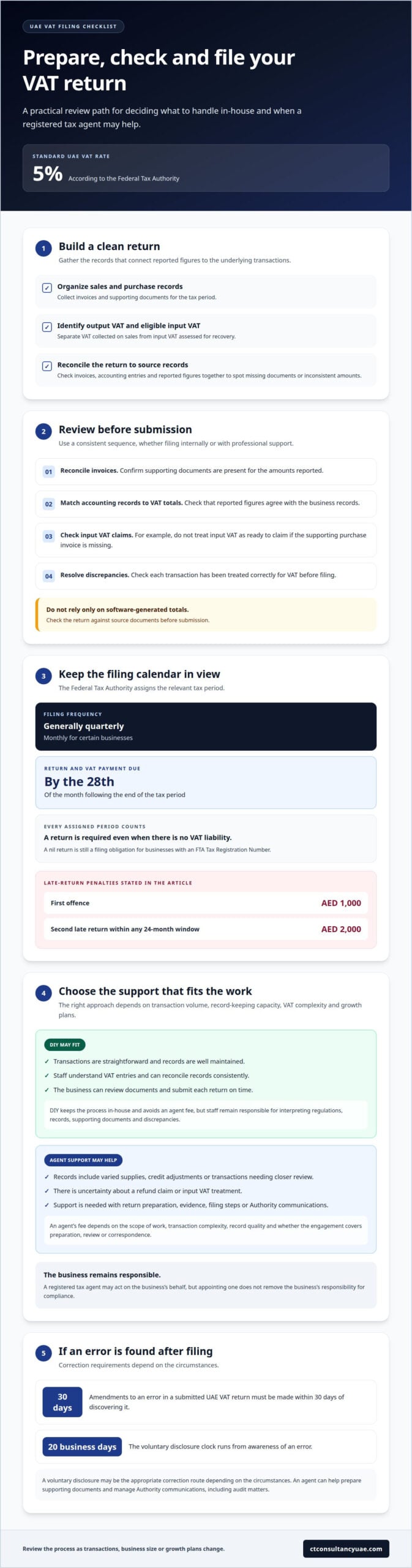
The UAE standard VAT rate is 5%, according to the Federal Tax Authority. Preparation involves organizing sales and purchase records, identifying output VAT collected, and assessing eligible input VAT for recovery. A clear reconciliation between invoices, accounting entries, and the return helps expose missing documents or inconsistent figures before filing.
DIY filing may suit a business with straightforward, well-maintained transactions and staff who understand VAT entries. A registered tax agent can help when records include varied supplies, credit adjustments or transactions that need closer review. Either way, check the return against source documents before submission instead of relying only on software-generated totals.
UAE VAT returns are generally filed quarterly, or monthly for certain businesses. Returns and VAT payments are due by the 28th day of the month following the end of the tax period. The Federal Tax Authority assigns the relevant period, so use that schedule to plan document collection, review, and payment.
Businesses with an FTA Tax Registration Number must file a return for every assigned period, including periods with no VAT liability. A nil return is still a filing obligation, not a reason to skip the period. Late-return penalties are AED 1,000 for a first offence and AED 2,000 for a second late return within any 24-month window.
A practical review sequence is to reconcile invoices, match accounting records to VAT totals, check input VAT claims and resolve discrepancies before submission. For example, do not treat input VAT on a purchase as ready to claim if the supporting invoice is missing. If you find an error after filing, the appropriate correction route may involve a voluntary disclosure, depending on the circumstances.
DIY filing keeps preparation in-house, but accuracy depends on record quality and the reviewer’s VAT knowledge. A tax agent can provide professional review and help with filing and payment steps. The decision comes down to whether your business can consistently reconcile records, review documents and submit each return on time.
A tax agent can support VAT compliance beyond return preparation, including reviewing records and communicating with the authority. The appropriate level of support depends on your in-house expertise and the complexity of your obligations.
DIY filing gives a business direct control over the process and avoids an agent’s fee. It also leaves staff responsible for interpreting regulations, maintaining records, preparing supporting documents and resolving discrepancies. A registered tax agent brings tax expertise and can assist with this work, but the business remains responsible for its obligations to the Federal Tax Authority.
Internal preparation may be manageable when records are straightforward. More complex transactions or uncertainty about a refund claim can make professional review useful.
With DIY filing, costs include staff time and any tools the business uses, but there is no agent fee. An agent’s fee depends on the scope of work, transaction complexity, record quality and whether the engagement covers preparation, review or authority correspondence. Compare the work transferred and expertise added, not just the invoice amount.
Support may include preparing attachments that explain return figures, such as reconciliations, invoices and relevant correspondence. Organized evidence links reported amounts to the underlying records.
A taxable person registered with the Federal Tax Authority may appoint a registered tax agent to act on their behalf in tax affairs. The appointment is contractual, and the agent must be registered and accredited by the Authority. The agent can communicate directly with the Authority, but the appointment does not remove the business’s responsibility for compliance.
For an error in a submitted UAE VAT return, amendments must be made within 30 days of discovering it. The voluntary disclosure clock runs for 20 business days from awareness of an error. An agent can help prepare supporting documents and manage Authority communications, including audit matters. Article 29 of the UAE Tax Procedures Law provides a reconsideration route for eligible disputes.
For tailored assistance with VAT obligations, explore UAE tax support services.
When assessing a UAE tax agent, consider official registration, relevant expertise and the work covered by the engagement. These factors help you judge whether the agent can handle your transactions and support accurate VAT returns.
UAE Tax Agent applicants need at least three years of recent professional experience in tax, accounting or law. They must also pass the Federal Tax Authority’s Tax Agent examination and obtain a Tax Agent registration number. These requirements distinguish registered agents from advisers who are not registered to practise as Tax Agents in the UAE.
Applicants need a recognised bachelor’s or master’s degree in tax, accounting or law. If their bachelor’s degree is in another field, they need a tax certification from an internationally known tax institution. They must document written and spoken proficiency in Arabic and English, and hold professional indemnity insurance or be covered by it.
Relevant industry experience matters because VAT treatment can depend on the transactions a business records. For example, a retailer with online sales may need advice that reflects its sales channels and supporting records. Ask how the agent’s experience relates to your activities rather than relying on a general claim of expertise.
Compare fee proposals by scope: return preparation, review, supporting records and communication with the Federal Tax Authority. Fees depend on transaction complexity, record quality, filing frequency and the level of ongoing support. Request a written scope that makes clear which tasks are included and which remain with your team.
Professional conduct matters, too. UAE Tax Agents must protect confidential information, subject to legal obligations, and refuse work that could breach the law or jeopardise the tax system’s integrity. Confirming FTA registration and understanding the engagement terms can help establish a clear working relationship. These checks are particularly useful when international transactions or past filing errors need careful review.
The right filing model depends on transaction complexity, accounting capacity and the time available for VAT compliance. Decide between DIY VAT filing and using a tax agent based on your team’s ability to maintain consistent records, review submissions and handle more complex activity.
Start with the work involved, not headcount alone. A business processing routine domestic sales through one accounting system, for example, may find DIY filing manageable. Staff still need to classify transactions correctly, reconcile records and review each submission. If one employee is responsible for filing alongside other finance tasks, VAT work may compete with essential operational duties.
Growth adds pressure when a business introduces e-commerce, cross-border sales, or new types of taxable transactions. Each channel can create different record flows and VAT questions, increasing the effort needed to maintain accuracy. A UAE retailer expanding from a physical shop to online sales, for instance, should reassess whether its existing review process can handle the changed transaction mix.
Compare an agent’s fee with the time spent on internal preparation and the work of building reliable accounting processes. DIY filing avoids an external service fee, but depends on staff knowledge, suitable records and consistent review. Professional support adds an expense, but may free internal capacity for budgeting, operations or growth planning. Weigh the proposed scope against the work your team would otherwise do.
Revisit the decision between DIY VAT filing and using a tax agent whenever your registration status, sales channels, transaction types or finance staffing changes. Consider, too, whether Arabic-language documents or international activity call for additional review skills. If returns become harder to reconcile or deadlines strain your accounting team, structured VAT support may be a better fit. Strengthen your process with support that matches your business operations.
CTC Tax & Accounting provides Ultimate Beneficial Ownership (UBO) Filing for businesses managing ownership information alongside their financial administration. If your VAT filing process needs stronger supporting records, Bookkeeping and Accounting Services can help organize the underlying financial information. Internal Audit Services can review internal controls and record-handling processes.
For businesses needing help with VAT matters, CTC Tax & Accounting provides VAT Registration and Compliance. UBO filing concerns ownership information, while VAT compliance focuses on tax records and obligations. Choose support according to your current administrative priorities rather than treating these services as interchangeable.
Contact CTC Tax & Accounting for a free consultation about VAT support for your business.
Choose a filing approach that fits your operations now and can adapt as transaction patterns change. The decision about DIY VAT filing versus using a tax agent should reflect your team’s capacity to maintain consistent records, review submissions and handle more complex activity over time.
As your needs evolve, strengthen the financial processes that support informed decisions. CTC Tax & Accounting provides Bookkeeping and Accounting Services, Internal Audit Services and VAT Registration and Compliance. These services can help organize financial records and support a more considered approach to VAT responsibilities as your business develops.
For guidance on a practical next step, contact CTC Tax & Accounting. A clear process today can help your business move forward with greater confidence.
A UAE Tax Agent is a professional registered with and accredited by the Federal Tax Authority to assist taxable persons with tax affairs. The appointment is contractual, so the engagement should define its scope, such as return preparation or authority correspondence. Agents must protect information obtained during their duties, subject to legal obligations, and refuse work that could breach the law.
Yes. Managing VAT internally can work when a business has reliable accounting records, a clear transaction-review process and staff who understand the relevant VAT treatment. For example, a business with consistent sales documentation may assign preparation and review to separate finance staff. If one person records transactions and submits returns without an independent review, errors may be harder to detect.
Choose the approach your business can sustain accurately as operations change. Internal filing may suit a stable business with capable finance staff; external support can help when new markets, sales channels or transaction types stretch that capacity. A hybrid arrangement is also possible: staff maintain day-to-day records while a professional reviews the process. Reassess when responsibilities or operations shift.
Professional VAT consultancy can help when a business needs guidance on complex transactions, internal controls or international activity. It is not automatically the better choice for every return. Distinguish general consultancy from formal representation: only an FTA-registered and accredited Tax Agent may practise as a Tax Agent in the UAE. The business remains accountable for its tax obligations.
VAT compliance involves more than submitting a return. It includes issuing accurate invoices, maintaining supporting records, assessing input VAT claims and preparing for possible audit questions. For example, a credit note should be traceable to the original transaction in the accounting records. A consistent document trail helps explain reported figures and supports an orderly review.
Businesses file through EmaraTax, the Federal Tax Authority’s online portal. A practical sequence is to organize sales and purchase records, reconcile VAT figures in the accounts, check the return fields against those records, submit the return and arrange payment. Keep supporting documents with the relevant tax period so you can explain the figures if the Authority requests information.