For decades, the United Arab Emirates was perceived as an effortless tax haven; however, in 2026, the 0% rate is a hard-earned privilege reserved for those who prioritize meticulous compliance. It’s natural to feel concerned about the evolving definitions of "Qualifying Income" or the administrative weight of new audit requirements. We recognize that the fear of losing your tax-exempt status due to a minor oversight is a significant concern for established entities and new market entrants alike. Navigating the corporate tax for UAE free zone landscape requires more than just basic registration; it demands a sophisticated understanding of jurisdictional nuances and substance requirements.
This guide provides the strategic clarity you need to navigate these complexities with confidence, ensuring you retain your 0% status while achieving total regulatory alignment. We’ll examine the critical pillars of the 2026 tax landscape, from maintaining adequate substance to mastering transfer pricing rules. By the end of this briefing, you’ll have a clear roadmap to facilitate a frictionless transition into this new era of fiscal responsibility, allowing you to focus on growth while we address the intricacies of your compliance framework.
Key Takeaways
- Understand the transition from a blanket tax-exempt environment to the rigorous, conditional Qualifying Free Zone Person framework essential for 2026 operations.
- Identify the specific criteria governing corporate tax for UAE free zone to distinguish between 0% qualifying income and the standard 9% taxable threshold.
- Establish a robust compliance foundation by meeting adequate substance requirements, including physical office presence and core income-generating activities.
- Prepare for mandatory regulatory oversight by implementing professional internal audits and maintaining meticulously audited financial statements.
- Mitigate operational risks by synchronizing your corporate tax strategy with existing Economic Substance Regulations and Anti-Money Laundering protocols.
The Evolution of Corporate Tax for UAE Free Zone Entities in 2026
The landscape of Taxation in the United Arab Emirates has matured into a sophisticated, multi-tiered framework that prioritizes transparency and international alignment. The paradigm shifted irrevocably with the introduction of Federal Decree-Law No. 47 of 2022. By 2026, the corporate tax for UAE free zone regime has become a performance-based system where the 0% rate is a privilege earned through rigorous compliance rather than a default setting. The Federal Tax Authority (FTA) now acts as a vigilant monitor, ensuring that every entity claiming preferential status meets strict legal benchmarks. This evolution reflects a broader commitment to global standards while maintaining the UAE’s competitive edge as a premier business hub.
Strategic tax planning is now essential for every license holder. Passive operation is no longer a viable strategy for maintaining fiscal efficiency. Instead, executives must adopt a proactive stance to secure their standing within the 0% bracket while avoiding the standard 9% rate applied to non-qualifying activities. This transition requires a deep dive into jurisdictional nuances and a commitment to meticulous record-keeping. It’s no longer enough to simply be located in a Free Zone; you must prove your right to the incentives provided by that location.
Defining the Qualifying Free Zone Person (QFZP)
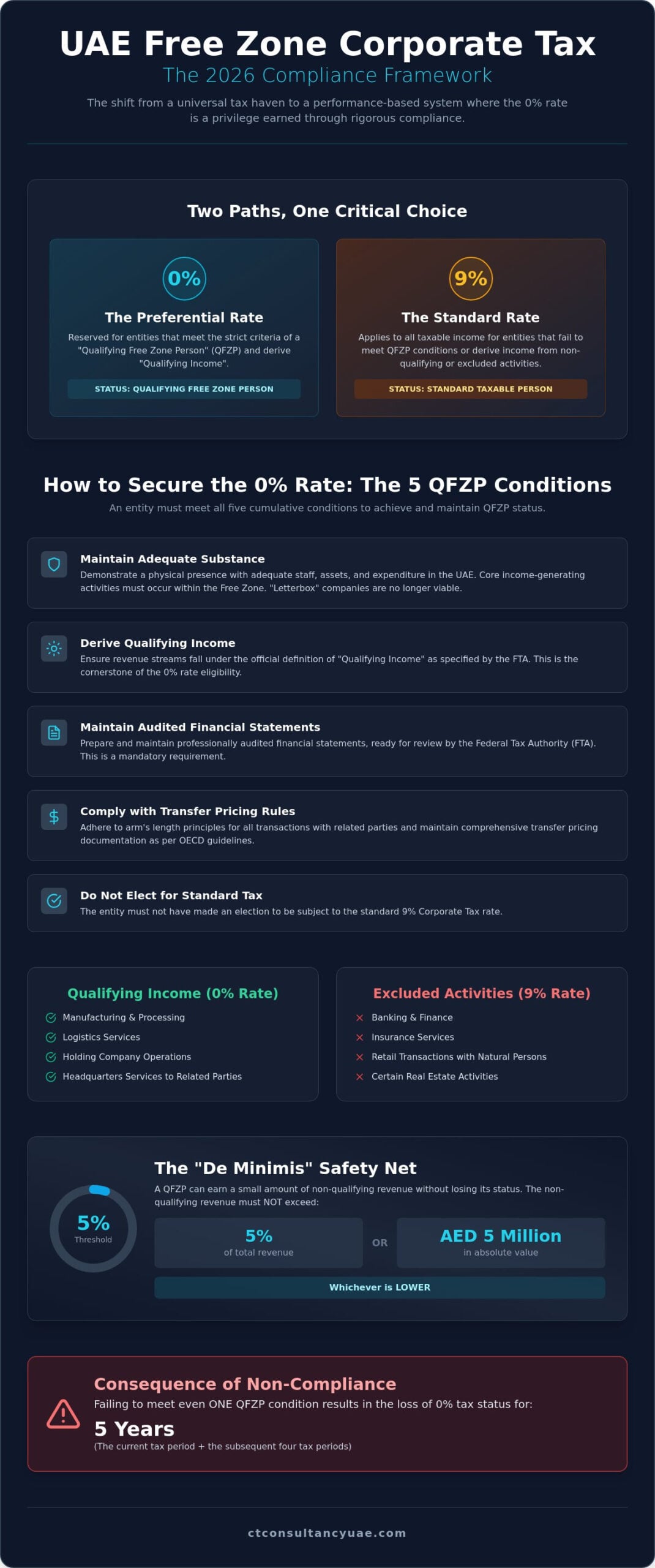
To retain the 0% incentive, an entity must achieve and maintain status as a Qualifying Free Zone Person (QFZP). This designation isn’t automatic; it requires meeting five cumulative conditions. An entity must maintain adequate substance in the UAE, derive qualifying income, avoid electing to be subject to standard corporate tax, comply with arm’s length principles and transfer pricing documentation, and ensure its financial statements are professionally audited. According to the 2026 FTA guidelines, a QFZP is defined as a Free Zone entity that maintains a physical presence with adequate staff and assets while deriving its revenue exclusively from sanctioned qualifying activities. Failing to meet even one of these criteria can trigger the loss of tax-exempt status for the current year and the subsequent four years.
The Shift in Executive Mindset: From Tax-Exempt to Tax-Compliant
The new regime demands a fundamental shift in how businesses view their UAE operations. The influence of OECD Base Erosion and Profit Shifting (BEPS) standards has pushed the UAE to implement robust substance requirements that target "letterbox" companies. Businesses can’t simply exist on paper anymore. They must demonstrate that their core income-generating activities occur within the Free Zone. Engaging with specialized Corporate Tax Advisory services has become the standard for firms seeking a frictionless transition. This professional oversight ensures that every operational decision aligns with the latest regulatory updates, transforming compliance from an administrative burden into a strategic advantage for long-term stability.
Achieving this stability often requires a holistic approach to both business and personal health. For executives managing the stress of these regulatory transitions, Dr.Vaishali Nore’s Homeopathy & Wellness Clinic provides natural wellness solutions to ensure physical and mental vitality remain a priority.
Qualifying Income vs. Excluded Activities: Determining Your Tax Rate
Distinguishing between income types is the pivot point for fiscal health under the corporate tax for UAE free zone regime. The 0% rate applies exclusively to "Qualifying Income," while a standard 9% rate is levied on taxable income that falls outside this definition. To maintain a competitive edge, executives must categorize their revenue streams against the Official FTA Corporate Tax Guide for Free Zones. Qualifying activities generally include manufacturing, logistics services, holding company operations, and headquarters services provided to related parties. Conversely, excluded activities such as banking, insurance, and retail transactions with natural persons are subject to the standard tax framework.
The "De Minimis" rule provides a narrow safety net for entities with mixed revenue. A Free Zone person can retain their qualifying status if their non-qualifying revenue doesn’t exceed 5% of their total revenue or AED 5 million, whichever is lower. Exceeding this threshold results in the loss of Qualifying Free Zone Person (QFZP) status, subjecting the entire taxable income to the standard regime. Precision in revenue classification is therefore not merely an accounting task; it’s a strategic necessity to protect your bottom line.
Revenue Streams and Their Tax Implications
Revenue derived from transactions with Mainland UAE businesses often carries different implications than international trade. While transactions with other Free Zone persons generally qualify for the 0% rate, income from immovable property is more complex. Income from commercial property located within a Free Zone and transacted with other Free Zone persons may qualify, but residential property income typically does not. For organizations with diverse portfolios, seeking specialized Corporate Tax Advisory is a prudent step to ensure each stream is optimized for compliance.
Navigating the 9% Standard Rate
When a Free Zone entity fails to meet QFZP criteria or earns non-qualifying income within the de minimis limit, the 9% standard rate applies to taxable profits exceeding AED 375,000. This threshold remains a cornerstone of the 2026 tax landscape, designed to support small to medium enterprises. Calculating this liability requires a meticulous approach to deductible expenses and transfer pricing. For a deeper look at managing these obligations, you might find our briefing on Corporate Tax Consultants Dubai helpful for aligning your local operations with federal requirements.
Maintaining Adequate Substance and Audit Readiness
The concept of "Adequate Substance" has transitioned from a theoretical guideline to a rigid enforcement standard for any entity seeking the 0% corporate tax for UAE free zone rate. By 2026, the Federal Tax Authority requires a demonstrable physical presence that aligns with the scale of an entity’s operations. This means maintaining a physical office within the zone and ensuring that Core Income-Generating Activities (CIGA) are performed locally by qualified employees. Letterbox companies no longer suffice. Every strategic decision must be traceable to the UAE, necessitating the meticulous documentation of board meetings and local decision-making processes to provide an irrefutable audit trail. To understand the depth of professional auditing required for such compliance, you can visit לוי ושות’ רואי חשבון (Levi and Co. CPA).
Establishing this substantive presence requires a holistic approach to corporate governance. It’s not just about having a desk; it’s about proving that the "mind and management" of the company reside within the jurisdiction. Regulators look for evidence that the entity has adequate operating expenditure and physical assets to support its revenue claims. Failure to document these elements effectively can lead to an immediate reclassification of income, triggering the standard 9% tax rate and potential penalties for non-compliance.
The Critical Role of Audited Financial Statements
In the 2026 landscape, audited financial statements are a non-negotiable prerequisite for maintaining Qualifying Free Zone Person status. Even smaller entities that previously operated without rigorous oversight must now prioritize annual audits to validate their fiscal claims. Selecting an audit partner with deep regional expertise is vital to ensure your filings meet the specific expectations of the FTA. For those looking to fortify their financial infrastructure, professional Accounting Services provide the necessary technical precision to navigate these high-stakes requirements without friction.
Bookkeeping as a Compliance Shield
Precision in day-to-day record-keeping serves as the ultimate defense against regulatory scrutiny. Robust bookkeeping ensures a clear, defensible separation between qualifying revenue and non-qualifying income, which is essential for staying within the de minimis limits. Real-time financial reporting allows for the immediate identification of potential tax risks before they escalate. Many forward-thinking firms are now leveraging Outsourced Bookkeeping Services to maintain the data integrity required for modern tax optimization. This structural accuracy ensures that when the FTA requests documentation, your response is prompt, professional, and precise.
Proactive preparation is the only way to secure your long-term stability in the UAE market. If you’re concerned about your entity’s current substance levels, you should consult our corporate tax specialists to conduct a comprehensive gap analysis and ensure your operations are fully audit-ready.
Strategic Tax Advisory: Mitigating Risks in the Free Zone Ecosystem
The 2026 fiscal environment demands a shift from isolated compliance to a unified regulatory strategy. For entities operating under the corporate tax for UAE free zone regime, tax filings represent only one facet of a broader legal obligation. The risks of failing to synchronize these efforts are severe, ranging from heavy administrative penalties to the potential revocation of business licenses. Beyond immediate financial loss, non-compliance carries significant reputational risks that can jeopardize international banking relationships and investor confidence. Achieving long-term stability requires a proactive approach that anticipates regulatory shifts before they impact your operational bottom line.
Holistic Compliance Management
A primary challenge for modern executives is the convergence of various reporting requirements. Your corporate tax position must align perfectly with your ESR Compliance in the UAE filings to avoid contradictory data submissions that could trigger an FTA investigation. Similarly, transparency regarding Ultimate Beneficial Ownership (UBO) is now a central component of tax profiles, as authorities look to verify the legitimacy of cross-border transactions. Integrating these streams ensures that your tax strategy doesn’t inadvertently conflict with Anti-Money Laundering (AML) protocols, creating a cohesive and defensible corporate posture that stands up to the highest levels of scrutiny.
Partnering with Experts for Long-Term Stability
SMEs often face a significant administrative burden when attempting to manage these multi-layered requirements internally. This is where high-level oversight becomes a critical friction-remover for the organization. By utilizing CFO Advisory Services, businesses gain access to the same strategic precision employed by multinational corporations. These experts provide customized tax roadmaps that account for specific Free Zone business models, ensuring that every operational shift is evaluated for its tax impact. As we progress through 2026, staying ahead of regulatory updates requires more than just awareness; it necessitates a partnership with advisors who possess the local expertise to turn compliance into a cornerstone of business growth and fiscal resilience.
Securing Your Fiscal Future in the 2026 Regulatory Landscape
The transition into the 2026 tax era represents a fundamental shift from operational simplicity to strategic complexity. Maintaining your status as a Qualifying Free Zone Person requires a meticulous alignment of your physical substance, revenue classification, and internal governance. Success in this new environment is not defined by mere presence within a jurisdiction; it’s defined by the precision of your financial reporting and your ability to demonstrate core income-generating activities locally. Establishing this foundation today is the only way to ensure your entity remains resilient against future regulatory scrutiny.
Navigating the intricacies of the corporate tax for UAE free zone regime demands a partner who understands the high stakes of international compliance. Since 2015, our expert advisors have specialized in the UAE regulatory landscape, providing the end-to-end support necessary to remove administrative friction. From robust bookkeeping and internal audits to high-level CFO advisory, we provide the technical mastery required to protect your bottom line. Secure your 0% tax status with a professional consultation from CTC Tax & Accounting. We’re here to facilitate your journey toward long-term stability and growth in the Emirates.
Frequently Asked Questions
Can a Free Zone company still benefit from a 0% corporate tax rate in 2026?
Yes, Free Zone entities can retain a 0% tax rate on qualifying income, provided they meet the stringent criteria of a Qualifying Free Zone Person (QFZP). This status requires maintaining adequate substance in the UAE, complying with transfer pricing rules, and ensuring all financial statements are professionally audited. It’s no longer an automatic right but a conditional incentive subject to rigorous Federal Tax Authority oversight.
What are the specific ‘Qualifying Activities’ for Free Zone entities?
Qualifying activities include high-level operations such as manufacturing and processing of goods, logistics services, holding company functions, and headquarters services provided to related parties. Additionally, fund management, wealth management, and reinsurance services often fall within this category. These activities are specifically designated by the Ministry of Finance to encourage core economic contributions within the corporate tax for UAE free zone framework.
Is an audit mandatory for all UAE Free Zone companies under the corporate tax law?
An annual audit is mandatory for any Free Zone entity seeking to qualify for the 0% preferential tax rate. The Federal Tax Authority requires audited financial statements to verify the accuracy of qualifying income claims and ensure compliance with substance requirements. Failing to produce a professional audit report results in the immediate loss of QFZP status and the application of the standard 9% tax rate.
What happens if my Free Zone company earns income from Mainland UAE?
Income derived from transactions with Mainland UAE is generally subject to the standard 9% corporate tax rate, particularly when dealing with natural persons. However, certain transactions with other Free Zone entities may still qualify for the 0% rate. It’s essential to segregate these revenue streams meticulously to avoid exceeding the thresholds that could jeopardize your overall tax-exempt status.
How does the ‘De Minimis’ rule work for non-qualifying income?
The de minimis rule allows a QFZP to earn a small amount of non-qualifying revenue without losing their 0% status on their qualifying income. This threshold is capped at 5% of total revenue or AED 5 million, whichever is lower. If your non-qualifying income exceeds these limits, your entire taxable income becomes subject to the standard 9% corporate tax rate for that period.
What are the penalties for failing to maintain adequate substance in a Free Zone?
Failing to maintain adequate substance leads to the immediate disqualification of your entity as a QFZP, resulting in a 9% tax on all profits. Critically, once this status is lost, the entity is barred from reclaiming the 0% incentive for the current year and the subsequent four tax periods. This multi-year penalty highlights the high stakes of corporate tax for UAE free zone compliance and the necessity of a robust operational setup.