Treating statutory compliance as a frantic year-end scramble is the single most expensive operational misstep an executive can make in the UAE. Successfully managing your corporate tax return filing in Dubai is never an isolated administrative task; it’s the calculated culmination of a disciplined, year-round financial ecosystem.
It’s entirely natural to feel burdened by the widening gap between statutory accounting profits and taxable net income, especially as the Federal Tax Authority accelerates automated cross-checks and levies strict non-compliance penalties. You shouldn’t have to guess whether your Free Zone de minimis thresholds are secure or if your business qualifies for vital exemptions. This guide delivers a definitive roadmap to help you master UAE corporate tax obligations, claim every legal relief, and protect your balance sheet from costly administrative infractions. Ahead, we outline the exact EmaraTax filing protocols, key statutory deadlines, and essential internal review practices required for frictionless regulatory compliance.
Key Takeaways
- Master statutory baseline obligations, including the AED 375,000 zero-bracket threshold and mandatory digital reporting protocols within the EmaraTax portal.
- Navigate each phase of corporate tax return filing in Dubai by reconciling standard accounting profit with complex tax adjustments for non-deductible expenditure.
- Capitalize on critical tax optimization mechanisms, such as Small Business Relief, while safeguarding your balance sheet against common deduction pitfalls.
- Leverage structured internal audits and specialized advisory oversight to identify compliance discrepancies before formal submission to the Federal Tax Authority.
The UAE Corporate Tax Framework: Requirements for 2026
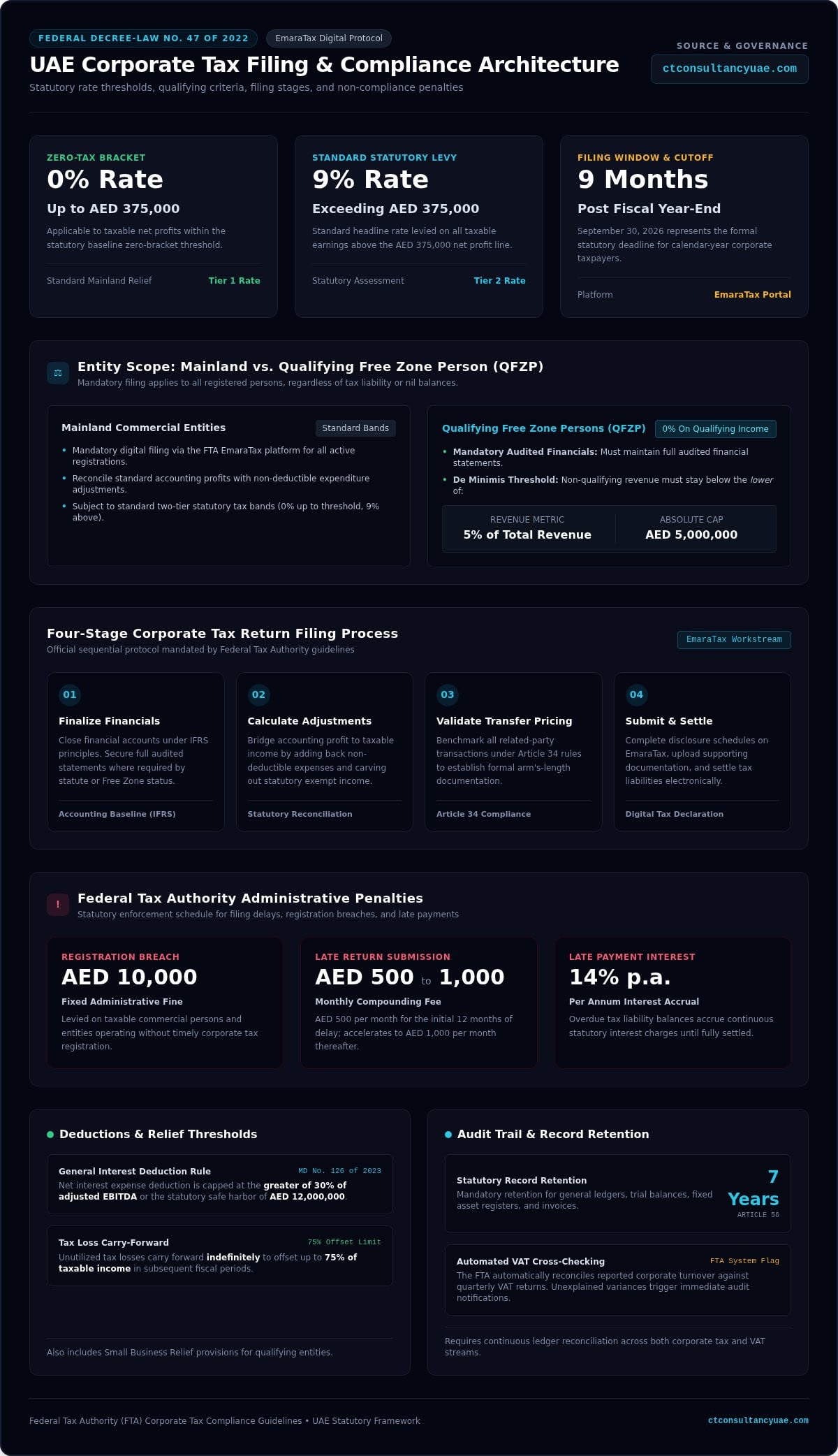
Federal Decree-Law No. 47 of 2022 anchors modern UAE direct taxation. Under this statutory code, taxable net profit up to AED 375,000 incurs a 0% rate, while earnings exceeding that threshold face a standard 9% levy. Within the evolving UAE taxation system, conducting corporate tax return filing in Dubai enterprises must translate net accounting profit into taxable income via precise statutory adjustments. Every declaration and settlement must occur digitally through the EmaraTax portal within nine months of fiscal year-end, making September 30, 2026, the critical deadline for calendar-year businesses.
Who Must File? Mainland vs. Free Zone Entities
Annual filing is mandatory for all registered taxable persons, regardless of whether operations generate taxable liability or nil balances. While mainland commercial enterprises follow standard tax bands, Qualifying Free Zone Persons (QFZPs) access a 0% rate on qualifying income. To retain this preferential status, Free Zone entities must maintain audited financial statements and ensure non-qualifying revenue stays below the de minimis threshold: the lower of 5% of total revenue or AED 5,000,000.
The Consequences of Non-Compliance
The Federal Tax Authority enforces strict administrative penalties to ensure regulatory discipline:
- Late filing penalties: AED 500 per month for the initial twelve months of delay, accelerating to AED 1,000 per month thereafter.
- Late settlement interest: Overdue tax balances accrue interest charges at 14% per annum.
- Registration breaches: Unregistered taxable entities face a fixed AED 10,000 fine.
Beyond statutory fines, discrepancies between filed figures and accounting ledgers trigger heightened FTA scrutiny. Executing an accurate corporate tax return filing in Dubai framework preserves corporate standing and shields your balance sheet from compounding enforcement measures.
A Step-by-Step Guide to Corporate Tax Return Filing
Filing an accurate return requires rigorous, continuous accounting controls long before the reporting window opens. Preparing your corporate tax return filing in Dubai submission follows four sequential stages under official Federal Tax Authority Corporate Tax guidelines:
- Finalize Financial Statements: Close all books under IFRS principles, securing audited financials where required by law or Free Zone status.
- Calculate Tax Adjustments: Adjust statutory accounting profit by adding back non-deductible expenses and carving out exempt income streams.
- Validate Transfer Pricing: Benchmark related-party transactions under Article 34 rules to establish arm’s-length pricing documentation.
- Submit and Settle: Log into EmaraTax, complete disclosure schedules, upload supporting records, and settle liabilities electronically.
Essential Documentation for a Successful Submission
Substantiating your return requires an organized financial audit trail. Taxpayers must assemble trial balances, general ledgers, fixed asset registers, and formal VAT reconciliations. Under Article 56 of the Corporate Tax Law, every transaction record and supporting invoice must be retained securely for at least seven years to withstand retrospective audits.
Reconciling VAT and Corporate Tax Data
The FTA automatically cross-references reported corporate revenues against quarterly VAT declarations. Unexplained variances between your turnover figures and taxable supplies trigger immediate system flags and audit notices. Engaging structured accounting services ensures seamless ledger reconciliation across both tax streams, mitigating reporting friction before your corporate tax return filing in Dubai protocol is completed. For broader financial governance, partnering with strategic tax advisors provides the internal controls needed to protect commercial operations year-round.
Optimizing Your Tax Position: Deductions and Reliefs
Strategic balance sheet positioning under the statutory UAE corporate tax framework allows companies to legally reduce taxable liability through allowable expenditure and legislative carve-outs. Under Ministerial Decision No. 126 of 2023, the General Interest Deduction Limitation Rule caps net interest expense deductions at the greater of 30% of adjusted EBITDA or a statutory safe harbor of AED 12,000,000. Unutilized tax losses can also be carried forward indefinitely to offset up to 75% of taxable income in subsequent fiscal years, provided continuity of ownership or activity is maintained.
Small Business Relief vs. Standard Filing
Ministerial Decision No. 131 of 2026 extends Small Business Relief (SBR) through December 31, 2029, providing relief for resident entities with gross revenue below AED 3,000,000. While electing SBR treats taxable income as AED 0, annual return submissions remain mandatory. The table below illustrates core differences:
| Feature |
Standard Corporate Tax Filing |
Small Business Relief (SBR) |
| Revenue Threshold |
Exceeding AED 3,000,000 |
Up to AED 3,000,000 |
| Compliance Scope |
Full statutory adjustments and transfer pricing disclosures |
Simplified declaration; relief elected directly on the return |
| Tax Rate |
0% up to AED 375,000; 9% on excess |
0% effective tax rate across all net profit |
Deductible Expenses: What You Can Claim
Operational costs incurred wholly and exclusively for business purposes qualify as allowable deductions. However, statutory exclusions apply. Non-deductible items include administrative fines, donations to unapproved charities, and corporate distributions. Under Article 32, client and staff entertainment expenses face a 50% deduction cap, requiring meticulous categorization in your general ledger.
To identify permissible deductions and claim legitimate exemptions ahead of your corporate tax return filing in Dubai, engage our corporate tax advisory specialists for a tailored balance sheet assessment.
The Value of Professional Corporate Tax Advisory
Treating statutory compliance as a transactional, clerical exercise exposes commercial enterprises to severe operational friction. Engaging specialized tax consultancy services safeguards your enterprise against swift regulatory shifts, converting technical obligations into long-term fiscal resilience. Executing structured internal audits verifies general ledgers and documentation before the Federal Tax Authority initiates a review, resolving reporting variances proactively. CTC Tax & Accounting delivers elite advisory grounded in decades of international financial experience, establishing the robust internal controls necessary for UAE corporate governance.
Beyond Filing: Strategic CFO Support
High-growth enterprises benefit when statutory filing directly integrates with overarching capital management. Through dedicated CFO advisory services, SMEs access high-level fiscal direction without the overhead of an in-house finance executive. We reject one-size-fits-all templates, crafting bespoke strategies that integrate VAT reporting, transfer pricing structures, and cash flow projections. This strategic alignment ensures your corporate tax return filing in Dubai actively supports sustainable expansion rather than draining executive bandwidth.
Preparing for an FTA Audit
Meticulous documentation standards establish an audit-ready operational trail across every reporting period. Should regulatory authorities initiate an inquiry, having reconciled ledgers, arm’s-length intercompany contracts, and audited statements ready prevents administrative disputes. Don’t wait for automated compliance flags to expose balance sheet vulnerabilities. Contact CTC Tax & Accounting today to perform a comprehensive diagnostic review of your financial records and secure frictionless corporate tax return filing in Dubai.
Master Your UAE Tax Compliance with Strategic Confidence
Achieving frictionless regulatory standing demands deliberate, year-round fiscal discipline. As corporate reporting becomes increasingly automated through EmaraTax, maintaining strict ledger integrity, properly accounting for non-deductible expenses, and securing applicable reliefs remain critical to safeguarding your balance sheet. When managing corporate tax return filing in Dubai businesses benefit most by treating compliance as a continuous strategic discipline rather than an isolated annual obligation, effectively eliminating administrative risk and preserving vital working capital.
Backed by decades of international financial expertise, CTC Tax & Accounting provides comprehensive support for enterprises across the Emirates, bridging everyday bookkeeping, proactive internal audits, and sophisticated CFO advisory. Our FTA-aligned compliance strategies ensure your statutory filings are thoroughly verified, fully compliant, and structured to optimize eligible exemptions. It’s time to take control of your corporate governance. Secure your business with expert corporate tax filing from CTC Tax & Accounting and navigate the evolving regulatory landscape with complete peace of mind.
Frequently Asked Questions
What is the deadline for corporate tax return filing in Dubai for 2026?
The statutory filing deadline is exactly nine months following the close of your relevant tax period. For taxable entities operating on a standard calendar financial year ending December 31, 2025, the final submission and tax settlement date is September 30, 2026. Businesses utilizing alternative fiscal calendars must calculate their nine-month window accordingly. Missing this window results in automatic monthly late filing penalties from the Federal Tax Authority.
Can I file my own corporate tax return on the EmaraTax portal?
Yes, authorized corporate signatories can submit filings directly through the Federal Tax Authority’s EmaraTax platform. However, self-filing carries operational risks if accounting profits aren’t correctly reconciled with statutory tax adjustments. Engaging professional corporate tax return filing in Dubai advisors ensures complex transfer pricing declarations, non-deductible expense exclusions, and VAT reconciliation alignments are completed without triggering automated system flags or unexpected compliance audits.
What are the penalties for late corporate tax filing in the UAE?
Late submission incurs an administrative penalty of AED 500 per month for the first twelve months, doubling to AED 1,000 monthly from the thirteenth month onward. In addition, unsettled tax liabilities attract a late payment penalty calculated at 14% per annum, accruing daily from the due date. Entities that failed to register on time face an immediate AED 10,000 fine, subject to specific ministerial waiver criteria.
Is Small Business Relief still available in 2026?
Yes, Small Business Relief remains active after Ministerial Decision No. 131 of 2026 extended the framework through December 31, 2029. Eligible resident taxable entities with gross revenue under AED 3,000,000 can elect for 0% taxable profit status. Even when claiming this relief, submitting an annual declaration via EmaraTax remains legally mandatory, and businesses cannot accumulate or transfer tax losses incurred during election years.
Do Free Zone companies need to file a corporate tax return?
Yes, every Free Zone entity must complete an annual tax return regardless of whether it qualifies for preferential rates. Qualifying Free Zone Persons enjoy a 0% corporate tax rate on qualifying income, but they must still submit audited financial statements and satisfy strict substance criteria. Managing your corporate tax return filing in Dubai requirements accurately ensures your entity preserves its qualifying status and avoids reclassification under standard mainland tax rates.