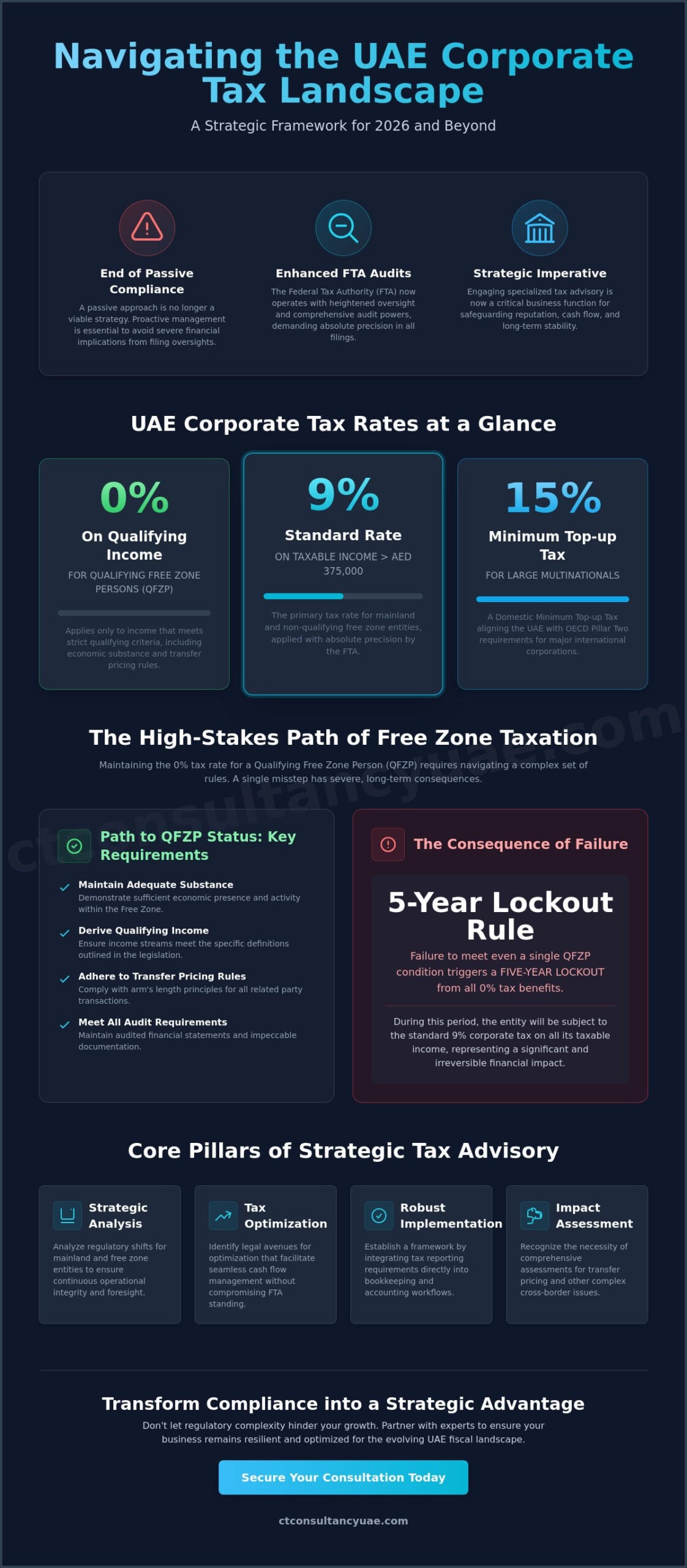
The UAE fiscal landscape has transitioned into an era where passive compliance is no longer a viable business strategy. With the Federal Tax Authority exercising enhanced audit powers and the implementation of a 15% Domestic Minimum Top-up Tax for large multinationals, the financial implications of a single filing oversight have become severe. Engaging a specialized corporate tax advisory in the UAE is no longer just about meeting a deadline; it’s about safeguarding your entity’s reputation in a market that now demands absolute precision and strategic foresight.
It’s clear that the intricacies of cross-border transfer pricing and the uncertainty surrounding 2026 Free Zone exemptions represent significant operational hurdles for executive decision-makers. You require a clear roadmap that removes friction from your regulatory obligations while simultaneously optimizing your global tax position. This guide provides a strategic framework to help you navigate mandatory registration deadlines and the universal audit requirements for Free Zone persons with confidence. We’ll explore how meticulous planning and expert-led compliance can protect your cash flow and ensure your business remains resilient against evolving international standards.
Key Takeaways
- Analyze the specific regulatory shifts defining the 2026 fiscal landscape for both mainland and free zone entities to ensure continuous operational integrity.
- Leverage professional corporate tax advisory in the UAE to transform mandatory compliance into a strategic tool for long-term fiscal stability and enhanced business valuation.
- Identify sophisticated legal avenues for tax optimization that facilitate seamless cash flow management without compromising your standing with the Federal Tax Authority.
- Establish a robust implementation framework by integrating tax reporting requirements directly into your established bookkeeping and accounting workflows.
- Recognize the necessity of comprehensive impact assessments to navigate the complexities of transfer pricing and the five-year lockout rule for free zone persons.
Navigating the UAE Corporate Tax Landscape in 2026
The year 2026 represents a pivotal juncture for the UAE Corporate Tax Landscape, marking the transition from initial policy rollout to a state of sophisticated regulatory maturity. While the introductory phase focused on registration and basic awareness, the current environment demands a granular understanding of how fiscal obligations intersect with complex operational structures. The Federal Tax Authority (FTA) now operates with heightened oversight, ensuring that the standard 9% tax rate on taxable income exceeding AED 375,000 is applied with absolute precision across both mainland and free zone entities. For organizations aiming to maintain a frictionless corporate presence, specialized corporate tax advisory in the UAE has become an indispensable asset for navigating these high-stakes requirements.
The role of the FTA has expanded beyond mere administration to become a cornerstone of national fiscal oversight. This authority ensures that the UAE remains aligned with international standards while fostering a competitive environment for businesses. It’s no longer sufficient to simply file a return; businesses must demonstrate a comprehensive grasp of their fiscal position. Strategic advisory provides the necessary clarity to manage these expectations, acting as a primary friction-remover for companies that prioritize long-term stability over short-term fixes. By integrating professional insights, firms can transform their tax functions from a compliance burden into a strategic lever for growth.
The Evolution of Federal Tax Authority (FTA) Regulations
By 2026, the FTA has decisively shifted its focus toward stringent enforcement and digital transparency. The era of manual reporting has largely been superseded by integrated electronic systems that facilitate real-time data exchange between businesses and the authority. This evolution means that inconsistencies in financial reporting are identified with greater speed and accuracy than in previous years. Recent updates to the UAE Corporate Tax Law have prioritized administrative efficiency, emphasizing that voluntary compliance is the only sustainable path for growth. Businesses must recognize that the FTA’s audit powers are now more comprehensive, making the accuracy of every digital submission a critical component of corporate governance.
Identifying Taxable Persons and Exemptions
Distinguishing between resident and non-resident taxable persons requires a sophisticated analysis of permanent establishments and management control. Resident persons generally include legal entities incorporated in the UAE, while non-residents are taxed on income derived from a permanent establishment or UAE-sourced income. Government entities and certain charitable organizations remain exempt, provided they meet strict qualifying criteria. However, the most complex area remains the "Qualifying Free Zone Person" (QFZP) status. To maintain a 0% rate on qualifying income, free zone businesses must adhere to rigorous economic substance standards and transfer pricing regulations. Failure to meet even a single condition can trigger a five-year lockout from these benefits, making expert guidance essential to preserve fiscal advantages.
Core Pillars of Professional Corporate Tax Advisory
Professional corporate tax advisory in the UAE operates as the structural foundation for any enterprise seeking to thrive within the Gulf’s evolving fiscal framework. It isn’t merely a response to legislative mandates; it’s a sophisticated alignment with international standards, including the OECD’s Pillar Two requirements for large multinationals. By adhering to the Official UAE Corporate Tax Law, businesses can ensure that their internal governance reflects the transparency and rigor expected by global regulators. This level of precision is vital for maintaining long-term stability, particularly as the Federal Tax Authority (FTA) shifts its focus toward detailed audits and documentation verification.
Reliable documentation serves as the primary defense against non-compliance penalties. In a mature market, the burden of proof rests entirely on the taxable person to justify their positions on exemptions, deductions, and credits. Without a structured advisory framework, businesses often find themselves with fragmented records that fail to withstand the scrutiny of a formal audit. A cohesive approach ensures that every transaction is recorded with fiscal foresight, providing a clear audit trail that preserves corporate reputation and cash flow. Engaging in this level of preparation acts as a primary friction-remover during high-stakes regulatory reviews.
Impact Assessment and Strategic Tax Planning
A comprehensive evaluation of a firm’s financial architecture is the first step toward achieving fiscal efficiency. Tax impact assessment serves as a proactive fiscal diagnostic designed to identify potential liabilities before they manifest in financial reporting. By analyzing how current business models interact with the 9% tax threshold, advisors can develop a multi-year strategy that optimizes the effective tax rate. This forward-looking approach allows for the intelligent allocation of resources, ensuring that tax obligations don’t impede the organization’s growth trajectory or investment potential. It’s about moving beyond reactive filing toward a model of strategic reassurance.
Transfer Pricing and Cross-Border Considerations
As UAE entities expand their global footprint, the complexity of cross-border transactions increases exponentially. Adhering to the Arm’s Length Principle is no longer optional; it’s a fundamental requirement for all related party transactions. To remain compliant, businesses must maintain rigorous documentation, including Master Files and Local Files that provide a detailed breakdown of global business operations and local transactional data. These measures prevent the unintended creation of permanent establishments in foreign jurisdictions and ensure that the group’s tax position remains defensible on both a regional and international scale. For those seeking to refine their internal controls, integrating professional accounting services can provide the data accuracy required for these high-level filings.
Beyond Compliance: The Strategic Value of Tax Optimization
Shifting the perspective from mandatory obligation to strategic advantage is essential for the modern executive. While many view fiscal management as a cost center, sophisticated corporate tax advisory in the UAE serves as a primary friction-remover that enhances business valuation by ensuring structural stability. By identifying legal avenues for optimization, companies can preserve cash flow and reinvest capital into core operations. Justifying the ROI of professional consultancy becomes straightforward when considering the avoidance of AED 10,000 late registration penalties and the preservation of eligibility for beneficial tax regimes. Precision in these matters doesn’t just satisfy regulators; it builds investor confidence and secures the entity’s financial future.
The synergy between compliance and valuation is often overlooked. A business with a transparent, optimized tax structure is inherently more attractive to stakeholders than one plagued by inconsistent reporting. Strategic advisory provides the reassurance that your fiscal positions are both aggressive enough to protect earnings and conservative enough to withstand scrutiny. This balanced approach is what separates market leaders from those who merely react to legislative changes. It’s a commitment to excellence that permeates every level of the organization’s financial architecture.
Small Business Relief and SME Incentives
The UAE government continues to foster a supportive environment for entrepreneurs through targeted incentives. For the tax periods ending on or before December 31, 2026, eligible resident taxable persons with a revenue threshold of AED 3 million or less can elect for Small Business Relief. This provision allows businesses to be treated as having no taxable income for the relevant period, provided they maintain rigorous compliance records. Adhering to the guidelines set by the UAE Federal Tax Authority is vital, as improper application of these reliefs can lead to retrospective adjustments. Strategic advisory ensures that your application procedures are flawless, allowing you to maximize the benefits of these national fiscal policies without administrative risk.
For entrepreneurs whose business interests extend to the UK, using a specialized service like mazumamoney.co.uk can provide the same level of professional accountancy support for limited companies, sole traders, and partnerships.
Mitigating Risks Through Rigorous Internal Audits
Proactive risk management is the hallmark of a resilient organization. Procedural weaknesses often lead to tax leakage, where missed deductions or incorrect treatments erode the bottom line over time. Implementing internal audit services allows businesses to pre-empt inquiries from the authority by identifying these vulnerabilities internally. This diagnostic approach fosters a culture of financial precision, ensuring that all reporting remains accurate and defensible. By establishing this level of internal oversight, you gain the peace of mind that your entity is prepared for any regulatory scrutiny, securing your long-term operational integrity in the UAE market. It’s a steady, informative process that moves your firm from identifying a requirement to achieving a comprehensive solution.
Implementation Framework for Seamless Tax Management
Establishing a robust foundation for recurring tax compliance requires a shift from sporadic filing to a continuous, integrated operational cycle. A high-level implementation framework ensures that every financial transaction is categorized with fiscal foresight, preventing the year-end rush that often leads to avoidable errors. By embedding tax reporting requirements directly into your core business processes, you create a system of organized momentum. This proactive approach relies on the precision of your data architecture, where the accuracy of annual tax return submissions is guaranteed by the integrity of daily entries. Engaging a specialized corporate tax advisory in the UAE provides the technical oversight necessary to maintain this framework, ensuring your business remains resilient against evolving Federal Tax Authority (FTA) expectations.
Data integrity is the cornerstone of any defensible tax position. In 2026, the FTA’s sophisticated digital audit tools mean that inconsistent financial reporting standards are flagged with unprecedented speed. Maintaining a meticulous calendar for registration and filing deadlines is no longer optional; it’s a critical component of risk management. For instance, businesses with a financial year ending December 31, 2025, must complete their filing and payment by September 30, 2026. Failure to adhere to these windows can trigger substantial penalties, such as the AED 10,000 fine for late registration, which can easily be avoided through structured planning and professional guidance.
Establishing Robust Accounting and Reporting Systems
The transition to a mature tax environment necessitates the implementation of FTA-compliant accounting software that facilitates real-time reporting. Training internal teams on the specific nuances of corporate tax record-keeping is vital for ensuring that taxable income is calculated accurately from the outset. Many organizations find that leveraging outsourced bookkeeping services provides the most reliable foundation for tax accuracy, as it integrates professional expertise directly into the financial workflow. This setup removes the friction of manual data entry and ensures that your books are always "tax-ready," allowing executive decision-makers to focus on growth rather than administrative hurdles.
Timely Registration and Return Filing Procedures
Navigating the EmaraTax portal requires a methodical approach to ensure that all corporate data is reflected correctly. The registration process involves several critical steps, including the submission of valid trade licenses, identification of authorized signatories, and clear disclosure of ownership structures. Best practices for a seamless submission include:
- Conducting a pre-filing review of the annual Corporate Tax Return to identify potential discrepancies.
- Verifying that all deductible expenses are supported by compliant documentation.
- Managing payments through the FTA’s integrated channels well in advance of the nine-month deadline.
- Maintaining a clear line of communication with the authority to resolve any clarifications promptly.
Establishing these procedures ensures that your entity remains in good standing while preserving cash flow. If you’re ready to secure your business against regulatory risks, partner with our expert tax advisors to implement a customized compliance roadmap today.
Partnering with CTC for End-to-End Fiscal Excellence
Partnering with a seasoned consultant is the definitive way to ensure that your fiscal operations are not only compliant but also optimized for long-term resilience. At CTC, our commitment to precision and strategic reassurance allows us to act as a primary friction-remover for businesses operating within the Emirates. We leverage a unique blend of international expertise and localized knowledge to provide solutions that are as meticulous as they are forward-thinking. By entrusting your corporate tax advisory in the UAE to our elite consultants, you gain a partner who values structural stability over temporary fixes, ensuring that your corporate presence remains seamless and secure.
Our methodology centers on the belief that tax management should never be an isolated administrative task; instead, it must be integrated into the broader narrative of your business growth. We provide a frictionless experience for entrepreneurs and corporate leaders, guiding them through the logical progression of UAE fiscal requirements with professional calm. This end-to-end support is designed to instill confidence, allowing you to manage the high-stakes nature of modern tax laws with the certainty that your entity is backed by deeply knowledgeable specialists. We don’t just provide services; we cultivate a supportive partnership aimed at sustaining your business through every regulatory shift.
Customized Advisory for National Growth
Sustainable success in the UAE requires a rejection of one-size-fits-all approaches in favor of bespoke tax frameworks. We develop individualized strategies that are meticulously aligned with the specific regulatory landscape of the Emirates, taking into account the unique nuances of your industry and corporate structure. Drawing from the deep heritage of CTC Tax & Accounting, our advisors ensure that every fiscal setup is robust enough to withstand the scrutiny of the Federal Tax Authority. This tailored precision ensures that your tax strategy doesn’t just meet current standards but is also prepared for future legislative updates.
Integrating CFO Insights with Tax Compliance
The most significant gap in traditional consultancy is the separation of tax filing from high-level financial strategy. We bridge this divide by integrating CFO advisory services directly into our tax planning workflows. This holistic approach ensures that your tax obligations are considered within the context of your overall financial health and cash flow requirements. By aligning regulatory compliance with strategic financial management, we provide a comprehensive solution that supports your long-term objectives. It’s time to move beyond basic filing and embrace a model of fiscal excellence. Schedule a Corporate Tax Consultation with our team today to secure your business’s future.
Future-Proofing Your Corporate Compliance Strategy
The 2026 fiscal environment in the UAE demands a transition from reactive filing to a state of permanent audit readiness. As the Federal Tax Authority continues to refine its digital oversight and enforcement mechanisms, the necessity for specializedcorporate tax advisory in the UAE becomes an essential component of high-level corporate governance. We’ve explored how the integration of FTA-aligned compliance frameworks and strategic optimization can preserve cash flow while ensuring absolute regulatory adherence. By leveraging decades of international financial experience, businesses can successfully navigate complex transfer pricing and the five-year lockout rules for Free Zone entities.
Whether you’re a large multinational or require specialized SME and freelancer support, our advisors provide the precision required to maintain a frictionless market presence. It’s time to move beyond the uncertainty of evolving regulations and embrace a roadmap designed for sustainable growth. Secure your business with expert Corporate Tax Advisory to ensure your entity remains resilient and competitive. We’re here to transform your tax function into a strategic pillar of long-term stability and success.
Frequently Asked Questions
Who is required to register for Corporate Tax in the UAE by 2026?
Registration with the Federal Tax Authority (FTA) is mandatory for all legal entities, including those operating within free zones and those with no taxable income. There is no minimum revenue threshold for registration. Companies incorporated on or after March 1, 2024, must register within three months of their license issuance date. Individuals with business turnover exceeding AED 1 million in a calendar year are also required to register.
What is the corporate tax rate for businesses in the UAE?
The standard corporate tax rate is 0% for taxable income up to AED 375,000 and 9% for income exceeding this threshold. Large multinational enterprises with consolidated global revenues of €750 million or more are subject to a 15% rate. This higher rate aligns with the OECD’s Two-Pillar Solution and the Domestic Minimum Top-up Tax implemented on January 1, 2025, ensuring global fiscal alignment.
Are Free Zone companies exempt from UAE Corporate Tax in 2026?
Free Zone businesses can benefit from a 0% tax rate on Qualifying Income provided they maintain adequate economic substance and comply with transfer pricing rules. All Qualifying Free Zone Persons are required to prepare audited financial statements regardless of their revenue level. Failure to meet these conditions results in a five-year lockout from the 0% rate, making specialized corporate tax advisory in the UAE essential for maintaining this status.
How does Small Business Relief work under the current UAE tax law?
Small Business Relief is available for resident taxable persons with revenue of AED 3 million or less during the current and previous tax periods. This relief allows eligible firms to be treated as having no taxable income for tax periods ending on or before December 31, 2026. Businesses must elect for this relief and maintain precise records to satisfy potential Federal Tax Authority inquiries and ensure long-term stability.
What are the penalties for non-compliance with corporate tax regulations?
The Federal Tax Authority imposes a fixed penalty of AED 10,000 for failure to register for corporate tax within the specified timeframe. Late filing of tax returns incurs a penalty starting at AED 500 per month, which increases to AED 1,000 per month if the return remains outstanding for more than 12 months. Proactive correction through voluntary disclosure can significantly reduce these administrative burdens and preserve your corporate reputation.
Is transfer pricing documentation mandatory for all UAE businesses?
Transfer pricing documentation is mandatory for businesses involved in related party transactions to prove adherence to the Arm’s Length Principle. While specific thresholds apply for the maintenance of Master Files and Local Files, all taxable persons must disclose their related party transactions in their tax returns. Maintaining rigorous documentation is the primary defense against adjustments during a tax audit and ensures your international operations remain frictionless.
How can a tax advisor help optimize my business structure for tax efficiency?
A professional advisor identifies legal avenues for tax optimization by aligning your corporate architecture with the specific incentives provided under UAE law. This includes navigating the complexities of Qualifying Free Zone status and ensuring that cross-border transactions are structured to avoid unintended permanent establishments. Strategic corporate tax advisory in the UAE transforms compliance from a cost center into a tool for preserving cash flow and enhancing business valuation.
What is the deadline for filing the annual UAE Corporate Tax return?
The deadline for filing corporate tax returns and paying any due tax is within nine months from the end of the business’s financial year. For businesses with a financial year ending December 31, 2025, the mandatory deadline is September 30, 2026. It’s vital to maintain a meticulous calendar to ensure all submissions are processed through the EmaraTax portal well in advance, avoiding the risks associated with last-minute filings.