
A control weakness rarely stays confined to one process. The consequences of poor internal controls can include fraud or unauthorised transactions, inaccurate financial reporting, compliance gaps, higher operating costs, and reduced confidence among investors and creditors. Internal controls provide reasonable assurance that a business can protect its assets, maintain reliable records, operate effectively, and meet its obligations. They cannot guarantee that every error will be prevented.
To identify and correct weaknesses, treat them as risks to business objectives, not isolated paperwork issues. This guide explains how control gaps affect compliance, financial statements, daily operations, and stakeholder confidence, and how risk-based reviews, reconciliations, clear approvals, and appropriate separation of duties can help address them.
Controls also need to evolve as a business changes. An internal audit can help establish whether procedures are well designed, consistently applied, and documented. Its findings give management a clearer basis for prioritising corrective action and improving the reliability of business decisions.
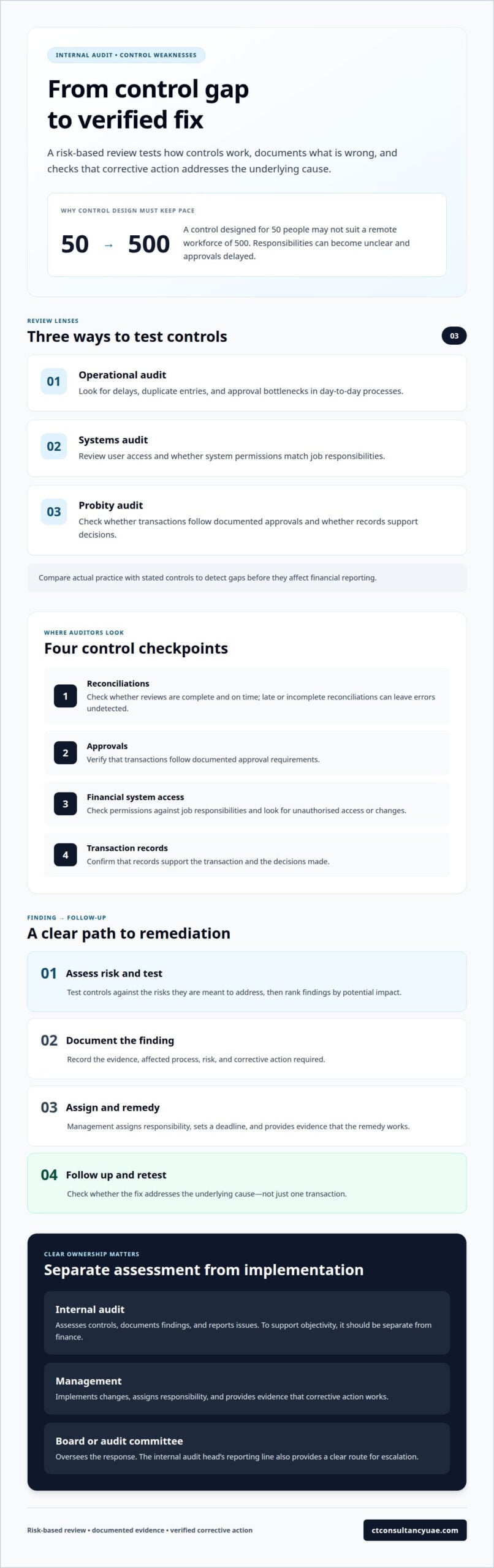
Internal auditors identify weaknesses by assessing risk, testing controls, and monitoring corrective actions. They may examine reconciliations, approvals, financial system access, and transaction records, then rank findings by potential impact. To support objectivity, internal audit should be separate from finance, with its head reporting to the board or audit committee. This reporting line also provides stakeholders with a clear route for escalation.
Audit scope should match the control being tested. An operational audit might examine delays, duplicate entries, or approval bottlenecks. A systems audit can review user access and whether permissions align with job responsibilities. A probity audit can assess whether transactions follow documented approvals and whether records support decisions. Comparing actual practice with stated controls helps auditors detect gaps before they affect financial reporting.
When auditors identify a finding, they document the evidence, affected process, risk, and corrective action required. Management assigns responsibility, sets a deadline, and provides evidence that the remedy works. For example, incomplete or late reconciliations can leave errors undetected. A documented review process helps identify and correct them sooner. Remediation takes staff time for investigation, rework, and retesting, while unresolved weaknesses can raise operating costs. Follow-up testing checks whether the fix addresses the underlying cause, not just one transaction.
Consider a hypothetical UAE retailer where one employee can create suppliers, approve invoices, and release payments. An unauthorised payment could go undetected. A control review can identify the overlapping duties and recommend independent approval and documented payment checks.
These examples show why audit findings need clear ownership. Internal auditors assess controls and report issues; management implements changes, while the board or audit committee oversees the response. Regular independent audits can identify compliance gaps and track corrective actions. A risk-based review of financial records, system access, and documented responsibilities can help strengthen controls before errors grow into larger losses.
Control gaps arise when procedures are poorly designed, applied inconsistently, or no longer suit the business. Their effects can reach daily operations, regulatory compliance, and stakeholder confidence.
In the UAE, the Central Bank, Dubai Financial Services Authority, and Abu Dhabi Global Market are among the regulators associated with compliance standards. In 2022, the UAE Central Bank imposed penalties on several banks for failing to meet anti-money-laundering standards. The specific consequence depends on the applicable requirements and failure; an unsupported assumption about a single penalty can mislead management.
Customer due diligence and enhanced due diligence help address KYC and AML gaps by verifying customer identities and applying additional checks to high-risk clients. Weak processes may leave suspicious activity or incomplete records unaddressed. Clear escalation procedures help staff refer red flags to the appropriate authorities, while documented checks make compliance work more transparent to management and external stakeholders.
People and policies matter as much as system design. An employee who does not understand approval limits may apply controls inconsistently, even when procedures are documented. Training should explain responsibilities, recordkeeping expectations, and how to escalate concerns. Leaders strengthen a culture of compliance by building these practices into daily operations, rather than treating policies as paperwork for an audit.
For UAE businesses reviewing tax-related compliance processes, structured tax compliance support can help address documentation and process gaps.
Weak financial reporting controls can distort business results and the decisions based on them. The effects may extend to cash planning, resource allocation, and stakeholder assessments.
A financial misstatement is an error or intentional inaccuracy that makes reported figures differ from the underlying transactions. For example, an unrecorded supplier invoice can understate expenses and liabilities, while an unsupported sales entry can overstate revenue. In either case, owners may use unreliable information to set budgets or approve spending. Supporting figures with original invoices, purchase orders, and receipts creates a traceable record.
Access controls matter too: weak permissions can allow unauthorised changes to financial data. A sound control environment clearly assigns preparation, approval, and review responsibilities, so one employee cannot control every stage of a transaction. This structure helps detect errors and reduces the risk of financial leakage.
Accurate, timely reporting gives decision-makers a dependable view of performance and obligations. Investors and creditors use financial statements to assess risk, so unexplained errors or late reports can weaken confidence in management’s reporting. A material weakness may be serious enough to be described in an auditor’s opinion, alerting potential investors to the control concern.
Cash-flow forecasting depends on complete records of receipts, payments, and liabilities. If supplier invoices or payroll obligations are omitted, forecasts may overstate available cash and complicate payment planning. Matching bank statements with accounting records and reviewing the trial balance can help identify discrepancies. Documenting the investigation supports correction before errors flow into reports.
Separating finance responsibilities helps protect the accuracy of records. For example, one employee can prepare a payment, another authorise it, and a separate reviewer match it to supporting documents. If staffing limits make full separation impractical, working with an external provider such as Account Dubai for bookkeeping and reconciliation, or instituting a documented management review, can provide an additional check. Consistent reviews and prompt corrections help keep reports useful for operational decisions and external stakeholders.
Internal controls help an organisation protect assets, maintain complete records, and operate efficiently and ethically. For a UAE business, documented approvals can reduce unauthorised payments while supporting reliable reporting and compliance with applicable requirements. Controls provide reasonable assurance that objectives can be met, but cannot guarantee that every error or instance of misconduct will be prevented.
The purpose is practical: clarify responsibilities, reduce preventable risks, and give management dependable information. Consider a purchase transaction. Authorisation limits define who can approve it, supporting documents show what was bought, and reconciliation helps confirm that the payment matches the invoice. If a step is missing, errors may go unnoticed and weaken the statements used for decisions.
Monitoring tests whether controls work in practice. Reviewing recurring journal entries, for example, can reveal whether unusual adjustments receive meaningful scrutiny. Regular reconciliations can identify differences between accounting records and bank activity, while follow-up confirms that corrections are recorded. These checks turn control objectives into observable routines, rather than written policies that staff may apply inconsistently.
Robust controls also support reputation and planning. Reliable financial data helps management forecast cash inflows and outflows, allocate working capital, and assess performance against budgets. The Turnbull Report, first published in 1999, frames internal control around reasonable assurance and organisational objectives. The takeaway is to design controls around actual risks, then monitor whether they remain effective as responsibilities and processes change.
For an independent assessment of whether controls support these objectives, arrange an internal control review.
CTC Tax & Accounting provides Internal Audit Services to help businesses assess whether controls are appropriately designed, consistently applied, and documented. Consider an internal audit if reconciliations remain incomplete, approval responsibilities are unclear, or financial records repeatedly contain errors. The review can identify control gaps, assess operational and reporting risks, and support a structured response.
Findings may also show where Bookkeeping and Accounting Services can help improve the quality and consistency of financial records. For UAE businesses reviewing tax processes, VAT Registration and Compliance or Corporate Tax Advisory may help address related compliance concerns. The right support depends on the control issue and the business process involved.
Contact CTC Tax & Accounting to discuss internal audit support for your business.
The consequences of poor internal controls are easier to address when improvement is an ongoing management discipline, not a response reserved for audit findings. Assign an owner to each material control, document how it should work, and include reviews in the relevant workflow. As the business changes, revisit whether responsibilities and approval routes still match the risks.
CTC Tax & Accounting can support this work through Internal Audit Services, Bookkeeping and Accounting Services, and VAT Registration and Compliance. The appropriate starting point depends on whether the priority is assessing control design, improving accounting records, or strengthening VAT processes. A focused discussion can help clarify the scope and the next practical step.
Contact CTC Tax & Accounting to discuss how your business can strengthen its control framework and maintain a more reliable basis for decisions.
The consequences of poor internal controls can spread across operations, finances, compliance, and business relationships. An approval gap, for example, may allow an unsuitable payment, while incomplete records make it harder to assess available cash or explain results. These effects can compound: management may make decisions using unreliable information while staff spend time investigating exceptions and responding to concerns from lenders or other stakeholders.
Weak controls can create opportunities to conceal unauthorised activity or misuse company assets. For example, an employee who can create suppliers and approve payments could add a fictitious vendor and direct funds improperly. Shared system credentials also make it harder to identify who changed a record. Clear access permissions, independent reviews of unusual payments, and escalation procedures reduce opportunities for concealment.
Reporting errors can occur when transactions are entered more than once, recorded in the wrong period, or posted without adequate supporting documents. An omitted payroll accrual, for instance, may make expenses for the period appear lower than they are. Weak close procedures can delay corrections too. Comparing source records with ledger entries and investigating material differences helps management determine whether an error affects reported performance.
In the UAE, consequences depend on the rules that apply to the business and the nature of the control failure. Non-compliance may expose an organisation to fines, penalties, legal sanctions, or additional auditor scrutiny. Businesses subject to financial-sector or AML-related oversight should take missing records and unaddressed process gaps seriously, as these can complicate efforts to show that required compliance procedures were followed.
Control failures can lead customers, lenders, investors, and suppliers to question whether business information and commitments are dependable. A delayed correction or an unexplained transaction may prompt stakeholders to request more evidence before proceeding. For a business seeking financing or investment, reduced confidence can make discussions more difficult. Prompt, transparent communication about corrective action can help preserve credibility.
Incomplete records or unclear evidence of controls can make audit work more time-consuming. Auditors may need additional explanations, supporting documents, or tests to understand how transactions were processed and reviewed. Management must also spend staff time locating records and resolving findings. A well-organised audit trail, with approvals and source documents kept together, can make testing more efficient and follow-up easier to manage.