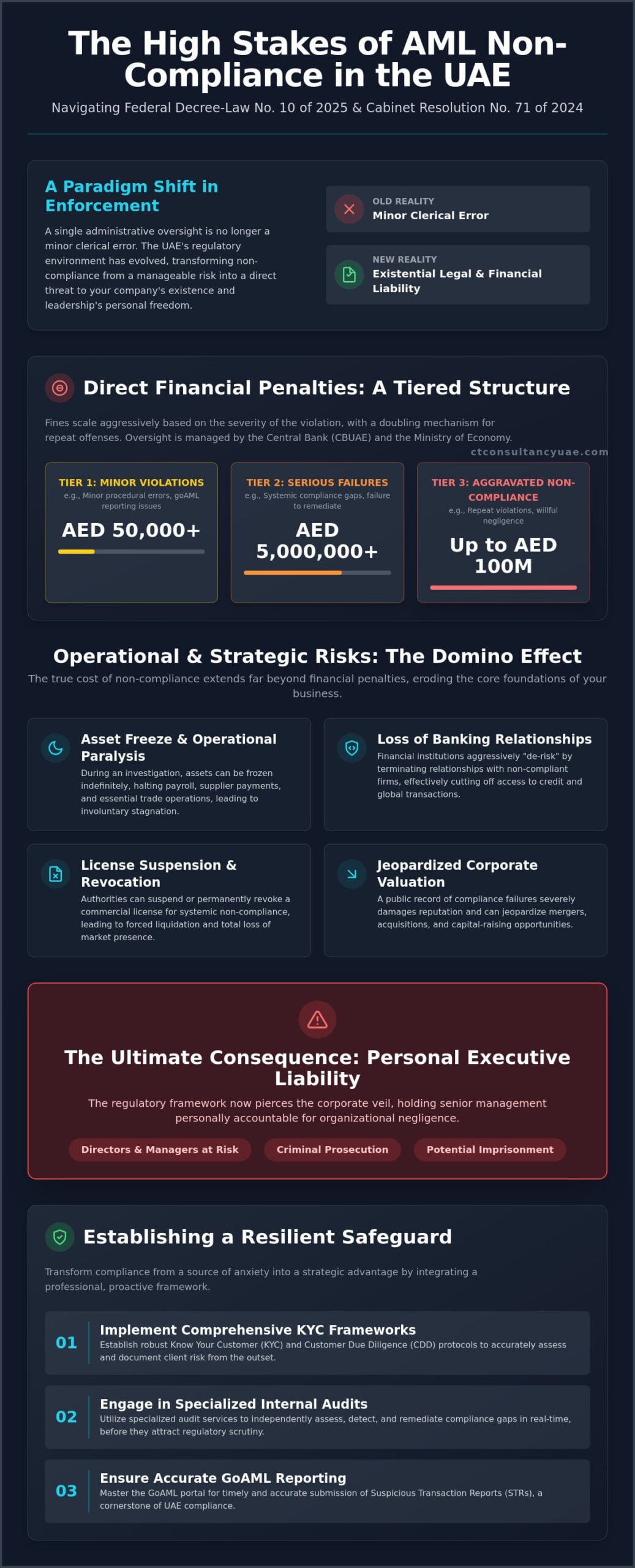
In the current UAE regulatory environment, a single administrative oversight in your goAML reporting is no longer a minor clerical error; it’s a direct threat to your corporate existence. The consequences of non-compliance with AML regulations under Federal Decree-Law No. 10 of 2025 have transitioned from manageable operational risks into existential legal and financial liabilities. You likely recognize that the UAE’s commitment to global transparency has intensified, yet the complexity of 41 distinct violation categories under Cabinet Resolution No. 71 of 2024 can feel overwhelming for even the most diligent directors.
This strategic overview provides the clarity you need to navigate these high-stakes requirements, ensuring your business remains a symbol of stability rather than a cautionary tale of regulatory enforcement. We’ll examine specific fine structures reaching up to AED 100 million, the reality of personal liability for senior management, and the precise roadmap your organization must follow to secure its license and reputation in 2026. By understanding these shifts, you can transform compliance from a source of anxiety into a strategic advantage that protects your company’s long-term growth and banking stability.
Key Takeaways
- Identify the tiered administrative penalty structure enforced by the Central Bank and Ministry of Economy, where individual violations can incur fines exceeding AED 5 million.
- Assess the severe operational consequences of non-compliance with AML, including the risk of “de-risking” by financial institutions and the subsequent loss of vital banking relationships.
- Recognize the shift toward personal executive liability, which now places directors and managers at risk of criminal prosecution and imprisonment for organizational negligence.
- Evaluate the strategic impact of compliance on corporate valuation, as non-compliant status can significantly jeopardize mergers, acquisitions, and capital-raising opportunities.
- Establish a resilient safeguard for your enterprise by integrating comprehensive KYC frameworks and specialized internal audit services to detect and remediate gaps in real-time.
The UAE Regulatory Landscape and Direct Financial Penalties
The UAE regulatory framework operates under a bifurcated oversight model designed to maintain the highest standards of financial integrity. The Central Bank of the UAE (CBUAE) maintains rigorous supervision over financial institutions, while the Ministry of Economy manages the compliance of Designated Non-Financial Businesses and Professions (DNFBPs), including real estate brokers and auditors. Under Federal Decree-Law No. 10 of 2025, these bodies possess the authority to levy significant fines that scale according to the severity of the breach. Identifying What is Anti-Money Laundering (AML)? provides the necessary context for why these authorities prioritize transparency and rigorous reporting. For local enterprises, the consequences of non-compliance with aml manifest as a tiered penalty structure. These administrative fines typically begin at AED 50,000 for minor procedural errors but can rapidly exceed AED 5,000,000 for systemic failures. The legal framework also includes a doubling mechanism; repeat violations within a specified period result in exponential financial exposure that can threaten the liquid capital of even established firms.
Administrative Fines and the GoAML Reporting Ecosystem
Administrative penalties are the immediate fiscal response to procedural AML failures. Central to this enforcement is the GoAML reporting portal, a mandatory platform managed by the Financial Intelligence Unit for submitting Suspicious Transaction Reports (STRs). Failing to register or utilize this system correctly often triggers the first wave of regulatory intervention. It’s also common for the Federal Tax Authority (FTA) to coordinate with AML supervisors during routine accounting services and audits, ensuring that tax records align precisely with anti-money laundering disclosures.
The Cost of License Suspension and Revocation
Beyond immediate liquid outflows, regulatory authorities hold the power to suspend commercial activities as a disciplinary measure. A temporary suspension can paralyze cash flow and trigger defaults on existing contractual obligations, creating a cascade of legal challenges. For businesses that exhibit systemic non-compliance or fail to remediate identified gaps after initial warnings, the Ministry of Economy can permanently revoke the commercial license. This terminal action effectively dissolves the entity’s right to operate within the UAE market, leading to forced liquidation and the total loss of market presence.
Operational and Strategic Risks: Beyond the Direct Fine
While financial penalties capture headlines, the structural erosion of a business’s operational capacity often proves more devastating. The consequences of non-compliance with AML extend into the very infrastructure of corporate stability, particularly regarding asset liquidity. When a regulatory body initiates an investigation, assets may be frozen for an indefinite period, halting payroll, supplier payments, and essential trade. This paralysis often forces a company into a state of involuntary stagnation from which it’s difficult to recover.
It’s a common misconception that compliance is an expensive burden; in reality, the cost of post-breach remediation projects frequently dwarfs the original investment in a robust framework. Specialized consultants must be engaged to overhaul legacy systems under strict regulatory deadlines, often while the business is under heightened scrutiny. This reactive approach creates significant friction, diverting management’s focus away from growth and toward survival.
Banking Relationship Stability and Credit Access
The UAE’s banking sector has adopted an aggressive "de-risking" strategy to align with international standards. If a business is flagged for AML deficiencies, financial institutions may unilaterally terminate the relationship to protect their own risk profile. Re-entering the formal financial system after being blacklisted is notoriously difficult, as a history of non-compliance serves as a permanent red flag for credit committees across the region. Without stable banking, a firm’s ability to utilize credit facilities or manage international transactions is effectively neutralized.
Reputational Damage in a Transparent Market
In an era of public registers and real-time news reporting, a compliance failure is impossible to contain. This visibility directly impacts business valuation during mergers or acquisitions, as potential buyers view AML gaps as massive contingent liabilities. For firms utilizing CFO advisory services to prepare for capital raising, a clean compliance record is a non-negotiable prerequisite for securing institutional investment. Protecting your market position requires a proactive stance, and engaging in a comprehensive regulatory health check can identify vulnerabilities before they manifest as strategic failures.
Personal and Executive Liability: The Ultimate Consequence
The shift in UAE enforcement strategy has moved decisively toward individual accountability. Under the current legal framework, the consequences of non-compliance with AML are no longer insulated within the corporate balance sheet. Directors, senior managers, and appointed compliance officers now face personal exposure that can lead to severe criminal sanctions. This evolution in the law reflects a zero-tolerance approach toward negligence, where the absence of intent doesn’t necessarily equate to an absence of liability. It’s vital to recognize that the UAE legal system has effectively dismantled the corporate veil in matters involving financial integrity.
A common misconception among both expatriate and local executives is that a lack of direct knowledge serves as a valid legal defense. In the UAE courts, the doctrine of willful blindness or gross negligence is sufficient to establish culpability. If a leader fails to implement mandatory internal controls or ignores red flags identified in the goAML system, they’re often held just as accountable as those who actively participate in the illicit activity. This makes the appointment of a qualified AML officer not just a procedural requirement, but a critical shield for the board of directors.
Fiduciary Duties and the Risk of Imprisonment
Federal Decree-Law No. 10 of 2025 explicitly outlines the criminal penalties for individuals who fail to fulfill their regulatory obligations. Under UAE law, executives can face significant prison terms if found to have knowingly facilitated or ignored money laundering activities. These sentences are frequently paired with personal fines that remain distinct from any administrative penalties levied against the business entity itself, ensuring that the financial burden of the breach is felt at the executive level.
Professional Disqualification and Travel Bans
Beyond the immediate threat of incarceration, an investigation into financial irregularities often results in an immediate travel ban, preventing the individual from leaving the country while the case remains active. If a conviction is secured, the professional fallout is terminal. Individuals are typically barred from holding any managerial position or board seat in a UAE company for a specified period; this effectively terminates their career within the region’s financial markets.
Securing your professional future requires more than just good intentions; it demands a verified, robust compliance architecture. You can safeguard your leadership team by engaging our specialized AML compliance services to ensure every regulatory mandate is meticulously documented and met.
Mitigating Risk through Professional Compliance Frameworks
To insulate your organization from the severe consequences of non-compliance with aml, you must move beyond a check-box mentality and adopt a comprehensive compliance architecture. This begins with a meticulously designed Know Your Customer (KYC) and Know Your Business (KYB) framework that serves as your primary filter against high-risk entities. By integrating these protocols with regular internal audit services, you can proactively identify procedural gaps before they attract regulatory scrutiny. In the 2026 landscape, a unified defense is essential; your AML strategy should be synchronized with VAT and tax compliance to ensure consistency across all federal filings. Utilizing specialized business advisory allows your leadership to remain agile as regional regulations continue to evolve.
Step-by-Step Remediation for Non-Compliant Entities
If your firm has fallen behind current standards, a structured remediation path is critical to mitigating existing exposure. First, conduct a rigorous gap analysis to evaluate your current policies against the latest 2025 decree. Second, expedite registration and address any back-filing requirements on the goAML portal to signal transparency to the Financial Intelligence Unit. Finally, implement ongoing staff training and deploy automated transaction monitoring to detect anomalies in real-time, ensuring that the consequences of non-compliance with aml are neutralized through visible, corrective action.
The Role of Strategic CFO Advisory in Compliance
Strategic CFO advisory services provide the high-level oversight necessary to embed compliance into your long-term financial planning. An expert CFO ensures that your financial statements remain transparent and audit-ready, which is a vital safeguard during intense regulatory reviews. By positioning compliance as a core financial pillar rather than an isolated legal obligation, you transform a regulatory requirement into a hallmark of corporate reliability and investment readiness. This integrated approach provides the frictionless operational environment necessary for sustained growth in the UAE’s sophisticated market.
Securing Your Corporate Legacy in the UAE’s Transparent Future
The UAE’s 2026 regulatory landscape has fundamentally redefined the relationship between business growth and legal integrity. As this overview has demonstrated, the transition toward severe administrative fines and personal executive liability marks a new era of rigorous enforcement. Organizations that fail to adapt risk more than just liquid capital; they risk their banking stability, market reputation, and the professional freedom of their leadership teams. Understanding the full spectrum of the consequences of non-compliance with AML is the first step toward building a resilient enterprise that thrives under global scrutiny.
Navigating these intricacies requires a partner with deep local roots and a global perspective on financial governance. CTC Tax & Accounting offers decades of international and UAE-specific regulatory experience, providing end-to-end support tailored specifically for DNFBPs and SMEs. Our specialized team delivers meticulous internal audits and strategic CFO advisory services to ensure your compliance framework is both resilient and future-proof. Protect your business with professional AML compliance support from CTC Tax & Accounting and ensure your operations remain frictionless. By prioritizing proactive mitigation today, you can focus on scaling your enterprise with the absolute confidence that your license and legacy are secure.
Frequently Asked Questions
What are the maximum fines for AML non-compliance in the UAE for 2026?
Legal entities can face corporate fines of up to AED 100 million for serious offenses such as money laundering or terrorist financing under Federal Decree-Law No. 10 of 2025. Administrative penalties for procedural breaches, including inadequate customer due diligence, typically range from AED 50,000 to AED 1,000,000 per violation. These tiered structures ensure that the consequences of non-compliance with AML serve as a formidable deterrent against institutional negligence.
Can a business owner go to jail for their company’s AML failures?
Yes, individual business owners and directors face criminal prosecution, including potential imprisonment, for gross negligence or complicity in illicit financial activities. The UAE legal framework holds senior management personally accountable to ensure that compliance is prioritized at the highest levels of corporate governance. This personal liability cannot be mitigated by paying a corporate fine, as the law targets the individuals responsible for the failure.
How often should a UAE company conduct an AML audit?
It’s recommended that companies conduct an independent AML audit at least once every twelve months to maintain strict regulatory alignment. Businesses operating in high-risk sectors, such as real estate or precious metal dealers, should consider more frequent reviews to address specific vulnerabilities. Regular assessments allow firms to remediate gaps in their KYC frameworks before they attract formal scrutiny from federal supervisors or lead to license suspension.
What is the goAML portal and is it mandatory for all businesses?
The goAML portal is a mandatory reporting platform managed by the UAE’s Financial Intelligence Unit (FIU) for all financial institutions and Designated Non-Financial Businesses and Professions (DNFBPs). It’s the required system for registering and submitting Suspicious Transaction Reports (STRs) to the authorities. Failing to register with goAML is a specific violation that carries administrative fines ranging from AED 50,000 up to AED 1,000,000.
Does AML compliance apply to Free Zone companies as well as Mainland firms?
AML compliance requirements apply equally to companies registered in UAE Free Zones and those operating on the Mainland. Regardless of the specific licensing jurisdiction, all entities must adhere to the federal standards established by Decree-Law No. 10 of 2025. This universal application ensures that the consequences of non-compliance with AML remain consistent across the country, maintaining the integrity of the UAE’s entire financial ecosystem.