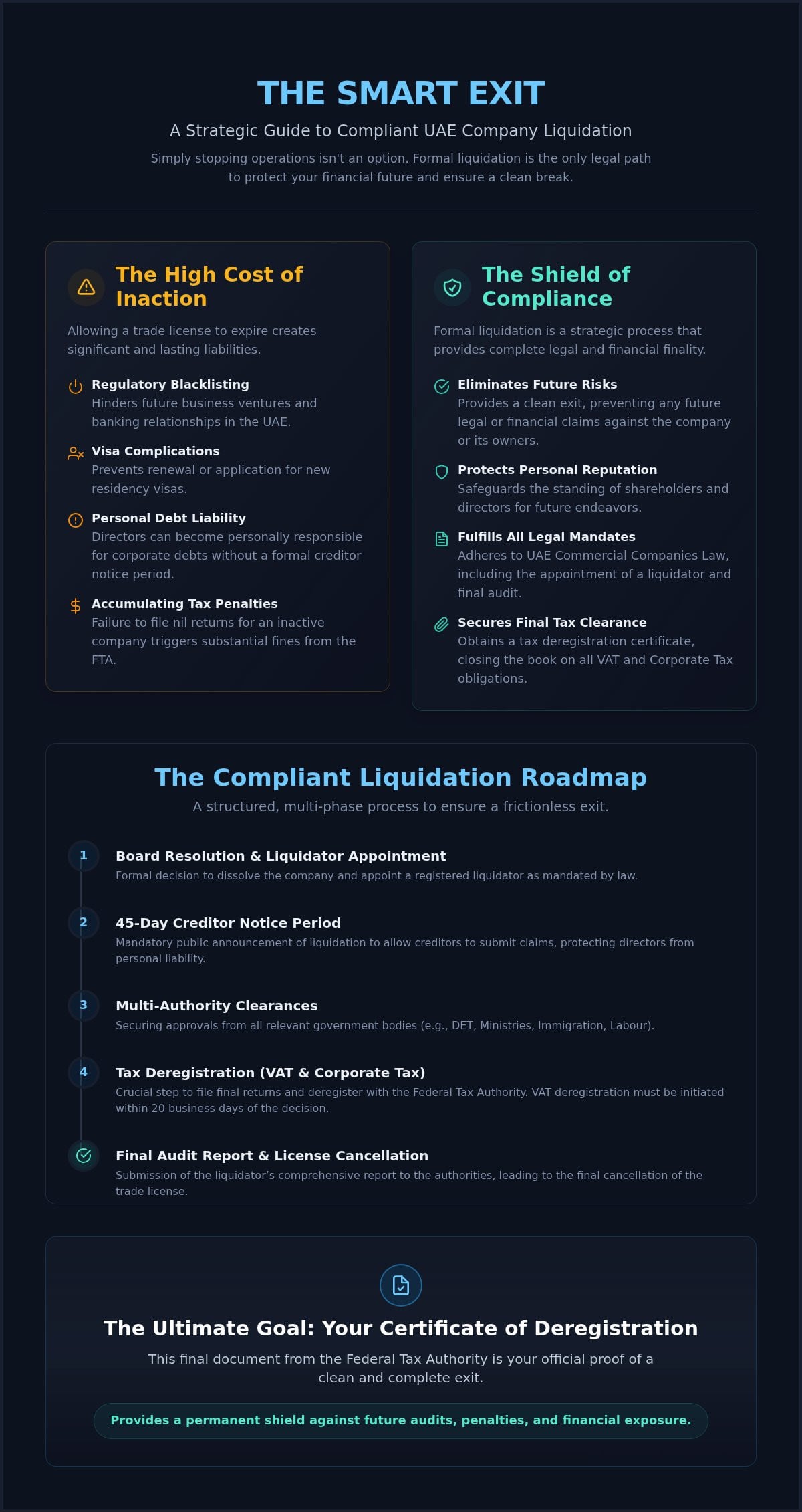
Simply walking away from a UAE trade license is no longer just a business failure; it’s a significant financial liability that can follow an entrepreneur for years. You’ve likely realized that the regulatory environment in 2026, particularly with the April updates to mainland closure guidance, requires more than just stopping operations. It’s natural to feel overwhelmed by the prospect of hidden Corporate Tax penalties or the labyrinth of multi-authority clearances required for a clean break.
Utilizing professional company liquidation services in Dubai is the most effective way to ensure your exit is a strategic shield rather than a bureaucratic nightmare. We promise to guide you through a structured, compliant roadmap to navigate the dissolution process, ensuring you mitigate regulatory risks and secure a final tax de-registration certificate. We’ll explore the mandatory 45-day creditor notice period, the digitization of license cancellations through portals like DET, and the critical steps for VAT and Corporate Tax deregistration to ensure zero future legal or financial exposure.
Key Takeaways
- Understand why allowing a trade license to simply expire poses significant risks, including potential blacklisting and future visa restrictions.
- Learn the mandatory requirements under the UAE Commercial Companies Law, including the appointment of a registered liquidator and the submission of a final audit report.
- Discover how expert company liquidation services in Dubai manage the mandatory 45-day public notice periods and multi-authority clearances for a clean exit.
- Ensure your long-term financial security by securing a final tax de-registration certificate and eliminating any lingering exposure to regulatory penalties.
Under UAE law, formal company liquidation is the only recognized method to legally dissolve a corporate entity and terminate its obligations to the state. It’s a strategic process that involves the systematic settlement of liabilities and the formal cancellation of the trade license. Engaging professional company liquidation services in Dubai ensures that this transition is handled with the precision required to protect the reputations of shareholders and directors. Simply stopping operations doesn’t end your legal responsibilities; it often marks the beginning of complex regulatory exposure.
Risks of Improper Business Closure
Simply allowing a license to expire is a high-risk strategy that often leads to severe administrative repercussions. Inactive companies remain visible on the Federal Tax Authority’s radar, and failure to file nil returns can trigger substantial penalties. Without a structured exit, the following risks become reality:
- Regulatory Blacklisting: Unresolved licenses can lead to the blacklisting of owners, hindering future entrepreneurial ventures or bank account openings in the UAE.
- Visa Complications: You can’t renew or obtain new residency visas if you’re linked to a non-compliant, unliquidated entity.
- Debt Liability: Without the mandatory 45-day creditor notice period, directors may find themselves personally liable for corporate debts that weren’t formally addressed.
Liquidation vs. Dormancy: Making the Right Choice
While some businesses opt to "freeze" their license for a specific period, this is merely a temporary deferment that still incurs government fees and administrative oversight. For those seeking a permanent market exit, full liquidation is the most cost-effective path. It provides the finality of a tax de-registration certificate, which serves as a shield against future audits. This structured approach, supported by expert business advisory, effectively removes the friction from the exit process, allowing for a clean transition to new opportunities without lingering financial shadows.
The Regulatory Framework for Company Liquidation Services in Dubai and the UAE
Mandatory Liquidation Reports and Audits
Licensing authorities require a comprehensive liquidator’s statement of affairs to validate that all liabilities have been addressed. This process often begins with a rigorous internal review to identify financial discrepancies before the official filing. Ensuring that your financial statements are current for the final liquidation period isn’t just a formality; it’s a strategic move to prevent delays during the Step-by-Step National Business Closure Process. Our team acts as a primary friction-remover, ensuring your accounting records are audit-ready before the final submission.
Tax Deregistration: VAT and Corporate Tax Obligations
The Federal Tax Authority (FTA) enforces strict timelines for de-registration that often catch businesses off guard. For instance, VAT de-registration must typically be initiated within 20 business days of the liquidation decision to avoid administrative penalties. Meeting the 2026 Corporate Tax requirements for liquidating entities adds another layer of complexity, as a final tax clearance is now a prerequisite for total closure. You can learn more about our comprehensive tax services to understand how these obligations impact your specific exit timeline. Expert guidance helps you secure a final tax deregistration certificate, effectively closing the door on future financial exposure.
Step-by-Step National Business Closure Process
The dissolution of a UAE corporate entity is a multi-phased operation that demands strict adherence to the protocols established by the UAE Ministry of Economy & Tourism. This structured journey begins with a formal shareholder resolution and culminates in the final erasure of the company from the national registry. Each stage requires meticulous coordination to ensure that all legal and financial obligations are definitively settled.
Initial Documentation and Legal Resolutions
The process initiates with the drafting of a Shareholder Resolution, which must be notarized to confirm the collective intent to dissolve the legal entity. You’ll need to compile a comprehensive dossier of essential documents, including trade license copies, the Memorandum of Association, and relevant powers of attorney. Appointing a qualified firm like CTC Tax & Accounting as the official liquidator is the most critical step in this phase. This appointment triggers the mandatory 45-day creditor notice period in local newspapers, which is a vital safeguard against future litigation or claims of unsettled debt.
Navigating Clearances and Bank Account Closure
Securing clearances from various government departments is often where the most administrative friction occurs. You must close corporate bank accounts and secure a "No Liability" letter before the final stages can proceed. Simultaneously, employee visas must be cancelled, and end-of-service gratuities must be settled to obtain necessary Labor and Immigration clearances. Our company liquidation services in Dubai streamline these complex interactions with utility providers, customs departments, and landlords, ensuring no lingering financial ties remain. Once all clearances are obtained and the notice period concludes, the final report is submitted for trade license cancellation. If you require specialized assistance to manage this transition, we invite you to consult our business advisory team for a tailored solution.
Strategic Liquidation Support: Ensuring a Frictionless Exit
Professional company liquidation services in Dubai provide a comprehensive shield, managing the transition from an operational entity to a legally extinguished one. This end-to-end management encompasses everything from the finalization of bookkeeping to the ultimate de-registration, and you can explore Fixed-fee legal consultancy and advisory fees to ensure that mainland, free zone, and offshore entities receive bespoke guidance tailored to their specific jurisdictional requirements. We act as the primary friction-remover, allowing you to focus on your next venture while we handle the intricate regulatory landscape.
The Role of CFO Advisory in Business Dissolution
Strategic asset realization is a critical component often overlooked in standard administrative closures. You’ll need to navigate the complex settlement of liabilities and the distribution of remaining assets to shareholders in a manner that remains tax-efficient under the 2026 regulatory updates. You can explore our strategic CFO services to understand how high-level financial planning mitigates the risk of value erosion during the winding-up phase. We ensure that every financial decision aligns with the broader goal of a clean, optimized exit, providing the precision required for high-stakes corporate governance.
Why Professional Expertise is Non-Negotiable
Attempting a DIY liquidation often results in overlooked filings that trigger punitive fines from the Federal Tax Authority or licensing bodies. It’s essential to maintain full compliance with Economic Substance Regulations (ESR) and Ultimate Beneficial Ownership (UBO) requirements even as the company ceases to trade. For instance, understanding ESR compliance in the UAE is vital, as reporting obligations don’t simply vanish because a business is closing. Our expert-led company liquidation services in Dubai eliminate these pitfalls, providing the meticulous planning required to protect your professional legacy and future business eligibility. We provide the reassurance that your exit is final, legal, and entirely frictionless.
Securing a Clean Exit and Protecting Your Professional Legacy
Navigating a business closure in the UAE’s evolving regulatory landscape demands more than just administrative effort; it requires a strategic approach to risk mitigation. By formalizing your market exit through structured company liquidation services in Dubai, you ensure that every obligation, from VAT de-registration to final UBO filing, is meticulously addressed. It’s a structured process that effectively shields shareholders and directors from lingering financial exposure and protects your future eligibility for new ventures within the region. Our team leverages decades of international financial experience and specialized expertise in UAE Corporate Tax and VAT to act as your primary friction-remover. We handle the complexities of comprehensive AML and UBO compliance so you can move forward with absolute confidence. Secure your business exit with professional company liquidation services and ensure your professional legacy remains unblemished. Your next entrepreneurial chapter begins with the security and professional calm of a definitive clean break.
Frequently Asked Questions
What is the difference between voluntary and compulsory liquidation in the UAE?
Voluntary liquidation is initiated by shareholders when a company is solvent and the owners elect to cease operations. In contrast, compulsory liquidation is a court-mandated process typically triggered by creditors or authorities when a business is insolvent. Professional company liquidation services in Dubai ensure that voluntary closures follow the mandatory 45-day notice period to protect directors from future liability claims or accusations of financial mismanagement during the winding-up phase.
How long does the company liquidation process typically take nationally?
The timeline for business closure varies based on the entity type and complexity of liabilities. Typically, a solvent Free Zone entity completes the process within one to three months. A mainland LLC generally requires two to four months due to the mandatory 45-day creditor notice period and multi-authority clearances. Complex or insolvent liquidations may extend from six to eighteen months. Professional oversight ensures these stages progress without administrative delays or procedural bottlenecks.
Can I liquidate a company if it still has outstanding debts or liabilities?
Is a liquidation report mandatory for all types of business closures?
A liquidation audit report is mandatory for all companies undergoing formal dissolution in the UAE, regardless of whether they are mainland or free zone entities. This report must be prepared by a licensed auditor and serves as a verified statement of the company’s financial position. It confirms that all liabilities have been settled and assets distributed. Without this document, licensing authorities and the Federal Tax Authority won’t approve the final trade license cancellation.
What happens to my residency visa when my company is liquidated?
All residency visas linked to the company, including those for investors and employees, must be cancelled before the trade license is officially terminated. This requirement involves settling all end-of-service gratuities and obtaining clearances from the Ministry of Human Resources and Emiratisation. It’s crucial to secure your personal banking and housing arrangements beforehand. Accessing corporate bank accounts becomes significantly more difficult once the primary investor’s visa is cancelled and the liquidation reaches its final stages.