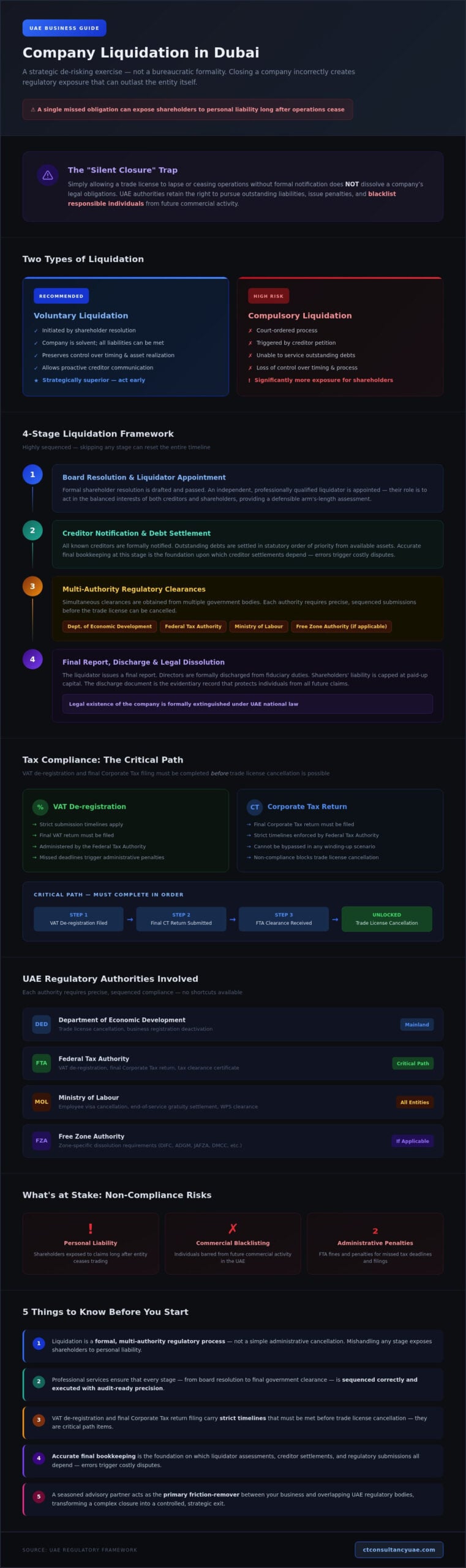
Closing a company is not the end of your obligations; in many cases, it’s where your most significant regulatory exposure begins. Business owners seeking company liquidation services in Dubai frequently discover that the winding-up process involves a layered sequence of government clearances, final tax settlements, and audit-ready financial submissions that, if mishandled, can result in personal liability long after the entity has ceased trading.
That concern is entirely legitimate. The UAE’s regulatory framework spans multiple authorities, from the Department of Economic Development to the Federal Tax Authority, and each requires precise, sequenced compliance before a company can be formally dissolved. A single overlooked obligation can stall the process or expose shareholders to claims they believed were settled.
This guide reframes liquidation not as a bureaucratic formality, but as a strategic de-risking exercise that, when executed with professional rigor, protects your financial interests and closes your regulatory footprint cleanly. You’ll find a structured walkthrough of the key procedural stages, the critical role of accurate final bookkeeping, and how to approach multi-authority clearances with confidence and precision.
Key Takeaways
- Company liquidation is a formal, multi-authority regulatory process—not a simple administrative cancellation—and mishandling any single stage can expose shareholders to personal liability well after the entity has ceased operations.
- Engaging professional company liquidation services in Dubai ensures that every procedural stage, from the initial board resolution to the final government clearance, is sequenced correctly and executed with audit-ready precision.
- VAT de-registration and final Corporate Tax return filing carry strict timelines that must be met before a trade license can be officially cancelled, making tax compliance a critical path item in any winding-up exercise.
- Accurate final bookkeeping is not a formality—it is the foundation upon which liquidator assessments, creditor settlements, and regulatory submissions all depend, and errors at this stage can trigger costly disputes.
- A seasoned advisory partner can act as the primary friction-remover between your business and the UAE’s overlapping regulatory bodies, transforming a complex closure into a controlled, strategically managed exit.
The Strategic Role of Professional Company Liquidation Services in Dubai
At its legal foundation, the company liquidation process is a formal statutory procedure through which a company’s affairs are wound up: its outstanding debts are settled in order of priority, its remaining assets are distributed to shareholders, and its legal existence is extinguished under national law. That definition, however, understates the strategic weight of the exercise. For business owners operating in the UAE, liquidation is not simply an administrative endpoint; it is the mechanism through which personal liability is formally severed from corporate obligation, and through which future commercial endeavors are protected from the residual risks of a poorly closed entity.
Professional company liquidation services in Dubai exist precisely because that severance is not automatic. It must be earned through a disciplined, sequenced process of creditor notification, financial settlement, and multi-authority clearance. Without it, shareholders carry exposure they may not even be aware of.
The alternative, what practitioners refer to as a "silent closure," is a common and costly mistake. Simply allowing a trade license to lapse, ceasing operations without formal notification, or failing to submit final tax returns does not dissolve a company’s legal obligations. UAE regulatory authorities, including the Federal Tax Authority and the Department of Economic Development, retain the right to pursue outstanding liabilities, issue administrative penalties, and in serious cases, blacklist the responsible individuals from future commercial activity in the jurisdiction. The reputational and financial consequences of that outcome extend far beyond the original entity.
The appointed liquidator serves as an independent authority in this process, a professionally qualified party whose role is to act in the balanced interests of both creditors and shareholders. This independence is not merely procedural; it provides a defensible, arm’s-length assessment of the company’s final financial position that neither creditors nor shareholders can unilaterally contest.
Voluntary vs. Compulsory Liquidation
Voluntary liquidation is initiated by a shareholder resolution, typically when the company is solvent and its directors can certify that all known liabilities will be met in full from available assets. Compulsory liquidation, by contrast, is court-ordered, most commonly triggered by a creditor’s petition following an inability to service debts. The distinction matters considerably: voluntary winding up preserves considerably more control over timing, creditor communication, and asset realization, making early, proactive engagement with qualified advisors the strategically superior approach.
Protecting Shareholder Interests
Formal liquidation provides shareholders with a critical legal shield. Once the process is correctly completed and the liquidator’s final report is issued, directors are formally discharged from their fiduciary duties, and shareholders’ liability is capped at the extent of their paid-up capital. That discharge document is not a formality; it is the evidentiary record that protects individuals from future claims. Engaging experienced accounting and advisory professionals to prepare audit-ready financial records ensures that the liquidator’s assessment is grounded in accurate data, eliminating the disputes that arise when final accounts are incomplete or inconsistent.
A Step-by-Step Framework for Company Liquidation in the UAE
The transition from strategic planning to tactical execution requires a disciplined adherence to the UAE’s statutory winding-up framework. This process is highly sequenced; skipping a single regulatory requirement can reset the timeline or lead to significant administrative delays. Professional company liquidation services in Dubai provide the structured momentum required to move through these phases without friction.
The framework follows four primary milestones:
- Step 1: Drafting the Board Resolution and formally appointing a registered liquidator.
- Step 2: Filing the initial application with the licensing authority to secure the preliminary liquidation certificate.
- Step 3: Managing the mandatory public notice period and addressing creditor claims.
- Step 4: Obtaining final clearances from labor, immigration, and utility providers.
The Appointment of a Registered Liquidator
In the UAE, only firms specifically approved by the relevant licensing authorities can issue the final liquidation report. This report is the definitive document the government requires to cancel a trade license. To facilitate this, your financial records must be impeccable. Engaging specialized accounting services to prepare audit-ready statements is a prerequisite for a smooth liquidator review. This ensures all assets and liabilities are precisely accounted for before the formal winding-up begins.
Navigating the Public Notice Period
Once the preliminary certificate is issued, the company must publish a notice of liquidation in two local newspapers: one in English and one in Arabic. This triggers a statutory 45-day window for creditors to come forward. Managing this period requires meticulous record-keeping and prompt communication to ensure any valid claims are settled or documented. It’s during this phase that the liquidation’s transparency protects shareholders from future litigation.
Concurrent with this window, the business must initiate UAE Federal Tax Authority VAT de-registration and settle any outstanding corporate tax obligations. Coordination between these various government departments is essential to avoid penalties. If you’re concerned about the complexity of these multi-authority clearances, reaching out for a strategic advisory session can help define a clear, risk-mitigated path forward.
Regulatory Compliance: VAT and Corporate Tax De-registration
Of all the procedural stages involved in formally winding up a UAE entity, tax de-registration carries the most unforgiving deadlines. A business must apply for VAT de-registration within 20 business days of the date it ceases to make taxable supplies, or from the date its taxable turnover falls below the mandatory registration threshold. Missing that window triggers administrative penalties from the Federal Tax Authority, penalties that accrue independently of whether the company has already ceased trading. The license cancellation process cannot be completed while outstanding VAT obligations remain unresolved, making this timeline a genuine critical path item rather than a procedural footnote.
Corporate Tax de-registration introduces a parallel obligation. Under the UAE Corporate Tax regime, a final tax return must be submitted for the period up to the cessation of business activities before the relevant authority will confirm the entity’s tax standing. This is not a step that can be deferred until after the trade license is cancelled; the sequence runs in precisely the opposite direction. The final return must be filed, assessed, and cleared before the licensing authority will accept the closure application. Engaging professional tax services at this stage ensures that both de-registration timelines are managed concurrently, eliminating the risk of one obligation stalling progress on the other.
Beyond VAT and Corporate Tax, two further compliance obligations demand attention during any company liquidation services in Dubai engagement:
- Ultimate Beneficial Ownership (UBO) records must be formally updated to reflect the entity’s dissolution and submitted to the relevant register before closure is confirmed.
- Economic Substance Regulation (ESR) filings require a final notification if the entity was within scope during its last financial period, even if that period was abbreviated by the winding-up process.
Final Tax Audits and Clearances
A Tax Clearance Certificate, issued by the Federal Tax Authority upon confirmation that all VAT and Corporate Tax obligations have been settled, is the definitive document demonstrating a clean tax record; without it, no liquidator can responsibly finalize their report, and no licensing authority will proceed with formal cancellation. The clearance process involves a reconciliation of all filed returns, a review of any outstanding assessments, and confirmation that no penalties remain unpaid. Businesses with complex transaction histories or multi-period VAT positions should anticipate that this review may require detailed supporting documentation, making audit-ready bookkeeping an essential prerequisite rather than an optional preparation.
AML and ESR Considerations During Winding Up
Dissolution does not terminate a company’s record-keeping obligations. UAE Anti-Money Laundering regulations require that financial records, customer due diligence files, and transaction documentation be preserved for a minimum of five years post-liquidation, with certain regulated entities subject to longer retention periods. A final ESR notification, where applicable, must accurately reflect the entity’s relevant activities and financial figures for its last period of operation. These are obligations that persist beyond the closure date, and structuring an appropriate archiving protocol before the entity is formally struck off is a discipline that protects former shareholders from compliance exposure in the years that follow.
If you’re approaching the tax de-registration phase and need a structured, sequenced approach to both VAT and Corporate Tax closure, speak with CTC’s tax compliance specialists to define a clear, penalty-free path to full regulatory discharge.
Why CTC Tax & Accounting is Your Strategic Partner for Business Closure
The distance between a technically correct liquidation and a strategically managed one is where professional advisory genuinely earns its value. Founded in 2015, CTC Tax & Accounting has spent years developing a practice built on one foundational principle: that business owners deserve a single, authoritative point of coordination between their interests and the UAE’s overlapping regulatory bodies. When you engage CTC for company liquidation services in Dubai, you’re not acquiring a checklist service; you’re securing a partner whose role is to absorb institutional friction before it reaches you.
That friction-removal function is substantive. CTC’s advisory team manages the sequencing of creditor communications, tax authority submissions, labor clearances, and liquidator engagements as an integrated workflow rather than a series of disconnected tasks. The result is a process that moves with controlled momentum, where no single authority’s timeline becomes a bottleneck for another’s clearance.
Our integrated CFO advisory services extend this value into asset realization and debt structuring decisions, ensuring that the financial architecture of your closure is as disciplined as the regulatory compliance surrounding it. This matters particularly when residual assets require structured disposal or when outstanding creditor positions require negotiated settlement.
Customized Liquidation Roadmaps
No two entities close under identical conditions. A mainland trading company with multi-period VAT history carries a different risk profile than a free zone holding structure with dormant accounts. CTC’s planning phase begins with a meticulous diagnostic review that maps your specific regulatory exposure, identifies sequencing risks, and establishes a tailored compliance strategy before a single government submission is made. Potential hurdles are surfaced early, not discovered mid-process.
Beyond Liquidation: Strategic Financial Planning
Closure is rarely a final destination. For entrepreneurs transitioning to new ventures, CTC’s advisory practice extends naturally into post-liquidation financial planning, ensuring that the clean regulatory slate achieved through a disciplined winding-up becomes the stable foundation for what comes next. That continuity of support, from dissolution through to new entity structuring, reflects a long-term partnership model rather than a transactional engagement.
If you’re ready to approach your business closure with the precision it demands, connect with CTC’s advisory team to begin with a structured, risk-mapped liquidation roadmap tailored to your entity’s specific position.
Close Your Business with Confidence, Not Complications
A well-executed closure is as strategically significant as a well-planned launch. Throughout this guide, one principle has remained constant: company liquidation services in Dubai demand meticulous regulatory planning, precise sequencing across multiple authorities, and audit-ready financial records that withstand independent scrutiny. Cutting corners at any stage doesn’t simplify the process; it extends your liability exposure into the future.
For SMEs and freelancers navigating this process, the stakes are particularly personal. Expert VAT and Corporate Tax de-registration, coordinated creditor communications, and a clean final tax clearance aren’t administrative luxuries; they’re the mechanisms that formally sever your personal obligations from a closing entity.
The right advisory partner doesn’t just manage the paperwork. They absorb the institutional friction, surface the risks early, and ensure your exit is as disciplined as your entry.
When you’re ready to move forward with clarity and control, secure a strategic consultation for your company liquidation today and take the first step toward a clean, confident closure.
Frequently Asked Questions About Company Liquidation Services in Dubai
How long does the company liquidation process take in the UAE?
The timeline varies considerably depending on entity type, regulatory complexity, and whether outstanding tax or labor obligations exist. A straightforward mainland company with clean accounts and no creditor disputes can typically complete the formal winding-up process within three to six months. Free zone entities often operate on slightly different timelines governed by their respective authorities. Entities with multi-period VAT histories, unresolved creditor claims, or incomplete financial records should anticipate a longer process.
The most common cause of timeline extension isn’t the government review itself; it’s incomplete documentation submitted at the outset. Audit-ready financial records prepared before the process begins are the single most effective way to control how long the closure actually takes.
Can I close my company if it has outstanding debts or liabilities?
Yes, but the presence of outstanding liabilities determines which liquidation pathway applies. Solvent companies can proceed through voluntary liquidation, where known debts are settled from available assets before the process concludes. Insolvent entities, where liabilities exceed assets, typically require court involvement and a formally appointed liquidator who manages creditor priority and asset distribution according to statutory rules.
In both scenarios, attempting to close a company without formally addressing its liabilities doesn’t extinguish those obligations. Creditors retain legal recourse against the entity until debts are properly settled or discharged through the statutory process, which is why structured professional guidance is essential rather than optional.
What happens to my residency visa during the liquidation process?
Residency visas sponsored by the company being liquidated must be cancelled as part of the winding-up process. This applies to the owner’s own visa and to any visas sponsored on behalf of employees. The Ministry of Human Resources and Emiratisation and the General Directorate of Residency and Foreigners Affairs both require formal cancellation submissions, and labor clearance from the relevant authority is a prerequisite for final trade license cancellation.
Shareholders or directors who intend to remain in the UAE after closure need to secure alternative visa sponsorship before their existing visa is cancelled, since the liquidation process itself doesn’t automatically trigger a grace period. Planning this transition well in advance of the formal closure date avoids unnecessary immigration complications.
Is it mandatory to appoint a liquidator for all types of company closures in Dubai?
The requirement to appoint a registered liquidator depends on the entity type, its jurisdiction, and whether the closure is voluntary or court-ordered. For most mainland companies undergoing formal voluntary liquidation, a licensed liquidator approved by the Department of Economic Development is required to issue the final liquidation report, which is the document the authority needs to cancel the trade license. Free zones operate under their own regulatory frameworks, and appointment requirements differ across jurisdictions.
Engaging professional company liquidation services in Dubai at the planning stage ensures you understand precisely which requirements apply to your specific entity before submissions begin, rather than discovering a mandatory step mid-process that resets your timeline.
What are the penalties for failing to de-register for VAT or Corporate Tax during liquidation?
Failing to apply for VAT de-registration within 20 business days of ceasing taxable supplies exposes the entity to administrative penalties from the Federal Tax Authority, and those penalties accrue regardless of whether the company has stopped trading. Late or missing Corporate Tax filings carry their own separate penalty structure under the UAE Corporate Tax regime. Critically, neither the licensing authority nor the appointed liquidator can finalize the closure while unresolved tax obligations remain outstanding.
The practical consequence is that tax non-compliance doesn’t just generate fines; it actively stalls every other stage of the liquidation. Coordinating VAT and Corporate Tax de-registration concurrently, with precise attention to their respective deadlines, is one of the highest-leverage actions available to any business owner navigating this process.