
Cash flow problems often begin in the books, before they appear in the bank account. Common bookkeeping mistakes by founders include entering transactions late, mixing personal and business spending, missing expenses or vendor payments, and recording revenue or costs in the wrong period. These gaps can make available cash look higher or lower than it is.
It’s easy to focus on the bank balance and assume it tells the whole story. But unpaid bills, customer payments received in advance, and expenses already incurred all affect the financial picture, even when no cash has moved yet.
This guide explains how to keep records current, separate business and personal finances, track expenses, manage vendor payments, and review accruals and provisions. Regular reviews of income, expenses, and cash flow can surface discrepancies earlier, giving you a clearer basis for day-to-day decisions and financial planning in the UAE.
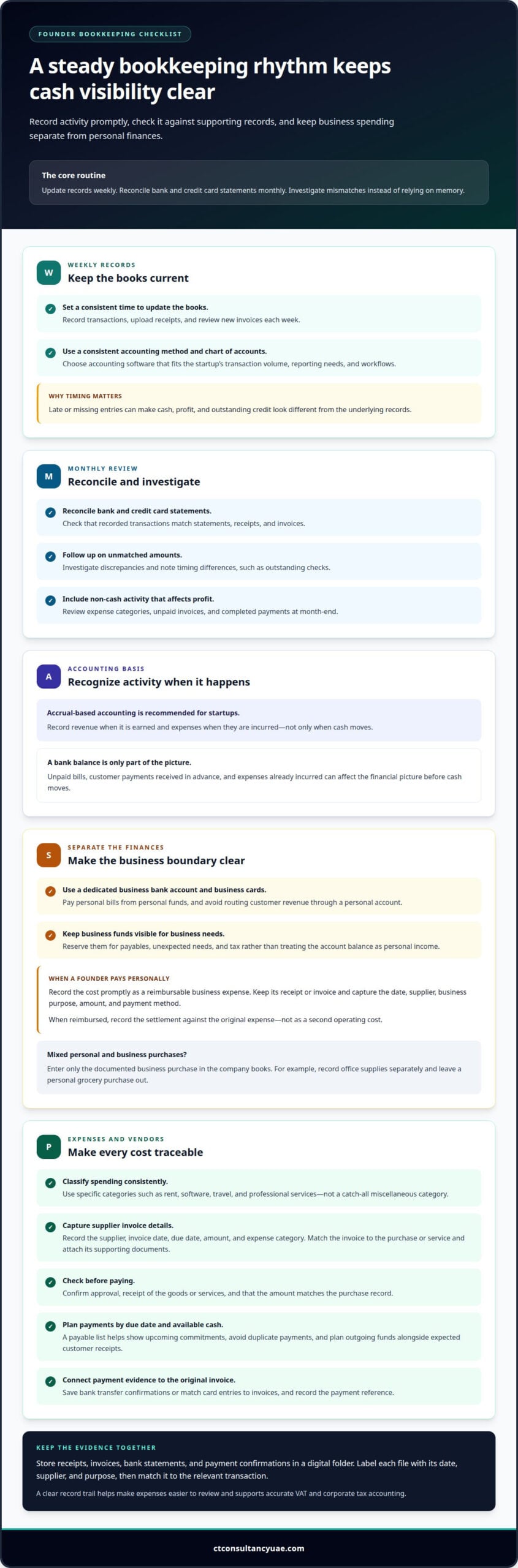
Late entries leave founders working from an incomplete view of cash, profit, and outstanding credit. Set a weekly time to record transactions, upload receipts, and review new invoices. Then reconcile the bank account and credit card statements monthly. This rhythm is more reliable than trying to enter 12 months of records near a filing deadline.
Early-stage startups need accounting software that fits their transaction volume, reporting needs, and workflows. Use a consistent method and chart of accounts, then update entries weekly and reconcile balances monthly. Accrual-based accounting is recommended for startups because it records revenue when earned and expenses when incurred, rather than waiting for cash movement.
For UAE bookkeeping, retain receipts and record every business expense, including small purchases. Keep invoices, bank statements, payment confirmations, and other supporting records together in a digital folder. Label each file with its date, supplier, and purpose, then match it to the relevant transaction. This supports accurate VAT and corporate tax accounting without relying on memory.
Common mistakes include entering transactions late, omitting expenses, losing receipts, and recording a payment twice. Each can distort reported profit or make an expense harder to substantiate. Unpaid tax liabilities, late returns, and incorrect deductions can also create compliance problems. Incomplete records may conceal discrepancies that need investigation.
For example, a founder pays for a business subscription personally but never records the expense. The business bank account shows no payment, while the books understate costs and overstate available cash. Record the purchase promptly, retain the receipt, and identify it as a business expense paid personally. A simple cloud folder makes the evidence easier to retrieve.
At each month-end, check that recorded transactions match statements, receipts, and invoices. Investigate unmatched amounts, note timing differences such as outstanding checks, and record non-cash transactions that affect profit. Regular updates make errors easier to find and give founders a more dependable view of cash available for obligations and operating decisions.
Open a dedicated business bank account and use business cards for company transactions. Pay personal bills from personal funds, and avoid routing customer revenue through a personal account. This gives financial reporting a clear boundary and shows which cash belongs to operations. Reserve business funds for payables, unexpected needs, and tax rather than treating the account balance as personal income.
Founders sometimes pay company expenses personally, particularly during setup or while travelling. Record each payment promptly as a reimbursable business expense, and retain its receipt or invoice. Use a consistent process to capture the date, supplier, business purpose, amount, and payment method. When the business reimburses the founder, record the settlement against the original expense, not as a second operating cost.
Keep supporting documents with the matching ledger entry. For example, attach a supplier invoice and payment confirmation to the transaction, then classify it consistently in the accounts. This creates a traceable record for later reporting and helps distinguish business spending from personal purchases. For business travel, the Internal Revenue Service says taxpayers must keep records of expenses and any advances received from their employer.
Mixed accounts can create errors even when a purchase is legitimate. If a founder pays for groceries and office supplies on one personal card, only the documented business purchase should enter the company books. Record the office supplies separately, retain the receipt, and leave the personal purchase out. This keeps expenses accurate and prevents personal spending from distorting profit or cash visibility.
Maintaining separate accounts also makes it easier to identify owner contributions, reimbursements, and withdrawals. A monthly review can trace each founder-paid cost from its receipt to the ledger and any repayment. If transactions have become difficult to distinguish, a review of accounting records can help restore a clear, consistent reporting trail.
Use a defined chart of accounts to classify expenses consistently. Keep categories specific enough to distinguish rent, software, travel, and professional services. For example, digital entrepreneurs sourcing packages from IPTV Reseller Store should classify those vendor costs under specific software or inventory accounts rather than miscellaneous expenses. Consistent classification helps founders compare spending across periods and assess how expenses relate to income without searching through individual invoices.
For each supplier invoice, record the supplier, invoice date, due date, amount, and expense category. Match it to the related purchase or service, then attach supporting documents to the transaction. If an invoice covers office equipment and a recurring service, separate the costs where appropriate rather than assigning the full amount to one category. Clear records support accurate reporting and filing.
Before paying a vendor, confirm that the invoice is approved, the goods or services were received, and the amount matches the purchase record. For example, when settling invoices for commercial property or grounds maintenance from a contractor like Kjk Tree Services, verifying completion reports ensures payments align with verified work. Schedule payment according to its due date and available cash. A payable list sorted by due date helps founders see upcoming commitments, avoid duplicate payments, and plan outgoing funds alongside expected customer receipts.
Record each payment reference and connect it to the original invoice. For a bank transfer, save the transaction confirmation with the supplier document; for a card payment, match the card entry to the invoice. This creates a traceable payment history and helps identify an invoice recorded twice or a payment posted to the wrong vendor account.
Review expense categories, unpaid invoices, and completed payments monthly. Compare the payable list with the accounting records, then investigate unmatched balances before filing or preparing internal reports. For example, an invoice marked as paid without a matching bank transaction may understate payables and distort cash visibility. Regular reviews help catch errors while the relevant documents are easy to find.
Cash balances alone can hide obligations and revenue timing. Accrual accounting records income when earned and expenses when incurred, even before payments move. For example, recognize an annual subscription payment proportionally over its 12-month service period, rather than treating the full receipt as income immediately. This gives founders a more accurate view of performance and cash commitments.
Accruals also capture costs already incurred but not yet invoiced or paid. If payroll has been earned by employees but remains unpaid at period-end, record the deferred wages as a liability. Provisions can represent expected obligations that affect the business’s financial position. Document the basis for each estimate, review it regularly, and update it when circumstances change.
Reconcile bank and credit card accounts monthly. Compare each statement with the ledger, identify unmatched payments, and account for timing differences such as outstanding checks. Monthly reconciliation makes errors easier to locate and supports dependable financial statements.
Using cash-basis records for one purpose and accrual figures for another can be practical, but inconsistent treatment creates confusion. A business may use cash-basis accounting for tax purposes while using accrual accounting for internal reporting. State the basis clearly in each report, and avoid comparing cash-basis income with accrual expenses as if they shared the same timing. Otherwise, apparent profit, liabilities, and growth trends may mislead decisions.
Review the balance sheet, income statement, and cash flow statement monthly. Check whether receivables, payables, payroll liabilities, and tax balances align with supporting records. Compare actual cash movements with expected payments and investigate material differences. Some businesses need quarterly visibility, while others rely on monthly or weekly insights to manage cash flow and calculate runway.
These reviews turn accruals and provisions into useful management information, not year-end adjustments. For a structured review of bookkeeping and reporting, explore bookkeeping and accounting support.
CTC Tax & Accounting helps founders maintain current books, organize transaction records, and review financial statements through its Bookkeeping and Accounting Services. This support is useful when delayed entries, unclear expense classifications, or unreconciled balances make cash flow difficult to assess.
When records need closer scrutiny, CTC Tax & Accounting’s Internal Audit Services can examine financial processes and identify control gaps. Its Tax Services can support related VAT and corporate tax accounting needs, helping founders connect their records with their reporting responsibilities in the UAE.
Accurate books help founders assess income, expenses, liabilities, and available cash using a consistent financial picture. Contact CTC Tax & Accounting to discuss support for your bookkeeping and accounting needs.
As your business grows, its financial processes need to keep pace with new transactions, obligations, and decisions. Treat bookkeeping as part of operational governance: define who maintains the records, who reviews them, and how unresolved differences are escalated. This creates accountability without making financial oversight dependent on a founder’s memory.
Common bookkeeping mistakes by founders are easier to prevent when sound processes are established before the business becomes more complex. A clear review routine supports more confident planning, while timely professional input can help when records become difficult to interpret or financial controls need closer attention. The right process should suit your business structure and reporting needs, rather than rely on a generic checklist.
CTC Tax & Accounting can discuss the support that fits your business’s accounting requirements. Contact CTC Tax & Accounting to take the next step toward more deliberate financial management and move forward with greater clarity.
CTC Tax & Accounting offers Bookkeeping and Accounting Services for founders who want support maintaining their records and addressing common bookkeeping mistakes. Turn to the firm when you need help with your bookkeeping or accounting.
As your needs extend beyond bookkeeping, CTC Tax & Accounting also offers VAT Registration and Compliance, Corporate Tax Advisory, and CFO Advisory Services. Its Internal Audit Services may also fit when you need internal audit support.
Common bookkeeping mistakes by founders include posting transactions to the wrong period, duplicating entries, and leaving bank fees or customer credit notes out of the ledger. For example, recording a customer refund as a new expense instead of linking it to the original sale can distort revenue reporting. Use transaction descriptions and review exception reports to spot entries that don’t match their source documents.
Founders often misclassify mixed-use costs, such as a mobile plan used for business and personal calls, or omit small bank charges and software renewals. Separate the business portion using a consistent, documented method, and classify it under the same account each period. For equipment or advance payments, record what was purchased and the period it covers so the accounting treatment reflects when it is used.
Use a dedicated business bank account and card, and route customer receipts and company payments through them. If a founder pays a company cost personally, record it as a founder-funded business expense with its invoice, purpose, and payment evidence. A personal card statement alone may not show which part of a mixed purchase belongs to the business, so retain the itemised receipt.
Keep sales and supplier invoices, receipts, bank statements, payment evidence, payroll records, contracts, and tax filings in an organised, retrievable archive. Retention periods depend on the record category and applicable UAE requirements, so use a documented schedule rather than one deletion date for every file. Store digital copies with clear dates and labels, and make sure each entry can be traced to supporting evidence.
Track payroll separately from contractor invoices and founder compensation, with a ledger account and supporting documents for each. Record the service or pay period, recipient, approval, amount, and payment reference; show earned but unpaid wages as a liability. Match contractor payments to invoices and engagement records. Document founder compensation according to the company’s approved arrangement, rather than treating every transfer as a business expense.