
Investors may see value in an opportunity and still hesitate if they cannot trace the numbers. For UAE businesses, building investor trust with audited financials means presenting an audited balance sheet, income statement and cash-flow statement, supported by notes explaining material figures and assumptions. Together, these statements show financial position, performance and cash movement, helping investors assess the business beyond its pitch.
Investors look beyond the audit opinion. Confidence also depends on timely, consistent disclosures, clear explanations of forecasts and reporting controls that support the figures. Whether you are preparing for a funding discussion or strengthening governance, the principle is the same: investors need information they can understand and assess. This guide covers what to include in an investor-facing package, what strengthens confidence, and how audits and regulatory oversight contribute to credible reporting in the UAE. It also explains how to connect historical results with projections so the financial story is coherent and grounded in business performance.
Investors need statements that connect financial position, performance and cash movement. In the UAE, a coherent reporting package helps them assess a company’s finances and governance.
Investor-facing audited financial statements present a company’s financial position, results and cash flows, together with an independent auditor’s opinion. The package typically includes a balance sheet, income statement, cash-flow statement, statement of changes in equity and explanatory notes. These documents help investors compare reported earnings with cash movement and understand how operations are funded. Notes can clarify material estimates, accounting policies and changes that affect how the figures should be interpreted.
Startups use audited historical accounts to support fundraising discussions and investor due diligence. Investors can compare reported results with forecasts, examine assumptions and trace figures to supporting records. A growth projection should link revenue to business drivers, such as customer retention or expansion, rather than rely on an unsupported target. Consistent documents help investors assess the company’s financial story and governance.
Annual report downloads should present the statements, notes and auditor’s report together, with the reporting period clearly identified. Earnings releases summarise selected results, but should not replace the underlying statements. Consistency across releases, reports and investor presentations helps readers reconcile figures and identify unexplained differences.
How much does an independent financial statement audit cost? The price depends on the company’s structure, record quality, reporting complexity and audit scope. It is provided after a quote request.
How long does a company audit typically take? Timing depends on the completeness of records, transaction complexity, availability of evidence and how promptly management answers questions.
What are the steps to prepare? Reconcile accounts, assemble statements and supporting documents, organise contracts and bank evidence, assign a reporting contact, and document and resolve discrepancies.
What audit opinions can investors receive? An unmodified opinion indicates fair presentation under the applicable framework. A qualified opinion identifies a specific issue; an adverse opinion indicates material misstatement, while a disclaimer means the auditor cannot express an opinion.
Investors assess more than reported profit: they examine disclosure quality, audit independence and business context. In the UAE, consistent reporting helps capital providers evaluate corporate performance across annual periods.
Transparent disclosures explain material results, assumptions and risks in a way investors can compare and understand. This matters because capital decisions depend on seeing how reported figures connect with business activity. In 2025, 85% of investors believed corporate disclosures about AI, cybersecurity and other areas needed improvement. Companies can respond with timely updates, plain-language explanations and consistent reporting across annual reports, earnings releases and investor presentations. For example, explaining a revenue change alongside customer retention or pricing shifts gives readers useful context.
Auditor independence means the external auditor can examine records and report findings without management influence. It matters because investors rely on an impartial assessment, not merely a signed report. In 2025, 35% of institutional investors expressed concern about audit firms’ independence from company management. Investors should look for relevant accounting qualifications, financial statement audit experience, familiarity with the applicable reporting framework and clear independence safeguards. The auditor’s opinion and disclosed relationships also help readers assess credibility.
Company history adds context to the numbers. Investors can compare annual performance, review changes in leadership or business structure, and consider whether stated strategies align with reported results. For an internationally active company, disclosures should explain material operations and revenue sources across markets. Clear explanations of entities, currencies and reporting segments help investors distinguish sustainable growth from one-off changes and make meaningful comparisons.
What qualifications should investors look for in an external auditor? Look for relevant professional accounting credentials, experience auditing comparable financial statements, knowledge of the applicable reporting framework and demonstrable independence from management.
What are the risks and warning signs in audited financials? Watch for late disclosures, retractions, unexplained changes in accounting treatment, recurring qualifications or gaps between earnings and cash flow. Late disclosures or retractions may reduce stock value by 10% or more, depending on the errors and investor reactions.
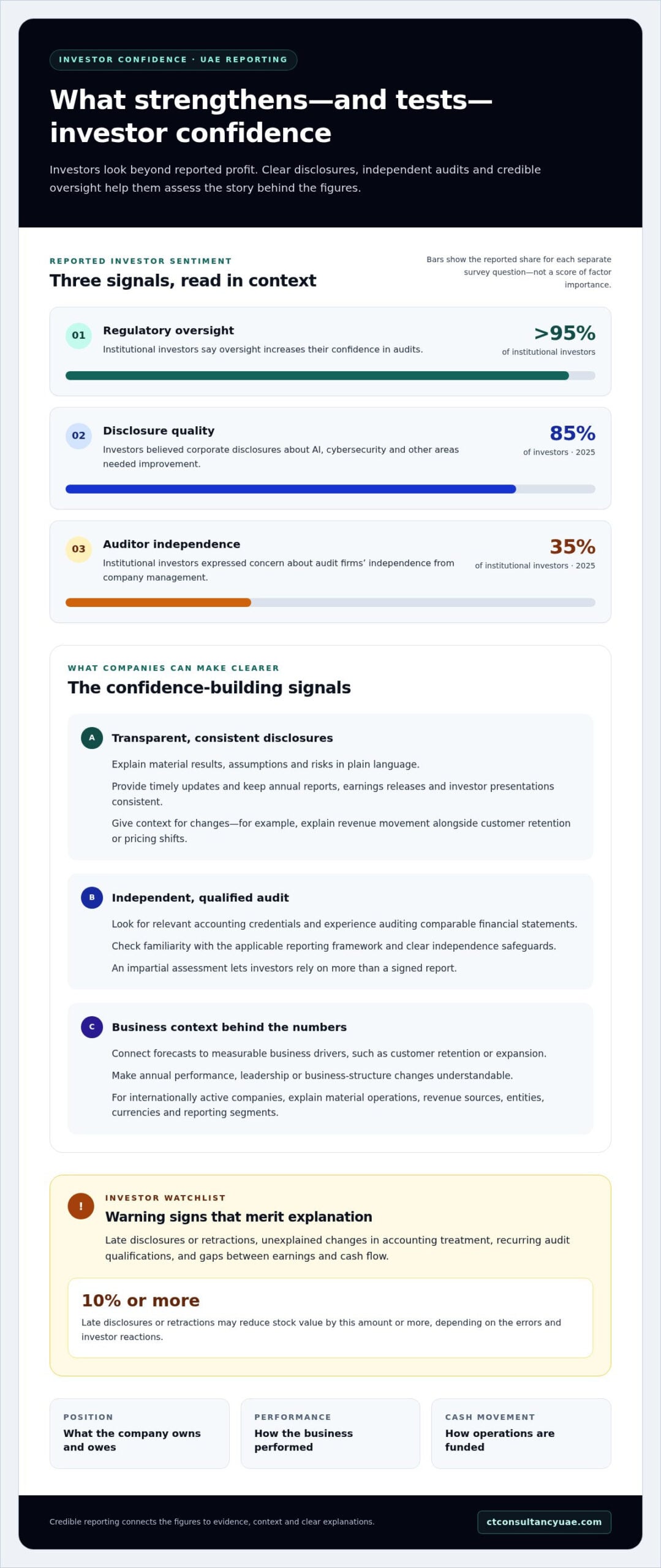
Regulatory oversight can strengthen confidence when it improves audit quality and accountability. More than 95% of institutional investors say oversight increases their confidence in audits. For companies seeking capital, credible scrutiny can make disclosures more persuasive across public and private markets.
Oversight works best when it tests the reliability of evidence, auditor independence and reporting controls. It should not become compliance volume for its own sake. Nearly one-third of surveyed investors believe the current regulatory burden on auditors is too high, underscoring the importance of proportionate, quality-focused supervision.
What are UAE audit requirements for companies seeking investment? Assess the company’s legal form, applicable licensing and sector framework, and any investor or financing agreements. Distinguish statutory obligations from an investor’s request for audited statements, then document the basis for the reporting approach.
For UAE businesses, an investor’s request may shape the due diligence package even when it is separate from a formal regulatory obligation. A written reporting policy can clarify the applicable accounting basis, audit scope, responsible executive and evidence-retention process. Consistent governance helps investors understand how each statement was prepared.
Operational discipline matters too. Assign owners to reporting tasks, maintain reconciliations and supporting documents, and record how material estimates were approved. For example, a documented review of revenue recognition gives management and auditors a traceable route from contracts to reported results. Stable procedures make omissions and unusual changes easier to identify.
Investors can assess oversight by examining the audit opinion, disclosures about reporting controls and explanations of significant accounting judgments. They can also compare periods and check whether identified issues receive clear responses. A complete, organised evidence trail supports this review, while unexplained inconsistencies can complicate due diligence and weaken confidence in the company’s public commitments.
For a business entering new markets, the goal is not simply to obtain an audit report. It is to establish reporting practices that withstand scrutiny, clarify accountability and give investors reliable evidence to evaluate the opportunity.
Companies should prepare investor statements using the accounting framework applicable to their jurisdiction, entity and reporting obligations. The external audit should follow the auditing standards applicable to the engagement. In the UAE, establish the relevant basis before preparing accounts, then apply it consistently across reporting periods and investor materials.
Accounting standards determine how transactions are recognised, measured, presented and disclosed. Auditing standards guide how an auditor assesses evidence and reports an opinion. They serve different purposes: applying an accounting framework does not, by itself, establish that an independent audit has been performed.
For an investor-ready reporting basis, document the framework, reporting period, significant accounting policies and material judgments. For example, explain how the company recognises revenue from contracts and presents estimates that affect reported results. Apply those choices consistently in annual statements, management accounts and fundraising models, or clearly explain any changes.
Before an audit, prepare reconciliations for bank accounts, receivables, payables and key balance-sheet accounts. Organise contracts, invoices, payroll records and tax calculations so each material balance has supporting evidence. Assign someone to respond to auditor requests, and record how management resolves discrepancies. These steps make the audit trail traceable rather than dependent on verbal explanations.
Investors should be able to identify the accounting basis and auditing standards used from the report itself. They can then assess whether the opinion covers the stated financial statements and period, and whether disclosed qualifications or significant judgments affect interpretation. Consistency across documents makes comparisons more meaningful. Unexplained differences between an audited report and a pitch deck warrant clarification.
In the UAE, bookkeeping and accounting support can help organise records and maintain consistent reporting before investor review. Explore bookkeeping and accounting services to strengthen the underlying records and reporting process.
CTC Tax & Accounting helps UAE businesses prepare reliable accounting records for investor review through Bookkeeping and Accounting Services. Turn to this support when reconciliations, transaction records or reporting processes need more structure before fundraising or an external audit. Organised books help management trace figures to source documents and keep financial reports consistent.
Where governance processes need further review, Internal Audit Services can help assess internal controls and identify areas requiring attention. VAT Registration and Compliance and Corporate Tax Advisory can also support businesses with relevant UAE tax obligations, connecting these considerations to financial reporting.
Investor readiness comes from disciplined records and clear accountability, not a single document. Contact CTC Tax & Accounting to discuss accounting support for your business.
Investor readiness is not a one-time exercise. As your business changes, keep financial reporting aligned with new operations, funding plans and governance responsibilities. Assign ownership for updating records and explaining material changes, so future investor discussions can build on a clear, current financial picture.
Building investor trust with audited financials also depends on the processes behind the statements. CTC Tax & Accounting offers Bookkeeping and Accounting Services to support organised records, Internal Audit Services to review controls, and VAT Registration and Compliance for relevant UAE obligations. These services help businesses strengthen financial processes as they prepare for investor scrutiny.
When you’re ready to discuss accounting support for your business, contact CTC Tax & Accounting today. A more structured reporting foundation can help you approach your next growth conversation with greater clarity and confidence.
Investors commonly examine revenue growth, gross margin, operating cash flow, liquidity and debt levels. The most useful metrics depend on the business model: a subscription company might highlight customer retention, while a manufacturer may focus on inventory turnover and working capital. Compare results across reporting periods and explain material changes so investors can distinguish recurring performance from one-off effects.
Audited statements give investors an independent assessment of whether reported financial information follows the stated accounting framework. That scrutiny can make it easier to trace balances to evidence, compare results with management’s claims and identify matters for further discussion. To build investor trust with audited financials, present the report alongside clear explanations of significant judgments. An audit opinion addresses the statements, not the company’s future prospects.
An audit typically covers a balance sheet, income statement, cash-flow statement and statement of changes in equity, together with explanatory notes. Investors should also review the auditor’s report and the period covered. For a corporate group, consolidated statements may be relevant; the reporting package should make clear which entities are included and how comparative figures relate to the current period.
Audited statements undergo an examination designed to support an auditor’s opinion; reviewed statements receive more limited procedures and provide less assurance. For unaudited statements, investors may need to assess management’s preparation and supporting records more directly. The report should identify the type of engagement, helping readers understand the level of scrutiny before using figures in an investment decision.