
What if the most uncomfortable moment in an audit isn’t a difficult question, but discovering that the records needed to answer it are missing, inconsistent or hard to trace? For UAE businesses, avoiding the embarrassment of a failed audit starts well before an auditor requests the first document. A last-minute search can expose gaps in reconciliations, approvals and supporting evidence that regular finance processes should bring to light.
It’s understandable to worry about whether your accounts tell a consistent story, whether transactions have adequate support and whether control weaknesses will surface unexpectedly. A more confident audit begins with a practical review of the records and processes behind your financial reporting.
This guide explains what to examine before audit work begins, how to organise traceable evidence and how to address control gaps transparently. It also shows how consistent bookkeeping, internal review and appropriate financial oversight can make audit preparation part of your regular finance routine instead of a stressful document hunt.
Audit findings can feel exposing, particularly when a question about a balance leads to a search through scattered files or conflicting explanations. Preparation cannot determine the auditor’s opinion, but it can make the evidence easier to locate, trace and understand. That distinction is central to avoiding the embarrassment of a failed audit: readiness means being able to support and explain the financial records, not guaranteeing a particular conclusion.
Missing support, inconsistent balances and vague transaction descriptions can lead to follow-up questions or additional audit work. For example, an expense may be difficult to verify if its accounting entry has no clear description and the supporting invoice or contract is hard to locate. A bank balance that differs from the ledger without a documented reconciliation can also leave questions about whether the difference has been investigated.
The audit’s scope and applicable requirements depend on the business and the purpose of the engagement. Establish which obligations apply to your circumstances rather than assuming one audit approach fits every entity. A general overview of understanding the fundamentals of an audit can help explain the broad purpose of audit work. For specific requirements, refer to relevant UAE authority guidance.
Being audit-ready means maintaining an orderly evidence trail. An accounting entry should be traceable to relevant support, such as an invoice or contract, and connected to related bank activity where appropriate. Clear explanations for unusual items help reviewers understand transactions without relying on informal recollection. Consistent bookkeeping and accounting processes support this structure throughout the year.
Internal readiness work is not the independent auditor’s work. Management and its advisers can organise records, review reconciliations and prepare explanations. The external auditor applies independent procedures and reaches their own conclusions. Preparation can make the process more orderly, but it does not replace independent judgement.
Uncomfortable audit questions often arise when figures are difficult to substantiate or explain. Unreconciled accounts, incomplete supporting documents, late accounting entries and unclear approval records can make it harder to establish how a balance was reached. These weaknesses may lead to follow-up questions or further audit work, but a finding does not automatically mean the audit has failed. The practical aim of avoiding the embarrassment of a failed audit is to identify and address gaps early, not to assume every query signals a serious problem.
An audit evidence trail is the connected record that allows a transaction to be followed from its accounting entry to relevant supporting documents and, where applicable, related bank activity. When bookkeeping is outdated, that trail may be fragmented. Balances can be harder to verify, transaction histories less clear, and explanations more dependent on staff recollection than accessible records.
Start with bank reconciliations and ledger balances, then trace selected entries to invoices, contracts or other relevant support. Check that figures in the financial statements can be linked to underlying records. List unexplained differences and missing documents, assign someone to investigate each item, and record what remains unresolved. Regular monthly bookkeeping and reporting help keep records current instead of allowing gaps to build up before an audit.
Consider an expense entered without a clear description, an approval recorded only in an informal message, or a reconciliation with no explanation for an outstanding difference. If responsibility for reviewing or approving transactions is unclear, staff may give inconsistent accounts of how a decision was made. Reduce ambiguity by documenting approvals, assigning clear responsibilities and applying consistent recordkeeping practices. These are practical control measures, not a claim that every UAE business is subject to identical statutory procedures.
When older entries or incomplete records make evidence difficult to interpret, a focused bookkeeping review can help clarify balances and supporting documents before audit work progresses.
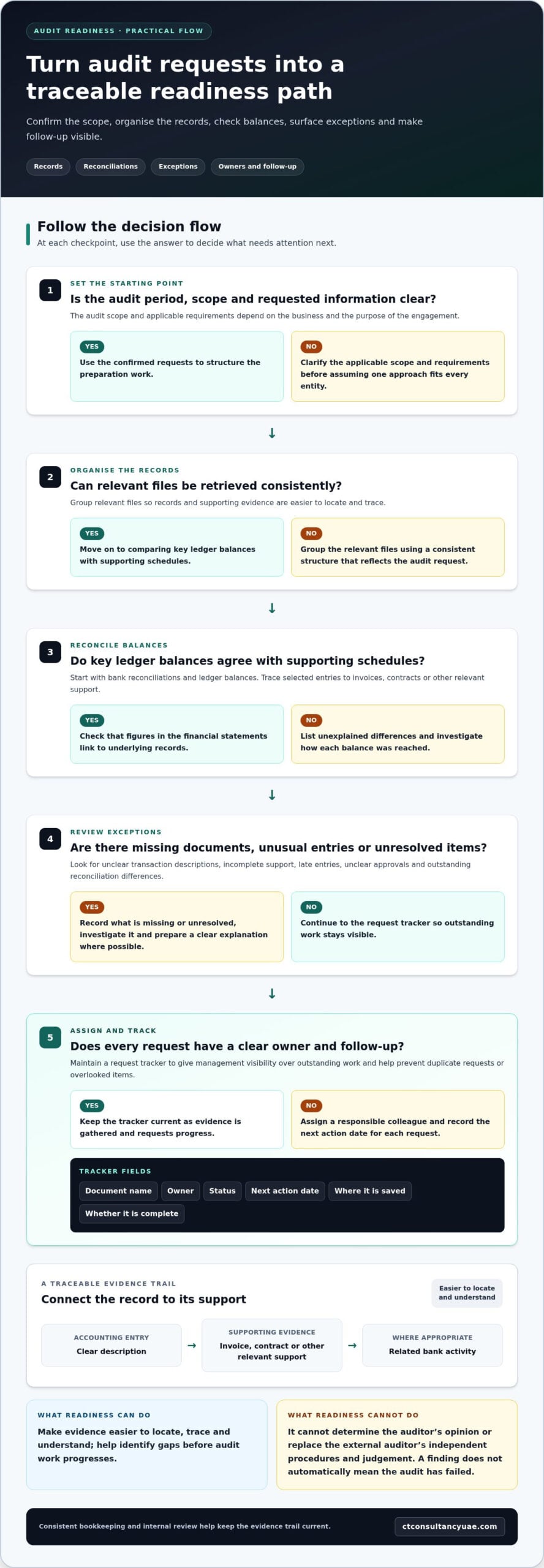
A structured preparation process turns a broad audit request into manageable tasks. Start by confirming the audit period, scope and requested information. Then work through this sequence:
Maintain a request tracker with the document name, owner, status and next action date. This gives management visibility over outstanding work and helps prevent duplicate requests or overlooked items. As you gather evidence, record where each document is saved and whether it is complete. Ongoing bookkeeping and organised records make it easier to assemble evidence through routine finance processes instead of relying on a last-minute search.
Use a consistent folder structure that reflects the audit request, such as period, account and document type. Keep related schedules, source documents and accounting records easy to cross-reference. For example, a ledger balance should point clearly to the reconciliation and underlying support. Adapt the structure to the engagement: a useful filing system is one that makes requested evidence straightforward to locate and review.
Record the issue, assess which balances or periods it may affect, and escalate it to the appropriate finance lead. Prepare a concise explanation based on available evidence, separating confirmed facts from items still under review. Don’t alter records to conceal an error or create misleading support. Transparent documentation gives management a clear basis for addressing the matter and supports avoiding the embarrassment of a failed audit.
For businesses that need help keeping accounting records organised, bookkeeping support can form part of a consistent audit-readiness process.
Additional support can be useful when bookkeeping has fallen behind, recurring reports don’t provide a clear view of balances, or management wants an internal perspective on selected processes. The right support depends on the need. Bookkeeping helps maintain and organise accounting records. Internal audit examines records, processes and controls within an agreed scope. CFO oversight supports financial reporting and management visibility. These services can clarify audit readiness, but none determines or guarantees an external auditor’s opinion.
An internal review can help management assess whether selected records and processes are operating as intended, identify areas needing attention and clarify responsibility for follow-up. Define the scope so the work addresses relevant concerns without being mistaken for the independent external audit. CTC provides internal audit and due diligence support, while CFO oversight can help connect review findings with financial reporting and management priorities.
When the main challenge is maintaining complete records and dependable reporting, audit preparation and monthly reporting can help create a more consistent accounting foundation. Backlog handling can bring older records into a clearer sequence, while ongoing bookkeeping supports continuity after immediate preparation work is complete.
Start by identifying the specific uncertainty: overdue bookkeeping, inconsistent reporting, a process that needs review, or limited management visibility. CTC’s a-la-carte approach lets businesses focus on relevant accounting or review needs instead of treating every requirement as the same assignment. This helps define the scope of work and the information needed to move forward.
Audit readiness is an ongoing finance discipline, not a last-minute assurance exercise. If you’d like to discuss where your business needs support, book a 20-minute free* consultation with CTC to consider a tailored approach. The objective is clearer records and better visibility, not a promised audit result.
Audit readiness is best treated as an ongoing management discipline, not a project that begins when an auditor requests documents. Decide where added structure would be most useful, whether that means keeping reporting current, bringing older records into order or reviewing selected processes. This forward-looking approach supports avoiding the embarrassment of a failed audit by helping your team address uncertainty before it becomes a last-minute pressure point.
CTC Tax & Accounting was founded in 2015 and brings 75 years of combined international finance and accountancy experience. Its Accounting Services include audit preparation and monthly financial reporting, helping businesses build a more consistent basis for financial oversight. Preparation can strengthen organisation and visibility, while the independent auditor remains responsible for their own procedures and conclusions.
Consider which readiness priority would make the greatest difference to your finance team, then discuss a tailored way forward. Schedule your 20-minute free* consultation to explore support suited to your business. With a clear plan and consistent attention to your records, you can approach the next audit with greater composure and control.
No. Preparation can’t guarantee a clean audit report because the independent auditor reaches a conclusion based on the evidence and procedures within the engagement’s scope. It can help management identify unsupported balances, explain unusual movements and respond to requests more efficiently. To avoid the embarrassment of a failed audit, focus on accurate records and transparent explanations rather than trying to control the auditor’s opinion.
Preparation should be part of the regular finance cycle, not reserved for a fixed period immediately before fieldwork. The right lead time depends on the size and condition of the records, the audit scope and the time needed to resolve open items. For example, a business with overdue bookkeeping may need more preparation than one that reviews its financial close and outstanding issues throughout the year.
Yes, accounting errors can generally be corrected before audit work, provided each adjustment is appropriate, properly supported and recorded transparently. Keep the original entry identifiable, document the reason for the correction, retain the supporting evidence and follow the business’s review and approval process. Don’t delete or overwrite records to hide an error. If an error affects previously reported information, assess its scope with the responsible finance lead.
Requests depend on the engagement, but may include trial balances, general ledger extracts, bank statements, payroll summaries, customer and supplier schedules, major contracts and records supporting significant estimates. Auditors may also ask for explanations of unusual movements or transactions. Use the audit team’s request list to determine what applies. Prepare the requested version and period, and note clearly when an item is unavailable or still being compiled.
No. Internal audit and independent external audit have different purposes, scopes and responsibilities. Internal audit work can help management examine selected controls, processes or records and identify matters for follow-up. It does not provide the independent external auditor’s procedures or conclusion. Whether an external audit is required depends on the business’s circumstances and applicable obligations, so establish the relevant requirements separately.