
A valuation can be technically sound and still cause disagreement if its purpose, assumptions, or independence are unclear. Avoiding conflicts during business valuation starts with defining the scope, selecting methods suited to the business and its circumstances, and disclosing potential conflicts.
Owners are right to expect a clear, defensible assessment, especially when it informs a sale, ownership change, or related-party transaction. No single method automatically resolves differences in expectations: forecasts, comparable businesses, and the valuer’s instructions can all affect the conclusion. This article explains how those choices shape confidence in a valuation, what information supports a realistic assessment, and why professional expertise matters. It also outlines how an independent business valuation can help UAE companies address questions of value through a structured, evidence-based process.
Common sources of conflict include differences in background information, shareholder roles and compensation, business risks, and projected cash flow. Owners may also disagree about economic rent, earnings adjustments, or which valuation method best reflects the company’s circumstances. These judgments can produce different conclusions, even when valuers receive the same facts. A disciplined approach to avoiding conflicts during business valuation makes assumptions visible and open to discussion.
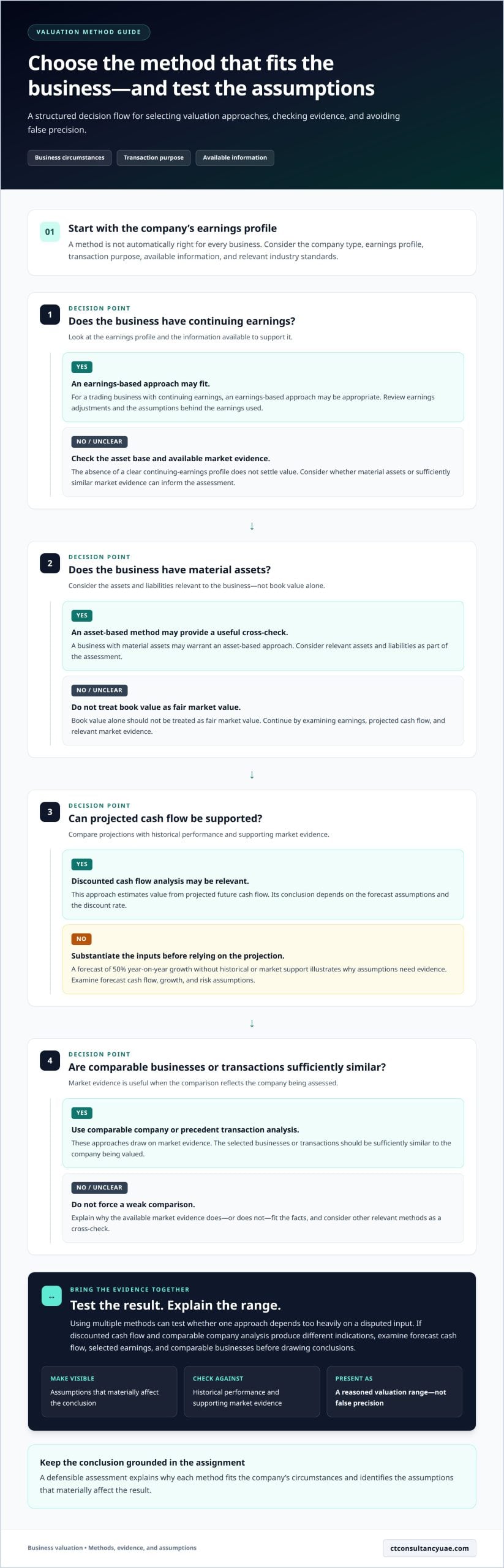
No single method suits every business or transaction. Discounted cash flow analysis estimates value from projected future cash flow, so the result depends on forecast assumptions and the discount rate. Comparable company and precedent transaction analyses draw on market evidence, which should reflect businesses or transactions sufficiently similar to the company being assessed. Asset-based methods may also be relevant, but book value alone should not be treated as fair market value.
A professional selects methods by considering the company’s type, transaction purpose, available information, earnings profile, and relevant industry standards. For example, a trading business with continuing earnings may call for an earnings-based approach, while a business with material assets may warrant an asset-based cross-check. The valuer should explain why each method fits the facts and identify the assumptions that materially affect the conclusion.
To resolve disagreements over forecasts, growth rates, and risk assumptions, a professional can compare projections with historical performance and supporting market evidence. A forecast of 50% year-on-year growth without historical or market support illustrates why assumptions need substantiation. Using multiple methods can test whether one approach depends too heavily on a disputed input; the results can then inform a valuation range rather than imply false precision. For example, discounted cash flow and comparable company analysis may produce different indications, prompting examination of forecast cash flow, selected earnings, and comparable businesses before conclusions are drawn. For owners, avoiding conflicts during business valuation also means understanding how each assumption may influence the outcome of a sale or ownership decision.
An instruction should identify the valuation date, purpose, intended users, and ownership interest being valued. A whole-company valuation may differ from an assessment of a minority shareholding because the rights and transaction context differ. Conflicts can arise when a valuer’s relationships, financial interests, or prior work create incentives that may compromise objectivity. RICS Rule 1 requires members and firms to act honestly and with integrity, identify conflicts, and not act where a conflict or serious risk exists.
Instructions should clarify whether the analysis concerns fair market value or fair value, and how relevant discounts or premiums will be considered. RICS identifies three types of conflict: conflicts between parties, own-interest conflicts, and confidential-information conflicts. For example, a firm asked to value an asset for a lender while advising the borrower may face competing duties. RICS standards also identify representing both buyer and seller in the same transaction as a potential threat to independence.
The valuation date matters because company performance, market conditions, regulations, and sales trends can change. The professional should specify the date and use information relevant to that point, rather than blending later developments into an earlier assessment. A buyer’s strategic interest also needs separate treatment: expected merger savings may increase what that buyer would pay, but stand-alone value excludes buyer synergies. Overstated savings or underestimated transition costs can distort the buyer’s assumptions.
Minority discounts, control premiums, and marketability discounts should be assessed in light of the ownership interest, valuation standard, transaction purpose, and governing shareholder agreement. The professional should explain whether each adjustment applies rather than applying it automatically. Fair value in certain appraisal or oppression proceedings often excludes minority and marketability discounts.
Before accepting an instruction, the firm should identify relevant relationships, assess confidentiality risks, and determine whether effective safeguards can protect independence. RICS guidance describes information barriers and informed consent as possible measures, but confidential information critical to value can make a conflict unavoidable. A clearly scoped business valuation assessment can document the date, interest, assumptions, and any disclosed conflicts before conclusions are relied upon.
Owner compensation can distort earnings when it differs from the cost of replacing the owner’s work. A professional normalises earnings by assessing the owner’s duties, working hours, and comparable responsibilities, then adjusting for above-market or below-market compensation. For example, if an owner handles sales and management, the analysis should account for the cost of replacing both roles.
Related-party transactions can also affect reported performance. Rent paid to an owner-controlled company, shared staffing costs, or purchases from a family-owned supplier may not reflect independent commercial terms. The valuer reviews agreements and records, then assesses whether adjustments are appropriate to reflect market value. The review should also consider assets and liabilities, including whether an obligation belongs to the business or a related party.
Personal goodwill is value tied to an individual’s relationships, expertise, or reputation, rather than assets that transfer with the company. If clients rely mainly on the owner, a buyer may face continuity risks after the transaction. By contrast, documented processes, transferable customer relationships, and a capable management team can support a smoother ownership transition. This distinction matters because business value should reflect what can continue after the owner exits.
The valuation purpose shapes the analysis. A merger may involve strategic benefits unique to the parties, while an ownership change may require assessing a specific shareholding. Tax planning calls for attention to relevant tax liabilities and transaction facts. In divorce proceedings, ownership rights and the purpose of the valuation must be clearly defined. In the UAE, applicable legal and tax considerations depend on the transaction and parties. The valuation should state its purpose and assumptions, without replacing legal or tax advice.
Transition capacity can influence the expected transaction price: a buyer may consider management continuity, customer retention, and the transfer of operational knowledge. A professional can identify owner-dependent functions and assess whether documented procedures or successor management could reduce disruption. This evidence helps distinguish transferable business assets from value that may remain with the departing owner.
A professional valuer turns financial records and transaction details into a reasoned assessment of value. For a UAE company, the engagement should establish the valuation purpose, relevant ownership interest, valuation date, and intended use before analysis begins. These boundaries help ensure the conclusion addresses the actual decision, such as a sale, shareholder buyout, or ownership change.
For the records review, provide financial statements, tax returns, and cash-flow projections. The valuer may also need details of owner compensation, shareholder roles, business risks, liabilities, and material assets. Lease obligations, potential litigation costs, and tax liabilities can affect the assessment. Patents, trademarks, proprietary software, and customer databases may also matter if they contribute to the company’s value.
Records alone may not explain how the business operates. A valuation may involve a site visit, meetings with key personnel, and follow-up questions about forecasts or unusual transactions. For example, if projected earnings rise sharply, the valuer can ask what historical performance or business evidence supports that outlook. Clear answers help distinguish documented assumptions from optimism.
Ask for a report that explains the methods used, material assumptions, and how the conclusion relates to the stated purpose. A professional generally provides a probable sale-price range for an arm’s-length transaction rather than presenting one figure as certain. Where ownership could be disputed, shareholders can agree to obtain and review an independent valuation annually alongside financial statements and tax returns. This creates a shared reference point before disagreement escalates.
Expertise matters most when the assignment is contested or may be scrutinised by others. A valuation expert witness should understand valuation theory, practice, and regulation, and should be able to explain how the evidence supports the conclusion. For a company preparing for a transaction or ownership decision, request a professional business valuation based on its records, purpose, and circumstances.
CTC Tax & Accounting provides business valuation for UAE owners preparing for a sale, ownership change, or another decision that depends on a clear assessment of value. The work considers the company’s financial information, valuation purpose, ownership interest, and relevant assumptions to present the analysis in a structured, decision-useful form.
When accounting records need context, bookkeeping and accounting services can help clarify financial records, while internal audit services can examine internal controls and processes. These services can complement valuation work when the underlying records or business practices affect the assessment.
If you are considering a transaction or need an independent basis for an ownership discussion, contact CTC Tax & Accounting to discuss business valuation.
A valuation is most useful when commissioned for a defined business decision, not treated as an isolated report. Before proceeding, identify who will rely on the assessment and which decision it needs to inform. This framing keeps the work relevant as your company considers growth, a transaction, or a change in ownership. Avoiding conflicts during business valuation also means choosing a process that supports transparent discussion among everyone affected by the outcome.
CTC Tax & Accounting provides business valuation, along with bookkeeping and accounting services, internal audit services, and VAT registration and compliance in accordance with UAE regulations. Bringing the right support together can provide a more considered basis for business decisions.
Contact CTC Tax & Accounting to discuss a valuation for your business and take the next step with confidence.
Before work begins, a professional can document the owners’ shared objective and the date the analysis will reflect. For a proposed shareholder buyout, for example, the instruction can distinguish a negotiating estimate from a valuation required under an existing agreement. It can also explain how later events will be treated, helping owners avoid disputes about whether information arising after the agreed date belongs in the analysis.
Prioritise relevant valuation experience, clear explanations of methodology, and a transparent process for identifying conflicts. Independence matters, as does the ability to show how evidence supports the conclusion. A well-scoped engagement should identify the intended use, required information, and how assumptions will be documented. These criteria help owners assess whether the work will be useful for their transaction or ownership decision.
A professional can first distinguish disagreements about source data from disputes over assumptions or interpretation. They can reconcile financial records, show how each disputed input affects the conclusion, and prepare a reasoned comparison of the parties’ positions. Involving a forensic accountant early may help surface issues before they escalate. A structured discussion focused on evidence and valuation impact gives owners a clearer basis for resolving differences.