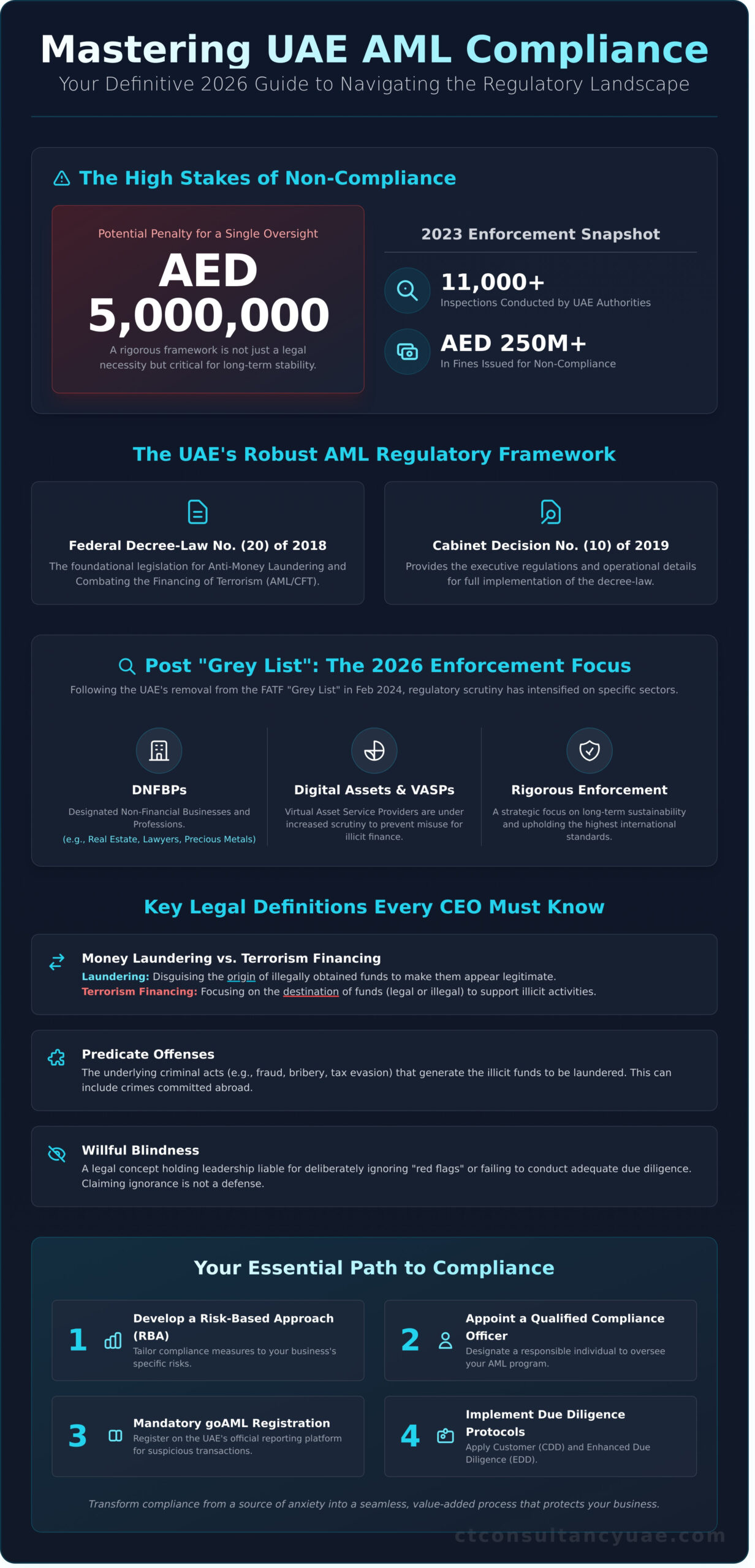
Gain a comprehensive understanding of the 2026 regulatory landscape, focusing on heightened oversight for digital assets and the specific implications of Federal Decree-Law No. (20) of 2018.
Master the AML compliance requirements in the UAE by developing a bespoke Risk-Based Approach (RBA) and appointing a qualified Compliance Officer to ensure long-term operational stability.
Determine if your enterprise falls under the classification of a Designated Non-Financial Business or Profession (DNFBP) and identify the specific triggers that necessitate immediate regulatory action.
Execute a seamless implementation strategy, from mandatory goAML registration to the application of Enhanced Due Diligence (EDD) protocols, to safeguard your business against severe administrative penalties.
Discover how a strategic partnership provides a “safe pair of hands,” facilitating meticulous planning and protecting your commercial license from the risks of non-compliance.
With the UAE Ministry of Economy issuing administrative penalties that can reach AED 5,000,000 for a single regulatory oversight, the margin for error in financial governance has effectively vanished. You likely recognize that adhering to a rigorous framework isn’t just a legal necessity but a critical component of your firm’s long-term stability. It’s common to feel overwhelmed by the complexities of aml compliance requirements uae, particularly when the technicalities of goAML registration and the granular demands of KYC documentation seem to multiply each quarter.
This definitive 2026 guide facilitates your mastery of the UAE’s sophisticated regulatory landscape by offering bespoke strategies to mitigate risk and secure your corporate standing. We’ll provide a clear, step-by-step roadmap that simplifies your reporting obligations and streamlines your risk assessment protocols. You’ll gain the precise insights needed to transform compliance from a source of anxiety into a seamless, value-added process that protects your business from scrutiny and ensures operational excellence.
Key Takeaways
Gain a comprehensive understanding of the 2026 regulatory landscape, focusing on heightened oversight for digital assets and the specific implications of Federal Decree-Law No. (20) of 2018.
Master the aml compliance requirements uae by developing a bespoke Risk-Based Approach (RBA) and appointing a qualified Compliance Officer to ensure long-term operational stability.
Determine if your enterprise falls under the classification of a Designated Non-Financial Business or Profession (DNFBP) and identify the specific triggers that necessitate immediate regulatory action.
Execute a seamless implementation strategy, from mandatory goAML registration to the application of Enhanced Due Diligence (EDD) protocols, to safeguard your business against severe administrative penalties.
Discover how a strategic partnership provides a “safe pair of hands,” facilitating meticulous planning and protecting your commercial license from the risks of non-compliance.
Understanding the UAE’s Robust AML Regulatory Framework
The UAE’s legal infrastructure for financial integrity rests upon Federal Decree-Law No. (20) of 2018 on Anti-Money Laundering and Combating the Financing of Terrorism and Financing of Illegal Organisations. This foundational legislation was later augmented by Cabinet Decision No. (10) of 2019, which provided the executive regulations necessary for full implementation. For a modern enterprise, aml compliance requirements uae represent a comprehensive set of internal controls designed to detect, prevent, and report suspicious financial activities. These laws align the nation with international anti-money laundering standards, ensuring that the local market remains a secure destination for foreign direct investment.
Following the UAE’s removal from the Financial Action Task Force (FATF) “Grey List” in February 2024, the focus has shifted toward long-term sustainability and rigorous enforcement. Authorities have signaled that the 2026 regulatory landscape will prioritize oversight for Designated Non-Financial Businesses and Professions (DNFBPs), such as real estate agents, lawyers, and precious metal dealers. Digital assets and Virtual Asset Service Providers (VASPs) are also under increased scrutiny. Compliance is no longer a check-box exercise; it’s a strategic necessity for maintaining operational licenses in a jurisdiction that now benchmarks itself against the world’s most transparent economies.
The Role of the Executive Office for AML/CFT
Established to centralize the national response to financial crime, the Executive Office for AML/CFT serves as the primary coordinator for the UAE’s overarching strategy. It facilitates a seamless flow of intelligence between the Central Bank of the UAE (CBUAE), the Ministry of Economy, and law enforcement agencies to ensure a unified front against illicit finance. The Executive Office’s primary mission is to safeguard the UAE financial system by implementing a robust national framework that mitigates risks and upholds international integrity.
Key Legal Definitions Every CEO Must Know
Understanding the nuances of the law is critical for executive decision-makers to avoid personal and corporate liability. Compliance failure often stems from a lack of clarity regarding core legal concepts. A bespoke approach to risk management starts with a precise understanding of these terms:
Money Laundering vs. Terrorism Financing: Money laundering involves disguising the origins of illegally obtained proceeds to make them appear legitimate. In contrast, terrorism financing focuses on the destination of funds, regardless of whether the source was legal or illegal, to support prohibited activities.
Predicate Offenses: These are the underlying criminal activities, such as fraud, bribery, or tax evasion, that generate the illicit funds being laundered. Under UAE law, any act committed abroad that’s considered a crime in both the UAE and the country of origin can be a predicate offense.
Willful Blindness: This legal concept holds a business liable if its leaders deliberately ignore “red flags” or fail to conduct due diligence. It means you can’t escape liability by simply claiming you didn’t know; the law expects a proactive effort to uncover the truth.
Maintaining a high level of vigilance is essential as the Ministry of Economy continues to issue substantial fines for non-compliance. In 2023 alone, the UAE authorities conducted over 11,000 inspections, resulting in fines exceeding AED 250 million. Adhering to aml compliance requirements uae isn’t just about avoiding penalties; it’s about building a resilient, reputable brand that can thrive in a highly regulated global economy. Our strategic advisory services ensure that your transition into this framework is efficient and meticulous, providing the precision your business needs to grow without friction.
The 5 Essential Pillars of an AML Compliance Program
The UAE regulatory framework, specifically Federal Decree-Law No. (20) of 2018, demands a structured approach to mitigating financial crime. Establishing a robust program isn’t merely a box-ticking exercise; it’s a strategic necessity to protect your license and reputation. To meet the aml compliance requirements uae authorities expect, your program must rest on five foundational pillars. These pillars ensure that your business isn’t just reacting to threats but actively preventing them through a systematic, logic-driven framework. A failure in any single pillar can expose the entire organization to severe administrative penalties and legal repercussions.
Developing a bespoke Risk-Based Approach (RBA) tailored to your specific industry
The appointment and responsibilities of a qualified AML Compliance Officer
Establishing robust Internal Policies, Procedures, and Controls (IPPC)
The necessity of independent audit functions to verify compliance integrity
Ongoing staff training and the cultivation of a ‘compliance-first’ corporate culture
Implementing the Risk-Based Approach (RBA)
A one-size-fits-all strategy fails in the complex Middle Eastern financial market. You must align your firm’s internal risk assessment with the National Risk Assessment (NRA) findings, which identify specific sectors and activities prone to exploitation. Firms categorize their client base into low, medium, and high-risk profiles based on variables like geographic location, transaction volume, and business type. By adopting a bespoke RBA, firms can strategically allocate their compliance resources toward the specific areas where the risks of money laundering and terrorism financing are highest. This precision ensures that high-risk entities receive intense scrutiny while low-risk operations remain efficient.
Appointing the Right AML Compliance Officer
UAE law mandates the appointment of a dedicated AML Compliance Officer who possesses the appropriate expertise and seniority. This individual acts as the primary liaison with regulators and is responsible for overseeing the daily execution of the compliance program. It’s vital that this officer has direct, unfiltered access to senior management and the board of directors to report findings without institutional friction. When structuring your leadership team, engaging in strategic advisory can help define this role’s scope to ensure both statutory adherence and operational fluidity.
Internal Policies, Procedures, and Controls (IPPC)
Your IPPC serves as the operational manual for your entire staff. These documents must detail the exact steps for Customer Due Diligence (CDD), Enhanced Due Diligence (EDD) for high-risk clients, and the screening of Politically Exposed Persons (PEPs). A critical component of these controls is the mechanism for transaction monitoring and the subsequent reporting of suspicious activities. All Suspicious Transaction Reports (STRs) must be filed through the goAML portal, which is managed by the UAE’s Financial Intelligence Unit (FIU) to ensure immediate regulatory oversight and data analysis.
Independent Audit and Ongoing Training
The fourth pillar requires an independent audit function to test the effectiveness of your internal controls. This isn’t a task for the AML officer; it must be conducted by a separate internal unit or an external specialist to provide an objective critique of your compliance integrity. Finally, a “compliance-first” culture is fostered through continuous training. Staff must be educated on the latest typologies of financial crime and the specific aml compliance requirements uae regulators have updated. This ensures that every team member, from the front desk to the boardroom, understands their role in maintaining a secure environment. For those looking to refine these processes, seeking professional compliance guidance can turn these regulatory hurdles into a seamless competitive advantage.
Identifying DNFBPs: Does Your Business Fall Under AML Scrutiny?
The UAE’s sophisticated regulatory framework extends its reach far beyond traditional banking institutions to include a specific group of non-financial entities known as Designated Non-Financial Businesses and Professions (DNFBPs). Under Federal Decree-Law No. (20) of 2018, these businesses are recognized as critical gatekeepers in the financial system. They’re often the first line of defense against the placement of illicit funds into the legitimate economy. Identifying whether your operations fall within this category is the first step in ensuring your aml compliance requirements uae are met with precision. For many entrepreneurs, the shift from a growth-focused mindset to a compliance-oriented one requires a strategic advisory partner to ensure the transition is seamless.
Real estate agents and brokers face some of the most stringent triggers in the UAE market. Any professional involved in the buying or selling of real estate for a client must adhere to strict Due Diligence (CDD) protocols. Compliance isn’t merely about documentation; it’s about verifying the source of wealth for transactions that often involve high-value assets. Similarly, Dealers in Precious Metals and Stones (DPMS) must report any cash transaction that meets or exceeds the AED 55,000 threshold. This requirement is designed to prevent the use of high-value portable assets as a vehicle for laundering money, a risk that the Ministry of Economy monitors with high-frequency audits. The same principles apply to other high-value goods sectors, such as the automotive industry, where specialized training like an Auto Finance Course is crucial for preparing finance and insurance managers for their compliance responsibilities.
Lawyers, notaries, and other independent legal professionals occupy a unique position within the aml compliance requirements uae landscape. Their obligations are triggered when they assist in the planning or execution of transactions for clients, such as the management of bank accounts or the organization of contributions for company creation. Unlike other sectors, legal professionals must balance client confidentiality with their statutory duty to report suspicious activities to the Financial Intelligence Unit (FIU). It’s a delicate equilibrium that demands a deep understanding of both local law and international best practices.
Trust and Company Service Providers (TCSPs) face the highest level of scrutiny among all DNFBPs. Because they facilitate the creation of complex corporate structures, they’re often viewed as higher-risk entities by regulators. TCSPs are required to maintain an up-to-date register of Ultimate Beneficial Owners (UBOs) and must be able to provide this data to authorities immediately upon request. The precision required in managing these records reflects the UAE’s commitment to global transparency standards.
AML for Accounting and Audit Firms
Firms providing accounting services are now central to the UAE’s transparency goals. Regulatory expectations require these firms to implement a risk-based approach when managing client funds or overseeing corporate restructures. With the 2023 implementation of UAE Corporate Tax, the intersection of tax compliance and AML reporting has deepened. Auditors are legally bound to report discrepancies that suggest tax evasion or the obfuscation of financial trails, ensuring that corporate financial statements reflect genuine economic activity.
Compliance for Real Estate and High-Value Assets
The Ministry of Economy has issued specific circulars requiring brokers to report all transactions involving cash or virtual assets exceeding AED 55,000. Looking ahead, the UAE’s National Strategy for AML/CFT suggests new 2026 thresholds will likely tighten these reporting requirements even further to align with evolving FATF standards. Brokers must now utilize the GoAML platform to report payments made via ‘Virtual Assets,’ a move that addresses the growing trend of property acquisitions using cryptocurrency in the Dubai and Abu Dhabi markets.
Step-by-Step Implementation: From goAML Registration to Reporting
The transition from theoretical understanding to operational execution is where many firms encounter friction. Adhering to the aml compliance requirements uae demands a precise, multi-layered strategy that begins with digital integration and ends with rigorous internal oversight. It’s not merely about filling forms; it’s about embedding a culture of transparency into your corporate DNA. Our experts facilitate a seamless transition through the following implementation phases.
Mastering the goAML Portal
Registration on the goAML portal is the definitive entry point for any Reporting Entity. By 2026, the documentation requirements have evolved to include the pre-approval of the Compliance Officer by the relevant supervisory authority and the submission of a valid trade license alongside a notarized Power of Attorney. The portal is divided into the ‘Reporting Management’ module, used for administrative tasks, and the ‘Analysis’ module, where the actual submission of Suspicious Activity Reports (SARs) and Suspicious Transaction Reports (STRs) occurs. A 2024 study by the Ministry of Economy indicated that 15% of registration delays stem from incorrect XML schema configurations during the initial setup phase. It’s vital to ensure your technical infrastructure aligns with the Financial Intelligence Unit’s (FIU) specifications to avoid administrative bottlenecks.
KYC and UBO: Beyond the Basics
Identifying the Ultimate Beneficial Owner (UBO) is a critical pillar of the aml compliance requirements uae. You must identify any individual who owns or controls 25% or more of the legal entity. For complex multi-layered structures involving offshore trusts or holding companies, this process requires deep forensic analysis. Screening against the UAE Local Terrorist List and the UN Consolidated List is mandatory for every transaction. Managing high-risk clients, such as Politically Exposed Persons (PEPs), requires the implementation of Enhanced Due Diligence (EDD) protocols. Many firms utilize specialized CFO advisory to ensure that UBO disclosures are integrated seamlessly into their broader financial governance frameworks. This approach ensures that your ownership reporting remains accurate even as corporate structures evolve.
Record Keeping and Data Retention
The UAE Federal Decree-Law No. (20) of 2018 mandates that all compliance records, including CDD documents and transaction logs, be maintained for a minimum of 5 years. While data privacy is protected under Federal Decree-Law No. 45 of 2021, these protections don’t exempt entities from AML transparency mandates. Under UAE law, ‘readily retrievable’ records are defined as documents that can be produced for inspection by the regulatory authority within 48 hours of a formal request. This requirement necessitates a bespoke digital archiving system that balances high-level security with immediate accessibility. In 2023, the FIU processed over 25,000 reports, highlighting the scale of active monitoring required. Failing to maintain these logs can result in significant penalties that jeopardize your operational license.
To ensure your business meets these rigorous standards without disrupting daily operations, consult with our strategic advisory team for a comprehensive compliance audit.
Mitigating Risk and Ensuring Seamless Regulatory Alignment with CTC
Adhering to the aml compliance requirements uae regulators demand is no longer a peripheral administrative task. It’s a core pillar of corporate survival. CTC Tax & Accounting serves as a safe pair of hands, guiding Dubai SMEs through the complexities of Federal Decree-Law No. 20 of 2018. We don’t just provide generic templates; we conduct bespoke health checks and rigorous gap analyses to identify vulnerabilities before they escalate into regulatory liabilities. Our methodology facilitates a transition from fragmented, manual compliance processes to automated, strategic oversight. This shift ensures that your business remains resilient against the evolving scrutiny of the Executive Office for Control and Non-Proliferation.
The Cost of Non-Compliance in 2026
The Ministry of Economy has intensified its enforcement stance, issuing over 225 administrative fines in the first quarter of 2024 alone. By 2026, the cost of oversight will likely double as digital monitoring tools become more prevalent. Administrative fines are substantial, ranging from AED 50,000 for minor procedural lapses to AED 5,000,000 for systemic failures in Suspicious Activity Reporting (SAR). Beyond the immediate financial drain, the threat of license revocation remains a constant reality for non-compliant entities.
Reputational damage often leads to the de-risking phenomenon, where UAE banks unilaterally terminate corporate accounts to protect their own risk ratings. This loss of banking access can trigger a 40% decline in business valuation almost instantly. Proactive compliance isn’t just a legal necessity; it’s a value-added strategy that protects your long-term equity. We help you implement the following safeguards:
Regular independent audits to verify the effectiveness of your AML/CFT framework.
Sophisticated Know Your Customer (KYC) protocols that go beyond basic document collection.
Real-time screening against global sanction lists and Politically Exposed Person (PEP) databases.
Comprehensive training programs for staff to ensure a culture of compliance from the ground up.
Strategic Partnership for Regulatory Excellence
A tailored approach is essential because off-the-shelf compliance software often fails to capture the unique risk profiles of Designated Non-Financial Businesses and Professions (DNFBPs). We prioritize precision over generic solutions. By integrating our AML advisory with our VAT and Tax services, we ensure total business integrity across every financial touchpoint. This holistic integration prevents discrepancies between tax filings and AML disclosures, which are frequently flagged during Ministry inspections.
Our consultants act as an extension of your executive team, providing the strategic advisory needed to navigate the aml compliance requirements uae authorities update periodically. We help you move away from reactive “firefighting” toward a state of organized momentum. This allows you to focus on market expansion while we handle the technical nuances of the regulatory framework. Meticulous planning today prevents the catastrophic disruptions of tomorrow.
Future-Proofing Your Enterprise Against Evolving Regulatory Standards
Navigating the shifting landscape of aml compliance requirements uae demands more than a basic checklist; it requires a strategic alignment with the Executive Office for Control and Non-Proliferation standards. By 2026, the integration of the five essential pillars, ranging from robust internal controls to rigorous goAML reporting, will distinguish resilient enterprises from those vulnerable to significant financial penalties. DNFBPs and SMEs must prioritize these frameworks now. It’s the only way to ensure operational licenses remain secure within the UAE’s maturing financial ecosystem.
CTC Tax & Accounting leverages over 10 years of specialized UAE regulatory expertise to facilitate this transition. Our consultants deliver a seamless integration of AML, Tax, and Accounting services, ensuring your business meets every mandate without disrupting commercial momentum. We’ve assisted more than 500 local firms in achieving full alignment with Ministry of Economy guidelines through our meticulous, bespoke advisory approach.
What are the administrative penalties for AML non-compliance in the UAE?
Administrative penalties for failing to meet aml compliance requirements uae range from AED 50,000 to AED 5,000,000 per violation. The Ministry of Economy and the Central Bank of the UAE impose these fines for infractions such as failing to appoint a compliance officer or neglecting to report suspicious transactions. Specific penalties include AED 200,000 for failing to take necessary measures to identify risks or AED 100,000 for failing to implement internal controls.
Who is required to register on the goAML portal?
Every Financial Institution and Designated Non-Financial Business and Profession (DNFBP) operating within the UAE must register on the goAML portal. This requirement encompasses sectors such as real estate brokers, precious metal dealers, lawyers, and audit firms. Registration is a prerequisite for fulfilling reporting obligations to the Financial Intelligence Unit (FIU), ensuring that entities remain aligned with the regulatory framework established by Federal Decree-Law No. (20) of 2018.
What is the difference between CDD and EDD in UAE law?
Customer Due Diligence (CDD) involves identifying the client and verifying their identity using reliable, independent source documents. Enhanced Due Diligence (EDD) is mandatory for high-risk customers, such as Politically Exposed Persons (PEPs) or entities from high-risk jurisdictions. While CDD is the standard baseline for all business relationships, EDD requires additional measures like investigating the source of wealth and obtaining senior management approval to proceed with the transaction.
Can a small business outsource its AML Compliance Officer role?
Small businesses categorized as DNFBPs can outsource the AML Compliance Officer role to specialized strategic advisory firms. While the execution of tasks is delegated to an external expert, the legal responsibility for compliance remains with the business license holder. This arrangement facilitates a bespoke compliance structure for smaller entities, ensuring they meet rigorous regulatory standards without the overhead of a full-time, in-house executive.
How often should a UAE company conduct an AML risk assessment?
UAE companies must conduct a formal AML risk assessment at least once every 12 months. This annual review ensures the firm’s internal controls remain effective against evolving financial threats. If a business undergoes a structural change, such as entering a new market or launching a high-value product line, an immediate interim assessment is required. Maintaining this cadence is essential for demonstrating a proactive approach to the Ministry of Economy.
What is the UAE Local Terrorist List and how often must it be checked?
The UAE Local Terrorist List is a registry of individuals and entities sanctioned by the UAE Cabinet under Resolution No. (74) of 2020. Businesses must screen their entire client database against this list daily or immediately upon the publication of any updates by the Executive Office for Control and Non-Proliferation. Failure to freeze funds or report a match within 24 hours can result in severe legal repercussions and license revocation.
What are the specific AML requirements for Free Zone companies vs. Mainland companies?
Mainland companies are primarily regulated by the Ministry of Economy, whereas Free Zone entities may fall under the jurisdiction of specific bodies like the DFSA in the DIFC or the FSRA in ADGM. All entities must adhere to the same federal aml compliance requirements uae, including goAML registration and UBO declarations. Free Zone companies often face additional bespoke reporting layers tailored to their specific financial ecosystems and international trade activities.
How do I report a suspicious transaction without ‘tipping off’ the client?
You report suspicious activity by filing a Suspicious Activity Report (SAR) or Suspicious Transaction Report (STR) through the goAML portal. To avoid ‘tipping off’, you mustn’t inform the client that a report is being filed or that an investigation is underway. Violating this confidentiality requirement is a criminal offense under UAE law, punishable by imprisonment and fines of at least AED 100,000.