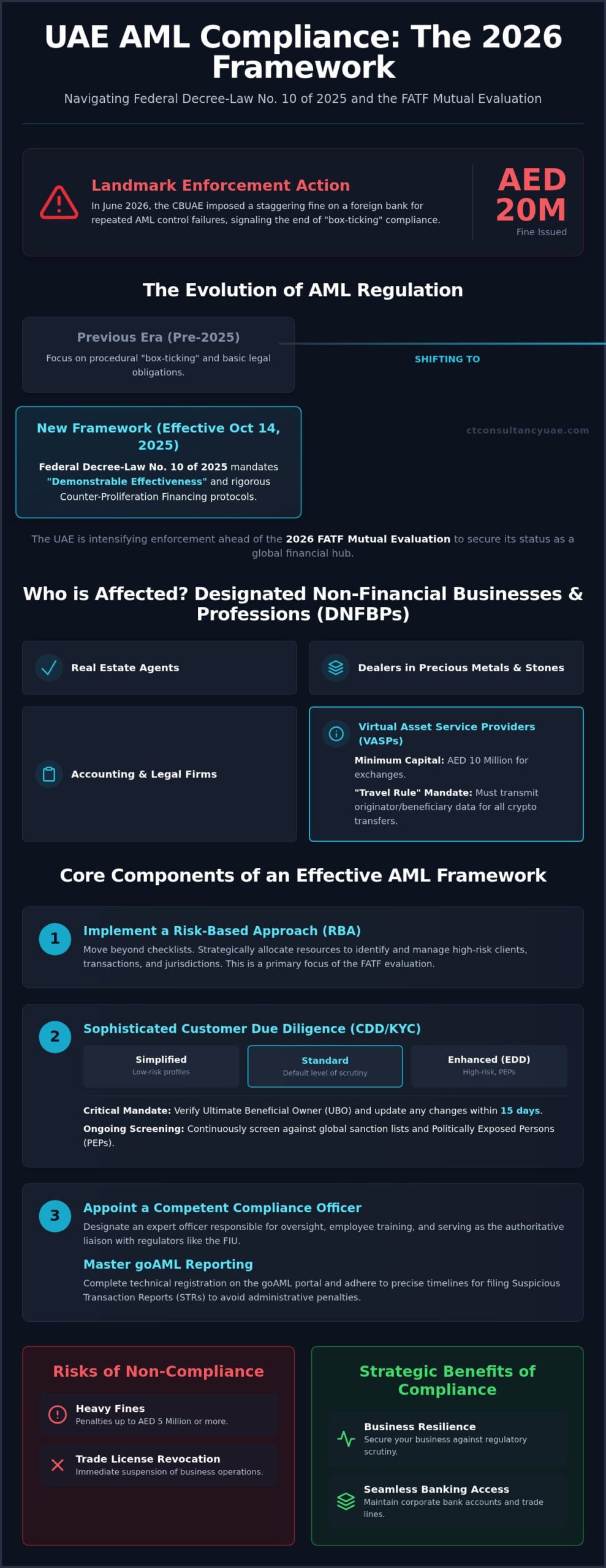
In June 2026, the Central Bank of the UAE imposed a staggering AED 20 million fine on a foreign bank branch for repeated failures in its anti-money laundering controls. This landmark enforcement action signals a definitive end to the era of "box-ticking" compliance. You likely recognize that maintaining robust aml compliance uae is no longer just a legal obligation; it’s a critical component of your operational stability.
The fear of heavy fines reaching up to AED 5 million or the sudden revocation of a trade license can be paralyzing, especially when you’re trying to distinguish between basic KYC protocols and the full AML frameworks required by Federal Decree-Law No. 10 of 2025. This guide provides the strategic reassurance and technical precision needed to transform these regulatory hurdles into a frictionless foundation for growth. We’ll examine the nuances of Cabinet Decision No. 134, clarify the goAML registration process, and outline a professional framework designed to secure your business against the heightened scrutiny of the 2026 FATF mutual evaluation.
Key Takeaways
- Understand the transition to Federal Decree-Law No. 10 of 2025 and how the expanded scope now mandates rigorous Counter-Proliferation Financing protocols.
- Learn to implement a sophisticated risk-based approach for aml compliance uae that prioritizes the identification of high-risk jurisdictions over simple procedural checklists.
- Master the technical requirements for goAML portal registration and the precise timelines required for filing Suspicious Transaction Reports to avoid significant administrative penalties.
- Discover the strategic synergy between your internal AML documentation and the “substance” requirements necessary for seamless Corporate Tax and VAT compliance.
- Establish a professional framework that serves as a friction-remover for banking access, ensuring your business remains resilient against the 2026 regulatory scrutiny.
The Evolution of AML Compliance in the UAE: The 2026 Landscape
Anti-money laundering (AML) represents a sophisticated defense mechanism designed to prevent the illicit integration of criminal proceeds into the UAE’s financial ecosystem. The current regulatory environment is anchored by Federal Decree-Law No. 10 of 2025, which came into effect on October 14, 2025, effectively repealing the previous 2018 legislation. This transition signifies a shift from procedural box-ticking to a results-oriented paradigm where "demonstrable effectiveness" is the primary metric of success. As the UAE undergoes its Financial Action Task Force (FATF) mutual evaluation in 2026, the rigor of local enforcement has intensified to secure the nation’s status as a transparent global financial hub. For executive decision-makers, maintaining robust AML compliance in the UAE protocols is no longer an optional administrative task; it’s the fundamental prerequisite for preserving corporate bank accounts and ensuring uninterrupted access to international trade lines.
Affected Entities: Are You a DNFBP?
The scope of the 2025 legislation extends significantly beyond traditional banking institutions. Designated Non-Financial Businesses and Professions (DNFBPs) are now under intense scrutiny, particularly those engaged in high-value transactions. This category includes real estate agents—where firms like TAG Property set the standard for compliance in the luxury sector—dealers in precious metals and stones, and accounting firms. Precision is non-negotiable. Virtual Asset Service Providers (VASPs) face even higher hurdles in 2026. Under the Capital Markets Authority’s Decision 4/R.M/2026, exchange services must maintain a minimum capital of AED 10 million, while all VASPs must implement the "Travel Rule" to transmit originator and beneficiary information for every crypto transfer. Failing to align with these standards can result in immediate license suspension.
The Role of Supervisory Authorities
The regulatory landscape is governed by a multi-tiered oversight structure. The Central Bank of the UAE (CBUAE) maintains authority over licensed financial institutions, while the Ministry of Economy supervises the DNFBP sector. At the center of this network lies the Financial Intelligence Unit (FIU), which serves as the national hub for analyzing reports of suspicious activity. Understanding these mandates is essential for any entity seeking business advisory services to navigate the complex reporting hierarchies effectively. Proper alignment with these authorities ensures that your AML compliance in the UAE framework isn’t just a document, but a functional shield for your business stability.
Core Components of an Effective AML Compliance Framework
Constructing a resilient architecture for AML compliance in the UAE necessitates a departure from static documentation in favor of a dynamic suite of internal policies, controls, and procedures (PCPs). These PCPs must be meticulously calibrated to the specific risk profile of your enterprise, ensuring that technical safeguards address actual operational vulnerabilities. Central to this framework is the Risk-Based Approach (RBA). This methodology, a focal point since the FATF Mutual Evaluation of the UAE, requires the strategic allocation of resources toward high-risk clients and jurisdictions to prevent the misuse of financial services.
Customer Due Diligence (CDD) and KYC
Sophisticated CDD protocols serve as the primary defense against illicit financial flows. Entities must distinguish between Simplified, Standard, and Enhanced Due Diligence (EDD) tiers, applying the appropriate level of scrutiny based on a client’s risk rating. In the 2026 regulatory environment, the verification of the Ultimate Beneficial Owner (UBO) is a critical mandate. Any modifications to UBO data must be updated within 15 days to maintain standing. Comprehensive screening against global sanction lists and Politically Exposed Persons (PEPs) is essential to identify potential conflicts before they escalate into regulatory breaches.
Appointing a Compliance Officer
The law requires the designation of a competent Compliance Officer who possesses the requisite expertise to oversee reporting and employee training. This officer serves as the authoritative liaison with regulators and is responsible for the continuous monitoring of transaction patterns. To ensure this role is supported by high-level financial intelligence, many organizations seek Strategic CFO Advisory for Compliance Oversight. This professional support ensures that the compliance function isn’t just a cost center but a guardian of business stability. Additionally, an independent audit function should be implemented to test the framework’s efficacy, ensuring the organization doesn’t fall victim to the "checklist" complacency that regulators now penalize.
Operationalizing Compliance: goAML Registration and Reporting
Registration on the goAML portal is the definitive gateway to operational legitimacy within the Emirates. This two-stage process requires initial access through the System Access Control (SAC) before formalizing the entity’s profile with the Financial Intelligence Unit (FIU). Achieving seamless AML compliance in the UAE depends on your ability to distinguish between Suspicious Transaction Reports (STRs) and Suspicious Activity Reports (SARs). While STRs are triggered by specific monetary movements, SARs capture broader behavioral anomalies where a transaction may not have yet materialized. In the 2026 regulatory climate, the mandate to report "without delay" is strictly enforced. Industry standards now dictate a window of 24 to 48 hours from the moment of suspicion to file a report. Failure to act within this narrow threshold can be interpreted as a deliberate failure of internal controls.
Common Reporting Red Flags
Identifying illicit activity requires a vigilant eye for patterns that lack a clear economic or lawful purpose. One prevalent red flag is "smurfing," where transactions are intentionally structured just below reporting thresholds to evade detection. Additionally, a client’s reluctance to disclose Ultimate Beneficial Ownership (UBO) information or provide a verifiable source of funds should immediately escalate your internal risk assessment. Maintaining comprehensive records of these interactions for a minimum of five years is essential. These archives serve as your primary evidence of due diligence during surprise regulatory inspections.
Consequences of Non-Compliance
The penalties for administrative lapses are severe, reflecting the high stakes of national financial security. Fines for failing to register with goAML range from AED 50,000 to AED 1,000,000, while more egregious violations of the 2025 Decree-Law can incur penalties as high as AED 5,000,000. Beyond the immediate fiscal impact, the UAE authorities increasingly utilize "naming-and-shaming" tactics, publishing the names of non-compliant firms. This public record can devastate business valuation and terminate vital partnership agreements. For those seeking to fortify their operations against these risks, engaging in Business Advisory for Risk Mitigation is a prudent step toward long-term stability.
Strategic Integration: AML, Corporate Tax, and Financial Health
Viewing AML compliance in the UAE as a siloed legal task is a strategic oversight that ignores the profound convergence of financial crime and tax frameworks. Under Federal Decree-Law No. 10 of 2025, tax evasion is explicitly categorized as a predicate offense for money laundering. This means that funds derived from unpaid corporate tax or VAT are treated as proceeds of crime. Consequently, your AML documentation serves a dual purpose. It provides the granular evidence of economic substance required for Corporate Tax filings while simultaneously validating the legitimacy of cross-border transactions for VAT compliance. By aligning these functions, an enterprise demonstrates a level of transparency that significantly enhances business valuation. Integrating these frameworks offers several strategic advantages:
- Verification of economic substance for Corporate Tax purposes.
- Mitigation of risks associated with VAT predicate offenses.
- Streamlined access to global credit lines and banking facilities.
- Improved positioning for international investors seeking low-risk partners.
The CTC Approach to Frictionless Compliance
Our methodology prioritizes the seamless integration of regulatory requirements into your existing business operations. We reject the generic, one-size-fits-all models that often create unnecessary operational friction. Instead, we offer Integrated Tax and Accounting Services that incorporate AML framework design from the outset. This holistic perspective ensures that every KYC record and transaction monitor contributes to a broader ecosystem of fiscal health. This approach allows entrepreneurs to focus on expansion rather than administrative complexity.
Preparing for a Regulatory Inspection
The intensity of Ministry of Economy and Central Bank inspections in 2026 leaves no room for ambiguity. A proactive pre-audit "health check" is the most effective way to identify procedural gaps before they attract administrative fines. Professional authority in documentation is paramount. Every policy must be backed by precise data and a clear risk-based rationale. If you’re seeking to fortify your organization against the evolving regulatory landscape, you should Contact CTC for a Comprehensive Compliance Audit. Meticulous planning today remains the only guaranteed safeguard for long-term corporate stability in the Emirates.
Securing Your Corporate Legacy in the 2026 Regulatory Era
The 2026 regulatory environment in the Emirates demands a shift from passive adherence to active, technology-enabled vigilance. We have explored how the transition to Federal Decree-Law No. 10 of 2025 and the rigorous goAML reporting standards have redefined the requirements for business stability. By integrating your risk assessments with broader corporate tax and financial strategies, you transform a legal obligation into a primary friction-remover for international expansion. Whether you are scaling operations or utilizing specialized fintech solutions like DUC App for international transfers, maintaining robust AML compliance in the UAE is the only way to safeguard your standing with global financial institutions and avoid the severe administrative penalties that now characterize the local landscape.
CTC Tax & Accounting offers the precision and reliability needed to navigate these complexities. With decades of international financial experience and a specialized focus on 2026 UAE regulatory updates, we provide personalized compliance frameworks that reject one-size-fits-all solutions. Secure Your Business Future with CTC’s Strategic AML Advisory and ensure your operations remain resilient in an era of heightened scrutiny. Your commitment to transparency today is the foundation for your growth tomorrow.
Frequently Asked Questions
Which UAE businesses are required to register for AML compliance in 2026?
Registration is mandatory for all Financial Institutions and Designated Non-Financial Businesses and Professions (DNFBPs) operating within the Emirates. This scope encompasses real estate brokers, auditors, precious metal dealers, and legal consultants. Under Federal Decree-Law No. 10 of 2025, virtual asset service providers (VASPs) and commercial gaming entities are also subject to these rigorous standards. Maintaining AML compliance in the UAE is a universal requirement for any entity facilitating high-value transactions or managing third-party assets.
What is the goAML portal and is registration mandatory for SMEs?
The goAML portal is a sophisticated digital platform developed by the United Nations to assist the Financial Intelligence Unit in monitoring national financial flows. Registration is absolutely mandatory for all regulated entities, including Small and Medium Enterprises (SMEs). Size does not provide an exemption from this obligation. Regulators have established that even smaller firms must have an active profile to report suspicious activities, with non-registration fines starting at AED 50,000.
What are the penalties for failing to file a Suspicious Activity Report (SAR)?
Failing to file a Suspicious Activity Report when illicit patterns are identified can result in administrative fines of up to AED 5,000,000. In addition to these fiscal penalties, the authorities may exercise their power to revoke trade licenses or publicly name non-compliant firms to protect the integrity of the financial system. The 2026 enforcement paradigm focuses on whether a firm’s reporting was truly "without delay," typically defined as within a 24 to 48-hour window.
How often should a business conduct an AML risk assessment in the UAE?
Businesses must conduct a comprehensive AML risk assessment at least annually or whenever there’s a significant change in their risk profile. The 2026 guidance from the Central Bank emphasizes a dynamic approach over a static yearly review. If your firm expands into new jurisdictions or introduces new financial products, an immediate reassessment is required. This ensures your AML compliance in the UAE framework remains calibrated to current threats and technological shifts in the market.
Can AML compliance be outsourced to a professional services firm like CTC?
While the ultimate legal liability remains with the business, the design, implementation, and auditing of compliance frameworks can be outsourced to specialized consultants. CTC specializes in bridging the gap between complex technical law and daily business operations through strategic advisory and internal audits. Engaging a professional partner ensures that your policies are customized to your specific industry nuances. This collaboration removes operational friction while maintaining a high standard of regulatory readiness.